Switching to a Skilled Worker Visa: Who Can, and the Alternatives
How to switch to a Skilled Worker visa from inside the UK: who can and cannot switch, student rules, B2 English, fees, timing and better alternatives.


In this article
- Who Can Switch
- Who Cannot Switch
- Special Rules for Students
- Switching From the Graduate Visa
- Switching From a Dependant Visa
- English Language
- Money to Support Yourself
- Fees
- How to Switch Step by Step
- When Can You Start Work?
- Your Partner and Children
- Switching and Settlement
- Alternatives to Switching to Skilled Worker
- A Worked Example: Graduate to Skilled Worker
- A Worked Example: Dependant to Skilled Worker
- Switching From Other Work Routes
- Timing Your Switch
- Questions to Ask Before You Switch
- Why Switching Is Usually Better Than Leaving and Reapplying
- Documents to Prepare
- Common Mistakes
- Choose the Route That Fits Your Career
- How We Checked This Article
Many people who end up on a Skilled Worker visa did not start on one. They came to the UK as students, as graduates, as dependants of a partner, or on another work route, and then found a job with a sponsoring employer. Switching from inside the UK saves the cost and disruption of leaving and applying from abroad, but not everyone can switch, and the rules differ depending on the visa you hold now.
This guide explains who can switch to a Skilled Worker visa from inside the UK, who cannot, the special rules for students, how the process works, what it costs, how switching affects your family and your path to settlement, and the alternatives you should consider before you switch, especially if you work in tech.
Key takeaways
- You can usually switch to Skilled Worker from inside the UK if your job meets the Skilled Worker requirements and your current visa is not on the excluded list.
- You cannot switch from a visit visa, short-term student visa, Parent of a Child Student visa, Seasonal Worker visa, domestic worker in a private household visa, immigration bail, or permission outside the rules.
- Student visa holders must have completed their course, or have a job start date after the course ends, or have studied a full-time PhD for at least 24 months.
- New Skilled Worker applicants, including people switching, need English at B2 since 8 January 2026.
- The fee from inside the UK is £943 for up to 3 years or £1,865 for more than 3 years, plus the health surcharge.
- Decisions usually take about 8 weeks, and you must not travel outside the Common Travel Area while you wait.
- If you have a strong track record in tech, Global Talent may be a better alternative, with no sponsor and no salary threshold.
Who Can Switch
GOV.UK says you can switch to a Skilled Worker visa if you are already in the UK on a different visa and your job meets the Skilled Worker eligibility requirements. That means you need:
- a job offer from an employer with a sponsor licence;
- a certificate of sponsorship from that employer;
- a job in an eligible occupation, usually at RQF level 6 or above since 22 July 2025;
- a salary that meets the threshold, usually the higher of £41,700 or the going rate for your occupation, or a reduced rate if you qualify as a new entrant;
- English at the required level.
In tech, the most common switches are from Student and Graduate visas, but there are many others. Common visas people switch from include Student, Graduate, High Potential Individual, Global Business Mobility, dependant visas on other routes, Youth Mobility Scheme, and family visas.
Who Cannot Switch
According to GOV.UK, you cannot switch from inside the UK if you hold:
- a visit visa;
- a short-term student visa;
- a Parent of a Child Student visa;
- a Seasonal Worker visa;
- a domestic worker in a private household visa;
- immigration bail;
- permission to stay outside the immigration rules, such as on compassionate grounds.
In these cases, you must leave the UK and apply for a Skilled Worker visa from abroad.
Special Rules for Students
Student visa holders face extra conditions. GOV.UK says you must meet one of these:
- you have completed the course you were sponsored to study;
- your job start date is after your course has finished;
- you are studying a full-time PhD and have been doing so for at least 24 months.
The rule about the start date means you can apply to switch before your course ends, as long as you will not start the sponsored job until after you finish. This lets many students line up a job during their final term and start straight after graduation.
Students who switch often qualify as new entrants, which means they can be paid 70% of the going rate, with a minimum of £33,400. Our guide to the new entrant Skilled Worker rules explains this.
Switching From the Graduate Visa
The Graduate visa is the most common route into Skilled Worker for tech graduates. You can switch at any time while your Graduate visa is valid, as long as you have a qualifying job offer. Points to remember:
- Graduate visa holders usually qualify as new entrants, with the reduced salary rate.
- Time on the Graduate visa counts towards the 4-year limit on new entrant salaries.
- The Graduate visa cannot be extended, so you must switch before it expires if you want to stay.
- From 1 January 2027, the Graduate visa will last 18 months for most graduates, down from 2 years. PhD graduates keep 3 years.
Under the earned settlement proposals, time on the Graduate visa would not count towards settlement. Switching earlier may help you start your settlement clock sooner.
Switching From a Dependant Visa
If you are in the UK as the dependant of someone on another route, such as a partner of a Skilled Worker, Global Talent holder or student, you can usually switch to your own Skilled Worker visa. This gives you independence: your status no longer depends on your partner. That can matter if your partner's job, visa or relationship circumstances change, because a dependant's permission usually ends when the main applicant's does.
Think about settlement before switching. Under the current rules, time as a dependant on a work route and time on Skilled Worker may combine towards settlement in some cases, but the rules are technical. If you are close to settling as a dependant, it may be better to wait.

English Language
Since 8 January 2026, new Skilled Worker applicants, including people switching from other routes, need English at B2 level. GOV.UK also says you must be able to speak, read, write and understand English. You can usually meet the requirement with:
- a degree taught in English, with Ecctis confirmation if awarded outside the UK;
- nationality of a majority English-speaking country;
- an approved Secure English Language Test at B2.
If you are switching from a Student or Graduate visa after studying at a UK university, your UK degree usually meets the requirement.
Money to Support Yourself
GOV.UK says that if you have been in the UK for less than 1 year, you must prove you can support yourself financially, usually by showing £1,270 held for 28 days, unless your employer certifies maintenance. Most people switching will have been in the UK for more than a year and will not need to show funds.
Fees
| Item | Up to 3 years | More than 3 years |
|---|---|---|
| Visa fee (inside the UK) | £943 | £1,865 |
| Visa fee (immigration salary list role) | £628 | £1,235 |
| Health surcharge per adult per year | £1,035 | £1,035 |
| Health surcharge per child per year | £776 | £776 |
Biometric enrolment is free. Your employer pays the certificate of sponsorship fee of £525 and the Immigration Skills Charge, which cannot be passed on to you. Our guide to Skilled Worker visa fees has the full breakdown.
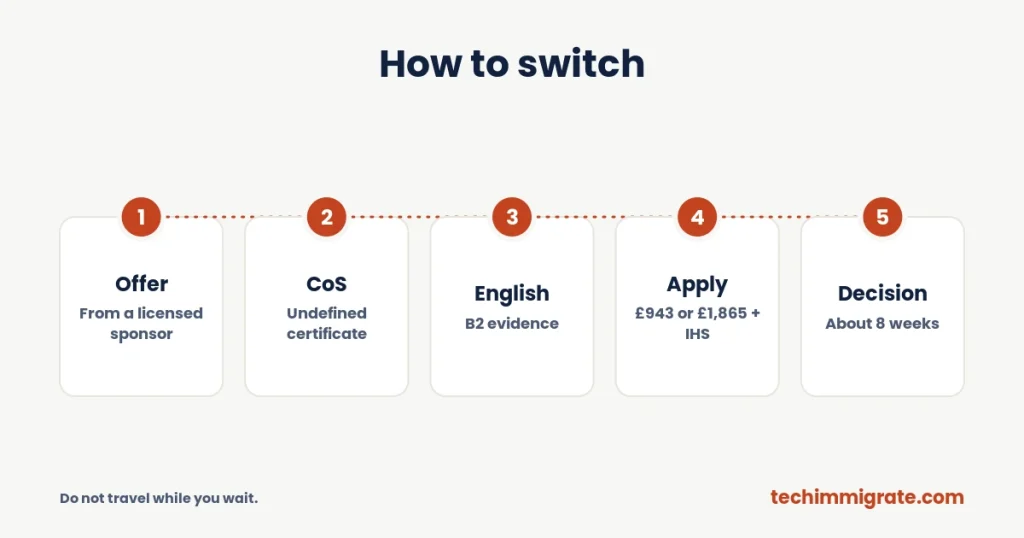
How to Switch Step by Step
- Check you can switch from your current visa.
- Get a job offer from a licensed sponsor, and confirm the occupation code and salary meet the rules.
- Receive your certificate of sponsorship reference number. Your employer will usually assign an undefined certificate because you are applying from inside the UK.
- Prepare your English evidence.
- Apply online before your current visa expires.
- Pay the fee and health surcharge.
- Prove your identity using the ID check app or at a UKVCAS appointment.
- Wait for a decision. GOV.UK says this usually takes about 8 weeks. A faster decision may be available for a fee.
- Check your eVisa once approved.
You must not travel outside the UK, Ireland, the Channel Islands or the Isle of Man until you get a decision, or your application will be withdrawn.
When Can You Start Work?
GOV.UK's switching page does not say when you can start your sponsored job. In practice, this depends on your current visa conditions and the rules in force. If your current visa already allows you to work in the role, for example a Graduate visa, you may be able to continue working. If it does not, for example a Student visa with restricted hours during term time, you may need to wait for the decision. Check with your employer and the current guidance before starting.
Your Partner and Children
GOV.UK says your dependants' visas do not switch automatically. They can apply at the same time as you, or before their current visas expire. Each pays the same visa fee and health surcharge. Our guide to the Skilled Worker dependant visa explains the family rules.
Switching and Settlement
Under the current rules, Skilled Workers can apply for ILR after 5 years on the route. Time on some previous routes may count towards that 5 years, but time on the Student and Graduate routes does not count towards work-route settlement.
Under the earned settlement proposals published on 2 November 2026, the default qualifying period becomes 10 years, with a 5-year path for people earning at least £50,271 and a 3-year path for the highest earners. Time on Student, Graduate and High Potential Individual routes would not count. For people switching early in their careers, the length of the path will depend heavily on salary progression. Our guide to the new ILR rules for Skilled Worker visa holders explains the details.
Alternatives to Switching to Skilled Worker
Before you switch, consider whether another route would serve you better.
Global Talent
Global Talent needs no sponsor, no job offer and no salary threshold. You need an endorsement from Tech Nation showing you are a leader or emerging leader in digital technology. Once endorsed, you can work for anyone, freelance or start a business, and people endorsed under exceptional talent can settle after 3 years under the current rules. Our guide to switching to the Global Talent visa explains the process, and our comparison of Global Talent vs Skilled Worker sets out the trade-offs.
High Potential Individual
If you graduated from a top-ranked university in the last 5 years, the High Potential Individual visa may give you 2 years, or 3 for PhD graduates, to work for any employer without sponsorship. It cannot be extended and does not lead to settlement. Our comparison of Global Talent vs HPI explains how it works.
Innovator Founder
If you want to start a business, the Innovator Founder visa may fit, with an endorsement from an approved body. Our comparison of Innovator Founder vs Global Talent explains the options.
A Worked Example: Graduate to Skilled Worker
A computer science graduate is on a Graduate visa that expires in June 2027. In February 2027, a London start-up offers her a software engineer role at £40,000 under code 2134.
- She qualifies as a new entrant because she is on a Graduate visa.
- 70% of the £54,700 going rate is about £38,300, and her salary meets that and the £33,400 minimum.
- Her UK degree meets the B2 English requirement.
- The start-up holds a sponsor licence and assigns an undefined certificate.
- She applies to switch in March 2027 and keeps working under her Graduate visa while she waits.
Her switch is approved in May 2027, before her Graduate visa expires.
A Worked Example: Dependant to Skilled Worker
A product designer is in the UK as the dependant partner of a Global Talent holder. She receives an offer from a fintech at £52,000 as a UX designer under code 2141, with a going rate of £43,800.
- She can switch from a dependant visa.
- Her salary exceeds the going rate and £41,700.
- She takes a B2 English test, because her degree was not taught in English.
Before switching, she considers settlement. Her partner will settle at 3 years, and she would need 5 years as a dependant. On Skilled Worker, she would need 5 years under the current rules. She decides the independence of her own visa is worth it, and that her settlement timeline is similar either way.
Switching From Other Work Routes
People on other work routes sometimes switch to Skilled Worker for stability or settlement:
- High Potential Individual. HPI holders can switch to Skilled Worker once they find a sponsor. Because HPI cannot be extended and does not lead to settlement, switching is often the next step for people who want to stay.
- Global Business Mobility. People transferred to the UK by their employer may switch to Skilled Worker if they want to stay longer or move into a role that leads to settlement. Time on Global Business Mobility does not count towards settlement on its own.
- Youth Mobility Scheme. Young people on the Youth Mobility Scheme can switch if they find a sponsor and meet the requirements.
- Global Talent. Switching from Global Talent to Skilled Worker is uncommon, because Global Talent is more flexible. It might make sense if an endorsement is withdrawn or a person cannot extend on Global Talent.
- Scale-up. Scale-up workers need sponsorship only for the first 6 months. Some switch to Skilled Worker if they move to an employer that cannot sponsor on the Scale-up route.
Timing Your Switch
Getting the timing right avoids gaps and stress:
- Apply well before your current visa expires. Aim for at least 8 to 10 weeks before, because processing usually takes about 8 weeks.
- Line up the certificate first. Your employer must assign the certificate of sponsorship before you can apply, and you must apply within 3 months of it being assigned.
- Plan around travel. Do not book trips abroad during the processing period.
- For students, think about the course end date. The job must start after the course ends unless you have completed the course or meet the PhD rule.
- For Graduate visa holders, think about the new entrant time limit. The longer you spend on the Graduate visa, the less time is left for new entrant salaries.
If your current visa is about to expire and your employer is not ready, talk to them urgently. Applying even one day late can leave you without lawful status.
Questions to Ask Before You Switch
- Does the job meet the skill level and salary rules for my situation?
- Will the employer certify maintenance, and pay any of the visa costs?
- How long will the certificate run, and will I need to extend before I can settle?
- Does switching help or hurt my settlement timeline compared with staying on my current route?
- Would Global Talent, HPI or another route give me more freedom for similar effort?
Why Switching Is Usually Better Than Leaving and Reapplying
If you can switch, it is almost always easier than leaving the UK and applying from abroad:
- No break in your life. You can keep your home, your current job if your visa allows, and your children's school places.
- No break in continuous residence. Leaving and reapplying can complicate your residence history, especially for long residence or settlement calculations.
- No new tuberculosis test, in most cases, because you are not applying for entry clearance.
- No need to show maintenance funds if you have been in the UK for more than a year.
The main downside is cost. The in-country fee of £943 or £1,865 is higher than the outside-UK fee of £819 or £1,618. For most people, the savings in travel, time and disruption more than make up for the difference.
If you are on an excluded visa, such as a visit visa, you have no choice: you must leave and apply from abroad. Do not start working for a sponsor while on a visit visa, because that would breach your conditions and could harm future applications.
Documents to Prepare
Most switching applications need:
- your current passport and eVisa details;
- your certificate of sponsorship reference number;
- your English evidence, such as your UK degree certificate, an Ecctis statement or a SELT reference;
- for students, evidence of course completion or your course end date, such as a letter from your university;
- bank statements, only if you have been in the UK for less than 12 months and your employer has not certified maintenance;
- for dependants applying with you, evidence of your relationship.
Your employer may also ask for documents for its own records, such as your degree certificate and references. Prepare these early to avoid delays in assigning the certificate.
Common Mistakes
- Applying from an excluded visa. Visitors and some other categories cannot switch.
- Switching from a Student visa too early. Your job must start after your course ends, unless you have completed it or meet the PhD rule.
- Missing your visa expiry date. You must apply before your current visa expires.
- Not meeting B2 English. The requirement for switching applicants rose in January 2026.
- Travelling while the application is pending. This withdraws the application.
- Forgetting dependants. Their visas do not switch automatically.
Usually yes, unless you are on a visit visa, short-term student visa, Parent of a Child Student visa, Seasonal Worker visa, domestic worker visa, immigration bail or permission outside the rules.
Only if your job start date is after your course ends, or you are on a full-time PhD and have studied for at least 24 months.
£943 for up to 3 years or £1,865 for more than 3 years, plus £1,035 per year health surcharge for each adult.
Usually about 8 weeks.
B2, since 8 January 2026, for new Skilled Worker applicants including people switching.
No. You must leave the UK and apply from abroad.
No. Each dependant must apply, either at the same time or before their visa expires.
Choose the Route That Fits Your Career
Switching to Skilled Worker from inside the UK is often the simplest way to keep working here after study or another visa. Check that you can switch, that your job meets the rules, and that your English evidence is ready. If you have a strong track record in tech, compare Global Talent before you commit to a sponsor. Our role-specific Global Talent guides explain what Tech Nation looks for.
How We Checked This Article
We checked switching rules, exclusions, student conditions and timing against GOV.UK's Skilled Worker switching page, and fees against the Skilled Worker costs page, in November 2026. Settlement reforms are from law firm summaries of the earned settlement response of 2 November 2026.
Tech Immigrate is independent of the Home Office. This article is general information, not legal advice. Check GOV.UK before you apply.
We write practical guides for tech professionals applying for the UK Global Talent visa. Tech Immigrate is independent of Tech Nation and the Home Office, and our articles are general information, not legal advice. Rules and fees change, so always check gov.uk before you apply.