
Skilled Worker Visa Extension Under the New Rules: What Has Changed
Skilled Worker visa extension new rules: salary thresholds, transitional protections, B1 or B2 English, skill level, sponsor duties and settlement reforms.


In this article
- The Changes at a Glance
- Salary Thresholds When You Extend
- English When You Extend
- Skill Level When You Extend
- New Sponsor Duties That Affect You
- Dependants When You Extend
- How Long Should You Extend?
- Why the Rules Have Changed So Much
- How Transitional Protections Work
- Changing Employer Under the New Rules
- Salary Paid in Every Pay Period
- Role Changes and Promotions
- Fees When You Extend
- A Fictional Example
- What Has Not Changed
- Planning for B2 at Settlement
- Common Mistakes
- The Bottom Line
- Getting Help
- Questions to Ask Your Sponsor
- Extensions and the Temporary Shortage List
- Keeping Records Through the Changes
- The Settlement Reforms in Brief
- When to Start Preparing
- What Caseworkers Check on an Extension
- If You Are Close to the Salary Line
- Extending From Outside the UK
- What the Changes Mean for Tech Workers
- Thinking Beyond the Next Extension
- Staying Informed
- Further Reading
- Your Dependants' English
- Your Next Step
- How We Checked This Article
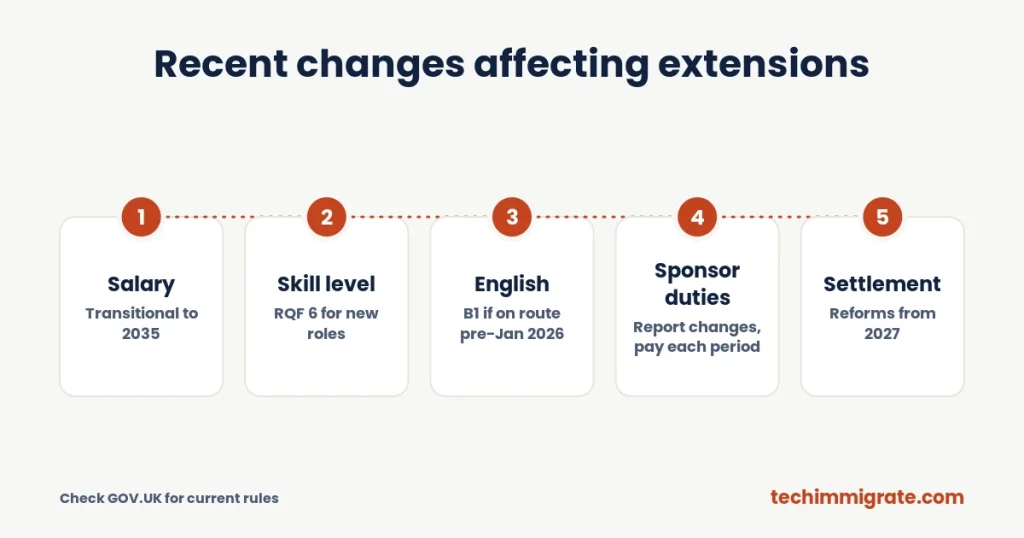
If you are extending a Skilled Worker visa now, the rules are not the same as when you first applied. Since 2024, the route has gone through a series of changes: higher salary thresholds, a higher skill level, tougher English requirements, new sponsor duties and, most recently, a planned overhaul of settlement. Some of these changes apply to you when you extend; others do not, because of transitional protections for people already on the route.
This guide explains how the recent changes affect Skilled Worker extensions specifically. It sets out which new rules apply to people extending, which transitional protections may help you, how the changes affect your dependants, and what the settlement reforms mean for how long you should extend. For the extension process itself, see our step-by-step guide to extending your Skilled Worker visa.
Key takeaways
- Extensions are assessed against the rules in force when you apply, with transitional protections for some people already on the route.
- People who first held a Skilled Worker visa before 4 April 2024 can usually rely on lower transitional salary thresholds, extended to 2035.
- People who held a Skilled Worker visa before 8 January 2026 usually only need B1 English when extending. New applicants and switchers need B2.
- Workers already in roles below RQF level 6 before 22 July 2025 may be able to extend under transitional arrangements, but those roles face restrictions, including on bringing new dependants.
- Sponsor guidance now requires salaries to be paid in every pay period and relevant role changes to be reported within 10 working days.
- Under the earned settlement reforms, how long you need before settling may change from 2027, which affects how long you should extend for.
The Changes at a Glance
| Change | Effective | Applies to extensions? |
|---|---|---|
| General salary threshold raised | April 2024, then 22 July 2025 | Yes, with transitional thresholds for pre-April 2024 workers |
| Skill level raised to RQF level 6 | 22 July 2025 | New roles; transitional arrangements for some existing workers |
| B2 English for new applicants | 8 January 2026 | No, for people who held the visa before that date; B1 applies |
| Sponsor guidance: eligible role, reporting | 6 March 2026 | Yes, through your sponsor's duties |
| Salary in every pay period | 8 April 2026 | Yes |
| Earned settlement framework | Planned from 2027 | Affects settlement, and therefore extension planning |
Salary Thresholds When You Extend
For new applicants, the salary must usually be the higher of the general threshold of £41,700 or the going rate for the occupation. If you first held a Skilled Worker visa before 4 April 2024, you may instead benefit from lower transitional thresholds, which the government has extended to 2035. The exact figures depend on your occupation code. Ask your employer to confirm which threshold it is using, and check the transitional tables on GOV.UK.
Only guaranteed basic pay counts. Bonuses, allowances and overtime usually do not.
English When You Extend
Since 8 January 2026, new Skilled Worker main applicants, including people switching into the route, need English at B2. If you held a Skilled Worker visa before that date and are extending or updating your permission, you usually only need to show B1, which you may already have demonstrated in an earlier application. If you are switching into Skilled Worker from another route, B2 usually applies. Our article on the English requirement for Skilled Worker visas explains the details.
Skill Level When You Extend
Since 22 July 2025, new Skilled Worker roles usually need to be at RQF level 6 or above. If you were already sponsored in a role below that level before the change, transitional arrangements may allow you to extend in the same role for a period. These roles may also be affected by the temporary shortage list, which ends on 31 December 2026. If your role is below RQF level 6, check the current rules on GOV.UK carefully before you extend.
New Sponsor Duties That Affect You
Sponsor guidance published on 6 March 2026 tightened several duties:
- Eligible role. Sponsors must make sure the role remains an eligible role for the route.
- Reporting changes. Relevant changes to your role must be reported within 10 working days.
- Salary in every pay period. From 8 April 2026, your salary must be paid in every pay period, not just on average over the year.
These are your sponsor's duties, but they affect your extension. If your sponsor has not reported a change, or has paid you irregularly, it can cause problems when you extend.
Dependants When You Extend
If your partner and children are already in the UK as your dependants, they can usually extend with you. If you are in a role below RQF level 6 and joined after the rules changed, you may not be able to bring new dependants. Each dependant pays the visa fee and the surcharge for the new period. Our article on new rules for Skilled Worker dependants explains the changes.
How Long Should You Extend?
Under the current rules, Skilled Workers can usually settle after 5 years. Under the earned settlement framework planned from 2027, the default becomes 10 years, with a 5-year path for those earning £50,271 or more in 3 of the last 5 years and a 3-year path for those earning £125,141 or more in 3 of the last 4 years. When you extend, think about:
- If you will reach 5 years soon, you may only need a short extension, or none, if you can apply for settlement under the current rules.
- If your earnings put you on the 5-year path under the new framework, extend to cover that date with a small buffer.
- If you may face a longer path, a longer extension avoids repeated applications, but costs more up front.
Generally yes, but if you first held a Skilled Worker visa before 4 April 2024, you may rely on lower transitional thresholds, extended to 2035.
If you held a Skilled Worker visa before 8 January 2026, you usually only need B1 when extending.
Possibly, under transitional arrangements for people already in such roles. Check GOV.UK.
Sponsors must keep the role eligible, report relevant changes within 10 working days and pay salary in every pay period.
They may change how long you need before settling, which affects how long you should extend for.

Why the Rules Have Changed So Much
The changes to the Skilled Worker route are part of the government's wider effort to reduce net migration while keeping the UK open to higher-skilled workers. Raising salary thresholds and the skill level reduces the number of roles that qualify. Raising the English requirement aims to improve integration. Tighter sponsor duties aim to reduce misuse of the route. The earned settlement reforms change how long people need to stay before settling. Each change has been introduced separately, which is why the rules can feel like a moving target for people already on the route.
How Transitional Protections Work
Transitional protections are designed to avoid penalising people who joined the route under older rules. They usually apply as long as you stay on the route without a break, sometimes even if you change employer. For example, the lower salary thresholds for people who first held a Skilled Worker visa before 4 April 2024 can continue to apply when you extend or change employer, and have been extended to 2035. But transitional protections can be lost if you leave the route, for example by switching to another visa and back, so check carefully before making changes.
Changing Employer Under the New Rules
If you change employer, you make a new application, which is assessed against the rules at that time. Transitional salary protections can usually still apply if you have stayed on the Skilled Worker route continuously. The B1 English requirement usually still applies if you held a Skilled Worker visa before 8 January 2026. But your new role must meet the current skill level rules, unless a transitional arrangement covers it. Check all of this with your new employer before you accept. Our article on changing employer on a Skilled Worker visa explains the process.
Salary Paid in Every Pay Period
From 8 April 2026, sponsor guidance requires that sponsored workers are paid at least the required salary in every pay period. This matters for people whose pay varies, for example because of unpaid leave, reduced hours or irregular payroll. If your pay dipped below the required level in some pay periods, your sponsor may need to explain or correct it, and it could affect your extension. Check your payslips before you apply, and raise any concerns with HR early.
Role Changes and Promotions
Under the sponsor guidance of 6 March 2026, relevant changes to your role must be reported within 10 working days. If you have been promoted, moved team or changed duties, check whether your occupation code still fits and whether your sponsor has reported the change. If your new role is in a different occupation code, you may need a new application rather than a simple extension. Getting this right before you extend avoids problems later.
Fees When You Extend
From inside the UK, the visa fee is £943 for up to 3 years and £1,865 for more than 3 years, plus the Immigration Health Surcharge of £1,035 per year for each adult and £776 per year for each child. Your sponsor pays a new certificate of sponsorship fee of £525 and the Immigration Skills Charge for the new period. If your new visa overlaps with time you have already paid surcharge for, you may get a partial refund for overlaps of 6 months or more. Our guide to Skilled Worker visa fees has the full breakdown.
A Fictional Example
Omar first came to the UK on a Skilled Worker visa in 2023 as a network engineer. His original salary met the threshold at the time. When he extends, the general threshold has risen, but because he first held a Skilled Worker visa before 4 April 2024, he can rely on the lower transitional threshold for his occupation. He held his visa before 8 January 2026, so he only needs B1 English, which he showed in his first application. His sponsor confirms that his role has not changed code and that he has been paid correctly in every pay period. He extends for 2 years, which will take him to 5 years on the route. This example is fictional and simplified.
What Has Not Changed
Some things remain the same. You still need a certificate of sponsorship from a licensed sponsor. You still need to apply before your current visa expires. You can still usually remain on the same conditions while your application is decided, if you applied in time. There is still no limit on the number of extensions. And time on the route still counts towards settlement, even if the length of the qualifying period may change under the reforms.
Planning for B2 at Settlement
Even if you only need B1 to extend, the earned settlement reforms plan to raise the English requirement for settlement to B2 from 26 March 2027. If you will apply for settlement after that date and are not exempt, you may need a B2 test at that point. It can make sense to prepare for B2 now, while you are thinking about your extension. Our article on B2 English for ILR explains the change.
Common Mistakes
- Assuming the old thresholds still apply without checking transitional rules.
- Assuming B2 is required when you only need B1, or the reverse.
- Not checking whether your role still fits its code after a promotion.
- Ignoring irregular pay periods.
- Extending for too long or too short without thinking about settlement.
- Applying late. A gap in status can cause serious problems.
The Bottom Line
Extending a Skilled Worker visa under the new rules is manageable if you know which changes apply to you. Check your salary against the current or transitional thresholds, confirm whether you need B1 or B2, make sure your role still fits its code and has been reported correctly, and think about how long to extend in light of the settlement reforms. Start early and work closely with your sponsor.
Getting Help
If your situation involves transitional protections, a role below RQF level 6, a recent role change or irregular pay, a regulated immigration adviser can help you check your position before you apply.
Questions to Ask Your Sponsor
- Which salary threshold are you using for my extension, and why?
- Has my occupation code changed since my last application?
- Have any role changes been reported?
- Have I been paid at least the required salary in every pay period?
- How long will my new certificate be, and how does that fit my settlement plans?
Extensions and the Temporary Shortage List
Some roles below RQF level 6 have relied on the temporary shortage list, which is due to end on 31 December 2026. If your role depends on it, check what will happen when you next extend after that date, and whether transitional arrangements apply. Few mainstream tech roles depend on the list, but some technician and support roles may.
Keeping Records Through the Changes
With rules changing frequently, it helps to keep a clear record of your own history: the date you first held a Skilled Worker visa, the English level you proved, your occupation codes and salaries over time, and every visa decision. These details decide which transitional protections apply to you, and having them to hand makes every extension easier.
The Settlement Reforms in Brief
Under the earned settlement response of 2 November 2026, the default qualifying period becomes 10 years, with a 5-year path for people earning £50,271 or more in 3 of the last 5 years, a 3-year path for those earning £125,141 or more in 3 of the last 4 years, and new mandatory requirements for everyone. There is no general transitional protection. Our article on Skilled Worker to ILR in 10 years sets out a plan for each stage of your visa.
When to Start Preparing
Because the rules have changed so often, it pays to start preparing for an extension earlier than you might expect. About six months before your visa ends, check the current rules on GOV.UK and compare them with your situation: your salary, your occupation code, your English level and your sponsor's plans. Around four months before, talk to HR about your new certificate. Around two months before, gather your documents and apply. Starting early gives you time to deal with surprises, such as a salary that needs adjusting under the current thresholds or a role change that needs to be reported first.
What Caseworkers Check on an Extension
When a caseworker assesses your extension, they check that your certificate of sponsorship is valid, that the job is genuine and matches the occupation code, that your salary meets the threshold that applies to you, that you meet the English requirement, and that there are no suitability concerns. They may also look at whether your sponsor has met its duties, for example by paying you correctly. Published Skilled Worker caseworker guidance, updated in 2026, explains how these checks are carried out. Our article on Skilled Worker caseworker guidance summarises the key points.
If You Are Close to the Salary Line
If your salary is close to the threshold that applies to you, check the figures carefully. Remember that going rates are based on a 37.5-hour week and are pro-rated for different hours, that only guaranteed basic pay counts, and that the threshold may have changed since your last application. If you fall short, your employer may be able to adjust your salary before assigning your certificate. If not, you may need to consider another role or route. Raise this early, because salary changes usually need approval and time to process.
Extending From Outside the UK
Most extensions are made from inside the UK, but if you are abroad when your visa ends, you may need to apply from outside the UK. The rules on salary, English and skill level are the same, but the fees are lower and you cannot rely on the protection of remaining in the UK on your existing conditions while your application is decided. Think carefully about how time abroad affects your continuous residence for settlement.
What the Changes Mean for Tech Workers
For most tech professionals, the recent changes have been less disruptive than for workers in lower-paid or lower-skilled roles. Most software, data, cyber security and product roles sit at RQF level 6 or above, and many salaries are well above the thresholds. The changes that matter most for tech workers are the English requirement for those switching in, the sponsor duties on pay and reporting, and the settlement reforms, which may link the length of your path to settlement to your earnings. Junior roles and roles outside London, where salaries may be closer to the thresholds, deserve the most careful checking.
Thinking Beyond the Next Extension
Each extension is a chance to review your longer-term plans. Ask yourself where you want to be in five years, whether your current employer is the right sponsor for that journey, and whether another route, such as Global Talent, could offer more freedom. If you are building a strong profile in your field, an extension might be the last one you need before switching to a route that does not depend on a sponsor.
Staying Informed
The Home Office announces changes through Statements of Changes to the Immigration Rules and updated guidance on GOV.UK, usually with a few weeks' notice. Checking these before each extension, or signing up for GOV.UK email alerts on immigration topics, is the simplest way to avoid being caught out by a new rule.
Further Reading
Our article on Skilled Worker visa new rules covers the wider changes to the route.
Your Dependants' English
Dependants do not currently need to meet an English requirement to extend their dependant visas. But if they will apply for settlement after 26 March 2027, adult dependants may need B2 at that point, unless exempt. Planning for this now, alongside your own extension, can save time later.
Your Next Step
If repeated extensions and changing rules are wearing you down, consider whether the Global Talent visa could offer a more flexible path. Our role-specific Global Talent guides explain what Tech Nation looks for.
How We Checked This Article
We checked the changes against GOV.UK's Skilled Worker visa pages, Statements of Changes to the Immigration Rules, the sponsor guidance of 6 March 2026 and Skilled Worker caseworker guidance, in November 2026. Settlement reforms are from summaries of the earned settlement response of 2 November 2026.
Tech Immigrate is independent of the Home Office. This article is general information, not legal advice. Check GOV.UK before you apply.
We write practical guides for tech professionals applying for the UK Global Talent visa. Tech Immigrate is independent of Tech Nation and the Home Office, and our articles are general information, not legal advice. Rules and fees change, so always check gov.uk before you apply.


