Skilled Worker to ILR in 10 Years? A Plan for Every Stage of Your Visa
UK ILR new rules for Skilled Worker visa holders: will you need 10 years? A practical plan for each stage of your visa, by salary band.


In this article
- The Planned Paths for Skilled Workers
- Stage 1: You Have Just Arrived (0 to 1 Year)
- Stage 2: You Are in the Middle (2 to 3 Years)
- Stage 3: You Are Close to 5 Years (4 Years or More)
- Salary Bands and What They Could Mean
- What the Mandatory Requirements Mean for You
- Could Global Talent Be Faster?
- Why Salary Matters More Than Ever
- What Counts as Earnings Is Still Being Decided
- Worked Example: Early-Career Engineer
- Worked Example: Senior Engineer Close to 5 Years
- Worked Example: Mid-Level Engineer Below the Threshold
- Protecting Yourself From the 20-Year Path
- What Employers Can Do
- Your Family Under the New Framework
- Keeping Track of the Final Rules
- Common Mistakes
- The Bottom Line
- Getting Help
- How the Change Compares With Other Countries
- Questions to Ask Yourself
- Settlement and Your Career Choices
- Extensions on the Way to Settlement
- The Role of the Sponsor Over a Longer Path
- English: Planning for B2
- What Happens to Time Already Spent
- Building Your Profile as a Back-Up Plan
- Staying Calm About the Changes
- Public Service Occupations
- Further Reading
- Revisit Your Plan Each Year
- Talk to Your Family Early
- Your Next Step
- How We Checked This Article
If you are on a Skilled Worker visa, the earned settlement reforms may feel like the goalposts have moved. For years, the plan was simple: 5 years on the route, then indefinite leave to remain. Under the government's response to the earned settlement consultation, published on 2 November 2026, the default qualifying period for most migrants becomes 10 years from 2027, with shorter paths for people who earn more or contribute in other ways.
The right response depends on where you are in your visa. Someone who arrived last month has very different options from someone who is 4 years in. This guide sets out what the change could mean for Skilled Workers at each stage, and a practical plan for each. For a full explanation of the reforms, see our article on new ILR rules for Skilled Worker visa holders.
Key takeaways
- Under the earned settlement response, the default qualifying period for settlement becomes 10 years from 2027.
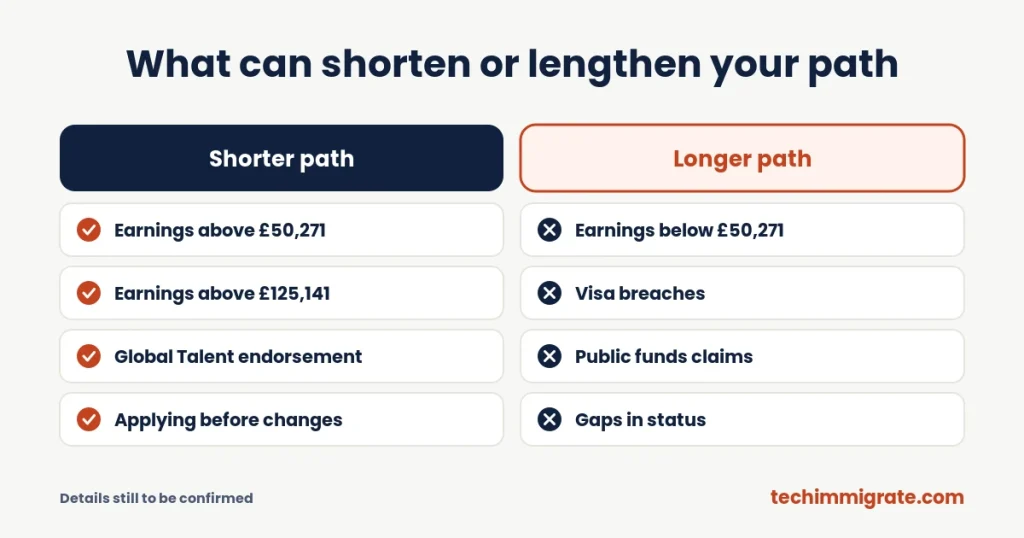
- Skilled Workers earning £50,271 or more in 3 of the last 5 years are expected to have a 5-year path. Those earning £125,141 or more in 3 of the last 4 years are expected to have a 3-year path.
- Everyone will need to meet new mandatory requirements, including B2 English from 26 March 2027, no criminal record, no public debts and a sustained contribution.
- There is no general transitional protection, so Skilled Workers close to 5 years may benefit from applying under the current rules before the changes take effect.
- Some workers who joined before April 2024 keep lower transitional salary thresholds until 2035, but that does not by itself protect the 5-year settlement period.
- Tech professionals with strong external recognition may be able to shorten their path by switching to the Global Talent visa.
The Planned Paths for Skilled Workers
| Path | Who it is expected to apply to |
|---|---|
| 3 years | Earnings of £125,141 or more in 3 of the last 4 years |
| 5 years | Earnings of £50,271 or more in 3 of the last 5 years, or certain public service occupations |
| 10 years | The default for those who do not qualify for a shorter path |
| 20 years | People with a qualifying breach of the rules or who have received public funds |
The details, including exactly which income counts and how the rules will be phased in, are still to be confirmed in the final rules.
Stage 1: You Have Just Arrived (0 to 1 Year)
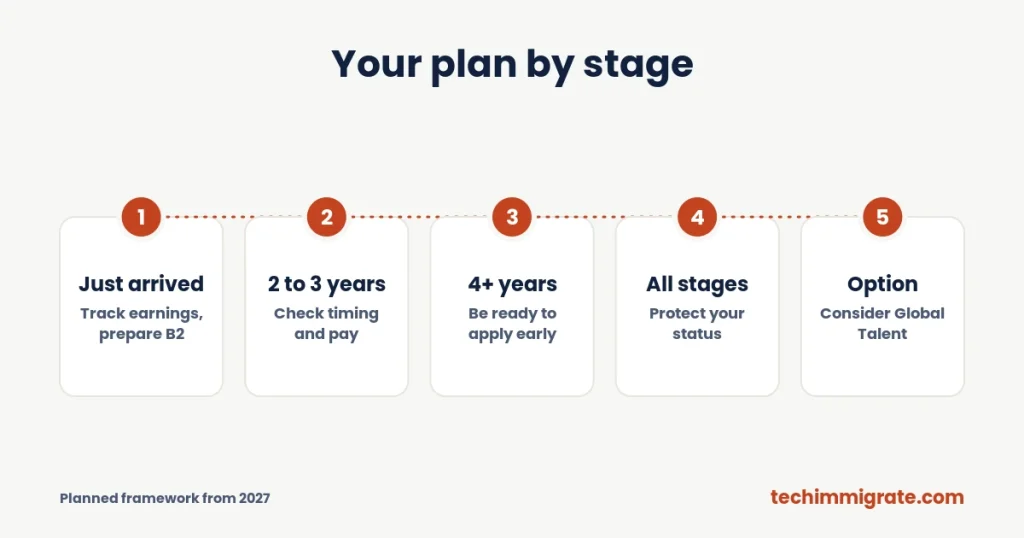
If you have recently started on a Skilled Worker visa, you are likely to settle under the new framework. Your plan:
- Understand your likely path. Compare your salary with the £50,271 and £125,141 thresholds, and think about how your pay is likely to grow over the next few years.
- Keep detailed earnings records from day one: payslips, P60s and tax records.
- Prepare for B2 English if you are not exempt and do not have an accepted degree.
- Protect your status. Apply for every extension in time and stay within your visa conditions.
- Consider your long-term route. If you have, or could build, strong external recognition, the Global Talent visa could offer a shorter path.
Stage 2: You Are in the Middle (2 to 3 Years)
If you are a few years in, you may still settle under the new framework, but timing matters more. Your plan:
- Work out your earliest current-rules settlement date. If you will reach 5 years before the relevant changes take effect, you may be able to settle under the current rules.
- Track your earnings for the past few years. If you have earned above £50,271 in most of them, you are well placed for the 5-year path.
- Plan career moves carefully. A promotion or move to a better-paid role could make a real difference. A job change also needs a new visa application, so plan it around your timeline.
- Check your absences. Make sure no 12-month period exceeds 180 days.
Stage 3: You Are Close to 5 Years (4 Years or More)
If you are close to 5 years, the most important question is whether you can apply under the current rules before the changes take effect. Your plan:
- Calculate your exact eligibility date. You can usually apply up to 28 days before you complete 5 years.
- Get everything ready now: Life in the UK test, English evidence, sponsor letter, payslips and absence record.
- Watch for confirmed commencement dates in Statements of Changes to the Immigration Rules.
- Apply as soon as you are eligible, and consider a faster decision if timing is tight.
Our guide to ILR for Skilled Worker visa holders walks through the application.
Salary Bands and What They Could Mean
| Salary over the relevant years | Likely path under the new framework |
|---|---|
| Below £50,271 | 10-year default, unless another shorter path applies |
| £50,271 to £125,140 | 5-year path, if earned in 3 of the last 5 years |
| £125,141 or more | 3-year path, if earned in 3 of the last 4 years |
These bands are based on the response and may change in the final rules.
What the Mandatory Requirements Mean for You
- B2 English from 26 March 2027. If you joined the route after 8 January 2026, you will already have shown B2. If you joined earlier with B1, you may need a new test.
- No criminal record and no public debts. Pay NHS, tax and Home Office bills on time.
- Sustained contribution. Earnings of at least £12,571 a year, which most Skilled Workers easily meet.
Could Global Talent Be Faster?
Global Talent is expected to be in the Highest Talent Group, with a 3-year path, although the details are still being defined. For tech professionals with strong evidence of recognition beyond their employer, a Global Talent endorsement could shorten the path to settlement significantly, as well as removing the dependence on a sponsor. Endorsement is hard to get, and how Skilled Worker time combines with Global Talent time under the new framework is still to be confirmed. Our comparison of Global Talent and Skilled Worker explains the trade-offs.
Under the planned framework, the default is 10 years, but Skilled Workers earning £50,271 or more in 3 of the last 5 years are expected to have a 5-year path.
If you can apply before the relevant changes take effect, you may be able to settle under the current 5-year rules.
The response does not include general transitional protection.
They protect lower salary thresholds for some workers, but they do not by themselves guarantee the 5-year settlement period.
Possibly. Global Talent is expected to have a 3-year path, but endorsement is hard to get.
Why Salary Matters More Than Ever
Under the current rules, salary mainly decides whether you can get or keep a Skilled Worker visa. Under the planned earned settlement framework, it may also decide how long you wait to settle. Two engineers on the same route, arriving on the same day, could settle years apart depending on what they earned. That makes career decisions, such as accepting a promotion, negotiating a pay rise or moving to a better-paid employer, much more important for your settlement timeline. It also makes good earnings records essential, because you may need to show your income for several specific years when you apply.
What Counts as Earnings Is Still Being Decided
The response sets income thresholds, but the final rules will need to say exactly which income counts. Questions include whether bonuses, overtime, benefits in kind, equity or income from a second job count, how part-years are treated if you arrive mid-year, and whether figures are measured by tax year or calendar year. Until the rules are published, keep complete records of every source of income, including payslips, P60s, P11Ds for benefits and records of any share awards. That way you will be able to evidence your earnings whatever form the rules take.
Worked Example: Early-Career Engineer
Amira joined a Skilled Worker role as a new entrant on £38,300 after her master's. Her salary is expected to rise as she gains experience. Under the planned framework, if she reaches £50,271 or more for 3 of the last 5 years before she applies, she would expect a 5-year path. If her salary stays lower, she could face the 10-year default. She asks her manager about the progression path, keeps every payslip and plans her settlement around her salary growth. This example is fictional and based on the planned framework.
Worked Example: Senior Engineer Close to 5 Years
Daniel has been a Skilled Worker for 4 years and 6 months, earning £72,000. Under the current rules, he will be eligible for settlement in 6 months. Under the planned framework, his earnings would put him on the 5-year path anyway. Either way, he prepares now: he books the Life in the UK test, checks his English evidence against the planned B2 requirement, asks HR for a sponsor letter and plans to apply as soon as he is eligible. This example is fictional.
Worked Example: Mid-Level Engineer Below the Threshold
Kemi is a QA engineer earning £45,000, 2 years into her Skilled Worker visa. Under the planned framework, she may face the 10-year default unless her salary rises above £50,271 for 3 of the last 5 years. She explores options: negotiating a pay rise as she takes on more responsibility, moving into a test automation role with a higher salary, or building her profile for a future Global Talent application. This example is fictional.
Protecting Yourself From the 20-Year Path
The response sets a 20-year path for people who have committed a qualifying breach of the immigration rules or received public funds. For Skilled Workers, the most common risks are applying to extend after a visa has expired, working outside the conditions of your visa, or a family member claiming benefits they are not entitled to. Keep a calendar of visa expiry dates, apply in time, check your conditions before changing role or starting side work, and make sure nobody in your household claims public funds while on a visa.
What Employers Can Do
Employers have a strong interest in helping sponsored staff settle, because settled employees no longer need sponsorship and are more likely to stay. Some employers may review pay for sponsored staff near the income thresholds, offer English training for those who need B2, or provide legal support for settlement applications. If you are a sponsored worker, it is reasonable to raise the reforms with HR and ask what support is available.
Your Family Under the New Framework
Under the response, partners who are with the main applicant are expected to settle at the same time as the main applicant, which could help families stay on the same timeline. Partners who join later may need to complete their own qualifying period. Children are expected to be exempt from the income, English and Life in the UK requirements. Couples can combine income to meet the sustained contribution requirement. Plan your family's applications together, and check how the final rules apply to dependants.
Keeping Track of the Final Rules
The response is a statement of policy, not the final law. Rules are due to be laid from December 2026, with implementation over 2027. Each Statement of Changes to the Immigration Rules will say what changes and when. Check GOV.UK regularly, and look for the explanatory memorandum that accompanies each Statement, which explains the changes in plain English.
Common Mistakes
- Assuming the 5-year path is guaranteed. It depends on your earnings and timing under the new framework.
- Assuming transitional salary thresholds protect your settlement period. They protect salary levels, not the qualifying period.
- Not keeping earnings records. You may need several years of evidence.
- Ignoring B2 English. It is planned from 26 March 2027.
- Letting your visa lapse. A breach could lead to a much longer path.
The Bottom Line
For many Skilled Workers in tech, the new framework will not mean 10 years. Earnings above £50,271 are expected to keep a 5-year path, and very high earnings a 3-year path. But workers on lower salaries, those with gaps in their status and those who do not prepare for the new requirements could face much longer. Work out where you stand, plan for your stage, keep good records and watch for the final rules.
Getting Help
If your situation is complicated, for example because you have changed routes, had gaps in status or have earnings that are hard to evidence, consider speaking to a regulated immigration adviser once the final rules are published.
How the Change Compares With Other Countries
Many countries that compete for tech talent offer permanent residence after a few years of skilled work, sometimes with points or income tests. The UK's move to a longer default with earnings-based reductions brings it closer to systems that reward higher earners with faster settlement. For tech professionals choosing where to build a career, the length of the path to settlement is now one more factor to weigh alongside salary, career opportunities and quality of life.
Questions to Ask Yourself
- How many years have I been on the Skilled Worker route?
- What have I earned in each of those years?
- Could I apply under the current rules before the changes take effect?
- Do I meet, or can I reach, B2 English?
- Have I had any gaps in status or breaches?
- Would a Global Talent endorsement be realistic for me?
Settlement and Your Career Choices
The reforms may change how you think about job moves. A move to a higher-paying role could shorten your path to settlement, while a move to a lower-paying role, such as an early-stage start-up, could lengthen it. That does not mean you should always choose the highest salary, but it does mean you should factor settlement into big career decisions, especially in the years that will count towards the income tests.
Extensions on the Way to Settlement
If you face a longer path than you expected, you will probably need more extensions before you settle. Each extension means a new certificate of sponsorship, a visa fee and a surcharge payment for the new period, as well as meeting the salary and English rules in force at the time. Under the current fees, extending from inside the UK costs £943 for up to 3 years or £1,865 for more than 3 years, plus £1,035 per year in surcharge for each adult. Over a 10-year path, these costs can add up to many thousands of pounds for a family. Planning for them early, and discussing them with your employer, helps avoid financial surprises.
The Role of the Sponsor Over a Longer Path
A longer path to settlement also means a longer period of dependence on a sponsor. If your employer stops sponsoring you, loses its licence or makes you redundant, you would need to find a new sponsor within the time allowed, or leave the UK. That risk grows with the length of the path. It is one reason why some tech professionals look for routes that are not tied to an employer, such as the Global Talent visa, and why building a strong professional profile can be valuable insurance.
English: Planning for B2
If you joined the Skilled Worker route before 8 January 2026, you may have shown English at B1. Under the planned framework, settlement will require B2 from 26 March 2027. If you are not exempt and do not have an accepted degree, plan to take a B2 test before you apply. Our article on B2 English for ILR explains how to prepare.
What Happens to Time Already Spent
Time you have already spent on the Skilled Worker route is expected to continue to count towards settlement under the new framework, although the qualifying period you need may change. Time on routes such as Graduate or High Potential Individual is not expected to count. If you switched from a Graduate visa, your settlement clock usually started when your Skilled Worker visa began.
Building Your Profile as a Back-Up Plan
Even if you are happy on the Skilled Worker route, building a profile that could support a Global Talent application is a sensible back-up plan. Speaking at events, writing about your work, contributing to open source projects, mentoring and leading visible projects all create the kind of external recognition Tech Nation looks for. Those activities also help your career generally, whether or not you ever apply. If your path to settlement on Skilled Worker turns out to be long, a strong profile gives you a realistic alternative.
Staying Calm About the Changes
It is natural to feel anxious when settlement rules change, especially if you have built your plans around the old timeline. But many Skilled Workers in tech are well placed under the new framework, and the details are still being finalised. Focus on the things you can control: keeping your status valid, keeping good records, preparing for the English requirement and building your career. Then review your plan once the final rules are published.
Public Service Occupations
The response also plans a 5-year path for people who have worked in specified public service occupations for 5 years. Few tech roles are likely to fall into this category, but some technology roles in public bodies, such as the NHS, might be considered depending on how the final rules define it. If you work in tech for a public sector employer, watch for the list of qualifying occupations when the rules are published.
Further Reading
For the default 10-year path and how it differs from long residence, read our article on the 10-year route to ILR.
Revisit Your Plan Each Year
Your position can change quickly: a pay rise, a new job, a family change or a new rule. Set a reminder to review your settlement plan once a year, checking your earnings, your absences, your visa dates and any updates from GOV.UK. A short annual review keeps you on track and helps you spot problems while there is still time to fix them.
Talk to Your Family Early
Settlement timelines affect the whole household: school choices, housing, a partner's career and long-term plans. Share your likely timeline with your family early, and revisit it together as the final rules become clear.
Your Next Step
If you have strong evidence of recognition in tech, explore whether the Global Talent visa could be your faster path. Our role-specific Global Talent guides explain what Tech Nation looks for.
How We Checked This Article
We based the planned framework on summaries of the government's response to the earned settlement consultation of 2 November 2026, and checked current Skilled Worker settlement rules against GOV.UK's Skilled Worker visa pages, in November 2026. Details may change before the new rules take effect.
Tech Immigrate is independent of the Home Office. This article is general information, not legal advice. Check GOV.UK before you apply.
We write practical guides for tech professionals applying for the UK Global Talent visa. Tech Immigrate is independent of Tech Nation and the Home Office, and our articles are general information, not legal advice. Rules and fees change, so always check gov.uk before you apply.