
English Requirement for the Skilled Worker Visa (B1, B2 and Exemptions)
The Skilled Worker English requirement: B2 for new applicants since January 2026, B1 for extensions, accepted tests, degrees, Ecctis and exempt countries.


In this article
- What the CEFR Levels Mean
- Who Needs B2 and Who Needs B1
- Ways to Prove Your English
- Who Does Not Need to Prove English
- Choosing the Best Evidence for Your Situation
- Planning Your English Evidence
- How Long Test Results Last
- Why the Level Rose to B2
- Using Ecctis: What You Need
- Preparing for a Four-Skills SELT
- English on Other Work Routes
- What Happens if Your Evidence Is Not Accepted
- What Your Employer Needs to Know
- Timeline: From Offer to Evidence
- Special Cases
- The Bigger Picture for Tech Workers
- English and Settlement
- English for Your Family
- A Worked Example: A Developer Applying From Abroad
- A Worked Example: A Skilled Worker Changing Employer
- A Worked Example: Switching From a Dependant Visa
- Common Mistakes
- Get Your Evidence Ready Early
- How We Checked This Article
For most people working in UK tech, English is not a barrier. They write code reviews, lead meetings and present to clients in English every day. Yet the English language requirement is still one of the most common sources of confusion in Skilled Worker applications, because the visa does not test ability in the abstract. It tests evidence. If your evidence does not fit one of the accepted categories, it does not matter how fluent you are.
The requirement also changed recently. Since 8 January 2026, new Skilled Worker applicants need English at B2 rather than B1, while people already on the route usually keep the B1 level when they extend. This guide explains the English requirement for the Skilled Worker visa: the levels, who needs which, every accepted way of proving it, who is exempt, and how to plan your evidence so it does not hold up your application.
Key takeaways
- New Skilled Worker applicants must prove English at CEFR level B2, covering reading, writing, speaking and understanding.
- People who held a Skilled Worker visa before 8 January 2026 usually need only B1 when they extend or update their visa.
- People switching into Skilled Worker from another visa need B2.
- You can prove English with a UK school qualification in English, a degree taught in English, an approved Secure English Language Test (SELT), or your nationality.
- Degrees taught in English from outside the UK need an Ecctis assessment.
- Nationals of certain countries, including Australia, Canada, Malta, New Zealand and the USA, plus listed Caribbean and Commonwealth countries, are exempt.
- If you already proved English in an earlier successful visa application, you may not need to prove it again.
What the CEFR Levels Mean
The UK uses the Common European Framework of Reference for Languages (CEFR) to describe English levels. The two that matter for the Skilled Worker visa are:
- B1 (intermediate): you can deal with most everyday situations, describe experiences, and give simple reasons for opinions.
- B2 (upper intermediate): you can understand the main ideas of complex text, including technical discussions in your field, interact with fluency and spontaneity, and produce clear, detailed text on a wide range of subjects.
For most tech professionals, B2 is well within reach. The challenge is not the level but the evidence. A senior engineer who has worked in English for a decade still needs one of the accepted forms of proof, and a caseworker cannot accept a reference letter or a portfolio of English-language work in place of it.
Who Needs B2 and Who Needs B1
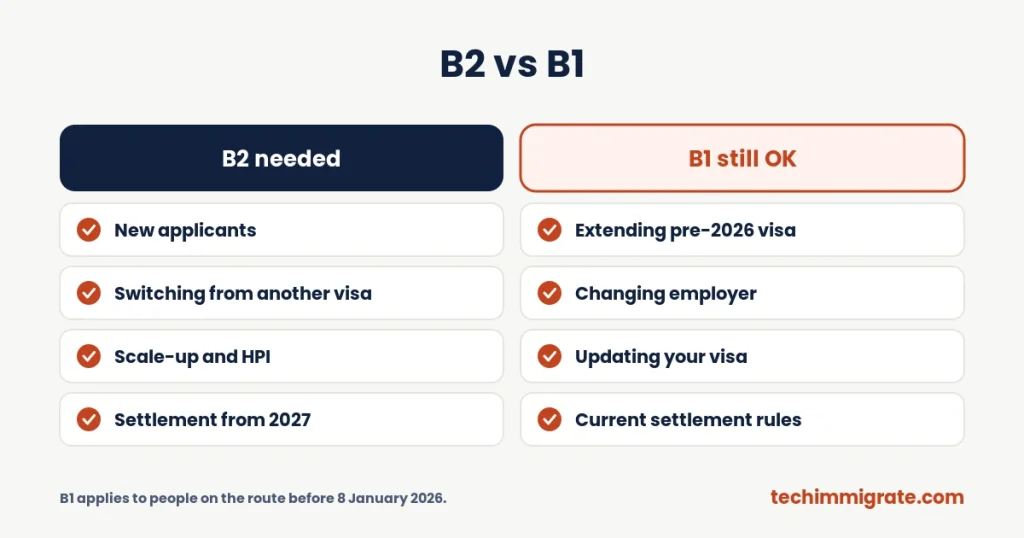
| Situation | Level needed |
|---|---|
| First Skilled Worker application from outside the UK | B2 |
| Switching into Skilled Worker from another visa | B2 |
| Extending a Skilled Worker visa held before 8 January 2026 | B1 |
| Updating a Skilled Worker visa (for example, changing employer) held before 8 January 2026 | B1 |
| Switching from the Health and Care Worker visa | No need to prove again |
GOV.UK confirms that anyone who held a Skilled Worker visa before 8 January 2026 needs only B1 when extending or updating, while applicants switching from a different visa need B2.
Ways to Prove Your English
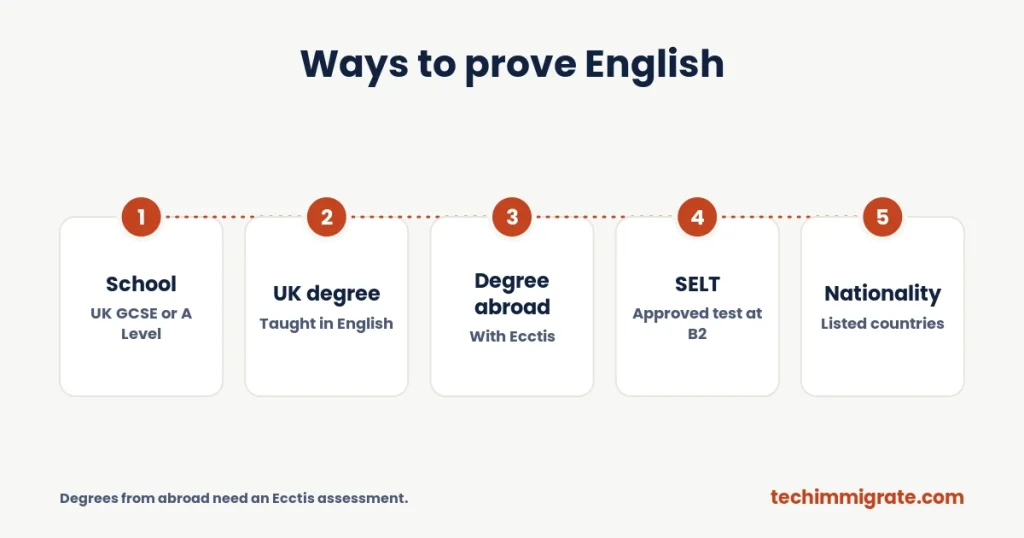
GOV.UK lists several ways to meet the requirement.
1. A UK school qualification
You can use a GCSE, A Level, Scottish National Qualification at level 4 or 5, or Scottish Higher or Advanced Higher in English, if you started studying for it before you were 18. This is mainly useful for people who went to school in the UK.
2. A UK degree
A degree-level qualification taught in English and awarded by a UK institution counts, even if you studied for it abroad, for example at an overseas campus of a UK university. For international students switching from a Student or Graduate visa, this is usually the simplest route. Keep a copy of your degree certificate, or a letter from your university confirming the award if the certificate has not yet been issued, ready to upload.
3. A degree from outside the UK taught in English
A degree from outside the UK can count if Ecctis confirms that it is equivalent to a UK bachelor's degree or higher and that it was taught in English. You apply to Ecctis for this assessment and pay its fee. Allow several weeks.
This is the most common route for experienced tech professionals applying from abroad. Many computer science, engineering and business degrees around the world are taught in English, but you need the Ecctis confirmation to use them.
4. A Secure English Language Test (SELT)
You can take an approved SELT at B2 or above, covering all four skills: reading, writing, speaking and listening. Approved providers include Trinity College London, the IELTS SELT Consortium, LANGUAGECERT and Pearson in the UK, and PSI Services, IELTS, LANGUAGECERT and Pearson outside the UK. The test must be taken at an approved centre. Check the minimum score for each skill before you book, because you usually need B2 in every component, not just an overall average.
5. Your nationality
Nationals of certain countries are exempt from proving English. GOV.UK lists certain Caribbean and Commonwealth countries and territories, plus Australia, Canada, Malta, New Zealand and the USA. If you are a national of a listed country, your passport is the evidence.
Who Does Not Need to Prove English
According to GOV.UK, you may not need to prove your English if:
- you already proved your English in an earlier successful visa application, at the required level;
- you are switching from the Health and Care Worker visa;
- you are a national of one of the listed countries;
- you are a doctor, dentist, nurse, midwife or vet who has passed an English assessment accepted by your regulatory body.
The first exemption is the one tech workers most often rely on, but check it carefully. If your earlier application proved English at B1 and you are now making a new application that needs B2, the earlier evidence may not be enough.
Choosing the Best Evidence for Your Situation
| Your situation | Usually the simplest evidence |
|---|---|
| UK graduate switching from Student or Graduate visa | Your UK degree |
| Experienced professional with a degree taught in English abroad | Ecctis assessment of your degree |
| National of a listed country | Your passport |
| No degree taught in English | A SELT at B2 |
| Already on Skilled Worker, extending | Your previous English evidence, at B1 |
Planning Your English Evidence
English evidence is one of the easiest parts of an application to sort out early, and one of the most frustrating to leave until the last minute.
- If you plan to use a degree from abroad, apply to Ecctis as soon as you start job hunting. The assessment can take several weeks, and you need your transcripts and certificate.
- If you need a SELT, book it early. Popular centres can be busy, and you may need a resit.
- If you rely on nationality, check that your country is on the current list.
- If you rely on earlier evidence, check what level it proved and whether it covers your current application.
How Long Test Results Last
SELT results are generally valid for 2 years from the date the test is awarded. If you are using a SELT, make sure it will still be valid on the date you apply. If you used a SELT in a previous successful application, you may be able to rely on it later even after 2 years, but check whether it meets the level now required.
Why the Level Rose to B2
The rise from B1 to B2 for new applicants came from the immigration white paper published in May 2025, which set out plans to raise English requirements across the system. The government's view was that a higher level of English supports integration and helps workers progress in their careers. The change applied from 8 January 2026 to new applicants on the Skilled Worker, Scale-up and High Potential Individual routes, among others.
For most professional tech roles, the practical impact is small, because the work already requires a high level of English. The biggest effect is on people who relied on B1 tests in the past, and on people in roles where English is used less intensively.
Using Ecctis: What You Need
If you are using a degree from outside the UK, you need an Ecctis assessment. In general, you will need to provide:
- a copy of your degree certificate;
- your academic transcript, showing the subjects and grades;
- evidence that the degree was taught in English, if your university is not in a majority English-speaking country, such as a letter from the university confirming the language of instruction;
- payment of the Ecctis fee.
Ecctis then issues a statement confirming whether your degree is comparable to a UK bachelor's, master's or doctoral degree, and an English language assessment confirming whether it was taught in English. You use the reference number in your visa application.
Start the process early. If your university needs to issue a medium-of-instruction letter, that can take time on its own.
Preparing for a Four-Skills SELT
Unlike the settlement test, which covers only speaking and listening, the Skilled Worker SELT usually covers all four skills: reading, writing, speaking and listening. Even fluent speakers can be caught out by the format. To prepare:
- Learn the format of the test you book, including timings and question types.
- Practise writing under time pressure, because many professionals rarely write long-form text by hand or without editing tools.
- Practise listening to a range of accents, since recordings may not match the English you use at work.
- Take a timed practice test from the provider, so you know what score you are likely to get.
- Book with a buffer before your application, in case you need to resit.
English on Other Work Routes
The English requirement varies between UK work routes:
| Route | English at entry |
|---|---|
| Skilled Worker (new applicants) | B2 |
| Scale-up (new applicants) | B2 |
| High Potential Individual | B2 |
| Innovator Founder | B2 |
| Global Talent | No English requirement at entry |
| Global Business Mobility | No English requirement for most categories |
Global Talent's lack of an English requirement at entry is one reason it suits some experienced professionals. They will still need to meet the English requirement if they later apply for settlement.
What Happens if Your Evidence Is Not Accepted
If the caseworker is not satisfied with your English evidence, they may ask for more information, or refuse the application. Common reasons include:
- a test taken at an unapproved centre, or a test that is not on the approved list;
- a test result below the required level in one or more skills;
- a degree from abroad without an Ecctis assessment;
- a nationality that is not on the exempt list;
- earlier evidence that proved a lower level than the one now required.
A refusal means losing the visa fee, so it is worth double-checking your evidence against the GOV.UK requirements before you apply.
What Your Employer Needs to Know
Your English evidence is your responsibility, but your employer has an interest in it too. A refused application means a delayed start date and a wasted certificate of sponsorship. Good sponsors usually:
- ask candidates early how they will prove English;
- build time for Ecctis assessments or tests into the hiring timeline;
- check that the start date on the certificate leaves enough time for any test resits.
If your employer has not raised English, raise it yourself. Tell them which route you will use and when you expect to have the evidence.
Timeline: From Offer to Evidence
A realistic timeline for English evidence might look like this:
- Week 0: you receive a conditional offer and confirm with HR how you will prove English.
- Weeks 1 to 2: you request a medium-of-instruction letter from your university if needed, or book a SELT.
- Weeks 2 to 6: Ecctis processes your assessment, or you sit and receive your SELT result.
- Week 6: your evidence is ready, and you apply once your certificate of sponsorship is assigned.
If you are confident you will be applying for UK roles in the next year, there is no harm in starting the Ecctis process or booking a SELT before you have an offer. Just remember that SELT results are generally valid for 2 years.
Special Cases
A few situations come up often enough to mention:
- Dual nationals. If you hold two nationalities and one of them is on the exempt list, you can usually rely on that nationality. Use the passport of the exempt country in your application, or include it as evidence.
- Degrees with mixed languages. If your degree was taught partly in English and partly in another language, Ecctis may not confirm it as taught in English. In that case, a SELT is usually the safer route.
- Online degrees. A degree from a UK institution taught in English counts even if you studied remotely, as long as it was awarded by the UK institution. Online degrees from institutions outside the UK need an Ecctis assessment in the usual way.
- Professional qualifications. Professional certifications, such as cloud or security certifications, do not count as English evidence, even if the exams were in English.
- School qualifications from abroad. English qualifications taken at schools outside the UK, such as international school certificates, are not usually accepted unless they fall within the categories GOV.UK lists. Check carefully before relying on them.
The Bigger Picture for Tech Workers
English is one of five or six requirements you must meet for a Skilled Worker visa, alongside the sponsor, the job, the salary, maintenance and, for some people, a tuberculosis test. It is usually the most predictable one: once you know which evidence you will use, there are few surprises. Getting it out of the way early lets you focus on the parts that depend on your employer, such as the certificate of sponsorship and the salary. Our guide to Skilled Worker visa requirements brings all the requirements together.
English and Settlement
The English requirement does not end with your visa. For indefinite leave to remain, you currently need English at B1 in speaking and listening. Under the earned settlement reforms published on 2 November 2026, the settlement requirement is due to rise to B2, with a planned start date of 26 March 2027.
If you are taking an English test for your Skilled Worker visa anyway, taking it at B2 or higher means you are already prepared for settlement. Our guide to the ILR English test explains the settlement requirement.
English for Your Family
Partners and children joining you as dependants on the Skilled Worker route do not usually need to prove English at entry. However, adult partners will need to meet the English requirement when they apply for settlement, unless exempt. Planning their evidence early can save stress later.
A Worked Example: A Developer Applying From Abroad
A backend developer applying from outside the UK has a bachelor's degree in computer science, taught in English, from a university abroad.
- She is not a national of a listed country.
- She applies to Ecctis for an assessment, which confirms her degree is equivalent to a UK bachelor's degree and was taught in English.
- She uses the Ecctis confirmation as her English evidence at B2.
She started the Ecctis process as soon as she began interviewing, so the assessment was ready when her certificate of sponsorship was assigned.
A Worked Example: A Skilled Worker Changing Employer
A data engineer has held a Skilled Worker visa since 2024. In 2027, he moves to a new employer and applies to update his visa.
- Because he held a Skilled Worker visa before 8 January 2026, he needs only B1.
- He proved B1 with a SELT in his first application, and that evidence was accepted.
- He does not need to prove English again for the update.
He decides to take a B2 test anyway, because he will need B2 for settlement under the proposed reforms.
A Worked Example: Switching From a Dependant Visa
A UX researcher in the UK as the dependant of a Global Talent holder receives a Skilled Worker offer. Her degree was not taught in English, and she has never proved English for a visa.
- Because she is switching from a different visa, she needs B2.
- She books a SELT covering all four skills at B2 and passes.
- She uses the SELT reference in her application.
Common Mistakes
- Assuming fluency is enough. You need evidence in an accepted form.
- Using a non-approved test. Only SELTs from approved providers at approved centres count.
- Forgetting the Ecctis step. A degree from abroad needs Ecctis confirmation.
- Relying on old B1 evidence for a new B2 application. Check the level you need.
- Booking the test too late. Leave time for a resit.
- Assuming nationality alone counts when your country is not listed. Speaking English as an official language does not make a country exempt.
B2 for new applicants and people switching from another visa. People who held a Skilled Worker visa before 8 January 2026 usually need B1 when extending or updating.
Yes, if it was taught in English. UK degrees count directly. Degrees from outside the UK need an Ecctis assessment.
Nationals of certain Caribbean and Commonwealth countries and territories, plus Australia, Canada, Malta, New Zealand and the USA.
Secure English Language Tests from approved providers, taken at approved centres, covering all four skills.
Usually not, if you proved it in an earlier successful application at the right level.
SELT results are generally valid for 2 years from the date awarded.
Not usually at entry as a dependant, but adult partners need to meet the requirement for settlement.
Get Your Evidence Ready Early
The English requirement is rarely a problem for tech professionals, as long as the evidence is in place. Work out which route applies to you, start any Ecctis assessment or test booking early, and aim for B2 so you are covered for settlement too. If you have a strong track record in tech, Global Talent has no English requirement at entry and needs no sponsor. Our role-specific Global Talent guides explain what Tech Nation looks for.
How We Checked This Article
We checked the levels, accepted evidence, exemptions and transitional rules against GOV.UK's Skilled Worker English language page and SELT guidance in November 2026. Settlement reforms are from law firm summaries of the earned settlement response of 2 November 2026.
Tech Immigrate is independent of the Home Office. This article is general information, not legal advice. Check GOV.UK before you apply.
We write practical guides for tech professionals applying for the UK Global Talent visa. Tech Immigrate is independent of Tech Nation and the Home Office, and our articles are general information, not legal advice. Rules and fees change, so always check gov.uk before you apply.


