
New Rules for Skilled Worker Dependants: What Families Need to Know
UK Skilled Worker dependant visa new rules: who can still bring family, costs, English, and how the settlement reforms affect partners and children.


In this article
- A Quick Summary of What Has Changed
- Who Can Bring Dependants Now
- Who Cannot Bring Dependants
- Costs for Dependants
- Maintenance Funds for Dependants
- English Requirements
- The Earned Settlement Reforms and Dependants
- What Families Should Do Now
- Why the Rules Have Changed
- Applying Together or Separately
- Relationship Evidence
- Children's Documents
- What Dependants Can Do in the UK
- Extending Dependants' Visas
- Children Who Turn 18
- Children Born in the UK
- If Your Role Is Below RQF Level 6
- Planning for Settlement as a Family
- Common Mistakes
- The Bottom Line
- A Worked Example: The Mensah Family
- A Worked Example: Joining Later
- Dependants and the No Public Funds Condition
- Partners Who Want to Work in Tech
- Changes That May Still Come
- Getting Help
- How Long Dependants' Visas Last
- Questions to Ask Before You Move
- Choosing the Right Route for Your Family
- How Decisions Are Made for Families
- Keeping Up to Date
- Your Next Step
- How We Checked This Article
If you are moving to the UK on a Skilled Worker visa, or are already here, the rules for bringing your partner and children have changed several times in recent years, and more changes are on the way. Some workers can no longer bring dependants at all. Others still can, but face new requirements, higher costs or a different path to settlement. For families, keeping track of what applies to you is essential.
This guide focuses on what is new for Skilled Worker dependants. It explains the recent changes, who can and cannot bring family members now, what the planned settlement reforms mean for partners and children, and what families should do to plan ahead. For the basics of how dependants apply, see our main guide to the Skilled Worker dependant visa.
Key takeaways
- Most Skilled Workers in tech roles at RQF level 6 or above can still bring their partner and children as dependants.
- Since 22 July 2025, new Skilled Workers in roles below RQF level 6, such as those relying on the Temporary Shortage List, generally cannot bring dependants.
- Care workers and senior care workers have been unable to bring new dependants since 11 March 2024.
- Dependants pay the same visa fee as the main applicant, plus the Immigration Health Surcharge: £1,035 per year for adults and £776 per year for children.
- Under the earned settlement reforms, partners with the main applicant are expected to settle at the same time, while partners who join later may need their own qualifying period.
- Children are expected to be exempt from the income, English and Life in the UK requirements for settlement under the reforms.
A Quick Summary of What Has Changed
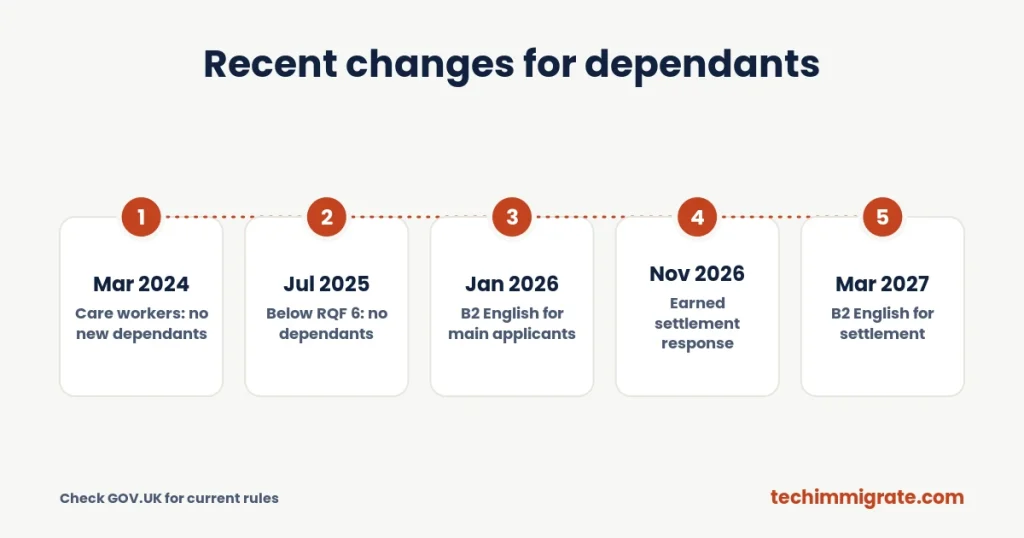
| Date | Change |
|---|---|
| 11 March 2024 | Care workers and senior care workers can no longer bring new dependants |
| 22 July 2025 | Skill level for new Skilled Worker roles raised to RQF level 6; new workers in roles below that level on the Temporary Shortage List generally cannot bring dependants |
| 8 January 2026 | New Skilled Worker main applicants need English at B2 |
| 2 November 2026 | Earned settlement response sets out new settlement rules, including for partners and children |
These changes mainly affect who can bring dependants and how dependants settle. The basic process for dependants applying alongside an eligible Skilled Worker has not changed.
Who Can Bring Dependants Now
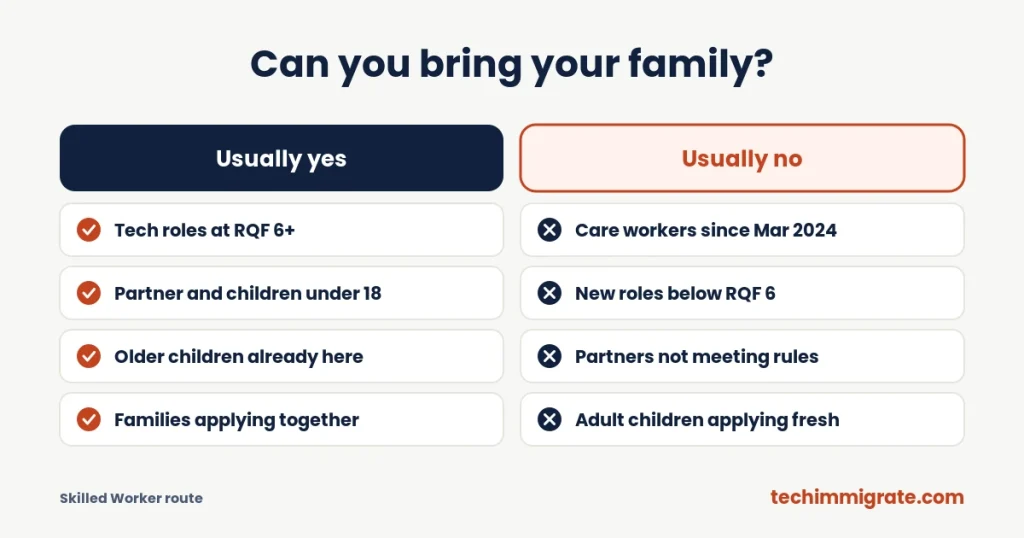
Most tech professionals on Skilled Worker visas can still bring family members. If your role is at RQF level 6 or above, which includes most software engineering, data, cyber security and product roles in eligible occupation codes, you can usually bring:
- Your partner: your husband, wife, civil partner or unmarried partner. Unmarried partners usually need to have lived together for at least 2 years.
- Your children under 18.
- Your children aged 18 or over, if they are already in the UK as your dependants.
Who Cannot Bring Dependants
- Care workers and senior care workers who applied after 11 March 2024 cannot bring new dependants.
- New Skilled Workers in roles below RQF level 6, for example roles relying on the Temporary Shortage List or Immigration Salary List, generally cannot bring dependants under the rules introduced on 22 July 2025.
There are transitional arrangements for some people already on the route before these changes. If you are in a lower-skilled role and were already a Skilled Worker before the changes, check whether you are covered.
Costs for Dependants
Each dependant pays the same visa fee as the main applicant and their own Immigration Health Surcharge.
| Fee | Outside the UK, up to 3 years | Outside the UK, over 3 years | Inside the UK, up to 3 years | Inside the UK, over 3 years |
|---|---|---|---|---|
| Visa fee per person | £819 | £1,618 | £943 | £1,865 |
The surcharge is £1,035 per year for adults and £776 per year for children under 18. For a family of four on 5-year visas applying from outside the UK, the visa fees are £6,472 and the surcharge is £18,110, a total of £24,582. Our article on Skilled Worker visa fees covers every cost.
Maintenance Funds for Dependants
Unless your employer certifies maintenance, or you have been in the UK for at least 12 months, you usually need to show funds for each dependant: £285 for a partner, £315 for the first child and £200 for each additional child. These funds must usually have been held for 28 days. Check GOV.UK for the current amounts and rules.
English Requirements
From 8 January 2026, new Skilled Worker main applicants need English at B2 level, up from B1. Dependants applying alongside a Skilled Worker do not currently need to meet a separate English requirement for their visa. For settlement, adult dependants will need to meet the English requirement, and under the earned settlement reforms that requirement rises to B2 from 26 March 2027. Children under 18 are usually exempt. Our article on the English requirement for Skilled Worker visas explains the main applicant's requirement.
The Earned Settlement Reforms and Dependants
The government's response to the earned settlement consultation, published on 2 November 2026, sets out important changes for families.
- Partners with the main applicant are expected to settle at the same time as the main applicant.
- Partners who join later may need to complete the same qualifying period themselves.
- Children are expected to be exempt from the income, English and Life in the UK requirements.
- Couples can combine income to meet the sustained contribution requirement of £25,142 a year.
- The main applicant's path matters: under the reforms, Skilled Workers earning £50,271 or more in 3 of the last 5 years are expected to have a 5-year path, while others may face the 10-year default.
The response does not include general transitional protection. Our article on ILR new rules for Skilled Worker visa holders explains the reforms in more detail.
What Families Should Do Now
- Check whether your role allows dependants, especially if it is below RQF level 6.
- Apply together if you can, so that everyone's visas run to the same date and partners are with the main applicant from the start.
- Budget for the full cost, including the surcharge for every family member.
- Plan for B2 English for adult dependants who will settle after 26 March 2027.
- Keep records of your relationship, your children's documents and your household income.
Most can, if their role is at RQF level 6 or above. Care workers and new workers in roles below RQF level 6 generally cannot.
The same visa fee as the main applicant, plus the Immigration Health Surcharge of £1,035 per year for adults or £776 per year for children.
Not for the dependant visa at present. Adult dependants will need English for settlement, at B2 from 26 March 2027 under the reforms.
Under the reforms, partners with the main applicant are expected to settle at the same time. Partners who join later may need their own qualifying period.
Under the reforms, children are expected to be exempt from the income, English and Life in the UK requirements.
Why the Rules Have Changed
The changes to dependant rules are part of a wider effort by the government to reduce net migration. Dependants make up a large share of people arriving on work visas, so limiting who can bring them was one of the quickest ways to reduce numbers. The government has focused restrictions on lower-skilled roles, while keeping the right to bring dependants for workers in graduate-level roles. For most tech professionals, that means the right to bring family members remains, but the costs have risen and the path to settlement is changing.
Applying Together or Separately
Your dependants can apply at the same time as you, or join you later. Applying together has clear advantages. Everyone's visa runs to the same date, which makes extensions and settlement simpler. Under the planned reforms, partners who are with the main applicant are expected to settle at the same time, while partners who join later may need to complete their own qualifying period. If you need to move first, for example because of a job start date, plan for your family to join as soon as practical, and keep records of the reasons for any delay.
Relationship Evidence
Partners need to show that the relationship is genuine and subsisting. Married couples and civil partners usually provide their marriage or civil partnership certificate. Unmarried partners usually need to show that they have lived together in a relationship similar to marriage for at least 2 years, with documents such as joint tenancy agreements, bank statements, utility bills or other official letters at the same address. Gather this evidence early, especially if you have moved between countries, because older documents can be hard to find.
Children's Documents
Children usually need a full birth certificate showing both parents. If only one parent is moving to the UK, or if parents are separated, you may need to show that the moving parent has sole responsibility, or that the other parent consents, or that there are serious reasons for the child to come. Check the rules on GOV.UK carefully and prepare documents in advance. Certified translations are needed for documents not in English or Welsh.
What Dependants Can Do in the UK
Partners on a Skilled Worker dependant visa can usually work for any employer or be self-employed, and can study, subject to some conditions. Children can attend school. Dependants cannot usually claim most public funds. This flexibility can make a big difference to a family's finances and quality of life, so check that your partner's plans fit the conditions of their visa.
Extending Dependants' Visas
When the main applicant extends their Skilled Worker visa, dependants usually need to extend too. Each pays the visa fee and the surcharge for the new period. If the main applicant changes employer and makes a new application, dependants usually need new applications as well. Our guide to extending a Skilled Worker dependant visa explains the process.
Children Who Turn 18
A child who first comes to the UK as a dependant while under 18 can usually extend as a dependant after turning 18, as long as they are not leading an independent life, for example by living separately or being married. A child who is already 18 or over when you first apply usually cannot come as a dependant unless they are already in the UK as your dependant. If you have teenage children, think about the timing of your move.
Children Born in the UK
A child born in the UK to Skilled Worker parents is not automatically British unless a parent is British or settled at the time of the birth. The child will usually need a dependant visa. Once a parent settles, the child may be able to register as a British citizen. Our article on ILR to British citizenship explains the options.
If Your Role Is Below RQF Level 6
If you are considering a Skilled Worker role below RQF level 6, check carefully whether you could bring your family before you accept. Under the rules introduced on 22 July 2025, new workers in many such roles cannot bring dependants. In tech, most roles are at RQF level 6 or above, but some support or technician roles may not be. Your employer's sponsor management team should be able to confirm the occupation code and skill level.
Planning for Settlement as a Family
Settlement is where the reforms matter most for families. If the main applicant is expected to have a 5-year path, partners who are with them from the start may be able to settle at the same time. Children are expected to be exempt from several requirements. Partners who join later, or main applicants who face the 10-year default, will have longer timelines. Work out each person's expected dates, and plan your applications and budget around them.
Common Mistakes
- Assuming all Skilled Workers can bring dependants. Care workers and new workers below RQF level 6 generally cannot.
- Forgetting the surcharge for each family member.
- Not gathering relationship evidence early.
- Letting a dependant's visa expire. Each person needs valid permission.
- Assuming a UK-born child is British. They usually are not unless a parent is British or settled.
- Ignoring the settlement reforms. Partners who join later may need longer to settle.
The Bottom Line
Most tech professionals on Skilled Worker visas can still bring their families, but the rules have tightened for lower-skilled roles, costs have risen, and settlement is changing. Apply together where you can, budget for the full cost, gather documents early and keep an eye on the earned settlement reforms. Check GOV.UK before you apply, because the rules continue to change.
A Worked Example: The Mensah Family
Kofi has accepted a role as a senior data engineer with a licensed sponsor in Manchester. His role is at RQF level 6, so he can bring his wife, Ama, and their two children, aged 7 and 12. They apply together from outside the UK for 5-year visas. Each person pays the £1,618 visa fee for a visa of more than 3 years. The adults each pay £5,175 in surcharge and the children £3,880 each. Kofi's employer certifies maintenance, so they do not need to show savings. Ama plans to work, and the children start school soon after arrival. Kofi earns above £50,271, so under the planned reforms he would expect a 5-year path to settlement, and Ama, having arrived with him, would expect to settle at the same time. This example is fictional and simplified.
A Worked Example: Joining Later
Liam moves to London on a Skilled Worker visa as a backend engineer. His partner, Sofia, stays abroad to finish a contract and joins him 18 months later. She pays the visa fee and surcharge for the remaining period of Liam's visa. Under the planned reforms, a partner who joins later may need to complete the same qualifying period herself, so Sofia's settlement date could be later than Liam's. If they had applied together, they might have settled at the same time. This example is fictional and simplified.
Dependants and the No Public Funds Condition
Like the main applicant, dependants on Skilled Worker visas usually have a condition of no recourse to public funds. That means they cannot claim most benefits, such as Universal Credit or housing assistance. Children can still attend state schools, and everyone can use the NHS after paying the surcharge. Under the planned reforms, receiving public funds before settlement is one of the factors that can lead to a 20-year path, so make sure nobody in the family claims benefits they are not entitled to.
Partners Who Want to Work in Tech
Many partners of tech workers are tech professionals themselves. On a dependant visa, they can usually work for any employer without sponsorship. If they later want their own route, they could switch to a Skilled Worker visa with their own sponsor, or, if they have strong evidence of recognition, apply for the Global Talent visa. Having their own route can give a family more security, because each person's status no longer depends on the other's job.
Changes That May Still Come
The government's immigration white paper of May 2025 proposed further changes, including English requirements for adult dependants that could increase over time. Not all proposals have been implemented yet, and the details may change. Keep an eye on Statements of Changes to the Immigration Rules and GOV.UK guidance, especially if you are planning a move or an extension in the next year.
Getting Help
If your family's situation is complicated, for example because of a previous refusal, a child living with another parent, or a role close to the RQF level 6 boundary, consider speaking to a regulated immigration adviser before you apply. A short consultation can save a costly refusal for the whole family.
How Long Dependants' Visas Last
Dependants' visas usually end on the same date as the main applicant's visa. If the main applicant's visa is cut short, for example because they lose their job and do not find a new sponsor in time, dependants' visas can be cut short too. That is one reason why many families aim for the security of settlement, or a route such as Global Talent that is not tied to an employer. Keep a close eye on the main applicant's visa dates and employment, and plan extensions for the whole family together.
Questions to Ask Before You Move
- Is my role at RQF level 6 or above, so that I can bring dependants?
- Will my family apply with me or join later, and how will that affect settlement?
- Can we afford the visa fees and surcharge for everyone?
- Will my employer certify maintenance, or do we need to show funds?
- Do we have all relationship and birth documents, with translations?
- Will my partner work, and does their visa allow it?
- Are any of our children close to 18?
Choosing the Right Route for Your Family
For some tech families, a different route may suit them better than Skilled Worker. The Global Talent visa lets the main applicant work for any employer, has lower visa fees and, under the planned reforms, is expected to offer a 3-year path to settlement. Dependants of Global Talent holders can also work freely. The trade-off is that endorsement is hard to get. Our comparison of Global Talent and Skilled Worker explores the options.
How Decisions Are Made for Families
When a family applies together, each person's application is considered, but they are linked. If the main applicant is refused, the dependants are usually refused too. If one dependant's documents are incomplete, that application may be delayed or refused while others are granted. Check every person's documents carefully before you submit, and make sure each application clearly links to the main applicant's.
Keeping Up to Date
The rules for dependants have changed several times in a short period, and further changes are possible. Before you apply, check the Skilled Worker partner and children page on GOV.UK, and look for any recent Statements of Changes to the Immigration Rules.
Your Next Step
If you are a tech professional weighing up how to bring your family to the UK, compare Skilled Worker with the Global Talent visa, which has no sponsor, lower visa fees and a shorter path to settlement for many. Our role-specific Global Talent guides explain what Tech Nation looks for.
How We Checked This Article
We checked the dependant rules, fees and maintenance amounts against GOV.UK's Skilled Worker visa pages, including the partner and children section, and the surcharge against GOV.UK's Immigration Health Surcharge pages, in November 2026. Settlement reforms are from summaries of the earned settlement response of 2 November 2026.
Tech Immigrate is independent of the Home Office. This article is general information, not legal advice. Check GOV.UK before you apply.
We write practical guides for tech professionals applying for the UK Global Talent visa. Tech Immigrate is independent of Tech Nation and the Home Office, and our articles are general information, not legal advice. Rules and fees change, so always check gov.uk before you apply.


