Skilled Worker Dependant Visa: Bringing Your Family to the UK
Bring your partner and children on a Skilled Worker dependent visa: who qualifies, costs, funds, documents, work rights and settlement explained.


In this article
- Who Can Come as a Skilled Worker Dependant
- Restrictions for Care Workers and Medium-Skilled Roles
- Proving Your Relationship
- The Financial Requirement
- Costs for Families
- How to Apply
- What Dependants Can and Cannot Do
- How Long Dependants Can Stay
- Children Born in the UK
- Settlement for Dependants
- Skilled Worker vs Global Talent Dependants
- A Worked Example: A Tech Family of Four
- Partners Joining Later
- Schools and Childcare
- What Happens When You Change Employer
- If Your Circumstances Change
- Partner Careers: Using the Right to Work
- Pre-Application Checklist for Families
- Common Mistakes
- Frequently Asked Questions
- Plan Your Family's Move
- How We Checked This Article
If you are moving to the UK on a Skilled Worker visa, your partner and children can usually come with you as dependants. They can live, work and study in the UK, and eventually settle. For most tech roles, the family rules are straightforward. But there are important exceptions, especially for care workers and some medium-skilled roles, and there are financial requirements, fees and timing rules that families need to plan for.
This guide explains the Skilled Worker dependant visa in full: who can come, how to prove your relationship, the financial requirement, costs, how to apply from outside and inside the UK, what dependants can do, children born in the UK, and how settlement works for family members now and under the proposed reforms. It also compares the Skilled Worker family rules with the Global Talent route.
Key takeaways
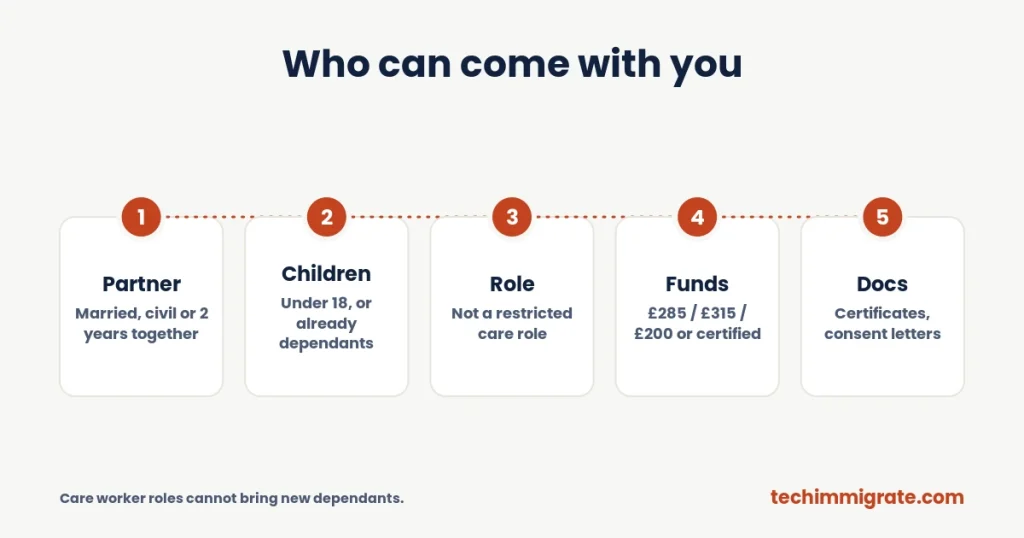
- Your husband, wife, civil partner or unmarried partner, and your children under 18, can usually apply as Skilled Worker dependants. Children over 18 can extend only if they already have permission as your dependant.
- Care workers and some medium-skilled roles have restrictions on bringing dependants, with exceptions for people continually employed in those roles since before cut-off dates.
- Unless your employer certifies maintenance, or your family has been in the UK for 12 months, you must show £285 for a partner, £315 for the first child and £200 for each additional child, held for 28 days.
- Each family member pays their own visa fee and the Immigration Health Surcharge of £1,035 a year.
- Dependants can work, except as a sportsperson or coach, study, and travel. They cannot claim most public funds.
- Dependants can apply for settlement after 5 years under the current rules, if they meet the requirements.
Who Can Come as a Skilled Worker Dependant
GOV.UK lists these family members:
| Family member | Who counts | Key requirement |
|---|---|---|
| Partner | Husband, wife, civil partner or unmarried partner | Genuine relationship, by marriage, civil partnership or at least 2 years together |
| Child under 18 | Your child, including a child born in the UK during your stay | Lives with you (unless in full-time education away from home), not married or in a civil partnership |
| Child over 18 | Only if they already have permission as your dependant | Must already be in the route |
Other relatives, such as parents or siblings, cannot come as Skilled Worker dependants.
Restrictions for Care Workers and Medium-Skilled Roles
This is the most important exception. For most tech roles at degree level, there are no restrictions on bringing dependants. But GOV.UK sets restrictions for some roles:
- Care workers and senior care workers: families can join from outside the UK only if the worker has been continually employed in that role on a Skilled Worker visa since before 11 March 2024, or if the child was born in the UK. Inside the UK, there are some additional exceptions, such as where the worker is the child's only living responsible parent or the other parent is also sponsored in that role.
- Jobs listed as medium skilled: similar exceptions apply, with a cut-off date of 22 July 2025.
If your role falls into one of these categories, check the current rules carefully before making family plans.
Proving Your Relationship
Partners
You need either a marriage or civil partnership recognised in the UK, or evidence of a relationship of at least 2 years. If you do not live together, you must show ongoing commitment, such as regular contact, financial support, shared childcare or time spent together as a couple. Good evidence spreads across the whole period: joint tenancy or mortgage documents, utility bills, bank statements and official letters addressed to both of you.
Children
You need the child's birth certificate showing you as a parent. The child must live with you, unless in full-time education away from home, and must not be married or in a civil partnership. GOV.UK asks for evidence of the child's address, such as a bank statement, credit card bill, driving licence, NHS registration document or a letter from their school or university.
If only one parent is in the UK, or parents are separated, the rules can be more complex. You may need evidence of sole responsibility or the other parent's consent. Take advice if your situation is unusual.
The Financial Requirement
Unless an exemption applies, you must show you can support your family, with these amounts for each dependant:
| Dependant | Amount |
|---|---|
| Partner | £285 |
| First child | £315 |
| Each additional child | £200 |
The funds must be held for 28 days in a row, with day 28 falling within 31 days of applying. You usually need to show proof unless:
- you and your family have all been in the UK on a valid visa for at least 12 months; or
- your employer confirms on your certificate of sponsorship that it will cover your family's costs for the first month.
A dependant applying later only needs to show funds if they have been in the UK for less than a year.
These amounts are on top of the main applicant's own maintenance requirement of £1,270, unless that is also certified or exempt.
Costs for Families
Each family member pays the same visa fee as the main applicant and the health surcharge for each year.
| Cost per dependant, from outside the UK | Up to 3 years | More than 3 years |
|---|---|---|
| Visa fee | £819 | £1,618 |
| Immigration Health Surcharge | £1,035 per year | £1,035 per year |
In-country fees are higher. For a partner and two children on 3-year visas from outside the UK, the visa fees come to 3 × £819 = £2,457 and the health surcharge to 3 × 3 × £1,035 = £9,315, a total of £11,772, on top of the main applicant's costs. Some employers contribute to family visa costs; it is worth asking.
How to Apply
From outside the UK
- Each family member applies online separately, as a partner or child, before travelling.
- They use your application number (GWF or UAN), or a family linking code if you received one.
- They prove their identity through the UK Immigration: ID Check app or at a visa application centre.
- They provide relationship and, where needed, financial evidence, and tuberculosis certificates if required where they live.
- A decision usually takes about 3 weeks. A faster decision may be available for a fee.
From inside the UK
Family members can apply at the same time as you or before their current visa expires. Their current visa remains valid until its original end date. A decision usually takes about 8 weeks, and they must not travel outside the UK, Ireland, the Channel Islands or the Isle of Man until a decision is made, or the application will be withdrawn.
Some visas do not allow switching to a dependant visa, including visit, short-term student and seasonal worker visas. Student visa holders can switch only if they have completed their course or studied a PhD for at least 24 months.
What Dependants Can and Cannot Do
| Can | Cannot |
|---|---|
| Work, except as a sportsperson or coach | Claim most public funds |
| Study | Get the State Pension |
| Travel abroad and return | Stay beyond the end of their permission |
| Apply for settlement after 5 years, if eligible |
Partners on Skilled Worker dependant visas have open work rights: they can work for any employer, be self-employed or start a business, subject to the exceptions above. That is a major benefit for families where both partners work in tech.
Children can attend state schools free of charge. University fee status for older children depends on residence and immigration rules, so check before they apply.

How Long Dependants Can Stay
Dependants' visas usually end on the same date as the main applicant's visa. If parents' visas end on different dates, a child's visa ends on the earlier date. When the main applicant extends, dependants should extend at the same time.
If the main applicant changes employer and applies to update their visa, dependants usually need to apply too, linked to the new application.
Children Born in the UK
A child born in the UK to Skilled Worker parents is not automatically a British citizen. You need a dependant visa for the child to travel in and out of the UK, and you will need a full UK birth certificate showing both parents' names. The dependant visa must be applied for before the child turns 18 if they want to stay in the UK. If a parent later gets indefinite leave to remain or citizenship, the child may be able to register as a British citizen.
Settlement for Dependants
Under the current rules
GOV.UK says dependants can apply for settlement after 5 years of UK residence if they meet the requirements. Partners must usually have lived with you as your dependant for 5 years, be in a genuine relationship, and meet the English and Life in the UK requirements unless exempt. Children usually settle when their parents settle.
Under the earned settlement reforms
The government's earned settlement response of 2 November 2026 proposes that:
- partners who arrive with the main applicant can settle at the same time, if they meet the requirements;
- partners who join later must complete the same qualifying period as the main applicant;
- children under 18 can settle with their parents and are exempt from the income, debt, English and Life in the UK requirements;
- couples can combine earnings to reach a household income requirement of £25,142.
Because the main applicant's qualifying period may become 3, 5, 10 or 20 years depending on earnings and history, the family's settlement timeline will depend on the main applicant's path. Changes will be implemented over 2027. Our article on the new ILR rules for Skilled Workers explains this.
Skilled Worker vs Global Talent Dependants
| Skilled Worker | Global Talent | |
|---|---|---|
| Who can come | Partner, children | Partner, children |
| Restrictions by role | Yes, for care workers and medium-skilled roles | No |
| Financial requirement | £285 partner, £315 first child, £200 each additional, unless exempt | None listed by GOV.UK |
| Visa fee per dependant | Same as main applicant | £766 |
| Partner's work rights | Open, with limited exceptions | Open, with limited exceptions |
| Settlement under current rules | Usually 5 years | Usually 5 years, even if the main applicant settles at 3 |
Our article on Global Talent dependants explains the Global Talent family rules.
A Worked Example: A Tech Family of Four
A software engineer is offered a sponsored role in Manchester at £62,000, with a 3-year certificate of sponsorship. The engineer's partner, a product designer, and their two children aged 4 and 8 will move too.
- Eligibility. The role is at degree level and not restricted, so dependants can come.
- Maintenance. The employer certifies maintenance for the whole family on the certificate, so no bank statements are needed.
- Fees. Four visa fees from outside the UK at £819 each, £3,276 in total, plus the health surcharge for 3 years: £6,210 for the two adults at £1,035 a year and £4,656 for the two children at £776 a year, a total of £14,142.
- Tests. If the family lives in a country on the tuberculosis list, each person needs a certificate.
- Work. The partner can work for any employer as soon as the visa starts, and finds a design role at a London-based remote company.
- Settlement. Under the current rules, the family could settle after 5 years. Under the proposals, the engineer's earnings above £50,271 suggest a 5-year path, and the partner, having arrived with the engineer, could settle at the same time if the reforms are adopted as proposed.
Partners Joining Later
Your partner and children do not have to come at the same time as you. Many families move in stages, with the main applicant arriving first to find housing and schools. Dependants can apply later, as long as you still hold Skilled Worker permission and they meet the requirements. Points to remember:
- they must apply from outside the UK unless they are already in the UK on a visa that allows switching;
- they may need to show maintenance funds if they have been in the UK for less than a year and your employer has not certified it;
- under the current rules, each dependant's settlement clock usually starts from their own first grant as your dependant;
- under the proposals, partners joining later would need the same qualifying period as the main applicant.
Schools and Childcare
Children of Skilled Workers can attend state schools free of charge. In England, school places are allocated through the local council, so apply as soon as you have an address. Childcare can be expensive, and some government-funded childcare support depends on immigration status, so check eligibility before relying on it in your budget.
What Happens When You Change Employer
If you move to a new sponsor, you must apply for new Skilled Worker permission before starting the new job. Your partner and children do not lose their status at that moment, but their permission is tied to yours. In practice, most families include the dependants in the same change-of-employment application, or apply for them straight after, so that everyone's visa ends on the same date. If you forget, your dependants may find their permission ends earlier than yours, or that they need a separate application later at a higher total cost.
A change of employer can also affect settlement. Under the current rules, continuous time on the Skilled Worker route counts, so moving jobs does not reset the clock. Under the proposed earned settlement rules, the salary used to judge your qualifying period may be the one you earn when you apply for ILR, so a move to a higher-paying role could shorten the path for the whole family.
If Your Circumstances Change
Life does not always follow the plan. These are the situations families ask about most often:
- The relationship ends. A former partner's permission is linked to the main applicant. They usually need to switch to a route of their own, such as Skilled Worker with their own sponsor, before their current permission is cut short. Specialist advice is worth getting early.
- The main applicant loses their job. The sponsor reports the end of employment, and the Home Office will usually shorten the whole family's permission, typically to 60 days. That window is the time to find a new sponsor or switch route.
- A child is born in the UK. A child born in the UK to a Skilled Worker is not automatically British. You can apply for the child as a dependant from inside the UK, and once a parent settles, the child may be able to register as a British citizen.
- A child turns 18. A child already in the UK as your dependant can usually extend as a dependant after 18, provided they still live with you and are not leading an independent life.
Partner Careers: Using the Right to Work
One of the strongest features of the dependant route is that your partner can work for almost any employer, at any salary, without a sponsor. That flexibility is valuable for tech couples:
- your partner can take a contract or freelance role, which a Skilled Worker cannot easily do;
- they can start a business, as long as they are not working as a professional sportsperson or coach;
- they can study, although some courses need ATAS clearance;
- if they later land a job that meets Skilled Worker rules, they can switch to their own visa, which protects them if your circumstances change.
Many partners of tech workers go further and look at the Global Talent route, which needs no sponsor and offers more freedom. If your partner has a track record in digital technology, read the Global Talent eligibility guide to see whether it fits.
Pre-Application Checklist for Families
Before anyone in the family pays a fee, run through this list together:
- Confirm that your occupation code allows dependants, and that your certificate of sponsorship has been assigned.
- Ask your employer whether they will certify maintenance for dependants, and check that it appears on the certificate.
- Gather marriage or civil partnership certificates, or evidence of two years living together for unmarried partners.
- Get full birth certificates for every child, showing both parents' names.
- If only one parent is moving with a child, get a signed consent letter from the other parent, or evidence of sole responsibility.
- Book tuberculosis tests for each family member if your country of residence is on the list.
- Budget for the visa fee and health surcharge for every person, not just the main applicant.
- Line up schools, childcare and housing before the move, because a UK address is needed for school places.
Working through the list early avoids the most common cause of delay: a missing document that leads to a request for more information.
Common Mistakes
- Assuming every role allows dependants, when care and some medium-skilled roles are restricted.
- Weak evidence for unmarried partners, covering only part of the 2 years.
- Not checking whether the employer has certified maintenance for the family.
- Funds dipping below the required amount during the 28-day period.
- Forgetting tuberculosis tests for family members.
- Travelling while an in-country application is pending.
- Not applying for a UK-born child's visa before planned travel.
- Letting a dependant's visa lapse when the main applicant changes job.
Frequently Asked Questions
Usually yes. Your partner and children under 18 can apply as dependants, unless your role is restricted, such as some care and medium-skilled roles.
£285 for a partner, £315 for the first child and £200 for each additional child, held for 28 days, unless your employer certifies maintenance or you have all been in the UK for 12 months.
Yes, for any employer or self-employed, except as a sportsperson or coach.
The same visa fee as the main applicant, from £819 from outside the UK for up to 3 years, plus the health surcharge of £1,035 a year.
Not automatically. The child needs a dependant visa to travel in and out of the UK.
Under the current rules, after 5 years if they meet the requirements. The earned settlement reforms propose changes from 2027.
Only in limited cases, such as if continually employed in the role on a Skilled Worker visa since before 11 March 2024, or for children born in the UK.
Plan Your Family's Move
For families in tech, the route you choose shapes your partner's rights, your costs and your settlement timeline. If you might qualify for Global Talent, it offers no financial requirement for dependants and freedom from sponsorship. Our role-specific Global Talent guides explain how to qualify.
How We Checked This Article
We checked the rules against GOV.UK's Skilled Worker partner and children page and Global Talent partner and children page, in November 2026. Fees come from the Home Office fee schedule in force from 8 April 2026. The settlement reform section draws on the government's earned settlement response (2 November 2026) as summarised by Lewis Silkin.
Tech Immigrate is independent of the Home Office. This article is general information, not legal advice.
We write practical guides for tech professionals applying for the UK Global Talent visa. Tech Immigrate is independent of Tech Nation and the Home Office, and our articles are general information, not legal advice. Rules and fees change, so always check gov.uk before you apply.