
Skilled Worker Caseworker Guidance: What Home Office Staff Check
What the Skilled Worker caseworker guidance says: sponsor, certificate, genuineness, occupation code, salary, English, funds and suitability checks.


In this article
- What the Caseworker Guidance Is
- Where to Find It and How Often It Changes
- Check 1: The Sponsor
- Check 2: The Certificate of Sponsorship
- Check 3: Is the Job Genuine?
- Check 4: Occupation Code and Skill Level
- Check 5: Salary
- Check 6: English Language
- Check 7: Financial Requirement
- Check 8: Tuberculosis and Criminal Record Certificates
- Check 9: Suitability
- Check 10: Settlement Applications
- Verification Checks and Interviews
- Requests for More Information
- What the Guidance Tells Us About Avoiding Problems
- How to Read the Guidance Efficiently
- Where Caseworkers Have Discretion
- Evidential Flexibility
- Caseworker Guidance vs Sponsor Guidance
- If Your Application Is Refused
- What Employers Can Do
- Self-Review: Check Your Application Like a Caseworker
- Why the Guidance Matters More Since 2026
- Other Caseworker Guidance Worth Knowing
- A Worked Example: A Clean Application
- A Worked Example: An Application That Raises Questions
- Common Mistakes
- Give the Caseworker No Reason to Pause
- How We Checked This Article
Every Skilled Worker application is decided by a Home Office caseworker, and every caseworker follows the same published playbook: the Skilled Worker caseworker guidance. It is a long, technical document, running to dozens of pages, that tells Home Office staff how to apply the Immigration Rules, what to check, when to ask for more information and when to refuse. Most applicants never read it. But understanding what caseworkers are told to look for is one of the best ways to make sure your application gives them no reason to pause.
This guide explains what the Skilled Worker caseworker guidance is, where to find it, what it covers, and the main checks caseworkers carry out: sponsorship, the certificate of sponsorship, the genuineness of the job, skill level, salary, English, financial requirements, suitability and settlement. It is written for tech workers who want to understand how their application will be assessed, not as a substitute for legal advice.
Key takeaways
- The Skilled Worker caseworker guidance is published on GOV.UK and tells Home Office staff how to decide Skilled Worker applications.
- It is updated regularly. Version 18.0 was published on 8 April 2026 and version 19.0 on 11 May 2026.
- Caseworkers check that the sponsor is licensed, the certificate of sponsorship is valid and the job is genuine and eligible.
- They check the occupation code, skill level and salary against the Immigration Rules and Appendix Skilled Occupations.
- They assess English, maintenance funds, tuberculosis certificates and criminal record certificates where relevant.
- They can request more information, carry out verification checks, interview applicants and refuse applications that do not meet the rules.
- Accurate, consistent applications are the best way to avoid questions.
What the Caseworker Guidance Is
The Immigration Rules set out the legal requirements for the Skilled Worker route. The caseworker guidance explains how Home Office staff should apply those rules in practice. It covers:
- what each requirement means and how to check it;
- what evidence is acceptable;
- when caseworkers have discretion;
- how to handle unusual cases;
- when to ask for more information or refuse.
The guidance is written for caseworkers, using "you" to mean the caseworker. It is published so that applicants, employers and advisers can see how decisions are made. It does not create new requirements beyond the Immigration Rules, but it explains how those requirements are interpreted, and in practice caseworkers follow it closely. If the guidance and the rules ever appear to conflict, the rules take priority, but such conflicts are rare.
Where to Find It and How Often It Changes
The guidance is published on GOV.UK as "Skilled Worker visa: caseworker guidance". It is updated whenever the rules or policy change. Recent versions include:
- Version 18.0, published for Home Office staff on 8 April 2026, alongside changes that took effect that day;
- Version 19.0, published on 11 May 2026, which, according to the GOV.UK change note, clarified transitional rules relating to the April 2024 changes, corrected settlement qualifying period information and clarified Common Travel Area switching restrictions.
Always check that you are reading the latest version, because older versions may describe rules that no longer apply.
There is also separate guidance for sponsors, which tells employers how to manage their licence and assign certificates of sponsorship. The two documents work together.
Check 1: The Sponsor
Caseworkers first check that your employer:
- holds a valid sponsor licence for the Skilled Worker route;
- has an A rating, or is otherwise able to assign the certificate;
- is not subject to action that would prevent sponsorship.
If the sponsor's licence has been suspended or revoked, your application is likely to fail. This is why it is worth checking your employer on the register of licensed sponsors before you apply. Our guide to the register of licensed sponsors explains how.
Check 2: The Certificate of Sponsorship
Caseworkers check that the certificate:
- is valid and has not been used before;
- was assigned no more than 3 months before the application;
- is the right type: a defined certificate for applications from outside the UK, an undefined certificate for most in-country applications;
- contains accurate details that match your application and documents.
Mismatches between the certificate and your application, such as a different job title, salary or start date, are a common reason for questions. Our guide to the certificate of sponsorship explains what it contains.
Check 3: Is the Job Genuine?
The guidance includes a genuineness requirement. Caseworkers must be satisfied that:
- the job is a genuine vacancy, or under the March 2026 sponsor guidance, an eligible role that really exists and requires the duties and hours on the certificate;
- the job has not been created mainly to help someone get a visa;
- you intend to do the job described.
Caseworkers may look at:
- whether the job description is realistic for the sponsor's business;
- whether the salary is credible for the role;
- whether your skills and experience fit the job;
- the sponsor's size, history and compliance record;
- any inconsistencies between your CV, the certificate and the job advert.
If a caseworker has doubts, they may ask for more information, contact the sponsor, or interview you.

Check 4: Occupation Code and Skill Level
Caseworkers check that the occupation code on your certificate:
- is eligible for the Skilled Worker route;
- is at the required skill level, usually RQF 6 or above for new applicants since 22 July 2025;
- genuinely matches the job described.
If the job description reads like a different occupation, for example a support technician role coded as software development, the caseworker can refuse. For people already on the route before 22 July 2025 in medium-skilled roles, the guidance explains the transitional arrangements. Our guide to occupation codes for tech roles explains how to choose the right code.
Check 5: Salary
Caseworkers check that the salary:
- meets the general threshold and the going rate for the code, or a lower rate that applies to you, such as new entrant or PhD;
- is guaranteed basic gross pay, excluding bonuses and most allowances;
- is calculated correctly for your hours, including the hourly rate;
- meets any transitional thresholds if you were on the route before 4 April 2024.
If you are relying on a salary concession, such as new entrant, caseworkers check that you meet the conditions, for example your age or your previous Student or Graduate visa. Our guide to Skilled Worker going rates explains the salary rules.
Check 6: English Language
Caseworkers check your English evidence against the required level: B2 for new applicants and people switching in, or B1 for people extending or updating permission held before 8 January 2026. They check that:
- a SELT is from an approved provider and at the right level;
- a degree is taught in English and, if from outside the UK, confirmed by Ecctis;
- a nationality exemption applies;
- any earlier evidence relied on was accepted at the right level.
Check 7: Financial Requirement
The guidance includes a financial requirement. Caseworkers check that you have enough money to support yourself, usually £1,270 held for 28 days, unless:
- your sponsor has certified maintenance on the certificate; or
- you have been in the UK with permission for at least 12 months.
They also check dependants' funds where relevant. Bank statements must meet the evidential rules, such as showing your name and the balance on each day.
Check 8: Tuberculosis and Criminal Record Certificates
Where relevant, caseworkers check that you have provided:
- a valid tuberculosis test certificate from an approved clinic, if you have lived in a listed country;
- criminal record certificates for jobs that require them, mainly in health, education and social care.
Check 9: Suitability
Like all routes, the Skilled Worker route has suitability requirements. Caseworkers check your immigration and criminal history, including:
- previous refusals and breaches;
- criminal convictions;
- deception in previous applications;
- NHS debts;
- exclusion or deportation orders.
They are instructed to consider whether information has been withheld. Declaring everything honestly is essential.
Check 10: Settlement Applications
The guidance also covers ILR applications on the Skilled Worker route. Caseworkers check the qualifying period, continuous residence, the sponsor's confirmation that you are still needed, salary at the time of application, English, the Life in the UK test and suitability. Our ILR requirements checklist for Skilled Workers brings these together.
Verification Checks and Interviews
The guidance allows caseworkers to verify documents and information. This can include:
- contacting the sponsor to confirm the job and salary;
- checking documents with the issuing organisation, such as a university or bank;
- checking test results with the English test provider;
- interviewing the applicant, in person or remotely.
Verification checks can delay a decision. If the Home Office contacts you or your employer, respond promptly and accurately. Make sure your employer's HR team knows to expect possible contact, and that the person named on the certificate as the contact is available and briefed on your role, salary and start date.
Requests for More Information
If something is missing or unclear, caseworkers can ask for more information before refusing. If you receive a request, you will usually be given a deadline. Failing to respond, or giving incomplete answers, can lead to refusal. Keep copies of everything you submit, along with a note of the date you sent it, in case you need to refer back to it.
What the Guidance Tells Us About Avoiding Problems
Reading the guidance from an applicant's point of view suggests some clear lessons:
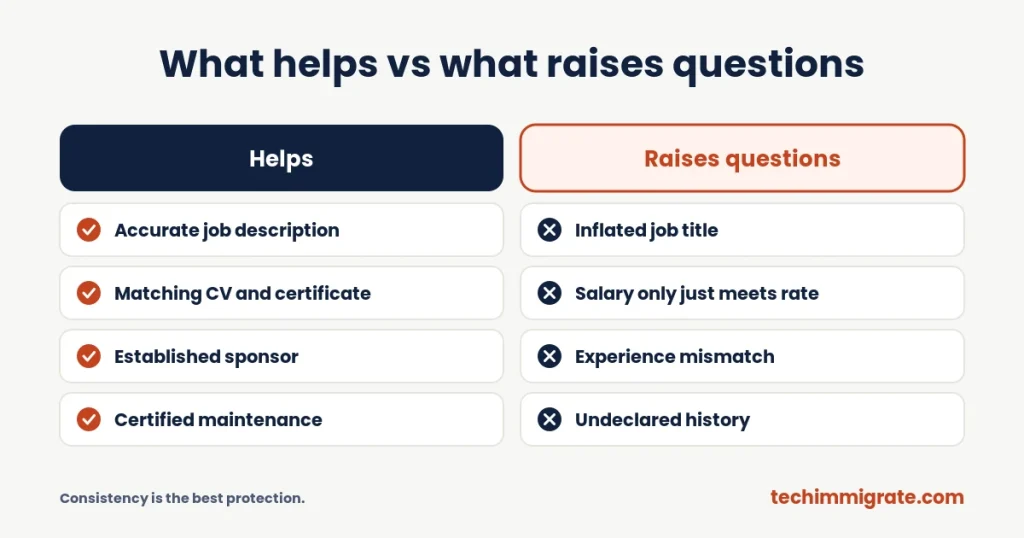
- Consistency matters. Make sure your CV, the job advert, the certificate and your application tell the same story.
- The job description must be real. Under the eligible role requirement, it should describe what you will actually do.
- Salary must be calculated correctly. Only base pay counts, and the right threshold must be used.
- Evidence must be in the accepted form. English, funds and TB certificates must meet the specific rules.
- Honesty is non-negotiable. Undisclosed history is treated seriously.
How to Read the Guidance Efficiently
The guidance is long, so it helps to read it selectively:
- Start with the contents page. It lists every section, such as licensed sponsor, genuineness requirement and financial requirement, with page numbers.
- Read the changes section. Each version lists what has changed since the last one, which tells you about recent rule changes.
- Focus on the sections relevant to you. A software engineer applying from abroad does not need the sections on care workers or prison officers.
- Read alongside the rules. The guidance explains Appendix Skilled Worker and Appendix Skilled Occupations, so have those to hand.
- Note any examples. The guidance sometimes includes examples of how caseworkers should approach particular situations.
Where Caseworkers Have Discretion
Most Skilled Worker requirements are clear-cut: the salary either meets the threshold or it does not. But the guidance gives caseworkers some discretion in areas such as:
- deciding whether a job is genuine, which involves judgement;
- deciding whether to request missing evidence rather than refusing;
- weighing explanations for inconsistencies;
- deciding whether to interview an applicant.
Where there is discretion, a clear, consistent application with a credible explanation for anything unusual gives the caseworker the best basis to decide in your favour.
Evidential Flexibility
The Immigration Rules include a general principle sometimes called evidential flexibility. In some situations, if a document is missing, in the wrong format or does not contain all the required information, the caseworker can contact you to request it rather than refusing straight away. This is not guaranteed, and it does not apply to every type of missing evidence. Relying on it is risky. It is far better to submit complete evidence first time.
Caseworker Guidance vs Sponsor Guidance
The Home Office publishes two related sets of guidance:
- Caseworker guidance, which explains how applications are decided;
- Sponsor guidance, which explains how employers must manage their licence, assign certificates and meet their duties.
For applicants, the caseworker guidance is the more directly relevant. For employers, the sponsor guidance is essential. Changes to the sponsor guidance, such as the eligible role requirement introduced in March 2026 and the requirement from 8 April 2026 to pay the required salary in every pay period, often affect how caseworkers assess applications too.
If Your Application Is Refused
If a caseworker refuses your application, the decision letter explains the reasons, with reference to the rules. You may be able to request an administrative review if you think the caseworker made a mistake in applying the rules. Administrative review is not a chance to submit new evidence in most cases; it is a check on whether the decision was correct on the evidence you provided.
If the refusal was due to missing or incorrect evidence, it may be quicker to make a fresh application with a new certificate of sponsorship. Talk to your employer and, if needed, take advice.
What Employers Can Do
Employers sponsoring tech workers can reduce the risk of caseworker questions by:
- writing accurate job descriptions that reflect the real role;
- choosing the occupation code that genuinely matches the duties;
- making sure the salary meets the going rate, using base pay only;
- certifying maintenance where possible;
- responding quickly if the Home Office contacts them about an application.
Self-Review: Check Your Application Like a Caseworker
Before you submit, review your application as a caseworker would. Ask yourself:
- Sponsor: is the employer on the register, licensed for Skilled Worker and A-rated?
- Certificate: is it valid, the right type, and assigned in the last 3 months? Do all the details match my passport and application?
- Genuineness: does the job description reflect what I will actually do? Does my CV show I can do it? Is the salary credible for the role?
- Code: does the occupation code genuinely match the main duties?
- Salary: does my base pay meet the right threshold, using only guaranteed basic pay?
- English: is my evidence in an accepted form, at the right level?
- Funds: has my sponsor certified maintenance, or do my bank statements meet the rules for 28 days?
- TB and criminal records: do I need them, and are they valid?
- History: have I declared every previous refusal, breach and conviction?
If you can answer yes to each question, your application is in good shape.
Why the Guidance Matters More Since 2026
The 2026 changes to sponsor guidance, especially the eligible role requirement and the closer focus on accurate job descriptions, show that the Home Office is paying more attention to whether sponsored roles are real and accurately described. For applicants, that means the quality of the job description and the consistency of the application matter more than before. A well-written, honest application from a credible sponsor remains the best protection.
Other Caseworker Guidance Worth Knowing
The Skilled Worker guidance is not the only caseworker guidance that may affect tech workers. Related documents include:
- Global Talent caseworker guidance, for people applying on the Global Talent route after endorsement;
- Scale-up Worker caseworker guidance, for people joining qualifying fast-growing companies;
- Global Business Mobility caseworker guidance, for intra-company transfers;
- Suitability guidance, which covers criminality, deception and other grounds for refusal across all routes;
- Continuous residence guidance, which explains how absences are assessed for settlement.
If you are weighing more than one route, reading the relevant guidance side by side shows how differently each route is assessed. The Global Talent guidance, for example, has no sponsor or salary checks at the visa stage, because the endorsement does that work.
A Worked Example: A Clean Application
A software engineer applies from abroad for a role at an established London fintech.
- The sponsor is A-rated and long-established.
- The defined certificate describes a backend engineering role under 2134, matching the job advert and her CV.
- Her salary of £65,000 exceeds the £54,700 going rate.
- Her English is evidenced by an Ecctis-confirmed degree taught in English.
- Maintenance is certified by the sponsor.
- She provides a valid TB certificate.
The caseworker has no questions, and the decision arrives within 3 weeks.
A Worked Example: An Application That Raises Questions
A candidate applies for a role at a 3-person start-up that recently obtained a sponsor licence. The certificate describes a senior software architect role at £55,000. His CV shows 2 years of junior support experience.
- The caseworker has doubts about whether his experience fits a senior architect role.
- The sponsor's small size and recent licence prompt questions about whether the role genuinely exists.
- The caseworker requests more information from the sponsor and the applicant, and invites him to an interview.
The application may still succeed if the sponsor can show the role is real and he has the skills, but it takes much longer and carries real risk.
Common Mistakes
- Inconsistent information between the certificate, CV and application.
- A job description that does not match the code or the real duties.
- Counting bonuses towards salary.
- English evidence in the wrong form, such as a non-approved test.
- Bank statements that do not meet the evidential rules.
- Not declaring past refusals or convictions.
A Home Office document published on GOV.UK that tells caseworkers how to decide Skilled Worker applications.
Regularly, whenever rules or policy change. Version 18.0 was published on 8 April 2026 and version 19.0 on 11 May 2026.
The sponsor, the certificate of sponsorship, the genuineness of the job, the occupation code and skill level, salary, English, maintenance, TB and criminal record certificates, and suitability.
Yes. The guidance allows interviews and verification checks where caseworkers need more information.
Caseworkers must be satisfied the job is genuine and that you intend to do it.
It can help you understand how your application will be assessed, but it is long and technical. Use it alongside GOV.UK's public pages and, if needed, professional advice.
Give the Caseworker No Reason to Pause
The caseworker guidance shows that most Skilled Worker refusals and delays come from inconsistency, inaccurate job descriptions, salary miscalculations and evidence in the wrong form. Get those right and most applications are straightforward. If you want a route with no sponsor, no certificate and no salary checks, and you have a strong track record in tech, our role-specific Global Talent guides explain what Tech Nation looks for.
How We Checked This Article
We checked the guidance's versions and coverage against the Skilled Worker caseworker guidance published on GOV.UK, including version 18.0 of 8 April 2026 and the change note for version 19.0 of 11 May 2026, and the March 2026 sponsor guidance changes against law firm summaries, in November 2026.
Tech Immigrate is independent of the Home Office. This article is general information, not legal advice. Check the latest guidance on GOV.UK before you apply.
We write practical guides for tech professionals applying for the UK Global Talent visa. Tech Immigrate is independent of Tech Nation and the Home Office, and our articles are general information, not legal advice. Rules and fees change, so always check gov.uk before you apply.


