
How to Extend Your Skilled Worker Visa (and Whether to Switch Instead)
How to extend a Skilled Worker visa: who can extend, fees, your employer's role, processing times, family, and when to settle or switch instead.


In this article
- When You Need to Extend
- Who Can Extend
- What Your Employer Has to Do
- How Much an Extension Costs
- How to Apply Step by Step
- Can You Keep Working While You Wait?
- Extending for Your Partner and Children
- Changing Employer Instead of Extending
- Extend, Settle or Switch? How to Decide
- A Worked Example: Extending to Reach Settlement
- A Worked Example: Extend or Switch?
- Documents to Prepare
- What Happens if Your Extension Is Refused
- Common Mistakes When Extending
- Questions to Ask Your HR Team
- Timeline Planning
- Plan Your Next Step
- How We Checked This Article
Your Skilled Worker visa is not open-ended. It lasts as long as your certificate of sponsorship says, up to a maximum period per grant, and when it nears its end you have to decide what comes next. For most people, that means extending the visa with the same employer. For others, it is the moment to change jobs, apply for indefinite leave to remain, or switch to a different route altogether, such as Global Talent.
This guide explains how to extend a Skilled Worker visa: who is eligible, what it costs, what your employer has to do, how long it takes, what happens to your family, and how to decide whether extending is the right move or whether switching would serve you better. It is written for people working in tech, but the rules apply to every Skilled Worker.
Key takeaways
- You can usually extend if you are in the same job, with the same occupation code, and still working for the sponsor that issued your current certificate of sponsorship.
- Your employer must assign a new certificate of sponsorship for the extension.
- The fee from inside the UK is £943 for up to 3 years or £1,865 for more than 3 years, plus the health surcharge of £1,035 per year.
- You must apply before your current visa expires. Decisions usually take up to 8 weeks.
- If you are changing employer or job, you need a new application rather than a simple extension.
- Your partner and children do not extend automatically. They need their own applications.
- If you are close to 5 years, check whether you can apply for ILR instead, especially with the earned settlement reforms coming.
When You Need to Extend
Your Skilled Worker visa ends on the date shown in your eVisa. That date is set by the length of your certificate of sponsorship, plus a short grace period. If your employer wants to keep you after that date and you are not yet eligible for settlement, you need to extend.
There is no overall limit on how long you can stay on the Skilled Worker route. You can extend as many times as you need, as long as you continue to meet the requirements. Many people extend once to bridge the gap between their first grant and the 5-year point when they can apply for indefinite leave to remain.
You must apply before your current visa expires. You can apply up to 3 months before, but not after. If your visa expires before you apply, you become an overstayer, which can harm future applications.
Who Can Extend
According to GOV.UK, you can usually extend if:
- you have the same job and occupation code as when you were last granted permission;
- you are still working for the employer who gave you your current certificate of sponsorship;
- your salary still meets the rules that apply to you.
If any of these has changed, you are not extending in the strict sense. You are applying to update your visa or for a new grant of permission, which has the same fee but different evidence.
Medium-skilled roles
Since 22 July 2025, most new Skilled Worker applications need to be for jobs at RQF level 6, roughly degree level. People who were already on the route in medium-skilled roles can usually stay and extend, but GOV.UK sets out extra conditions, such as having received their first certificate of sponsorship before 22 July 2025 and having continuously held Skilled Worker permission since then. Most tech roles, such as software developers and data scientists, are already at degree level, so this mainly affects technicians and support roles.
Salary rules on extension
The general salary threshold for new Skilled Worker applications is £41,700, or £33,400 for new entrants, and you must also meet the going rate for your occupation. Some people who were first sponsored before 4 April 2024 may benefit from transitional salary rules on extension. The thresholds that apply to you depend on your history on the route, so ask your employer's HR team or check the tables in the Immigration Rules before you apply.
Going rates for common tech roles include:
| Occupation code | Role | Going rate |
|---|---|---|
| 2134 | Programmers and software development professionals | £54,700 |
| 2133 | IT business analysts, architects and systems designers | £54,900 |
| 2131 | IT project and programme managers | £58,200 |
| 2135 | Cyber security professionals | £48,500 |
If your salary has not kept up with these rates, talk to your employer early. A pay rise may be needed before the new certificate can be assigned.
English language
From 8 January 2026, new Skilled Worker applicants need English at B2. If you already proved your English in an earlier Skilled Worker application, you usually do not need to prove it again for an extension. Check the rules that apply to your case, and keep your old certificate or degree evidence to hand.
What Your Employer Has to Do
Your employer is a central part of the process. They need to:
- Assign a new certificate of sponsorship for the extension, showing your job, occupation code, salary and the new end date. The certificate fee is £525 for the employer.
- Pay the Immigration Skills Charge for the additional period. For large sponsors, this is £1,320 per year, and for small sponsors or charities £480 per year, under the rates in force from 16 December 2025.
- Confirm your salary and that the role is genuine.
Your employer cannot legally pass the Immigration Skills Charge or certificate fee on to you. Some employers also pay the visa fee and health surcharge, but they do not have to.
How Much an Extension Costs
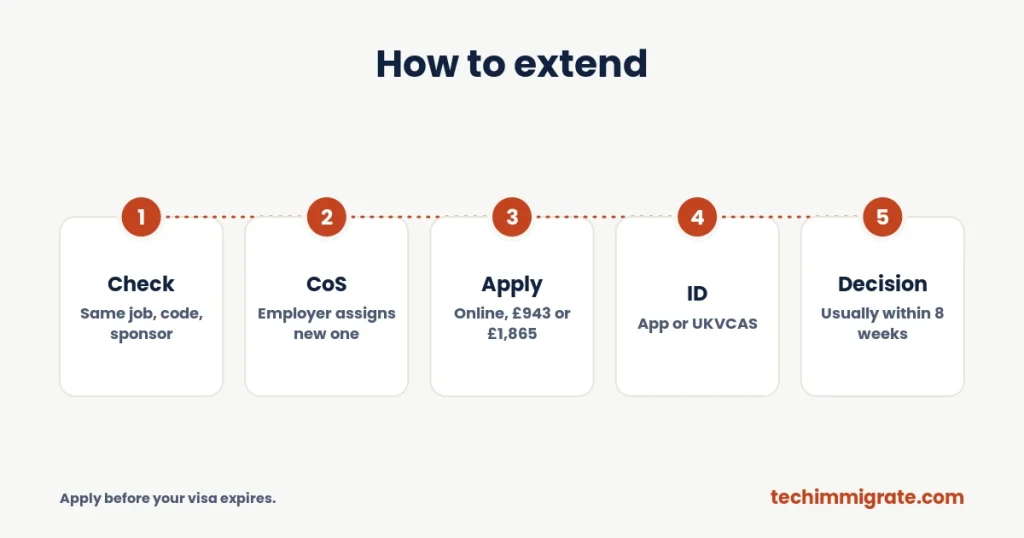
GOV.UK lists these fees per person for applications made from inside the UK:
| Length of visa | Standard fee | Immigration salary list role |
|---|---|---|
| Up to 3 years | £943 | £628 |
| More than 3 years | £1,865 | £1,235 |
On top of the visa fee, you pay the Immigration Health Surcharge at £1,035 per year for each adult. Children under 18 pay £776 per year.
Here is an example for one person extending for 3 years with a standard role:
- Visa fee: £943
- Health surcharge: £1,035 × 3 = £3,105
- Total: £4,048
Add £500 if you want a priority decision, or £1,000 for super priority, where available.
You do not usually need to show maintenance funds for an extension, because you will have been in the UK for at least 12 months on a valid visa.
How to Apply Step by Step
- Check your dates. Confirm when your current visa expires and plan to apply at least 6 to 8 weeks before.
- Get your certificate of sponsorship reference number from your employer.
- Apply online on GOV.UK using the extension form.
- Pay the fee and health surcharge.
- Prove your identity. Depending on your nationality and documents, you may use the UK Immigration: ID Check app or attend a UKVCAS appointment.
- Upload your documents, which may include your passport, certificate reference, payslips and any required evidence.
- Wait for a decision. GOV.UK says you will usually get a decision within 8 weeks.
- Check your eVisa after approval to make sure the new expiry date is shown correctly.
Can You Keep Working While You Wait?
If you apply before your current visa expires, your existing permission is extended by law until your application is decided, and for a short period after any appeal or review. This means you can usually keep working for your sponsor on the same terms while you wait. You must stay in the UK, Ireland, the Channel Islands or the Isle of Man until you get a decision, or your application will be treated as withdrawn.
This is one of the strongest reasons to apply in good time. If you apply even one day after your visa expires, you lose this protection.
Extending for Your Partner and Children
Your dependants' visas do not extend automatically with yours. GOV.UK confirms that if they do not apply, their permission stays valid until its original end date. They can apply at the same time as you, or later, as long as it is before their own visas expire.
Most families apply together so that everyone's visa ends on the same date. Each dependant pays the same visa fee and health surcharge as the main applicant. Our guide to the Skilled Worker dependant visa explains the rules for partners and children in detail.
Changing Employer Instead of Extending
If you are moving to a new employer, you cannot simply extend. You need to apply to update your visa with a new certificate of sponsorship from the new sponsor. The fee is the same as an extension, and you can usually start the new job once you have applied, as long as the certificate has been assigned and you have provided evidence of your right to work.
Points to watch:
- Your new employer must hold a sponsor licence.
- Your new role must meet the current skill level and salary rules, which may be stricter than when you first came.
- You must not start work for the new employer until you have applied.
- Changing employer does not reset your 5-year clock towards settlement.
Extend, Settle or Switch? How to Decide
Before you apply for an extension, ask whether another option would serve you better.
Option 1: Apply for ILR instead
If you will reach 5 years on the Skilled Worker route before your current visa expires, you may be able to apply for indefinite leave to remain instead of extending. You can apply up to 28 days before you complete your 5 years. Settling removes the need for a sponsor and ends the cycle of visa fees. Read the ILR requirements checklist to check you qualify.
The earned settlement reforms make this decision more urgent. Under the government's response of 2 November 2026, the default qualifying period becomes 10 years, with a 5-year path for people earning at least £50,271. The changes are expected to be implemented over 2027, and there is no general protection for people already on the route. If you can apply for ILR under the current rules soon, it may be worth doing so rather than extending.
Option 2: Extend for a short period
If you are, say, 4 years and 3 months into the route, a short extension may be enough to reach the 5-year point. Ask your employer to set the certificate end date so that it covers you until you are eligible for ILR, with a buffer for processing.
Option 3: Switch to Global Talent
Global Talent does not need a sponsor, has no salary threshold, and lets you change jobs, freelance or start a business freely. People endorsed under exceptional talent can settle after 3 years under the current rules, and time on Skilled Worker can usually be combined with Global Talent towards settlement.
Switching makes most sense if:
- you have a strong track record in digital technology, such as product launches, open-source work, publications or speaking;
- you want to leave your sponsor or go freelance;
- your salary is below the threshold for a shorter settlement path under the reforms.
Our guide to Global Talent vs Skilled Worker compares the two routes in detail, and our guide to switching to the Global Talent visa explains the process.

A Worked Example: Extending to Reach Settlement
A data engineer came to the UK in October 2022 on a 3-year Skilled Worker visa, sponsored by a retail tech company. Her visa expires in October 2025. She extends for 3 years in September 2025, giving her permission until October 2028.
She reaches 5 years in October 2027 and can apply for ILR from September 2027. Under the current rules, she should be eligible if she still meets the requirements. Under the reforms, her salary of £62,000 is above the £50,271 threshold, so she would likely remain on a 5-year path if earnings are counted as proposed.
She takes the Life in the UK test and a B2 English test in 2026, so that she is ready whatever happens. She also checks every 12-month window of her travel to make sure she has not been outside the UK for more than 180 days.
A Worked Example: Extend or Switch?
A senior frontend developer with 6 years of experience has been on a Skilled Worker visa for 2 years. His visa expires in 6 months. He speaks at JavaScript conferences, maintains a popular open-source library and has been featured in industry publications.
He has two options:
- Extend his Skilled Worker visa for 3 years and stay tied to his employer, with settlement at the 5-year mark under the current rules, or later under the reforms.
- Apply for Global Talent with a Tech Nation endorsement, which would give him freedom to work for anyone and could let him settle sooner if he is endorsed under exceptional talent.
He decides to apply for Global Talent first, keeping his Skilled Worker visa in place while the endorsement is decided. If the endorsement is refused, he still has time to extend.
Documents to Prepare
The extension application is usually lighter than your first application, but have these ready:
- your current passport, and any new passport if it has changed since your last grant;
- your certificate of sponsorship reference number;
- your eVisa details and UKVI account login;
- recent payslips showing your salary, in case the caseworker asks for them;
- evidence of English if your earlier evidence does not cover you;
- a tuberculosis test result only if you have spent time in a listed country recently and the rules require one;
- for dependants, evidence of your relationship and that you still live together.
If your name, nationality or passport has changed, update your UKVI account before you apply so your eVisa stays accurate.
What Happens if Your Extension Is Refused
Refusals of straightforward extensions are uncommon, but they do happen, usually because of a salary problem, a mismatch between the certificate and the real job, or a suitability issue. If your application is refused:
- read the decision letter carefully, because it explains the reasons and any right to an administrative review;
- check the deadline for administrative review, which is short, usually 14 days if you are in the UK;
- talk to your employer, who may be able to correct a certificate error and support a fresh application;
- consider whether another route, such as Global Talent or a different sponsor, is a better fit.
If you applied before your old visa expired, your permission continues while an administrative review is pending, so you can usually keep working during that time. Take advice quickly if you are unsure, because the time limits are strict.
Common Mistakes When Extending
- Leaving it too late. Applying after your visa expires means you lose your right to work and may become an overstayer.
- Assuming dependants extend automatically. They need their own applications.
- Not checking the salary rules. Pay that met the rules 3 years ago may not meet them now.
- Travelling while the application is pending. Leaving the Common Travel Area withdraws the application.
- Wrong occupation code. If your job has changed, your employer may need to use a different code, which can affect the salary rules.
- Ignoring settlement. Extending when you could have applied for ILR can cost you money and expose you to new rules.
Questions to Ask Your HR Team
A short conversation with HR or your employer's immigration adviser early on can prevent problems later. Useful questions include:
- Will the company sponsor my extension, and for how long?
- Which occupation code will be used, and is it the same as last time?
- Does my current salary meet the rules that apply to me, including the going rate?
- Will the company cover the visa fee and health surcharge for me and my family?
- If I reach 5 years during the extension, will the company support my ILR application with a sponsor letter?
- Who should I contact if the Home Office asks for more information?
Write down the answers and keep them with your visa records.
Timeline Planning
A simple timeline helps avoid last-minute stress:
- 6 months before expiry. Talk to HR about the extension, check your salary against the rules, and decide whether to extend, settle or switch.
- 3 months before. Your employer assigns the certificate. You gather documents.
- 2 months before. Apply online and book identity checks.
- During processing. Keep working for your sponsor and avoid travel outside the Common Travel Area.
- After approval. Check your eVisa and update your share code if you need to prove your right to work.
Your new permission usually matches the length of your new certificate of sponsorship. There is no overall limit on time spent on the route.
£943 for up to 3 years or £1,865 for more than 3 years, plus £1,035 per year health surcharge for each adult. Immigration salary list roles pay lower visa fees.
GOV.UK says you will usually get a decision within 8 weeks. Priority options may be available for a fee.
You must stay in the UK, Ireland, the Channel Islands or the Isle of Man until you get a decision, or the application will be withdrawn.
Yes. Your employer must assign a new certificate for the extension.
Usually not, if you proved your English in an earlier Skilled Worker application. Check the rules for your case.
If your occupation code has changed, you need to apply to update your visa rather than extend.
If you will reach 5 years before your visa expires, check whether you can apply for ILR instead, especially with the reforms coming.
Plan Your Next Step
An extension is often the simplest option, but it is not always the best one. Check your settlement date, your salary against the current rules, and whether a route like Global Talent could give you more freedom. If you have built a strong track record in tech, our role-specific Global Talent guides explain what Tech Nation looks for and how to put together an application.
How We Checked This Article
We checked eligibility, fees and processing times against GOV.UK's Skilled Worker extension page and Skilled Worker costs page in November 2026. Going rates and salary thresholds are from the Immigration Rules Appendix Skilled Occupations as reported at the time of writing. Settlement reforms are from law firm summaries of the earned settlement response of 2 November 2026.
Tech Immigrate is independent of the Home Office. This article is general information, not legal advice. Check GOV.UK before you apply.
We write practical guides for tech professionals applying for the UK Global Talent visa. Tech Immigrate is independent of Tech Nation and the Home Office, and our articles are general information, not legal advice. Rules and fees change, so always check gov.uk before you apply.


