Tech Nation Startup Founder Route: Why a Successful Business Is Not Enough (5 Gaps)
Revenue and funding do not equal endorsement on the Tech Nation startup founder route. See the five gaps founders miss and how to close each one.

In this article
- What Is the Tech Nation Startup Founder Route?
- Why a Successful Business Is Not Enough on the Tech Nation Startup Founder Route
- The Five Gaps on the Tech Nation Startup Founder Route
- Gap 1: Personal Contribution vs Company Success
- Gap 2: Innovation vs Execution
- Gap 3: Independent Recognition
- Gap 4: The Product-Led Test
- Gap 5: Evidence vs Claims
- Illustrative Example (Fictional): Before and After Closing the Gaps
- Does Funding or Revenue Help on the Tech Nation Startup Founder Route?
- A Tech Nation Startup Founder Route Self-Audit
- How a Reviewer Reads a Founder Case
- What Your Recommenders Should Cover for Founders
- Illustrative Example (Fictional): An Early-Stage Founder
- A 30-Day Gap-Closing Plan
- Quick Wins Founders Often Overlook
- Exceptional Talent or Exceptional Promise for Founders?
- What If Your Startup Failed, Pivoted or Is a Side Project?
- Tech Nation Startup Founder Route Mistakes Applicants Report
- What Happens If Tech Nation Refuses You?
- Tech Nation Startup Founder Route FAQ
- Your Next Step
- How We Checked This Article
The Tech Nation startup founder route is not a separate visa. Founders use the same digital technology endorsement as everyone else, and the panel judges them, not their company. Revenue, funding and growth help only when they prove what you personally did.
Many founders assume a thriving business speaks for itself. It does not. This article explains why, names the five gaps that sit between success and endorsement, and shows how applicants in this position close each one.
Key takeaways
- There is no special founder visa inside Global Talent. Founders apply through the digital technology endorsement and the same criteria.
- Meeting the criteria is necessary but not enough. Tech Nation's independent panel decides overall.
- Five gaps explain most weak founder cases: personal contribution, innovation, independent recognition, the product-led test and evidence quality.
- Company metrics help only when you tie them to your own decisions and back them with outside proof.
- Each gap has a practical fix, and most take weeks, not days.
What Is the Tech Nation Startup Founder Route?
The Tech Nation startup founder route is the digital technology endorsement, used by founders who run product-led companies. Tech Nation does not run a separate stream for startups. On gov.uk, the business side of digital technology covers commercial, investment or digital product expertise in a technology company that creates software, hardware or processes data.
Founders therefore face the standard test. You need one mandatory criterion and two of four optional ones. You also need recommendation letters and up to ten evidence documents. For the full structure, see our Global Talent Visa criteria guide.
At the time of writing, the endorsement fee is £561 and the visa fee is £205. Check gov.uk and the Tech Nation visa page for current figures and guidance.
Why a Successful Business Is Not Enough on the Tech Nation Startup Founder Route
A successful business shows that your company did well, but the panel must decide whether you are a leader or emerging leader. Those are different questions. A company can thrive because of a lucky market, a strong team or one big customer.
Tech Nation's panel decides overall whether to endorse. Meeting the criteria is necessary, but it does not guarantee a yes. So even a founder with revenue, funding and press can fall short if the evidence does not point back to them.
In practice, founders often hand over company material and hope the reviewer connects the dots. Reviewers will not do that work for you. Instead, you must draw the line from your decisions to the results, and then prove the line with sources.
The Five Gaps on the Tech Nation Startup Founder Route
Five gaps explain most weak founder cases, and each one has a fix. Applicants and advisers report these patterns in forums and blogs. They are not official Tech Nation rules, so treat them as a useful checklist.
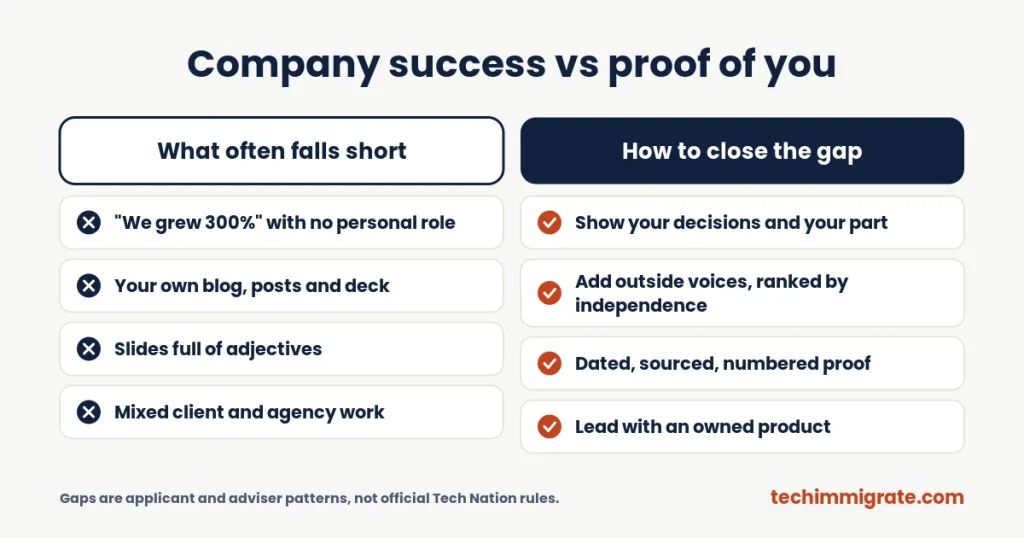
| Gap | What it looks like | The fix |
|---|---|---|
| 1. Personal vs company | "We grew 300%" | Show your decisions and your part |
| 2. Innovation vs execution | Running a good business | Show what was new |
| 3. Independent recognition | Your own posts and awards | Add outside voices |
| 4. Product-led test | Services or agency work | Show an owned product |
| 5. Evidence vs claims | Adjectives and slides | Dated, sourced proof |
Gap 1: Personal Contribution vs Company Success
The first gap is the biggest: company results do not show your personal contribution. A reviewer reads "revenue grew from £200,000 to £2 million" and asks one question. What did you do?
Founders often write "we" for everything. That is natural in a team, but it hides your part. Applicants report that this is a frequent reason for weak OC3 cases, where the criterion looks at your own contribution to a business.
How to close it
Pick three decisions that mattered and write each as a short story. State the choice, the date, the alternatives and the result. Then attach proof, such as a board memo, a pricing change log or a letter from an investor or customer that names you.
Also split team results from yours. If you led hiring, say how many people and which roles. If you set the strategy, show the document. Specific claims beat sweeping ones.
Gap 2: Innovation vs Execution
The second gap is innovation versus execution, because running a company well is not the same as creating something new. A well-run delivery business can have fine margins and still show no innovation.
Tech Nation's optional criterion on innovation looks at new products or technology in a product-led company. Execution matters, yet it is not the claim. Ask yourself what your product does that did not exist before, or what it does in a new way.
How to close it
Name the one feature, model or approach that was new. Compare it with named alternatives in a short page. Then show dated launch records, usage numbers and an outside source that confirms it. A separate article in this series covers innovation evidence for the business route in more depth.
Gap 3: Independent Recognition
The third gap is independent recognition, because Tech Nation looks for proof from outside your own company. Tech Nation's guidance says evidence for recognition must come from outside your employer, and that internal awards and posts on LinkedIn or Medium do not count on their own.
Founders often own the channels they use as proof. A company blog, a self-written press release and a founder interview on your own podcast all sit inside your control. However, a news article by a journalist, an invitation to speak at a sector event or a judge's role at a competition sits outside it.
How to close it
List every outside mention from the last five years. Then rank them by independence: who chose to write or invite you, and did money change hands? Keep the best three. If your list is thin, plan real activity, such as mentoring through a structured programme or speaking at a recognised event.
Gap 4: The Product-Led Test
The fourth gap is the product-led test, and it can sink a strong founder. Tech Nation asks whether your company is a product-led digital technology business. A consultancy, agency or outsourcing firm may fall outside it, even when it earns well.
Founders with mixed models face the hardest calls. A studio that builds client apps and also runs its own SaaS tool has a product, but the product must lead the story. Applicants in this situation often anchor the case on the owned product only.
How to close it
Write one paragraph that names your product, who uses it and how it earns. Then check it against four tests: you own it, customers use it, you shaped it and someone outside confirms it. If the paragraph is weak, fix the story or choose a different evidence line before you spend weeks collecting documents.
Gap 5: Evidence vs Claims
The fifth gap is evidence versus claims, since adjectives are not proof. "Fast-growing", "market-leading" and "award-winning" mean nothing without a dated, sourced fact behind them.
Tech Nation's guidance says documents must not be AI-written or templated. It also limits the portfolio to ten documents of up to three A4 sides each, so every page must earn its place.
How to close it
Take each claim in your draft and attach three things: a date, a source and a number. If you cannot, delete the claim. Next, check that no document serves two criteria, because one document cannot be reused. Finally, read each page as a stranger and ask what it proves.
Illustrative Example (Fictional): Before and After Closing the Gaps
Illustrative example (fictional): Kofi founded a logistics software startup. It has £1.8 million in annual revenue, 22 staff and a seed round. His first plan uses six company documents: a pitch deck, a funding announcement, a revenue chart, a team page, a blog post and a customer list.
A reviewer would see a good business, but not what Kofi did or what was new. So he rebuilds the plan around the five gaps.
| Gap | Before | After |
|---|---|---|
| Personal vs company | "We scaled to 22 staff" | Hiring plan he wrote, plus a letter naming his role |
| Innovation | General "platform" claim | Dated launch of route-optimisation feature he designed |
| Independent | Own blog and deck | Trade press article and an industry panel invitation |
| Product-led | Mixed client work | Owned SaaS product shown first |
| Evidence | Slides with adjectives | Accountant-prepared accounts and analytics exports |
None of this changes the company. It changes how well the case shows Kofi.
Does Funding or Revenue Help on the Tech Nation Startup Founder Route?
Funding and revenue help when they act as proof of your work, not as proof of the company's size. Investors checked your product before they paid, so a funding round can show outside validation. Likewise, paying customers show the market chose what you built.
However, amounts alone are weak. A £5 million round says little about you unless the evidence shows your role in winning it and in building what it funded. Bootstrapped founders can use revenue, contracts and customer letters in the same way.
Applicants in this situation often ask if they need funding at all. The criteria do not set a funding threshold. What counts is evidence that you led, shaped or built something that mattered, and that people outside your business can confirm it.
A Tech Nation Startup Founder Route Self-Audit
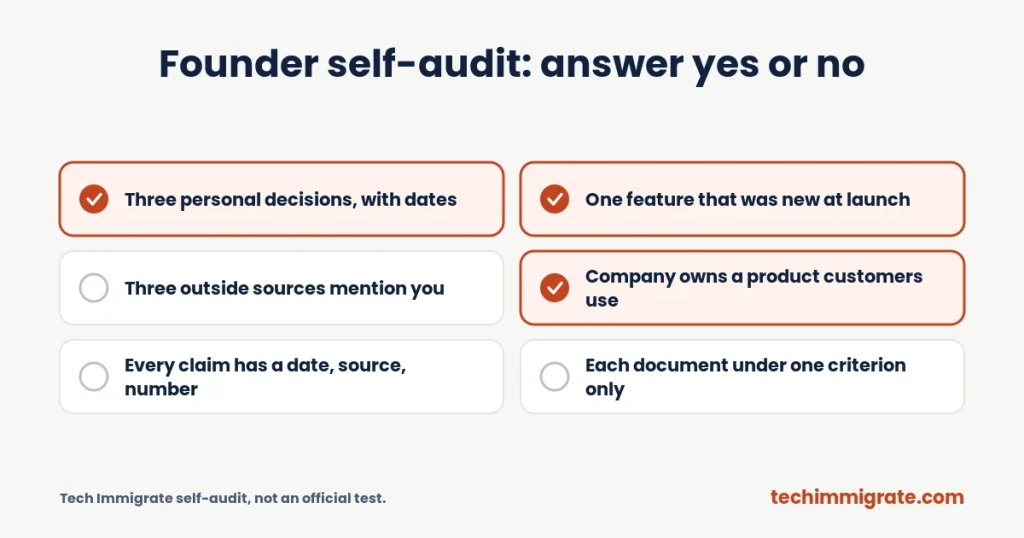
Run this audit before you write a single document. It takes about an hour and saves weeks of rework. Answer each question with yes or no, and then fix every no.
- Can you point to three decisions that you personally made, with dates?
- Can you name one feature of your product that was new when you launched it?
- Do at least three sources outside your company mention you or your product?
- Does your company own a digital product that customers use?
- Does every claim have a date, a source and a number?
- Is each document assigned to one criterion only?
If you score five or six, move to drafting. If you score three or four, spend a few weeks closing the gaps first. With fewer than three, pause and ask whether Talent or Promise, and your timing, fit your situation.
How a Reviewer Reads a Founder Case
A reviewer reads your portfolio as a set of claims and asks whether each claim has proof. They do not know your market, so they cannot fill gaps with goodwill. In practice, a clear page beats a clever one.
Think of four quick questions a reader may ask while turning each page. Who did this? When did it happen? How do we know? Why does it matter to digital technology? If a page leaves one of these open, the case gets weaker.
Because the panel reads many files, short and plain writing helps. Lead each document with its point, and then give the proof. Avoid jargon that only your sector understands, and explain any acronym once.
What Your Recommenders Should Cover for Founders
Recommendation letters support your evidence, but they do not replace it. Tech Nation expects three letters from established experts who have known your work for at least 12 months. For founders, the best letters add facts that documents cannot show.
A strong letter names what you built, when you built it and what changed as a result. It also says how the writer knows the work, for example as an investor, a customer or a peer founder. Generic praise adds little.
You can help your recommenders by sending a short fact sheet. Include dates, product names and the specific points you want them to confirm. Then let them write in their own words, because templated letters weaken the case. Our recommendation letters guide has more detail.
Illustrative Example (Fictional): An Early-Stage Founder
Illustrative example (fictional): Mei launched a budgeting app 18 months ago. It has 9,000 users, no outside funding and one small grant. She wonders if a young company can pass the test.
Her case leans on personal decisions: the product idea, the privacy-first design and the pricing. She adds the grant award letter, a trade press feature and a letter from a bank partner that piloted her app. Because her track record is short, Promise may fit better than Talent.
However, she accepts that her recognition evidence is thin. So she plans six months of structured mentoring and two conference talks before applying. That delay costs time, but it gives her case outside voices.
A 30-Day Gap-Closing Plan
Most founders can close the biggest gaps in about a month if they start with the audit. This plan assumes you already have a product and a few outside mentions.
- Days 1-5: Run the self-audit. List every claim and mark what proof exists.
- Days 6-12: Write three decision stories for Gap 1. Collect the memos, logs and screenshots behind them.
- Days 13-18: Draft the innovation page for Gap 2. Add launch dates and usage exports.
- Days 19-24: Collect outside sources for Gap 3 and confirm the product-led story for Gap 4.
- Days 25-30: Trim every page for Gap 5. Delete unsourced claims and check document limits.
Then book time for letters, since referees need notice, and ask early because busy experts often take weeks to reply. Tech Nation says preparation can take up to 12 weeks overall, so treat 30 days as a first pass.
Quick Wins Founders Often Overlook
Some fixes cost little and help a lot. First, gather every dated launch note and changelog now, because old pages vanish. Second, save screenshots and archive links of press mentions before sites change. Third, ask early customers for short, specific letters while they still remember the story.
Also keep a simple log of decisions as you make them. A one-page memo written at the time carries more weight than a story written years later. Likewise, keep copies of investor updates, since they show dates, numbers and your role in one place.
Exceptional Talent or Exceptional Promise for Founders?
Founders can apply under either route, and the right one depends on how established you are. Exceptional Talent suits established leaders. Exceptional Promise suits emerging ones. Settlement can follow after three years on Talent and five on Promise.
An early-stage founder with one product and a small track record may sit closer to Promise. A founder with several years of results and recognition may sit closer to Talent. Our guide on Exceptional Talent vs Exceptional Promise explains how the two compare, and it helps you decide before you plan evidence.
What If Your Startup Failed, Pivoted or Is a Side Project?
A failed or pivoted startup can still support a case, because the criteria look at your contribution, not whether the company survived. A product that launched, found users and taught you hard lessons may still show innovation and impact.
Employed applicants with a side startup face a different issue. Applicants report that reviewers want to see real traction, not a hobby. So show users, revenue or outside support, and keep the story honest about scale.
In both cases, outside proof matters most. A letter from an early customer, an accelerator place or a journalist's article can show that the work was real.
Tech Nation Startup Founder Route Mistakes Applicants Report
Founders tend to repeat the same handful of errors. These come from applicant forums and adviser blogs, not from Tech Nation, so use them as a prompt rather than a rule.
- Using the pitch deck as the main document.
- Claiming team results as personal results.
- Leaning on funding announcements with no role evidence.
- Counting an internal award or a self-published post as recognition.
- Collecting evidence from before the last five years.
- Asking recommenders who are friends instead of established experts who know the work.
Our article on Tech Nation endorsement mistakes covers more.
What Happens If Tech Nation Refuses You?
A refusal is not the end, because you have two options. First, you can request an endorsement review. It is free, and you must ask within 28 days of the refusal. However, you cannot add new evidence during a review.
Second, you can submit a fresh application with stronger evidence and pay a new fee. Applicants in this situation often use the refusal feedback to find which gap hurt most. Then they close it before reapplying. Read the gov.uk Global Talent page and check the current review rules before you act.
Tech Nation Startup Founder Route FAQ
Not as a separate visa. Founders apply through the Global Talent digital technology endorsement and meet the same criteria as other applicants. The panel judges your personal leadership and contribution, so company success alone does not decide the outcome.
No. Revenue and funding can support your case, but they do not prove what you personally did or what was new. Tech Nation's panel decides overall, so link every figure to your own decisions and add outside proof.
The criteria do not set a funding threshold, and they focus on your leadership in digital technology. Bootstrapped founders can use revenue, contracts and customer letters. Check the current Tech Nation and gov.uk wording for any location rules.
It is harder, because Tech Nation looks for product-led digital technology businesses. Applicants in this situation often build the case around a product the firm owns and runs, and show it with dated records and outside evidence.
Build them before you apply. Seek structured mentoring, speaking slots at recognised events, trade press or customer letters. Internal awards and self-published posts do not count on their own, so focus on sources you do not control.
Your Next Step
Want the guide for your role? See the guides.
Next, open the startup founders guide, one of our role-specific endorsement guides with an evidence checklist and planner. You can also browse the full guides hub, or look at the tech investors guide and the product managers guide if your work blends those roles.
How We Checked This Article
We checked the route structure, fees and timings on the gov.uk Global Talent digital technology page and the main gov.uk Global Talent page. We checked the application process on the Tech Nation visa page. Alongside those, we read adviser articles and applicant discussions about founders, and we label those points as applicant-reported, not official.
Tech Immigrate is independent of Tech Nation and the Home Office. This article is general information, not legal advice, and nobody can guarantee an endorsement. Always confirm current rules on gov.uk before you apply.
We write practical guides for tech professionals applying for the UK Global Talent visa. Tech Immigrate is independent of Tech Nation and the Home Office, and our articles are general information, not legal advice. Rules and fees change, so always check gov.uk before you apply.