Global Talent Visa for DevOps and Cloud Engineers: Building vs Operating
Can DevOps and cloud engineers get the Global Talent visa? DevOps vs systems administration, which roles fit, what evidence counts, and 2026 costs.


In this article
- Can DevOps Engineers Get the Global Talent Visa?
- What Is the Difference Between DevOps and Systems Administration?
- Which Infrastructure Roles Usually Fit?
- How Do the Criteria Apply to Platform Work?
- How Do You Make Infrastructure Work Visible?
- Which DevOps Evidence Is Strong, and Which Is Weak?
- What Recent Infrastructure Applications Show
- Exceptional Talent or Exceptional Promise for DevOps Engineers?
- Who Should Write a DevOps Engineer's Letters?
- Does a Side Product Help a DevOps Application?
- How Do You Handle Security and Confidentiality?
- What Does the Visa Cost for a DevOps Engineer?
- Why Do DevOps Engineers Choose Global Talent?
- What Happens If a DevOps Engineer Is Refused?
- What Should a DevOps Engineer’s Personal Statement Say?
- How Should a DevOps Engineer Start?
- Which Guide Should a DevOps Engineer Use?
- Frequently Asked Questions
- How We Checked This Article
DevOps and cloud engineers can get the UK Global Talent visa. The government's list of skills covered by Tech Nation, updated on 1 July 2026, names DevOps and SysOps engineers as a suitable technical role. The same list describes systems administration, service delivery, outsourcing and technical consultancy as unsuitable, and that is where many infrastructure careers sit. So the question for a DevOps engineer is not whether the job title qualifies, but whether your work built platforms that a digital product depends on, and whether people outside your employer recognise you as a leader (Exceptional Talent) or emerging leader (Exceptional Promise).
This article is for DevOps engineers, site reliability engineers, platform engineers, cloud engineers and infrastructure architects. It explains the line between DevOps and systems administration, which infrastructure roles fit, how each criterion applies to platform work, how to make invisible infrastructure work visible, and what recent applications reported on the Tech Nation Visa Forum show.
Key takeaways
- DevOps and SysOps engineers are named on the GOV.UK Tech Nation skills list, updated 1 July 2026. Systems administration is listed as unsuitable.
- The difference is building versus operating: platforms, automation and tooling that change how a product is built and run, not keeping existing systems running.
- Infrastructure work at IT services, managed service providers and consultancies is often read as service-based. A 2025 refusal described nine years of cloud experience that way.
- A July 2026 forum case was refused partly because the company did not read as product-led.
- Reliability, cost, speed and scale results need a baseline and confirmation. Architecture diagrams alone are weak.
- Endorsement costs £561 and the visa £205, plus the £1,035 yearly health surcharge.
Can DevOps Engineers Get the Global Talent Visa?
Yes. Tech Nation assesses DevOps engineers as technical applicants, and the GOV.UK list of technical and business skills covered by Tech Nation, last updated on 1 July 2026, names DevOps and SysOps engineers among the suitable technical skills. It sits alongside other infrastructure-adjacent roles on the list, such as operating systems engineers and principal-level software engineers.
The same list, in paraphrase, describes as unsuitable: corporate roles, service delivery, process delivery, outsourcing, technical or management consultancy, ERP consultancy and systems administration. That is the tension at the heart of every DevOps application. Infrastructure work spans a wide range, from designing the deployment platform for a fast-growing product to patching servers and resetting access for a corporate IT department. Tech Nation is interested in the first, not the second.
The visa is a good fit for infrastructure people. There is no sponsor and no salary threshold, and you can move between product companies, contract or start a business. Many DevOps engineers work as contractors, which a sponsored visa does not allow. Our article on the benefits of the Global Talent visa covers the advantages and trade-offs.
What Is the Difference Between DevOps and Systems Administration?
The skills list does not define the line, so applicants have to show which side of it they are on. A useful way to think about it is building versus operating.
| DevOps, SRE and platform engineering | Systems administration | |
|---|---|---|
| Main activity | Building platforms, automation and tooling | Running and maintaining existing systems |
| Who uses the result | Engineering teams shipping a product | Internal users and IT services |
| How success shows | Faster releases, higher reliability, lower cost, more scale | Systems stay up; tickets get resolved |
| Typical evidence | Platform adoption, deployment metrics, reliability changes | Uptime of systems someone else designed |
| Fit with the skills list | Named as suitable | Named as unsuitable |
Most DevOps careers include both. What matters is which one your evidence shows. An application built around "managed 400 servers and maintained 99.9% uptime" reads as operations. One built around "designed the deployment platform that took the company from weekly releases to fifty a day, now used by every product team" reads as building.
Which Infrastructure Roles Usually Fit?
| Profile | Typical fit | What usually decides it |
|---|---|---|
| Platform or DevOps engineer at a SaaS or app company | Strong | Platforms you built that product teams depend on |
| Site reliability engineer at a product-led tech company | Strong | Reliability and scale changes you led, with baselines |
| Engineer at a cloud, infrastructure or developer-tools product company | Strong | Your contribution to the product others buy |
| Maintainer of widely used open-source infrastructure tooling | Strong | Independent adoption of the tool |
| DevSecOps engineer embedding security in delivery | Good | Changes to how the product is built and secured |
| Cloud engineer at a bank or large corporate | Mixed | Corporate roles are flagged; product impact must be clear |
| Engineer at a managed service provider or IT services firm | Weak | Service delivery and outsourcing are listed as unsuitable |
| Cloud consultant delivering client migrations | Weak | Technical consultancy is listed as unsuitable |
| Systems or network administrator | Weak | Systems administration is listed as unsuitable |
A 2025 forum applicant with more than nine years in cloud and AI was refused under Exceptional Talent. They reported that their experience was judged service-based rather than product-led, and that their technical contribution evidence came from a service-based company and lacked proof of individual impact. That is the most common infrastructure refusal pattern.

How Do the Criteria Apply to Platform Work?
You need the Mandatory Criterion plus two of four optional criteria.
| Criterion | What it asks | DevOps evidence that fits |
|---|---|---|
| Mandatory | Recognition as a leading talent or emerging leader | Invited talks at respected infrastructure or cloud-native conferences, maintainer roles in widely used projects, expert roles, media naming you |
| OC1: Innovation | A track record of innovation as a founder, senior executive or employee working on a new digital field or concept | A new platform approach or tool you created that was adopted, backed by an expert explaining why it was new |
| OC2: Beyond your job | Recognition for work outside your occupation that advances the field | Open-source infrastructure tools others depend on, contributions to major projects, structured voluntary mentoring |
| OC3: Significant contribution | Technical contribution as an employee of a product-led company | A platform, migration or reliability programme that changed what the product could do |
| OC4: Academic | Research contributions | Rarely relevant unless you publish research |
Most DevOps engineers pair OC3 with OC2. The infrastructure world has a strong open-source culture, and many of the tools engineers use every day are built by people like you. Contributions that matter to those projects, or a tool of your own that others adopt, are among the strongest evidence a DevOps engineer can have.
Forum reviewers stress that each piece of evidence should support one criterion only, and that letters support evidence rather than meet a criterion on their own. Our article on what Tech Nation actually checks explains each criterion.
How Do You Make Infrastructure Work Visible?
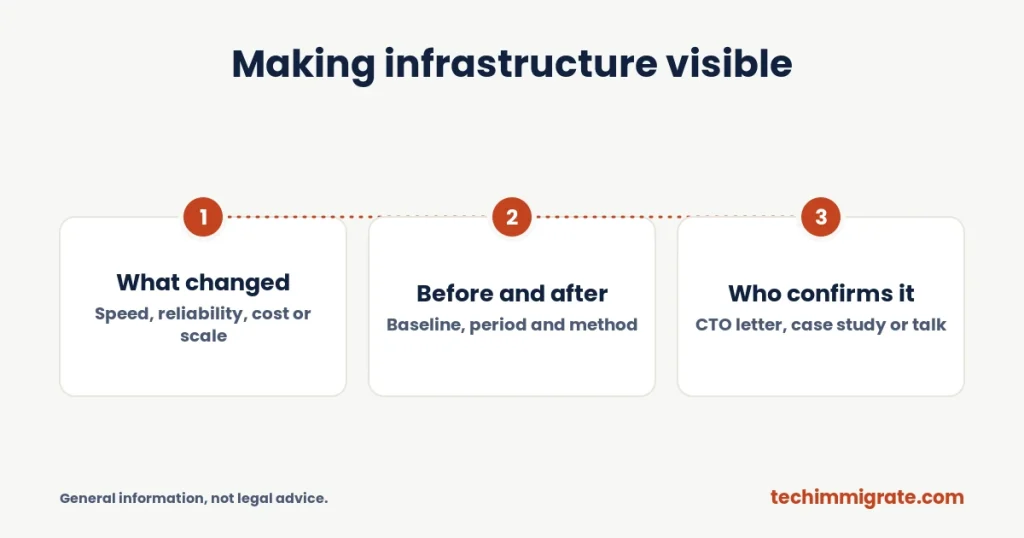
Good infrastructure is invisible. When it works, nobody notices. That makes it hard to prove, and it is why architecture diagrams, runbooks and screenshots of dashboards are so common in DevOps applications, and so often discounted.
Three things make platform work into evidence:
- Show what changed for the product. Deployment frequency, lead time for changes, incident rates, recovery time, infrastructure cost per user, or scale handled. These are business outcomes for an engineering organisation.
- Show the before and after. Every figure needs a baseline, a period and a method. "Reduced cloud costs by 40%" means little without the starting cost, the traffic and the timeframe.
- Show who confirms it. A CTO or VP of engineering letter that states the result, an engineering blog post the company published, a vendor case study about your platform, or a conference talk where you presented it.
Vendor case studies deserve a special mention. Cloud providers and infrastructure tool companies often publish customer stories. If your platform work was featured, that is third-party confirmation from a recognised technology company. A 2025 forum reply also suggested that architecture diagrams are weak alone and should be paired with measurable results and testimonials from senior people outside your team.
Which DevOps Evidence Is Strong, and Which Is Weak?
This is general guidance from the criteria and forum reports, not an official scoring system.
| Evidence | Usually strong when | Usually weak when |
|---|---|---|
| Platform you built | Adopted by product teams, outcomes confirmed by leadership | Described only in your own document |
| Reliability or speed improvement | Baseline, period, method, and a senior letter | Uptime of systems you maintained |
| Cost reduction | Confirmed by finance or engineering leadership | Estimated by you |
| Open-source tool or contribution | Independent adoption, substantial role | A few small commits to famous projects |
| Vendor case study | Names you or your team's work | Generic customer logo listing |
| Conference talk | Invited or competitively selected at a respected event | Webinars, internal talks, virtual meet-ups |
| Certifications | Never on their own | Cloud certifications show training, not recognition |
Cloud certifications are worth a direct word. Many DevOps engineers hold several, and they matter for jobs. For Tech Nation, they show training, not recognition by the field, and they rarely help an application.
What Recent Infrastructure Applications Show
These cases come from the Tech Nation Visa Forum. They are applicant-reported, and replies are member opinion, not official guidance.
- 2023, DevOps evangelist endorsed under Talent. A DevOps and technology evangelist with a strong public profile in open-source and community work shared their Exceptional Talent endorsement and encouraged others who hesitated because of impostor syndrome.
- 2023, refused after moving into DevOps. An engineer who had moved from 3D product design into DevOps within five years was refused, with reviewers noting a large gap between their evidence and the bar.
- August 2025, refused under Talent. A cloud and AI engineer with nine years' experience was refused. The work was described as service-based, talks and webinars as not impactful enough, papers as low-tier, college mentoring as not field-advancing, and technical evidence as lacking proof of individual impact.
- July 2026, second attempt under Promise. A senior DevOps engineer at a UK product company, who had also built a small product of their own, was rebuilding after a refusal that said the company did not read as product-led. Reviewers advised leading with the infrastructure, automation and reliability work, not mixing two unrelated identities in one application, and backing any claim of novelty with an expert letter that names exactly what is new.
The pattern: endorsed infrastructure engineers have public, recognised work, usually in open source or community. Refused ones rely on service-company experience, low-tier publications or self-documented architecture. Our article on the Global Talent visa success rate shows how much stricter Tech Nation has become.
Exceptional Talent or Exceptional Promise for DevOps Engineers?
| Exceptional Talent | Exceptional Promise | |
|---|---|---|
| Typical profile | Senior platform or SRE lead with external standing | Earlier-career engineer with emerging recognition |
| Experience | Usually more than 5 years | 5 years or less in digital technology |
| Recognition | Recognised across the infrastructure community | Early signs, such as talks and open-source adoption |
| Settlement | After 3 years | After 5 years |
Refusal wording shared on the forum in 2026 described Promise as intended for applicants with 5 or less years experience. Engineers who moved into DevOps from systems administration or support should think about how their earlier years will be counted; Tech Nation may count from when your digital technology track record began. Our article on Exceptional Talent vs Exceptional Promise explains the choice.
Who Should Write a DevOps Engineer's Letters?
You need three letters from established leaders in digital technology. For DevOps engineers, strong combinations usually include:
- A CTO, VP of engineering or head of platform who saw your platform change how the company builds and runs its product.
- A maintainer or senior figure in an open-source project you contributed to, or a technical leader at a vendor whose product your work relied on.
- A senior engineer or engineering leader at another company who adopted your tool or approach.
The July 2026 reviewers suggested that testimony from peer engineers at partner companies, and independent technical validation, strengthen claims of technical contribution and novelty. Letters must be signed documents; the Home Office does not accept web links. Our guide to recommendation letters covers who to ask.
Does a Side Product Help a DevOps Application?
Many infrastructure engineers build products of their own: a developer tool, a SaaS for a niche, an automation platform. A side product can help, but it can also blur your application. In July 2026, forum reviewers told a DevOps engineer who had also built a small SaaS that presenting two unrelated roles in one application may weaken it, and that building the product itself looked more like full-stack development than DevOps.
A side product helps most when it is infrastructure work in its own right, such as an open-source tool other engineers adopt, or when it has commercial results that a stranger could check, such as paying customers confirmed by payment data. If it is small and early, it is usually better as supporting context than as a main piece of evidence.
How Do You Handle Security and Confidentiality?
Infrastructure engineers handle sensitive information: network layouts, security controls, credentials and incident details. None of that should go into an application, and none of it is needed.
Show outcomes and recognition instead. A letter from your CTO stating that your platform cut deployment time from hours to minutes, or that incidents fell by a stated proportion after your reliability programme, proves the point without exposing anything. Public material, such as an engineering blog post, a conference talk or a vendor case study, has already been through your company's approval process and is safe to use. Never send internal architecture documents or configuration, and remember that every document is read by Home Office staff and Tech Nation assessors.
What Does the Visa Cost for a DevOps Engineer?
Figures checked on GOV.UK in November 2026:
| Item | Cost or time |
|---|---|
| Endorsement (Stage 1) | £561 |
| Visa (Stage 2) | £205 |
| Immigration Health Surcharge | £1,035 per adult per year |
| Each partner or child | £766 each, plus their surcharge |
| Endorsement decision | Usually 5 to 8 weeks |
| Visa decision | About 3 weeks outside the UK, 8 weeks inside |
| Free endorsement review | Within 28 days of a refusal; no new evidence |
| Settlement | After 3 years (Talent) or 5 years (Promise) |
The government's earned settlement response of 2 November 2026 keeps 3 years for a highest talent group that includes Global Talent, while setting a 10-year baseline for most routes. New rules are expected from December 2026. Our cost breakdown has worked examples.
Why Do DevOps Engineers Choose Global Talent?
Infrastructure skills are in demand across the UK, and many DevOps engineers can get a sponsored job. Global Talent adds what a sponsored visa cannot:
- Contracting. Many DevOps and cloud engineers work on day-rate contracts, which a sponsored visa does not allow.
- Moving between companies freely. No new sponsorship is needed for a new role.
- Starting a company. Infrastructure engineers often build developer tools or platforms of their own.
If you are in the UK on another visa, you can usually switch to Global Talent from inside the country once endorsed.
What Happens If a DevOps Engineer Is Refused?
You can ask for a free endorsement review within 28 days, but you cannot add new evidence. A review is worth it when the panel misread something you sent, for example treating platform work at a product company as service delivery when your letters and the company description made the product clear.
Where the refusal says the work was service-based, the publications were low-tier or the impact was self-documented, the problem is the evidence, and a new application is usually the better path. The July 2026 applicant described above took that route after a refusal that said the company did not read as product-led. Each application is assessed independently, so rebuild around the criteria and current guidance. Our article on how to challenge a Global Talent refusal explains every route.
What Should a DevOps Engineer’s Personal Statement Say?
Since February 2026, the personal statement is typed into the Home Office form. Use it to settle the building-versus-operating question before the assessor opens your documents. Describe yourself as the engineer who built the platforms, not the person who keeps them running, if that is accurate, and name the product-led companies whose products depended on your work.
Then point to your two or three strongest outcomes and the recognition you have outside your employer, linking each to the evidence that proves it. Close with what you plan to do in the UK, in specific terms. Avoid tool lists: naming Kubernetes, Terraform and every cloud service you know tells the assessor about your skills, not your impact. Our guide to the Global Talent personal statement covers structure and length.
How Should a DevOps Engineer Start?
Before paying £561:
- Sort building from operating. List the platforms and tools you built, and set aside maintenance work.
- Check where the work happened. Product-led companies and open source fit best; managed services and consultancy do not.
- Find baselines for every speed, reliability, cost or scale figure, and someone to confirm each.
- List outside recognition only. Talks, open-source adoption, vendor case studies, expert roles. Drop certifications.
- Pick one clear identity. Lead with infrastructure if that is your strongest work; do not mix unrelated roles.
- Read the current Tech Nation guide and GOV.UK pages. Since August 2025 you apply on GOV.UK and email documents to the Home Office.
Our article on turning GitHub into Global Talent evidence covers open-source evidence in detail.
Which Guide Should a DevOps Engineer Use?
We do not yet have a guide written only for DevOps engineers. The closest is the Global Talent Visa Endorsement Guide for Software Developers, which covers technical applicants, open-source evidence and product-led contribution. It is 114 pages, aligned with Tech Nation's applicant guide, with 20 evidence checklists, a 12-week planner, 30 refusal fixes and 4 anonymised refusal cases with the wording decoded. If your infrastructure work is mainly security, the Cybersecurity Specialists guide may fit better. You can see all of our role guides on the guides page.
I was refused the first time I applied for Global Talent, then reapplied and was endorsed. The guides are built on what changed between those two applications.
Frequently Asked Questions
Yes. DevOps and SysOps engineers are named on the GOV.UK Tech Nation skills list, updated 1 July 2026. You need an endorsement showing recognition as a leader or emerging leader.
Systems administration is listed as unsuitable on the same skills list. DevOps evidence should show building platforms and automation, not maintaining existing systems.
They can apply, but service delivery, outsourcing and technical consultancy are listed as unsuitable. A 2025 refusal described cloud experience at a service-based employer as not product-led.
Rarely. Certifications show training, not recognition by the field. Talks, open-source adoption and confirmed platform outcomes carry far more weight.
Platforms or tools others depend on, with baselines and confirmation: deployment speed, reliability, cost or scale changes confirmed by engineering leadership, open-source adoption, or vendor case studies.
They are closely related technical roles. What matters is showing that you built infrastructure a digital product depends on, at a product-led company or in public.
GOV.UK says endorsement decisions usually take 5 to 8 weeks.
How We Checked This Article
We checked eligibility, fees, timings and settlement periods on the GOV.UK digital technology Global Talent pages and the list of technical and business skills covered by Tech Nation, updated 1 July 2026, in November 2026. Process details draw on the Home Office Global Talent caseworker guidance published 3 August 2026.
Applicant cases come from the Tech Nation Visa Forum: a July 2026 DevOps engineer's second attempt, an August 2025 cloud engineer refusal, a 2023 DevOps evangelist endorsement, a 2023 refusal after a move into DevOps and a 2026 Promise refusal proforma. Forum material is applicant-reported or member opinion, not official guidance.
Tech Immigrate is independent of Tech Nation and the Home Office. This article is general information, not legal advice.
We write practical guides for tech professionals applying for the UK Global Talent visa. Tech Immigrate is independent of Tech Nation and the Home Office, and our articles are general information, not legal advice. Rules and fees change, so always check gov.uk before you apply.