Global Talent Visa Routes Explained: Endorsement, Research Fast-Track and Prizes
Every Global Talent visa route explained: Tech Nation endorsement, research fast-track, the prestigious prize route, costs, timings and which suits you.


In this article
- The Three Ways In
- Route 1: Standard Endorsement
- Route 2: Research Fast-Track Endorsement
- Route 3: The Prestigious Prize Route
- Comparing the Routes
- Exceptional Talent and Exceptional Promise Are Not Separate Routes
- Routes That No Longer Exist
- Which Route Should a Tech Professional Use?
- What Is the Same on Every Route
- Could the Routes Change?
- Costs by Route: Worked Examples
- A Short History of the Routes
- Common Mistakes When Choosing a Route
- Mixed Careers: Tech, Research and Design
- Frequently Asked Questions
- Find the Route That Fits Your Evidence
- How We Checked This Article
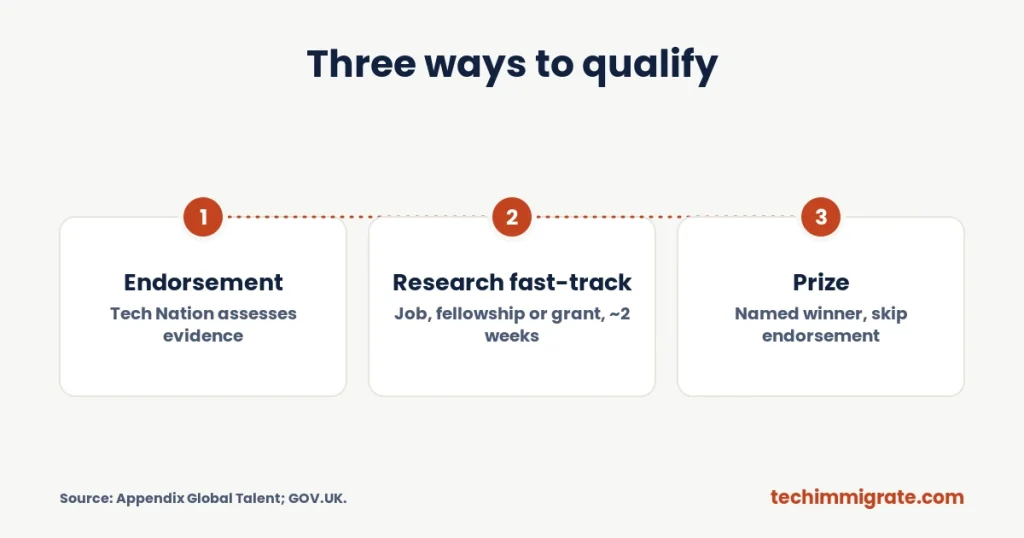
The Global Talent visa is often described as a single route, but there are several ways into it. Most tech professionals go through a two-stage endorsement by Tech Nation. Researchers can sometimes use a fast-track endorsement based on a job, fellowship or grant. And winners of certain prestigious prizes can skip endorsement altogether and apply straight for the visa.
Which route you use affects how long it takes, what you have to prove, what it costs at each stage and, in some cases, how quickly you can settle. This guide explains every Global Talent route in plain English, who each one is for, how they compare, and how a tech professional should choose. It also covers the routes that no longer exist, because older guides still mention them.
Key takeaways
- There are three ways to qualify: a standard endorsement assessed on your evidence, a fast-track endorsement for some researchers, and a prestigious prize that removes the endorsement stage.
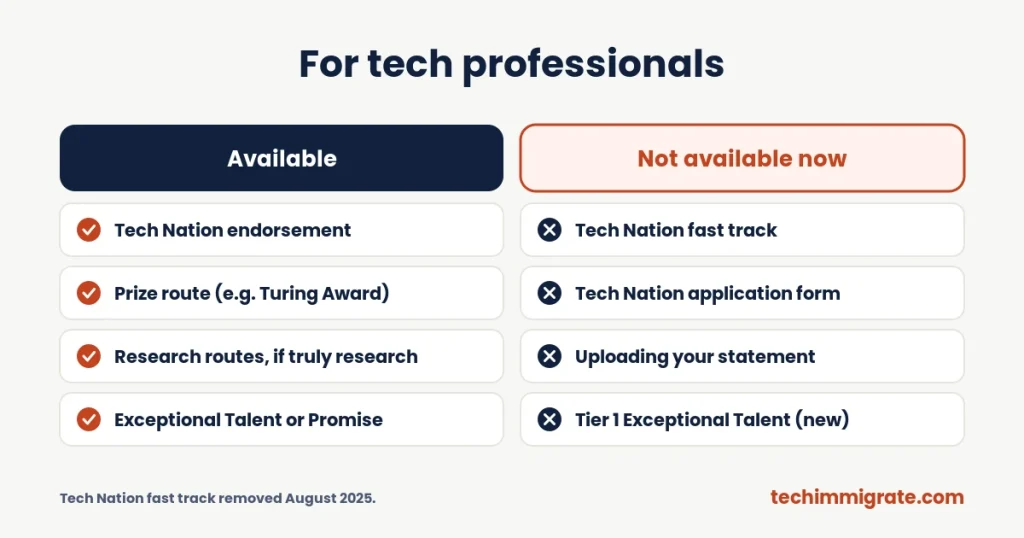
- For digital technology, the only endorsement route is Tech Nation's assessment of your evidence. Tech Nation removed its fast track in August 2025.
- Research fast-track routes, based on an eligible job, fellowship or UK Research and Innovation-endorsed grant, are usually decided in about 2 weeks. Peer review for researchers usually takes about 5 weeks.
- Prize winners apply directly for the visa and pay the full £766 at that stage. The prize lists were last updated on 21 April 2026.
- Endorsed applicants pay £561 for endorsement and £205 for the visa. Everyone pays the health surcharge.
- Design became a new Global Talent field from 1 July 2026.
The Three Ways In
Appendix Global Talent allows you to qualify for the visa in one of two ways: by holding an endorsement from an approved endorsing body, or by being the named winner of an eligible prestigious prize. Within endorsement, some research applicants can use faster routes. That gives three practical routes.
| Route | Who it suits | Stages | Typical decision on qualification |
|---|---|---|---|
| Standard endorsement | Most applicants, including all tech applicants | Endorsement, then visa | Tech: applicants report 5 to 8 weeks |
| Research fast-track endorsement | Researchers with an eligible job, fellowship or endorsed grant | Endorsement, then visa | About 2 weeks |
| Prestigious prize | Named winners of listed prizes | Visa only | No endorsement stage |
Route 1: Standard Endorsement
This is the route almost every tech applicant uses. You apply for endorsement from the endorsing body for your field, it assesses your evidence, and if you are endorsed you have 3 months to apply for the visa.
The endorsing bodies
There are endorsing bodies for three broad fields:
| Field | Endorsing body |
|---|---|
| Digital technology | Tech Nation |
| Science, engineering, humanities and medicine | The Royal Society, the Royal Academy of Engineering, the British Academy, and UK Research and Innovation |
| Arts and culture, including architecture, fashion, film and television, and design | Arts Council England, working with specialist partner organisations |
Design was added as a Global Talent field by the March 2026 statement of changes, taking effect from 1 July 2026, with the Design Business Association assessing applicants in that area. Our article on Global Talent endorsement explains each body in more detail.
How Tech Nation's endorsement works
For digital technology, Tech Nation assesses whether you are a leader (Exceptional Talent) or potential leader (Exceptional Promise). You must meet a mandatory criterion and at least two of four optional criteria, using a CV, a personal statement, three letters of recommendation and up to 10 pieces of evidence.
The process changed significantly in 2025 and 2026:
- Since 4 August 2025, you apply only through the GOV.UK form. Tech Nation's own application platform closed.
- Tech Nation's fast-track section was removed in August 2025. Tech Nation has said a replacement is under review.
- Since February 2026, the personal statement is typed into the GOV.UK form.
For tech applicants, there is no shortcut: every application is assessed on its evidence. Our guide on how to apply for Global Talent endorsement walks through Stage 1.
Peer review for researchers
Researchers without a qualifying job, fellowship or grant can apply through peer review. Their application is assessed by the relevant endorsing body, usually with a decision in about 5 weeks according to GOV.UK. This is the research equivalent of Tech Nation's evidence-based assessment.
Route 2: Research Fast-Track Endorsement
GOV.UK describes several faster endorsement routes for academics and researchers, usually decided in about 2 weeks:
- An eligible academic or research job offer at an approved UK institution.
- An individual fellowship from an approved list.
- A UK Research and Innovation-approved research grant, where you are named on research funded by an endorsed funder.
These routes rely on the fact that a recognised UK institution or funder has already judged your work, so the endorsing body does not reassess your full record.
Does this help tech professionals?
Only if your work is genuinely research. A machine learning researcher taking up an eligible university post, or someone named on an endorsed grant, may find a research route faster than Tech Nation. An engineer or product manager in industry will usually not qualify.
The choice of body also affects settlement. People endorsed by the research bodies can apply for indefinite leave to remain after 3 years, and absences for research abroad can be disregarded in some cases. Tech Nation Exceptional Promise holders need 5 years, and the research absence exemption does not apply to Tech Nation endorsements. If your work genuinely sits between digital technology and research, choose the body that matches your strongest evidence. Our tech researchers guide explains how to think about this.
Route 3: The Prestigious Prize Route
If you are the named winner of a prize on the Home Office's eligible prestigious prize lists, you can skip endorsement and apply directly for the visa.
Which prizes count
The lists cover several fields, including science, engineering, humanities and medicine; digital technology; arts and culture; film and television; fashion; and architecture. They were last updated on 21 April 2026. For digital technology, the list includes awards such as the Turing Award and the ACM Prize in Computing.
GOV.UK's digital technology list sets out the conditions:
- prizes on the list have been recommended by and agreed with the endorsing body;
- they must be open to all nationalities;
- winners must be chosen by experts or peers, not by a public vote;
- you must be the named winner. Awards for a specific work, or prizes that recognise a whole organisation rather than an individual, do not count.
The Home Office checks publicly available information, such as the prize organisation's website, to confirm you won. Only prizes named exactly as on the list count. Other awards from the same institution do not qualify unless they are also listed.
What the prize route costs and gives you
You pay the full £766 at the visa stage, plus the health surcharge. Prize holders can apply for indefinite leave to remain after 3 years.
For most tech professionals, the prize route is not realistic: the listed awards are among the most prestigious in computing. But if you have won one, it is by far the simplest route.
Comparing the Routes
| Tech Nation endorsement | Research fast-track | Prestigious prize | |
|---|---|---|---|
| Who decides your talent | Tech Nation | Research endorsing body, relying on the job, fellowship or grant | The prize committee, already done |
| Evidence needed | CV, statement, 3 letters, up to 10 documents | Evidence of the job, fellowship or grant | Proof you won the prize |
| Decision time for qualification | Applicants report 5 to 8 weeks | About 2 weeks | None |
| Fees | £561 + £205 | £561 + £205 | £766 at visa stage |
| ILR | 3 years (Talent) or 5 years (Promise) | 3 years | 3 years |
| Refusal risk | High: about 82% of decided cases refused in 2025 | Low if you hold an eligible position | Low if you are the named winner |
The refusal figure comes from Freedom of Information data reported by Edgewater Legal. Our article on the Global Talent success rate explains it.
Exceptional Talent and Exceptional Promise Are Not Separate Routes
People sometimes describe Exceptional Talent and Exceptional Promise as two routes. Strictly, they are two levels within endorsement. You choose which level to apply for, and the endorsing body assesses you against it. The difference matters for settlement: under the current rules, Tech Nation Exceptional Talent holders can settle after 3 years and Exceptional Promise holders after 5. Our comparison of Exceptional Talent and Exceptional Promise explains how to choose.
Routes That No Longer Exist
If you read older guides, you may see references to routes that have closed or changed:
- Tier 1 (Exceptional Talent). The predecessor of Global Talent, replaced in February 2020. People who still hold it can extend under Global Talent.
- Tech Nation's own application form. Closed on 4 August 2025.
- Tech Nation fast track. Removed in August 2025. It previously allowed some applicants with an eligible UK job offer or certain accelerator connections to be assessed faster.
- Uploading your personal statement. Replaced in February 2026 by typing it into the GOV.UK form.
If a guide tells you to use any of these, it is out of date.
Which Route Should a Tech Professional Use?
For almost every tech professional, the answer is the Tech Nation endorsement route. Use this simple decision path:
- Are you the named winner of a prize on the digital technology or science list? If yes, use the prize route.
- Is your work primarily academic research, and do you have an eligible job offer, fellowship or endorsed grant? If yes, consider a research fast-track route.
- Is your work primarily research but without an eligible position? Compare research peer review with Tech Nation, based on where your strongest recognition comes from.
- Otherwise, apply to Tech Nation as Exceptional Talent or Exceptional Promise.
If you are still unsure after working through these questions, look at where your three strongest referees come from and what your five strongest pieces of evidence show. Those two signals usually point clearly to one body. If they point in different directions, that is a sign your application needs more focus before you apply anywhere.
You cannot choose an endorsing body simply because you think it is easier. Each body assesses applicants in its own field, and applying to the wrong one usually leads to refusal.
What Is the Same on Every Route
Whichever way you qualify, the visa stage is the same:
- You apply online from outside the UK, or switch or extend inside the UK.
- You prove your identity through the UK Immigration: ID Check app or at an appointment.
- You pay the Immigration Health Surcharge of £1,035 a year.
- Decisions usually take about 3 weeks from outside the UK and 8 weeks from inside.
- Your partner and children can come as dependants, each paying £766 plus the surcharge.
- You can work for any employer, be self-employed, or start a business.
The settlement rules for the main applicant differ by route, as shown above. Our Global Talent ILR guide explains them.
Could the Routes Change?
The Migration Advisory Committee's Review of Talent Routes, published on 17 November 2026, looked at how the Global Talent and other talent routes work. It found that endorsement rates on the standard routes fell from 74% in 2021 to 44% in 2025, and recommended changes including that referees send letters directly to endorsing bodies, conflict-of-interest rules, and an income threshold at settlement. Separately, the government's earned settlement response of 2 November 2026 keeps a 3-year settlement path for a "Highest Talent Group", whose definition depends on the committee's advice.
None of these recommendations is law yet. But they suggest the standard endorsement route will remain the main way in for tech professionals, with more checks rather than fewer. If you are planning an application in 2027, assume that letters, evidence and earnings at settlement will all be checked more closely, and prepare accordingly. Keeping records of your work, recognition and UK earnings from the day you arrive costs nothing and protects you whatever the final rules say.
Costs by Route: Worked Examples
The government fees for qualifying are the same in total for endorsement and prize routes, but they are paid at different times, and the risk of losing money differs.
Tech Nation endorsement, single applicant, 5-year visa. You pay £561 at Stage 1. If you are refused, that fee is not refunded. If you are endorsed, you pay £205 for the visa and £5,175 in health surcharge, a total of £5,941.
Research fast-track, single applicant, 3-year visa. You pay £561 for endorsement and £205 for the visa, plus £3,105 in health surcharge, a total of £3,871. The risk of losing the endorsement fee is lower if you clearly hold an eligible position.
Prize route, single applicant, 5-year visa. You pay £766 at the visa stage and £5,175 in health surcharge, a total of £5,941, with no separate endorsement step.
Adding a family. On every route, each dependant pays £766 plus £1,035 for each year of their visa. For a partner and two children on 5-year visas, that adds £17,823.
The biggest financial risk on the Tech Nation route is a refused endorsement, which costs £561 and weeks of preparation. That is why an honest self-assessment before applying matters. Our article on Global Talent eligibility includes a 10-question self-check, and our cost breakdown covers every fee from endorsement to settlement.
A Short History of the Routes
Understanding how the routes evolved helps explain why so much advice online is inconsistent.
- Before 2020: Tech professionals applied under Tier 1 (Exceptional Talent), with Tech Nation as the designated competent body. There was an annual cap on numbers.
- February 2020: Global Talent replaced Tier 1 (Exceptional Talent). The cap was removed, and the research fast-track routes were introduced.
- May 2021: The prestigious prize route started, letting named winners of listed prizes skip endorsement.
- April 2025: Tech Nation was re-appointed as the digital technology endorsing body under a new contract running to April 2028, with options to extend.
- August 2025: Tech Nation's own application form and fast track were removed; applications moved fully to GOV.UK.
- February 2026: The personal statement moved into the GOV.UK form.
- April 2026: The prestigious prize lists were updated.
- July 2026: Design was added as a new Global Talent field.
Each change has made older guides less reliable. When you read advice, check when it was written.
Common Mistakes When Choosing a Route
Applying to the wrong body. Some applicants with mixed careers apply to whichever body they think is easier. Endorsing bodies assess people in their own field, and an application that does not fit is likely to be refused. An industry engineer with a few papers is usually a Tech Nation applicant, not a research applicant.
Assuming an award qualifies for the prize route. Many prestigious awards are not on the list. Industry awards, company awards, startup competition wins and awards for a product or team do not count unless they are named on the list and you are the named individual winner. They can still be strong evidence in a Tech Nation application.
Waiting for a fast track that no longer exists. Some applicants delay because they expect a Tech Nation fast track to return. Tech Nation has said a replacement is under review, but there is no date. If your evidence is ready, waiting may cost you time.
Choosing the level by ambition rather than evidence. Applying for Exceptional Talent because it settles faster, when your evidence shows promise, is one of the most common causes of refusal.
Ignoring settlement differences. If you are genuinely eligible for more than one route, the route you choose can change your settlement date by 2 years. Check before you apply.
Mixed Careers: Tech, Research and Design
Some people sit across fields. A product designer may wonder whether the new design route or Tech Nation is right. An AI researcher in a lab may be unsure between a research body and Tech Nation. A founder of a creative technology studio may straddle arts and digital technology.
The rule of thumb is to apply where your strongest recognition comes from:
- If your recognition comes mainly from the tech industry, through products, users, technical talks and open-source adoption, apply to Tech Nation.
- If it comes mainly from academic peers, through publications, citations, grants and research positions, consider the research bodies.
- If it comes mainly from the design profession, through design awards, exhibitions and design press, consider the design route.
Your letters of recommendation should come from the same world as your strongest evidence. A mixed application with letters from three different fields can look unfocused. Our UX and product designers guide covers the choice for designers.
Frequently Asked Questions
In practice, three: standard endorsement assessed on your evidence, research fast-track endorsement based on an eligible job, fellowship or grant, and the prestigious prize route.
Not at the moment. Tech Nation removed its fast track in August 2025 and assesses every application on its evidence.
Prizes on the Home Office's digital technology list, such as the Turing Award and the ACM Prize in Computing. You must be the named winner, and only prizes named exactly as on the list count.
£766 at the visa stage, plus the Immigration Health Surcharge. There is no separate endorsement fee.
Yes, if their work is genuinely research and they hold an eligible job offer, fellowship or endorsed grant, or choose research peer review. Choose the body that matches your strongest evidence.
They are two levels within endorsement. Tech Nation Exceptional Talent leads to ILR after 3 years and Exceptional Promise after 5.
No. It was replaced by Global Talent in 2020, but existing holders can extend under Global Talent.
Find the Route That Fits Your Evidence
For most tech professionals, the route is Tech Nation endorsement, and success depends on evidence. Our role-specific Global Talent guides explain what Tech Nation looks for in your field and how to present it, so you can apply for the level your evidence supports.
How We Checked This Article
We checked the routes against Appendix Global Talent, Appendix Global Talent: Prestigious Prizes, GOV.UK's pages on the Global Talent visa, researchers and academics and the digital technology prize list (updated 21 April 2026), and the Home Office Global Talent caseworker guidance (version 19.0), in November 2026. Process changes come from Tech Nation and reporting on the August 2025 changes. The refusal figure comes from a Freedom of Information response published by Edgewater Legal, and reform proposals from the Migration Advisory Committee's Review of Talent Routes (17 November 2026).
Tech Immigrate is independent of Tech Nation and the Home Office. This article is general information, not legal advice. Check GOV.UK before you apply.
We write practical guides for tech professionals applying for the UK Global Talent visa. Tech Immigrate is independent of Tech Nation and the Home Office, and our articles are general information, not legal advice. Rules and fees change, so always check gov.uk before you apply.