Tier 1 Exceptional Talent to Global Talent: What Changed and What It Means Now
Tier 1 Exceptional Talent became the Global Talent visa in February 2020. What changed, what stayed the same, and how to spot out-of-date advice.


In this article
- What Tier 1 (Exceptional Talent) Was
- Why It Was Replaced
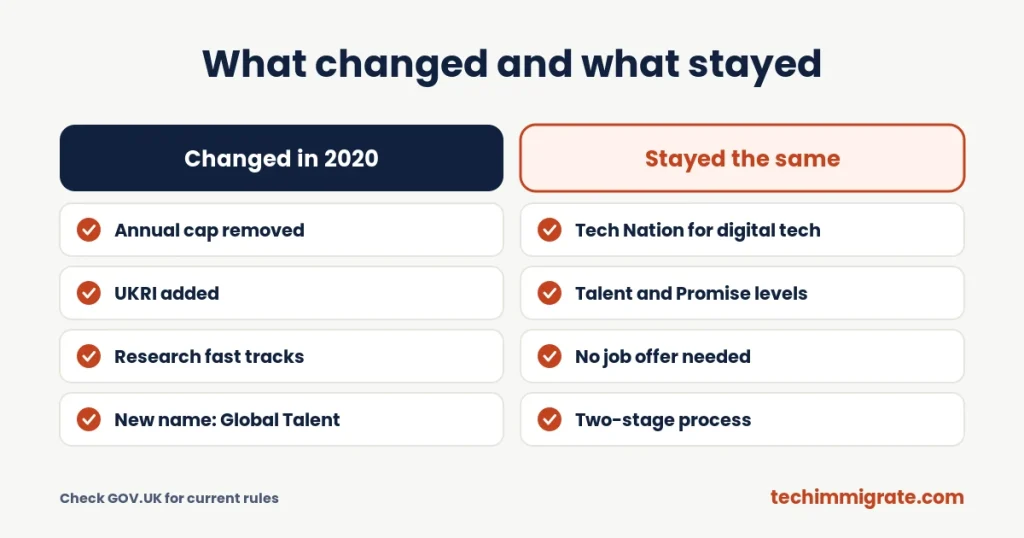
- What Changed in 2020
- What Stayed the Same
- How the Route Has Changed Since 2020
- What Is Changing Next
- Why You Still See "Tier 1" Online
- How to Tell if Advice Is Out of Date
- If You Held Tier 1 (Exceptional Talent) Leave
- Tier 1 Exceptional Talent vs Other Old Tier 1 Visas
- What It All Means for Tech Professionals Today
- How the Digital Technology Criteria Have Evolved
- How Settlement Has Changed
- What the History Means for Different Applicants
- Lessons From the Route's History
- Why the UK Keeps Changing Its Talent Visas
- How to Check the Current Rules Yourself
- Common Misunderstandings
- The Bottom Line
- Your Next Step
- How We Checked This Article
If you have been reading about UK visas for tech professionals for a while, you have probably seen the phrase "Tier 1 Exceptional Talent", or even "Tier 1 Global Talent". Older blog posts, forum threads and some recruiters still use these names. But the Tier 1 (Exceptional Talent) visa closed to new applicants on 20 February 2020, when it was replaced by the Global Talent visa. The UK's old "tier" labels for work visas have been phased out.
This guide explains what the Tier 1 Exceptional Talent visa was, why it was replaced, what actually changed for tech professionals, what stayed the same, and how the route has continued to evolve since 2020. It also explains what the change means for anyone reading older advice, and for people who held Tier 1 (Exceptional Talent) leave in the past.
Key takeaways
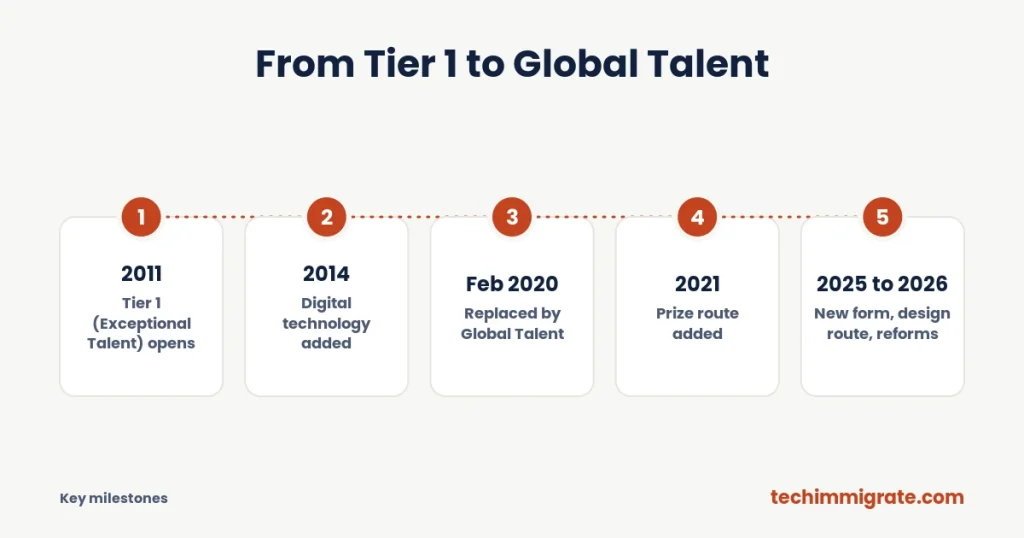
- Tier 1 (Exceptional Talent) was introduced in 2011 and closed to new applicants on 20 February 2020.
- It was replaced by the Global Talent visa, which kept the same basic idea: endorsement as a leader or emerging leader, with no job offer needed.
- The biggest changes were the removal of the annual cap of 2,000 places, the addition of UKRI as an endorsing body, and new fast-track routes for researchers.
- Tech Nation remained the endorsing body for digital technology when the change happened.
- Since 2020, the route has kept changing: a prize route was added in 2021, the digital technology application moved to a single GOV.UK form in 2025, and a design route opened in 2026.
- There is no such thing as a "Tier 1 Global Talent visa" today. If you see the phrase, the advice may be out of date.
What Tier 1 (Exceptional Talent) Was
The Tier 1 (Exceptional Talent) visa was introduced in 2011 as part of the UK's points-based system. It was designed for internationally recognised leaders and emerging leaders in science, humanities, engineering, the arts and, later, digital technology. Like today's Global Talent visa, it did not need a job offer or a sponsor. Applicants first had to be endorsed by a designated body, then apply for the visa.
The annual cap
The route had a limit on the number of endorsements each year. It started at 1,000 a year and later rose to 2,000. In practice, the cap was never reached, according to several law firms that reviewed the route when it closed.
Digital technology joins the route
Digital technology was added in April 2014. Tech City UK, the organisation that later became Tech Nation, was given a designated allocation of 200 endorsements for people showing exceptional talent in digital technology. At first, the digital technology route was only open to recognised world leaders, not emerging leaders. That changed over the following years, and Exceptional Promise became available to digital technology applicants too.
The endorsing bodies
Under Tier 1 (Exceptional Talent), the endorsing bodies were the Royal Society, the British Academy, the Royal Academy of Engineering, Tech Nation and Arts Council England.
Why It Was Replaced
In January 2020, the government published a Statement of Changes to the Immigration Rules (HC 56) that replaced Tier 1 (Exceptional Talent) with a new Global Talent category from 20 February 2020. The main aim was to make the UK more attractive to top scientists and researchers, while keeping and expanding the route for other fields, including digital technology.
The change was described at the time as an expansion and renaming of the existing route rather than a completely new visa. The basic structure, endorsement followed by a visa application, stayed the same.
What Changed in 2020
| Feature | Tier 1 (Exceptional Talent) | Global Talent (from 20 Feb 2020) |
|---|---|---|
| Annual cap | 2,000 places | No cap |
| Endorsing bodies | Royal Society, British Academy, Royal Academy of Engineering, Tech Nation, Arts Council England | The same five, plus UKRI |
| Research fast tracks | Limited | New fast tracks, including UKRI endorsed funder |
| Name | Tier 1 (Exceptional Talent) | Global Talent |
| Job offer needed | No | No |
| Endorsement levels | Exceptional Talent and Exceptional Promise | Exceptional Talent and Exceptional Promise |
No cap
The annual limit was removed. Because the old cap had never been reached, this made little practical difference for most applicants, but it signalled that the UK was open to more talented people.
UKRI joins as an endorsing body
UK Research and Innovation became an endorsing body, running the endorsed funder route for researchers funded by approved grants.
Faster routes for researchers
New fast-track options were introduced for researchers with eligible jobs, fellowships or grants. These remain one of the fastest ways into the visa, with endorsement decisions usually within about 2 weeks.
More generous treatment of research absences
Absences from the UK for research purposes linked to the visa were not counted against continuous residence for settlement, for people endorsed by the research bodies.
What Stayed the Same
For tech professionals, most of the essentials did not change in 2020.
- Tech Nation remained the endorsing body for digital technology.
- The two levels, Exceptional Talent and Exceptional Promise, stayed.
- No job offer or sponsor was needed.
- The two-stage process, endorsement then visa, stayed.
- The freedom to work for any employer, be self-employed or start a business stayed.
If you read an older article about Tier 1 (Exceptional Talent) for digital technology, the overall idea will still be recognisable. But many details, such as fees, forms, criteria wording, evidence rules and settlement rules, will have changed.
How the Route Has Changed Since 2020
The Global Talent visa has not stood still. Some of the most important changes since it replaced Tier 1 include:
- The prize route (May 2021). People who have won certain prestigious prizes can skip endorsement and apply for the visa directly. The prize list has since been expanded, including by 27 prizes in November 2025, and was updated again in April 2026.
- Settlement for research-endorsed Promise holders. People endorsed under Exceptional Promise by the research bodies can settle after 3 years, while Tech Nation and Arts Council England Promise holders settle after 5 years under the current rules.
- A single GOV.UK form for digital technology (August 2025). Stage 1 for digital technology moved to one online form on GOV.UK.
- The personal statement typed into the form (February 2026). Applicants now type their personal statement directly into the Home Office form.
- The design industry route (July 2026). Designers can apply through Arts Council England, with the Design Business Association assessing applications.
- UKRI's expanded list (2026). UKRI added research-intensive businesses to its list of approved employing and hosting organisations.
Our article on Global Talent visa changes covers the most recent changes in more detail.
What Is Changing Next
Two major reviews could reshape the route again.
Earned settlement
The government's response to the earned settlement consultation, published on 2 November 2026, plans a new settlement system from 2027, with a 10-year default and shorter paths for some. Global Talent is expected to fall into a "Highest Talent Group" with a 3-year path, but the details are still being finalised. Our article on Global Talent and the new settlement rules explains what is known.
The Migration Advisory Committee's review of talent routes
The MAC's review, published on 17 November 2026, found that endorsement rates on the standard routes fell from 74% in 2021 to 44% in 2025. It recommended changes including referee letters sent directly to endorsing bodies, stronger conflict-of-interest rules and an income threshold at settlement for talent routes.
Why You Still See "Tier 1" Online
The old name lingers for several reasons.
- Old articles stay online. Many guides written before 2020 still rank in search results.
- People use familiar labels. Recruiters and professionals who learned the system before 2020 may still say "Tier 1".
- "Tier 2" has the same problem. The old Tier 2 (General) visa was replaced by the Skilled Worker visa in December 2020, and people still use the old name. Our article on Tier 2 vs Skilled Worker explains that change.
- Mixed phrases appear. You may see "Tier 1 Global Talent" or "Tier 1 (Global Talent)". These combine the old and new names. They refer to the Global Talent visa, but suggest the source may be older or informal.
How to Tell if Advice Is Out of Date
When you read about the Global Talent visa online, look for these warning signs.
- It calls the visa "Tier 1". The article may predate 2020.
- It mentions an annual cap. The cap was removed in 2020.
- It quotes old fees. Fees change most years. The current fees are £561 for endorsement and £205 for the visa, plus the Immigration Health Surcharge of £1,035 per year.
- It describes a Tech Nation portal or old application process. Stage 1 for digital technology moved to a single GOV.UK form in August 2025.
- It ignores the earned settlement reforms. Settlement rules are changing from 2027.
- It does not mention the prize route or design route. These were added after 2020.
The safest approach is always to check GOV.UK for the current rules.
If You Held Tier 1 (Exceptional Talent) Leave
The Tier 1 (Exceptional Talent) category closed to new entrants and extensions on 20 February 2020. People who held Tier 1 (Exceptional Talent) leave at that point were able to move onto the Global Talent route, and many have since settled. If you are one of the few who still has questions about how earlier Tier 1 time counts, for example because you left the UK and are thinking of returning, check the current settlement guidance on GOV.UK or get advice from a regulated adviser. Time spent on Tier 1 (Exceptional Talent) was generally treated in line with Global Talent time for settlement purposes when the routes were combined, but your individual history matters.
If you settled years ago with indefinite leave to remain on an older document, you may need to make sure your status is recorded as an eVisa. GOV.UK's No Time Limit application is free for people with ILR in older documents. Our article on the UK eVisa explains how this works.
Tier 1 Exceptional Talent vs Other Old Tier 1 Visas
Tier 1 (Exceptional Talent) was one of several Tier 1 visas, which are sometimes confused.
| Old visa | What happened to it |
|---|---|
| Tier 1 (General) | Closed to new applicants in 2010 and 2011 |
| Tier 1 (Entrepreneur) | Closed to new applicants in 2019; replaced by Start-up and Innovator, later Innovator Founder |
| Tier 1 (Graduate Entrepreneur) | Closed in 2019; replaced by Start-up |
| Tier 1 (Investor) | Closed to new applicants in 2022 |
| Tier 1 (Exceptional Talent) | Replaced by Global Talent on 20 February 2020 |
Only Tier 1 (Exceptional Talent) has a direct modern successor in the Global Talent visa. If you are a founder, the modern routes to consider are Global Talent and Innovator Founder. Our comparison of Innovator Founder and Global Talent explains the difference.
What It All Means for Tech Professionals Today
For someone applying today, the history matters mainly as context. The route you are applying for is the Global Talent visa, assessed by Tech Nation for digital technology, with these essentials:
- Stage 1: endorsement, £561, usually decided within 5 to 8 weeks.
- Stage 2: visa application, £205 plus the surcharge, usually decided within about 3 weeks from outside the UK or 8 weeks from inside.
- Criteria: one mandatory criterion and two of four optional criteria.
- Documents: up to 10 pieces of evidence, three letters, a personal statement and a CV.
- Visa: up to 5 years at a time, extendable without limit.
- Settlement: currently 3 years for Exceptional Talent and 5 years for Tech Nation Exceptional Promise, with reforms planned from 2027.
Our Global Talent visa guide walks through every step.
How the Digital Technology Criteria Have Evolved
The core idea of the digital technology criteria has been stable since the Tier 1 days: applicants must show recognition as a leader or emerging leader, plus achievements in areas such as innovation, recognition beyond their occupation, significant contributions and academic work. But the way the criteria are worded and applied has shifted over time.
- From world leaders only to emerging leaders too. When digital technology joined Tier 1 in 2014, the allocation was for recognised world leaders. Exceptional Promise for digital technology came later, opening the route to people earlier in their careers.
- A sharper focus on product-led companies. Business applicants must show their work is in-house at product-led digital technology companies, and roles in consultancy, outsourcing and service delivery are generally excluded.
- Tighter scrutiny of evidence and letters. Endorsement rates have fallen sharply in recent years, and Tech Nation's guidance now says it may contact referees and that AI use within the application is not acceptable.
- A simpler application process. The move to a single GOV.UK form in 2025, and typing the personal statement into the form from 2026, changed how applications are put together.
The result is a route that is open to more people in principle than Tier 1 was, but which applies the criteria more strictly in practice.
How Settlement Has Changed
Settlement has always been one of the main attractions of the route, and the rules have shifted several times.
- Under Tier 1 (Exceptional Talent), Exceptional Talent holders could settle after 3 years and Exceptional Promise holders after 5 years.
- Under Global Talent, research-endorsed Exceptional Promise holders gained the 3-year path, while Tech Nation and Arts Council England Promise holders kept 5 years.
- Under the earned settlement reforms, the government plans a new framework from 2027, with Global Talent expected in a Highest Talent Group with a 3-year path, plus new requirements such as B2 English from 26 March 2027.
If you are planning around settlement, always check the rules that will apply on the date you apply, not the date you arrived.
What the History Means for Different Applicants
- Software engineers and data specialists: the route has become more open to people at earlier career stages, but also more demanding about external recognition.
- Founders: the Tier 1 (Entrepreneur) route is long gone, so Global Talent and Innovator Founder are now the two main founder options.
- Researchers: the 2020 changes made the route much faster for many researchers, through fast tracks and UKRI.
- Designers: the 2026 design route gives some designers a second endorsing route alongside Tech Nation.
Lessons From the Route's History
The history of the route offers two practical lessons. First, the rules change regularly, so plans built on old advice can go wrong. Second, the basic test has stayed the same for more than a decade: show, with strong evidence, that you are a leader or emerging leader recognised beyond your employer. Applicants who focus on that test, rather than on shortcuts or loopholes, tend to do well whatever the current rules look like.
Why the UK Keeps Changing Its Talent Visas
Talent visas sit at the meeting point of two policy goals that pull in different directions. On one side, the government wants the UK to compete for the best scientists, engineers, founders and creative professionals, and talent routes are a visible signal of openness. On the other, it wants to reduce overall migration and make sure routes are not used in ways they were not designed for. Each change to the route reflects a balance between those goals at a particular moment.
The 2020 change leaned towards openness, by removing the cap and adding fast tracks. The more recent changes, such as tighter scrutiny of evidence and the earned settlement reforms, lean towards control, while still keeping a short path to settlement for the most talented. The Migration Advisory Committee's 2026 review shows that the government is actively thinking about how to keep the route selective. Expect that balance to keep shifting.
How to Check the Current Rules Yourself
Because the route changes often, it is worth knowing where to look.
- GOV.UK's Global Talent pages set out the current requirements, fees and processing times for each field.
- The Immigration Rules, Appendix Global Talent, contain the legal requirements. They are detailed, but they are the final word.
- Statements of Changes announce new rules before they take effect, usually with an explanatory memorandum in plain English.
- Endorsing body guidance, including Tech Nation's for digital technology, explains how the criteria are applied.
- Home Office caseworker guidance shows what staff check when they decide applications.
When you read any guide, including ours, check the date and compare key facts against these sources. Our article on the Global Talent visa caseworker guidance explains how to use the Home Office's own guidance.
Common Misunderstandings
- "Tier 1 Exceptional Talent still exists." It closed on 20 February 2020.
- "Global Talent is a completely different visa." It is the successor to Tier 1 (Exceptional Talent), with the same basic idea.
- "There is a cap on Global Talent visas." The cap was removed in 2020.
- "Old guides are still accurate." Many details have changed, including fees, forms, criteria and settlement.
- "Tier 1 means it is a premium version." Tier 1 was simply the old category name for high-value migrants.
No. It closed to new applicants on 20 February 2020 and was replaced by the Global Talent visa.
The Global Talent visa, which kept the same basic idea of endorsement for leaders and emerging leaders.
Not as an official name. "Tier 1 Global Talent" is an informal mix of the old and new names. The current visa is simply the Global Talent visa.
The annual cap of 2,000 places was removed, UKRI was added as an endorsing body, and new fast tracks were introduced for researchers.
No. Tech Nation remained the endorsing body for digital technology.
Look for old names, a cap, old fees or old application processes. Always check GOV.UK.
The Bottom Line
Tier 1 (Exceptional Talent) is history, but its core idea lives on in the Global Talent visa: the UK will let exceptional people live and work freely, without a sponsor, if an expert body confirms their talent. The name, the cap, the forms, the endorsing bodies and the settlement rules have all changed over the years, and they will keep changing. What has not changed is that a strong, well-evidenced case is the only reliable way in. If you are reading older advice, use it for background, and rely on current GOV.UK guidance for anything that affects your application.
Your Next Step
Whatever the name, the hardest part of the route has always been endorsement. Our role-specific Global Talent guides explain what Tech Nation looks for today in software developers, data and AI specialists, product managers, designers, founders and more, based on the current criteria rather than older advice.
How We Checked This Article
We checked the history of the route against the Statement of Changes to the Immigration Rules (HC 56) and its explanatory memorandum, Home Office guidance on Tier 1 (Exceptional Talent), and law firm summaries of the change, and the current rules against GOV.UK's Global Talent visa pages, in November 2026. Recent changes and reforms are from GOV.UK, law firm summaries, the earned settlement response of 2 November 2026 and the Migration Advisory Committee's review of 17 November 2026.
Tech Immigrate is independent of the Home Office and Tech Nation. This article is general information, not legal advice. Check GOV.UK before you apply.
We write practical guides for tech professionals applying for the UK Global Talent visa. Tech Immigrate is independent of Tech Nation and the Home Office, and our articles are general information, not legal advice. Rules and fees change, so always check gov.uk before you apply.