
Tier 2 vs Skilled Worker Visa: What Changed and What It Means Now
Tier 2 vs the Skilled Worker visa: what changed in 2020, how the rules have moved since, and what it means for people who started on Tier 2.


In this article
- A Short History
- What Changed in December 2020
- How the Skilled Worker Rules Have Changed Since
- Tier 2 vs Skilled Worker Today
- What It Means if You Started on Tier 2
- Tier 2 (Intra-Company Transfer) and Global Business Mobility
- Why People Still Say Tier 2
- Settlement: Old Rules, Current Rules and Proposed Rules
- How the Points Work Now
- What Happened to the Shortage Occupation List
- From Biometric Residence Permits to eVisas
- Sponsor Costs: Then and Now
- The Route Many Former Tier 2 Workers Overlook
- What Stayed the Same
- Tier 2 Settlement Rules for Older Cases
- A Worked Example: A Developer Who Started on Tier 2
- A Worked Example: Reading an Old Job Advert
- Dependants: Then and Now
- If You Left the UK After Tier 2 and Want to Return
- Checking Old Advice
- Common Misunderstandings
- Know Which Rules Apply to You
- How We Checked This Article
Years after it was replaced, people still talk about the "Tier 2 visa". Recruiters advertise "Tier 2 sponsorship", job boards filter for it, and many people who came to the UK before 2020 still describe themselves as Tier 2 workers. But the Tier 2 (General) visa no longer exists. Since 1 December 2020, the main sponsored work route has been the Skilled Worker visa.
This guide explains the difference between Tier 2 and the Skilled Worker visa: what changed when the route was renamed, how the rules have moved since, what it means for people who started on Tier 2, and whether old Tier 2 rules still matter for your extension or settlement. If you are a tech worker comparing old advice with current rules, this is the place to start.
Key takeaways
- The Tier 2 (General) visa was replaced by the Skilled Worker visa on 1 December 2020, when the UK introduced its new points-based system.
- The Skilled Worker route removed the annual cap, the resident labour market test and the cooling-off period, and initially lowered the skill and salary thresholds.
- Since 2024, the rules have tightened again: the general salary threshold is now £41,700, and most new jobs must be at RQF level 6.
- Time on Tier 2 (General) counts towards settlement on the Skilled Worker route.
- People first sponsored before 4 April 2024 can benefit from transitional salary rules when they extend or change employer.
- Tier 2 (Intra-Company Transfer) was replaced first by the Intra-Company routes and then by Global Business Mobility.
- When someone says "Tier 2 sponsorship" today, they almost always mean Skilled Worker sponsorship.
A Short History
The UK introduced the points-based system in 2008. Tier 2 was the route for skilled workers with a job offer, and Tier 2 (General) was its main category. Over the years, the route had:
- an annual limit on the number of certificates of sponsorship for people applying from abroad;
- a resident labour market test, requiring employers to advertise jobs to settled workers first in most cases;
- a skill level at RQF 6, roughly degree level, for most roles;
- a salary threshold, which was £30,000 for experienced workers for much of the late 2010s;
- a maximum total stay of 6 years, unless the worker qualified for settlement;
- a 12-month cooling-off period after leaving the route.
After the UK left the EU, the government redesigned the system. On 1 December 2020, Tier 2 (General) was replaced by the Skilled Worker route, which was open to both EU and non-EU workers.
What Changed in December 2020
| Feature | Tier 2 (General) | Skilled Worker (from Dec 2020) |
|---|---|---|
| Annual cap | Yes | Removed |
| Resident labour market test | Yes, in most cases | Removed |
| Skill level | RQF 6 | Lowered to RQF 3 |
| General salary threshold | £30,000 (experienced) | £25,600 |
| Maximum stay | 6 years | No maximum |
| Cooling-off period | 12 months | Removed |
| Tradeable points | No | Yes, for salary, shortage occupation, PhD |
| Path to settlement | 5 years | 5 years |
The early Skilled Worker route was more flexible than Tier 2. Removing the cap and the labour market test made it easier for employers to sponsor, and lowering the skill level opened the route to many more jobs.
How the Skilled Worker Rules Have Changed Since
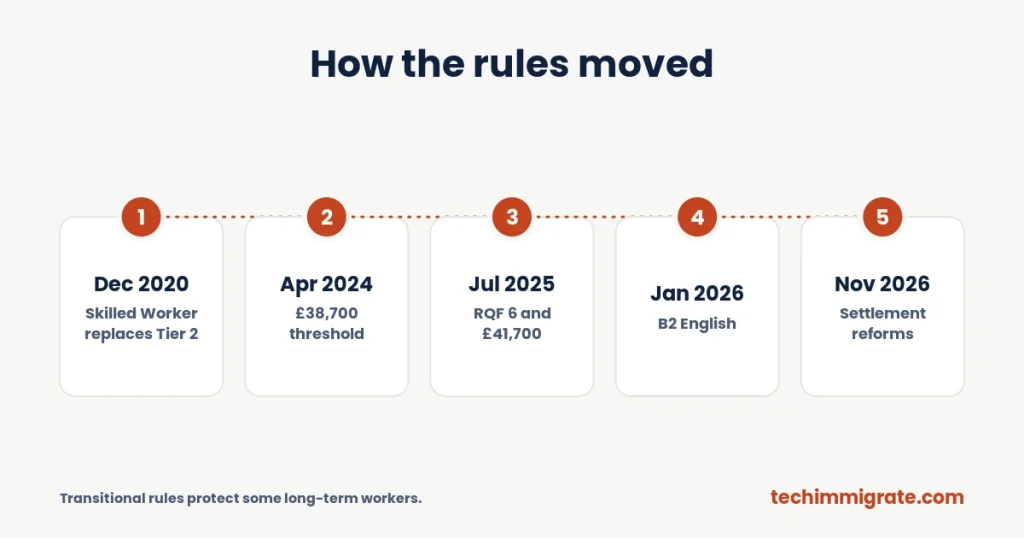
The flexibility of 2020 did not last. In recent years, the rules have moved back towards, and in some ways beyond, the old Tier 2 standards:
| Date | Change |
|---|---|
| 11 March 2024 | Care workers can no longer bring new dependants |
| 4 April 2024 | General threshold raised to £38,700; new going rates; shortage occupation list replaced by immigration salary list |
| 22 July 2025 | Skill level raised to RQF 6 for most new roles; general threshold £41,700; new entrant £33,400 |
| 16 December 2025 | Immigration Skills Charge increased by 32% |
| 8 January 2026 | English requirement raised to B2 for new applicants |
| 2 November 2026 | Earned settlement response proposes a 10-year default path to ILR |
The result is a route that looks very different from the one launched in 2020. Today's Skilled Worker route has the same degree-level skill requirement as old Tier 2, a much higher salary threshold, a higher English requirement and higher employer costs. It still has no cap, no labour market test, no maximum stay and no cooling-off period. Our guide to the new Skilled Worker rules explains the recent changes.
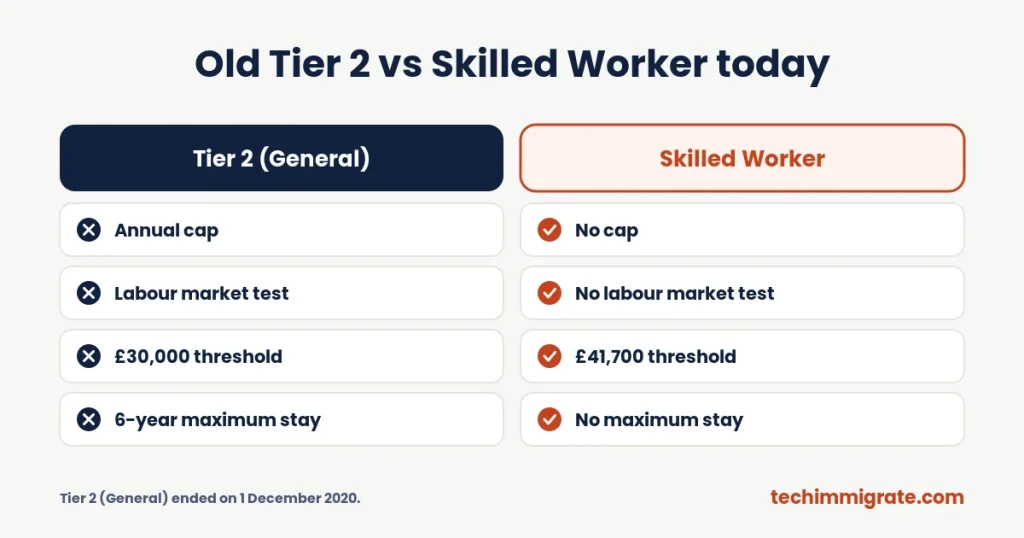
Tier 2 vs Skilled Worker Today
| Feature | Old Tier 2 (General) | Skilled Worker today |
|---|---|---|
| Annual cap | Yes | No |
| Labour market test | Yes, in most cases | No |
| Skill level | RQF 6 | RQF 6 for most new roles |
| General salary threshold | £30,000 | £41,700 |
| New entrant threshold | £20,800 | £33,400 |
| English | B1 | B2 for new applicants |
| Maximum stay | 6 years | No maximum |
| Cooling-off period | 12 months | None |
| Proof of status | Biometric residence permit | eVisa |
| Settlement | 5 years | 5 years now; 10-year default proposed |
What It Means if You Started on Tier 2
Many people who are still in the UK on a Skilled Worker visa started on Tier 2 (General). Their Tier 2 permission was treated as Skilled Worker permission when the route changed. Here is what that means in practice:
- Your time counts. Time on Tier 2 (General) counts towards the 5-year qualifying period for settlement on the Skilled Worker route under the current rules.
- You extend as a Skilled Worker. If you still need to extend, you apply under the Skilled Worker rules, not Tier 2.
- Transitional salary rules may help. People first sponsored before 4 April 2024 can benefit from lower transitional salary thresholds when they extend or change employer, and these arrangements have been extended for a long period.
- Your old BRP has been replaced. Most biometric residence permits expired by the end of 2024. You prove your status with an eVisa through your UKVI account.
If you started on Tier 2 before December 2020 and are still on the route today, you are very likely already past 5 years and may be able to apply for ILR. If you have not done so, check your eligibility now, especially with the earned settlement reforms coming.
Tier 2 (Intra-Company Transfer) and Global Business Mobility
Tier 2 also had an Intra-Company Transfer (ICT) category for employees moving to the UK branch of a multinational. That category was renamed Intra-Company Transfer in 2020 and then replaced by the Global Business Mobility routes in April 2022, including the Senior or Specialist Worker route.
Unlike Tier 2 (General) and Skilled Worker, these intra-company routes do not lead directly to settlement. People who want to stay long term usually switch to Skilled Worker or another route.
Why People Still Say Tier 2
The Tier 2 name stuck because it was used for more than a decade. Many recruiters, HR teams and job boards still use it, often as shorthand for any sponsored work visa. When you see "Tier 2 sponsorship available" in a job advert today, it almost always means the employer can sponsor a Skilled Worker visa.
If you are job hunting, it is worth searching for both terms. Some employers use "Skilled Worker sponsorship", some still use "Tier 2", and some use "visa sponsorship" generally. Whatever the wording, verify the employer on the register of licensed sponsors and ask which occupation code and salary they plan to use, because the advert itself tells you nothing about whether the role meets today's rules.
Settlement: Old Rules, Current Rules and Proposed Rules
Under Tier 2, workers could settle after 5 years if they met the settlement salary threshold and other requirements. The Skilled Worker route kept the 5-year path.
The government's response to the earned settlement consultation, published on 2 November 2026, proposes a different framework:
- a 10-year default qualifying period;
- a 5-year path for people earning at least £50,271;
- a 3-year path for people earning at least £125,141, or in the highest talent group;
- new requirements including English at B2 and no debts to public bodies.
The changes are expected to be implemented over 2027, with no general transitional protection for people already on the route. If you started on Tier 2 and have not yet settled, this is a strong reason to check your eligibility now. Our guide to the new ILR rules for Skilled Worker visa holders explains the details.
How the Points Work Now
Both Tier 2 and Skilled Worker were described as points-based, but the points work differently. Under the Skilled Worker route, you need 70 points. Fifty of those are mandatory and come from three things:
- a job offer from a licensed sponsor;
- a job at the appropriate skill level;
- English at the required level.
The remaining 20 points come from salary. In most cases, you earn them by being paid at least the general threshold and the going rate. In some cases, you can earn them with a lower salary through other characteristics, such as being a new entrant, having a relevant PhD, or working in a job on the immigration salary list.
In practice, most applicants do not think in terms of points at all. If you meet the job, skill, English and salary requirements, you have the points.
What Happened to the Shortage Occupation List
Under Tier 2 and the early Skilled Worker route, the shortage occupation list allowed lower salaries for jobs in short supply. Several tech roles were on it at various times. On 4 April 2024, it was replaced by the immigration salary list, which is shorter and offers a smaller discount. Jobs on the immigration salary list have a lower general threshold of £33,400 and lower visa fees, but must still meet the going rate. Very few tech roles are on the current list.
From Biometric Residence Permits to eVisas
Tier 2 workers usually received a biometric residence permit (BRP) as proof of their status. The UK has now moved to eVisas, which are digital records of your immigration status, accessed through a UKVI account. Most BRPs expired by the end of 2024.
If you started on Tier 2 and still have an old BRP, make sure you have set up your UKVI account and can access your eVisa. You need it to prove your right to work and rent, and to travel. Our guide to the UK eVisa explains how it works.
Sponsor Costs: Then and Now
Employers sponsoring Tier 2 workers paid a certificate of sponsorship fee and, from 2017, the Immigration Skills Charge. Both still exist on the Skilled Worker route, but they are higher:
- the certificate of sponsorship fee is now £525;
- the Immigration Skills Charge is £1,320 per year for large sponsors and £480 for small sponsors, from 16 December 2025.
These costs cannot be passed on to the worker. Higher sponsor costs are one reason some employers are more selective about sponsorship than they were under Tier 2.
The Route Many Former Tier 2 Workers Overlook
Many tech workers who came on Tier 2 have spent years building a strong professional profile: leading teams, shipping products, speaking at events, contributing to open source, or building companies. Some of them may qualify for the Global Talent visa, which needs no sponsor and no salary threshold.
For someone already near settlement on Skilled Worker, switching may not make sense. But for someone who wants to leave their sponsor, freelance, or start a business before they settle, Global Talent can offer freedom that neither Tier 2 nor Skilled Worker ever did. Time on Skilled Worker can usually be combined with Global Talent towards settlement under the current rules. Our comparison of Global Talent vs Skilled Worker explains the trade-offs.
What Stayed the Same
Despite the name change and the many rule changes since, some core features have stayed the same from Tier 2 to Skilled Worker:
- You need a sponsor. Both routes depend on a job offer from a licensed employer.
- You are tied to that employer. Changing employer needs a new application on both routes.
- Your partner and children can usually join you, with the exceptions noted above.
- The route can lead to settlement, currently after 5 years.
- The employer has compliance duties, such as reporting when you leave or when your role changes.
- Most professional tech roles qualify, because they have always been at degree level.
For a software developer, data engineer or security specialist, the experience of being sponsored today is not very different from being sponsored on Tier 2 a decade ago. The main differences are a higher salary bar, a higher English level, higher costs for the employer and a more uncertain path to settlement.
Tier 2 Settlement Rules for Older Cases
People who settled under Tier 2 years ago did so under the rules in force at the time, which included a settlement salary threshold and some different documentary requirements. If you already hold ILR from a Tier 2 period, nothing changes for you. ILR is permanent, subject to the usual absence and revocation rules.
If you are still on the route, the settlement rules that apply are today's Skilled Worker settlement rules, with any transitional protection that applies to your case. Check the current requirements in our ILR requirements checklist.
A Worked Example: A Developer Who Started on Tier 2
A backend developer arrived on a Tier 2 (General) visa in October 2019, sponsored by a fintech in London. In December 2020, his permission became Skilled Worker permission. He extended in 2022 with the same employer.
- October 2024: he reached 5 years and could have applied for ILR.
- He did not apply, because he was busy and his visa was valid until 2025.
- In 2025, he extended again rather than settling.
In November 2026, he realises that the earned settlement reforms could affect him. He checks his eligibility: more than 7 years on Tier 2 and Skilled Worker, salary of £78,000, Life in the UK test passed, English evidence ready. He applies for ILR immediately under the current rules.
His story is a common one. Many long-term Tier 2 and Skilled Worker holders have been eligible to settle for years but have not applied.
A Worked Example: Reading an Old Job Advert
A data analyst sees a job advert that says "Tier 2 sponsorship available".
- She checks the employer on the register of licensed sponsors and finds it licensed for the Skilled Worker route with an A rating.
- She asks HR which occupation code and salary they plan to use.
- The salary is £45,000, and the code's going rate is £52,300.
The advert used old language, but the rules that apply are today's Skilled Worker rules. Because the salary does not meet the going rate, and she does not qualify as a new entrant, the employer would need to raise the offer.
Dependants: Then and Now
Tier 2 (General) workers could bring their partners and children, and partners could work for almost any employer. That is still true for most Skilled Workers, with one major exception: since 11 March 2024, care workers and senior care workers cannot bring new dependants. Workers on the temporary shortage list also cannot bring dependants.
For tech workers, the family rules are broadly the same as they were under Tier 2. Each dependant pays the visa fee and health surcharge, and partners and children can usually settle when they meet their own qualifying period. Our guide to the Skilled Worker dependant visa has the details.
If You Left the UK After Tier 2 and Want to Return
Some people worked in the UK on Tier 2, left, and now want to come back. Under the old rules, a 12-month cooling-off period could stop them returning on Tier 2 for a year. That rule no longer exists. You can apply for a new Skilled Worker visa at any time, as long as you meet the current requirements.
Points to remember:
- you will need to meet today's salary, skill and English rules, not the old Tier 2 rules;
- your previous time on Tier 2 may not combine with new Skilled Worker time towards settlement if there was a long break, because continuous residence will usually have been broken;
- you will need a new certificate of sponsorship from a licensed employer.
If you built a strong profile while you were away, for example by leading a team or founding a company, check whether Global Talent might be a better route back.
Checking Old Advice
Much of the advice online about UK work visas was written for Tier 2 and is now out of date. Treat these claims with caution if you see them:
- "Employers must advertise the role for 28 days first." The resident labour market test was removed in December 2020.
- "There is a monthly cap on certificates." The cap was removed.
- "The salary threshold is £30,000." It is now £41,700 for most new applicants.
- "You need B1 English." New applicants now need B2.
- "You can only stay 6 years." There is no maximum stay on Skilled Worker.
- "Your BRP is your proof of status." Status is now proved with an eVisa.
When you read any advice, check the date it was written and confirm the current rules on GOV.UK.
Common Misunderstandings
- "Tier 2 still exists." It does not. Tier 2 (General) was replaced by Skilled Worker in December 2020.
- "Tier 2 rules apply to my extension." You extend under the Skilled Worker rules, though transitional salary rules may help.
- "There is a 6-year limit." The 6-year maximum stay was removed when Skilled Worker replaced Tier 2.
- "I need to wait 12 months after leaving before reapplying." The cooling-off period was removed.
- "My Tier 2 time doesn't count for ILR." It does count towards Skilled Worker settlement under the current rules.
- "Old salary thresholds still apply." New applicants must meet today's thresholds.
The Skilled Worker visa replaced Tier 2 (General) on 1 December 2020. People still use the old name, but the current rules are the Skilled Worker rules.
Yes. Time on Tier 2 (General) counts towards the 5-year qualifying period on the Skilled Worker route under the current rules.
No. The 6-year maximum stay was removed when the Skilled Worker route was introduced.
Tier 2 used £30,000 for experienced workers for much of its life. The Skilled Worker general threshold is now £41,700, or £33,400 for new entrants.
It became the Intra-Company Transfer route and was then replaced by Global Business Mobility in April 2022.
Usually yes. It almost always means Skilled Worker sponsorship. Check the employer on the register of licensed sponsors.
Know Which Rules Apply to You
The Tier 2 name lives on, but the rules that matter now are the Skilled Worker rules, with transitional protection for some people who have been on the route for a long time. If you started on Tier 2 and have been in the UK for 5 years or more, check whether you can settle now. If you are in tech and want a route without a sponsor, our role-specific Global Talent guides explain what Tech Nation looks for.
How We Checked This Article
We checked current rules against GOV.UK's Skilled Worker visa pages in November 2026. Historical Tier 2 thresholds and features are from the Immigration Rules in force before December 2020 and Home Office statements of changes. Settlement reforms are from law firm summaries of the earned settlement response of 2 November 2026.
Tech Immigrate is independent of the Home Office. This article is general information, not legal advice. Check GOV.UK before you apply.
We write practical guides for tech professionals applying for the UK Global Talent visa. Tech Immigrate is independent of Tech Nation and the Home Office, and our articles are general information, not legal advice. Rules and fees change, so always check gov.uk before you apply.


