UK Graduate Visa (PSW): Rules, Length and What Comes Next
The UK Graduate visa explained: 2 years or 18 months from 2027, £937 fee, work rights, no extensions, settlement, and how to switch to your next route.


In this article
- What the Graduate Visa Is
- Who Is Eligible
- How Long It Lasts
- When to Apply
- What It Costs
- What You Can Do on a Graduate Visa
- What You Cannot Do
- Family Members
- Decision Time
- The Big Limitation: It Cannot Be Extended
- Does It Count Towards Settlement?
- Your Next Step: Where to Go From the Graduate Visa
- Graduate Visa vs Other Routes
- Working as a Contractor or Freelancer
- Starting a Business
- Tax and National Insurance
- Travel and Absences
- Hiring Graduate Visa Holders: The Employer View
- What Happens if You Do Not Switch
- Applying Step by Step
- Is the Shorter Visa a Problem?
- Questions to Ask at the Start of Your Graduate Visa
- Making the Most of Your Graduate Visa
- A Worked Example: Graduate to Skilled Worker
- A Worked Example: Graduate to Global Talent
- Common Mistakes
- Use the Bridge Well
- How We Checked This Article
For international students finishing a degree in the UK, the Graduate visa is often the bridge between study and a career. It lets you stay in the UK after your course and work in almost any job, at any level, for any employer, without needing a sponsor. For tech graduates, it is a chance to get UK experience, build a portfolio and find the employer or route that will let you stay longer.
But the Graduate visa is changing. From 1 January 2027, most graduates will get 18 months rather than 2 years. It cannot be extended, it does not lead to settlement on its own, and under the earned settlement proposals, time on it would not count towards settlement at all. This guide explains the Graduate visa rules, how long it lasts, what it costs, what you can and cannot do, and, most importantly, how to plan your next step before it runs out.
Key takeaways
- The Graduate visa, sometimes called post-study work (PSW), lets you stay in the UK after completing an eligible UK degree on a Student visa.
- It lasts 2 years if you apply on or before 31 December 2026, and 18 months if you apply on or after 1 January 2027. PhD graduates get 3 years.
- The application fee is £937, plus the Immigration Health Surcharge, usually £1,035 per year.
- You can work in most jobs, look for work and be self-employed, with no sponsor and no salary threshold.
- You cannot extend the Graduate visa, and it does not lead to settlement on its own.
- You can switch to other routes, such as Skilled Worker or Global Talent, from inside the UK.
- Decisions usually take about 8 weeks, and you can stay in the UK while you wait.
What the Graduate Visa Is
The Graduate visa is a post-study work route for international students who have completed a degree in the UK. It was introduced in 2021 and replaced earlier schemes that had been closed for several years.
Its purpose is simple: to give graduates time to work in the UK after their studies, without needing a job offer or a sponsor. Many use it to find a sponsored job, build experience or start a business. For employers, it also means they can hire international graduates without the cost and paperwork of sponsorship, at least for the length of the visa, which makes Graduate visa holders easier to hire than people who need a sponsor from day one. For tech graduates in particular, it is often the window in which they get their first UK job, their first production experience and their first professional references in the UK.
Who Is Eligible
According to GOV.UK, you can apply for a Graduate visa if:
- you are in the UK when you apply;
- you hold a Student visa or Tier 4 (General) student visa;
- you have studied an eligible UK bachelor's degree, postgraduate degree or other eligible course for a minimum period on that visa;
- your education provider has told the Home Office that you have successfully completed the course.
You do not need a job offer, a minimum salary, savings, or a separate English test.
How Long It Lasts
The length depends on your qualification and when you apply:
| Qualification | Apply on or before 31 December 2026 | Apply on or after 1 January 2027 |
|---|---|---|
| Bachelor's or master's degree | 2 years | 18 months |
| PhD or other doctoral qualification | 3 years | 3 years |
The visa starts on the day your application is approved. If you are finishing a course around the end of 2026, the timing of your application could make a 6-month difference.
When to Apply
You must apply online before your Student visa expires. You can apply once your education provider has told the Home Office that you have completed your course. You do not need to wait for your graduation ceremony or certificate.
If you are unsure whether your provider has reported your completion, ask them. Applying before they have reported it can lead to delays or refusal.
What It Costs
| Item | Cost |
|---|---|
| Application fee | £937 |
| Immigration Health Surcharge | Usually £1,035 per year |
For a 2-year Graduate visa, the total is £937 plus £2,070 in health surcharge, £3,007. For an 18-month visa, the surcharge is usually calculated for 1.5 years. For a 3-year PhD Graduate visa, the surcharge is £3,105.
If you work in public sector healthcare, GOV.UK notes that you may be eligible for the Health and Care Worker visa instead, which is cheaper and has no annual surcharge.

What You Can Do on a Graduate Visa
GOV.UK says you can:
- work in most jobs;
- look for work;
- be self-employed;
- live in the UK with your partner and children, if they are eligible;
- travel abroad and return to the UK;
- do voluntary work.
For tech graduates, the flexibility is the main attraction. You can:
- take a junior developer, data or design role at any company, including start-ups that cannot sponsor;
- work as a contractor or freelancer;
- start your own tech company;
- take internships or short-term roles to build experience;
- work part-time while building a portfolio or side project.
There is no salary threshold and no skill level requirement.
What You Cannot Do
On a Graduate visa, you cannot:
- apply for most public funds or the State Pension;
- work as a professional sportsperson;
- extend the visa;
- study on a course that is eligible for a Student visa, although you can study on other courses.
Family Members
Your partner and children can stay with you on the Graduate route only if they are eligible, which usually means they were already in the UK as your dependants on your Student visa. You cannot usually bring new dependants who were not already your dependants.
Decision Time
GOV.UK says a decision usually takes about 8 weeks after you have applied, proved your identity and provided your documents. You can stay in the UK while you wait. You may need an appointment to prove your identity, which can add time.
The Big Limitation: It Cannot Be Extended
The Graduate visa is a one-time, fixed-length visa. GOV.UK states plainly that you cannot extend it. When it ends, you must either have switched to another route or leave the UK.
This makes planning essential. From the day your Graduate visa starts, you should be working towards your next route. Put your visa end date in your calendar, set reminders at 12, 6 and 3 months before it, and treat each reminder as a checkpoint to review whether your plan is on track.
Does It Count Towards Settlement?
Under the current rules, time on the Graduate visa does not count towards the 5-year qualifying period for settlement on work routes such as Skilled Worker. It may count towards the 10-year long residence route, but the earned settlement response says that route will close.
Under the earned settlement proposals published on 2 November 2026, time on the Graduate route would not count towards settlement under the new framework at all. This makes the Graduate visa a pure bridge: valuable for experience, but not a step on the settlement clock.
It also matters for the new entrant salary rules on Skilled Worker. Time on the Graduate visa counts towards the 4-year limit on new entrant salaries.
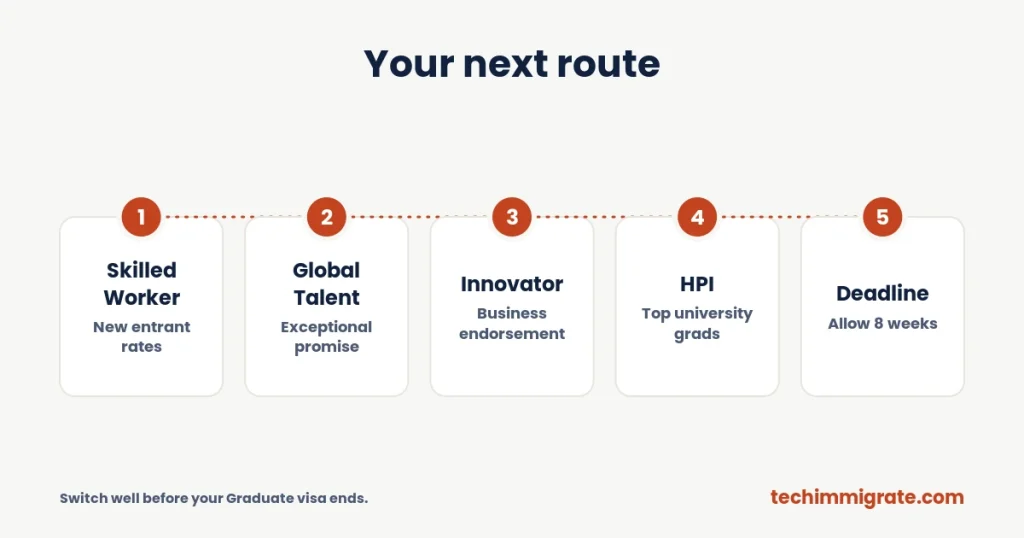
Your Next Step: Where to Go From the Graduate Visa
Skilled Worker
The most common next step. You need a job offer from a licensed sponsor, at an eligible skill level and salary. As a recent Graduate visa holder, you usually qualify as a new entrant, so you can be paid 70% of the going rate, with a minimum of £33,400. For a software developer, that is about £38,300 rather than £54,700. You can switch from inside the UK at any time while your Graduate visa is valid. Our guide to switching to a Skilled Worker visa explains how.
Global Talent
If you build a strong track record quickly, for example by founding a start-up with real traction, leading open-source work with wide adoption, or winning recognised awards, you may qualify for a Global Talent endorsement under exceptional promise. Global Talent needs no sponsor and no salary threshold, and lets you work for anyone or run your own business. Our guide to switching to the Global Talent visa explains the process.
Innovator Founder
If you want to build a business, the Innovator Founder route may fit, with an endorsement from an approved body.
High Potential Individual
If your degree is from a top-ranked university on the Home Office list, HPI is an option, but it does not lead to settlement either. Our comparison of Global Talent vs HPI explains the differences.
Graduate Visa vs Other Routes
| Feature | Graduate | High Potential Individual | Skilled Worker | Global Talent |
|---|---|---|---|---|
| Sponsor needed | No | No | Yes | No |
| Salary threshold | None | None | £41,700 or going rate | None |
| Self-employment | Yes | Yes | No | Yes |
| Length | 18 months to 3 years | 2 or 3 years | Up to 5 years per grant | Up to 5 years per grant |
| Can extend | No | No | Yes | Yes |
| Leads to settlement | No | No | Yes | Yes |
The Graduate visa and HPI are similar in flexibility, but neither leads to settlement. Skilled Worker and Global Talent do.
Working as a Contractor or Freelancer
The Graduate visa allows self-employment, so you can work as a freelance developer, designer or data consultant, or contract through your own limited company. This can be a good way to gain varied experience and build a portfolio. Points to remember:
- register with HMRC for self-assessment and keep good records of your income;
- if you set up a limited company, you will have director and company filing duties;
- contracting experience may help a future Global Talent application if it shows impact and recognition, but it does not lead to a Skilled Worker visa unless an employer later sponsors you as an employee.
Starting a Business
Many tech graduates use the Graduate visa to start a company. The visa allows it, and there is no requirement for investment or endorsement. If your start-up grows, your next route might be:
- Global Talent, if you can show recognition as an emerging leader, for example through traction, funding or industry recognition;
- Innovator Founder, if you can win an endorsement for your business;
- Skilled Worker, sponsored by your own company, although this is complex for founders and comes with strict rules.
Plan your route early, because building the evidence for Global Talent or an Innovator Founder endorsement takes time.
Tax and National Insurance
On a Graduate visa, you pay income tax and National Insurance like any other worker. If you are employed, your employer deducts them through payroll. If you are self-employed, you pay them through self-assessment. You may also be paying the Immigration Health Surcharge, which you paid upfront when you applied. You cannot usually claim most public funds.
Travel and Absences
You can travel abroad and return on a Graduate visa. Because the visa does not count towards settlement, absences do not usually affect your settlement clock. But if you plan to switch to a route that does lead to settlement, such as Skilled Worker, your continuous residence will start to matter from that point. If you might rely on the long residence route while it remains open, absences during your Graduate visa may also matter.
Hiring Graduate Visa Holders: The Employer View
Employers can hire Graduate visa holders without sponsorship. They only need to carry out a right-to-work check using a share code. That makes Graduate visa holders attractive to start-ups and small companies that cannot sponsor. Some employers are wary because the visa is time-limited, so it helps to explain your plan, for example that you aim to switch to Skilled Worker with them, or that you are preparing a Global Talent application.
What Happens if You Do Not Switch
If your Graduate visa ends and you have not switched to another route, you must leave the UK. Staying after your visa expires makes you an overstayer, which can seriously harm future applications. If you need more time, the only options are to switch to another route before your visa expires, or leave and apply from abroad.
Applying Step by Step
- Check that your provider has reported your course completion to the Home Office.
- Check your Student visa expiry date and make sure you apply before it.
- Gather your documents, including your passport and your Student visa details.
- Apply online on GOV.UK and pay the fee and health surcharge.
- Prove your identity, using the UK Immigration: ID Check app if you can, or at an appointment.
- Wait for a decision, usually about 8 weeks. You can stay in the UK while you wait.
- Check your eVisa once approved, and generate a share code for employers.
Is the Shorter Visa a Problem?
The move from 2 years to 18 months for most graduates from 1 January 2027 cuts the time you have to find your next route by a quarter. For tech graduates, the impact depends on your plans:
- If you are aiming for Skilled Worker, 18 months is usually enough if you start your job search early and target employers that sponsor graduates.
- If you are building a start-up or a track record for Global Talent, 18 months is tight. Start collecting evidence from the beginning.
- If you are a PhD graduate, you still have 3 years.
If you are finishing your course in late 2026, applying on or before 31 December 2026 secures the 2-year visa.
Questions to Ask at the Start of Your Graduate Visa
On the day your Graduate visa is approved, take an hour to answer these questions. They will shape the next 18 months or 2 years:
- What route do I want to be on when this visa ends: Skilled Worker, Global Talent, Innovator Founder, or something else?
- If Skilled Worker, which employers in my field sponsor graduates, and what salary will I need as a new entrant?
- If Global Talent, what evidence do I already have, and what do I need to build, such as open-source impact, recognised awards, publications or a start-up with traction?
- How much of my new entrant time will I use up on the Graduate visa, and does that matter for my plans?
- What is my deadline to apply for my next visa, allowing 8 weeks for processing and a buffer?
- What will I do if my first plan does not work out?
Write the answers down and revisit them every few months. Graduates who plan early are far more likely to stay in the UK on the route they want.
Making the Most of Your Graduate Visa
With 18 months or 2 years, time goes quickly. A plan helps:
- Months 0 to 3: start applying for roles, especially those with sponsors who hire graduates. Build or update your portfolio.
- Months 3 to 9: gain experience in a role, even if it is not sponsored. Contribute to open source, write about your work, and build a public profile.
- Months 9 to 12: decide your next route. If you are aiming for Skilled Worker, focus on employers that sponsor. If you are building towards Global Talent, start collecting evidence.
- Before the final 3 months: apply to switch. Do not leave it until the last few weeks, because switching can take up to 8 weeks.
The shorter 18-month visa makes this plan tighter. If you apply on or after 1 January 2027, aim to secure your next route within the first year.
A Worked Example: Graduate to Skilled Worker
A data science master's graduate applies for a Graduate visa in November 2026 and gets 2 years.
- She takes a contract role at a start-up for 6 months to gain experience.
- In month 8, she receives a sponsored offer from a health tech company at £40,000 as a data engineer under code 2134.
- As a new entrant, she qualifies at about £38,300.
- She switches to Skilled Worker from inside the UK, with about 16 months of her Graduate visa unused.
Her Skilled Worker time starts counting towards settlement, while her Graduate time does not. Switching early started her settlement clock sooner.
A Worked Example: Graduate to Global Talent
A computer science graduate applies for a Graduate visa in March 2027 and gets 18 months.
- He co-founds a developer tools start-up that gains thousands of users and raises a pre-seed round.
- He speaks at two recognised developer conferences and his open-source library is widely adopted.
- After 12 months, he applies for Global Talent under exceptional promise, with letters from recognised experts.
With Global Talent, he can keep running his start-up without needing a sponsor.
Common Mistakes
- Applying after your Student visa expires. You must apply before it ends.
- Applying before completion is reported. Check with your provider first.
- Waiting too long to plan the next step. The visa cannot be extended.
- Assuming Graduate time counts towards settlement. It does not.
- Forgetting the new entrant time limit. Graduate time counts towards the 4-year limit.
- Leaving the switch to the last weeks. Switching can take up to 8 weeks.
2 years if you apply on or before 31 December 2026, 18 months if you apply on or after 1 January 2027, and 3 years for PhD graduates.
£937, plus the Immigration Health Surcharge, usually £1,035 per year.
No. You must switch to another route or leave the UK when it ends.
No. You can work in most jobs or look for work without a sponsor.
Yes. You can work for yourself or start a business.
No. Time on the Graduate visa does not count towards work-route settlement, and under the proposed reforms it would not count at all.
Yes, from inside the UK, once you have a qualifying sponsored job offer.
Use the Bridge Well
The Graduate visa is one of the most flexible visas the UK offers, but it is short and cannot be extended. Use it to gain experience, build your profile and move onto a long-term route as early as you can. If you are building a strong track record in tech, Global Talent could give you freedom without a sponsor. Our role-specific Global Talent guides explain what Tech Nation looks for.
Related reading: How to Apply for the Graduate Visa: Step-by-Step.
How We Checked This Article
We checked eligibility, length, fees, conditions and decision times against GOV.UK's Graduate visa pages in November 2026. Settlement reforms are from law firm summaries of the earned settlement response of 2 November 2026.
Tech Immigrate is independent of the Home Office. This article is general information, not legal advice. Check GOV.UK before you apply.
We write practical guides for tech professionals applying for the UK Global Talent visa. Tech Immigrate is independent of Tech Nation and the Home Office, and our articles are general information, not legal advice. Rules and fees change, so always check gov.uk before you apply.