
Graduate Visa to Skilled Worker (or Global Talent): Your Next Step
Moving from the Graduate visa to Skilled Worker or Global Talent: new entrant salaries, exceptional promise, timing your switch and settlement.


In this article
- Your Options at a Glance
- Option 1: Skilled Worker
- Option 2: Global Talent
- Finding a Sponsor as a Graduate
- Building a Global Talent Case Early
- Starting a Business on the Graduate Visa
- Your Family
- Other Options From the Graduate Visa
- A Simple Decision Table
- What Employers Look For in Graduate Hires
- Questions to Ask Yourself Every Few Months
- Money: Budgeting for the Switch
- How to Decide
- Timing Your Switch
- The Skilled Worker Switch Step by Step
- The Global Talent Switch Step by Step
- Settlement After the Switch
- A Worked Example: Graduate to Skilled Worker
- A Worked Example: Graduate to Global Talent
- A Worked Example: Skilled Worker First, Global Talent Later
- Common Mistakes
- Plan Your Next Step Now
- How We Checked This Article
The Graduate visa gives you time, but not forever. Whether you have 18 months, 2 years or 3 years, at some point you need to move onto a route that lets you stay longer and, ideally, leads to settlement. For most tech graduates, that next step is either the Skilled Worker visa, sponsored by an employer, or the Global Talent visa, endorsed by Tech Nation. Choosing between them, and timing the move well, can shape the next decade of your career in the UK.
This guide is a decision guide for tech graduates on a Graduate visa. It compares Skilled Worker and Global Talent from a graduate's point of view, explains how the new entrant rules make sponsorship easier, shows how to build a realistic Global Talent case early in your career, sets out the timing and process for each switch, and works through examples of graduates who took each path.
Key takeaways
- From a Graduate visa, the two main next steps for tech graduates are Skilled Worker and Global Talent.
- Skilled Worker needs a job offer from a licensed sponsor. As a recent graduate, you usually qualify as a new entrant, at 70% of the going rate with a minimum of £33,400.
- Global Talent needs an endorsement. Early-career graduates usually apply under exceptional promise, which needs evidence that you are a potential leader in digital technology.
- You can switch to either route from inside the UK while your Graduate visa is valid.
- Graduate visa time does not count towards settlement, so switching earlier starts your settlement clock sooner.
- Graduate visa time counts towards the 4-year limit on new entrant salaries.
- Many graduates switch to Skilled Worker first and move to Global Talent later as their profile grows.
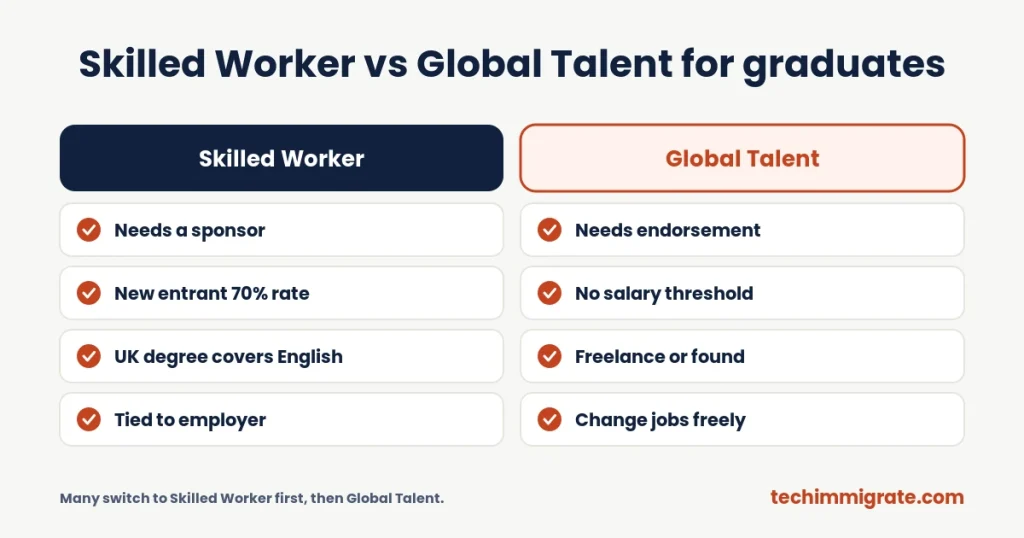
Your Options at a Glance
| Feature | Skilled Worker (new entrant) | Global Talent (exceptional promise) |
|---|---|---|
| What you need | Job offer from a licensed sponsor | Endorsement from Tech Nation |
| Salary rule | 70% of going rate, minimum £33,400 | None |
| English | B2, usually met by your UK degree | None at entry |
| Change jobs freely | No | Yes |
| Freelance or found a company | No | Yes |
| Fee from inside the UK | £943 or £1,865 | £766 in total |
| Settlement under current rules | 5 years | 5 years for exceptional promise |
| Typical difficulty for graduates | Finding a sponsor | Building strong evidence |
Option 1: Skilled Worker
For most tech graduates, Skilled Worker is the most realistic next step. The new entrant rules make it much easier than it would be for an experienced hire.
What you need
- a job offer from an employer on the register of licensed sponsors;
- a certificate of sponsorship from that employer;
- an eligible job, usually at RQF level 6 or above, such as software developer, data engineer or cyber security analyst;
- a salary of at least 70% of the going rate for the occupation, with a minimum of £33,400, because you qualify as a new entrant;
- English at B2, which your UK degree usually meets.
New entrant salaries for tech roles
| Role | Going rate | New entrant rate (approx.) |
|---|---|---|
| Software developer (2134) | £54,700 | £38,300 |
| IT business analyst or architect (2133) | £54,900 | £38,400 |
| Cyber security professional (2135) | £48,500 | £33,950 |
| UX or UI designer (2141) | £43,800 | £33,400 floor |
Check the exact new entrant rate for your occupation code in the official tables.
The 4-year limit
Your total stay on new entrant rates cannot be more than 4 years, including your time on the Graduate visa. If you spend 2 years on the Graduate visa, you have up to 2 years left at new entrant rates. After that, your salary must meet the full going rate to extend. Our guide to the new entrant Skilled Worker rules explains the details.
Pros and cons
Pros: realistic for most graduates, clear requirements, leads to settlement, and many large employers sponsor graduates.
Cons: ties you to your employer, needs a new application to change jobs, and requires salary growth to stay on the route and, under the reforms, to reach a shorter settlement path.
Option 2: Global Talent
Global Talent is the more flexible route, but the evidence bar is higher. Graduates usually apply under exceptional promise, which is for people early in their careers who show potential to become leaders in digital technology.
What Tech Nation looks for
Tech Nation looks for evidence that you stand out, not just that you are a good graduate. For early-career applicants, strong evidence might include:
- founding a start-up that has gained real users, revenue or investment;
- open-source projects with meaningful adoption beyond your own circle;
- winning recognised national or international competitions or hackathons;
- research publications or recognised technical writing;
- speaking at recognised conferences or meetups;
- recommendation letters from recognised experts in the tech sector who know your work.
A strong degree, internships and a good job are not usually enough on their own. Tech Nation looks for recognition beyond your immediate role. That is why many graduates treat Global Talent as a goal for a few years into their career, rather than an immediate next step, while still collecting evidence from the start. Our guide to Global Talent visa eligibility includes a self-check.
Pros and cons
Pros: no sponsor, no salary threshold, freedom to change jobs, freelance or found a company, and leads to settlement.
Cons: harder to qualify for early in your career, takes time to build and present evidence, and endorsement is not guaranteed.
Finding a Sponsor as a Graduate
Graduates often find sponsorship easier than they expect, because the new entrant rate lowers the salary bar. To improve your chances:
- Target graduate schemes at large employers, including tech companies, banks, consultancies and fintechs, many of which sponsor their graduate intake.
- Use the register of licensed sponsors to check employers before you apply. Our guide to the register of licensed sponsors explains how.
- Mention that you qualify as a new entrant in your applications and interviews, so employers know the lower salary rule applies.
- Use your university careers service, which often has relationships with employers that sponsor.
- Network, through alumni, meetups and online communities. Referrals carry weight.
- Consider working for an employer without a licence first, then asking whether it would sponsor you. Some employers apply for a licence for a strong candidate they already know.
Building a Global Talent Case Early
If Global Talent is your goal, start building evidence from your first day on the Graduate visa, or even while studying:
- Ship something people use. A product, tool or library with real adoption is strong evidence.
- Make your work visible. Write about what you build, give talks at meetups, and contribute to open source.
- Get recognised. Enter competitions, apply for awards and fellowships, and seek media coverage for genuine achievements.
- Build relationships with experts. Recommendation letters from recognised people in the sector are central. They need to know your work well.
- Keep records. Save metrics, press coverage, user feedback and evidence of impact as you go.
Even if you switch to Skilled Worker first, this work makes a later Global Talent application much stronger.
Starting a Business on the Graduate Visa
The Graduate visa allows self-employment, so many graduates start companies during it. If your start-up is your main focus, Skilled Worker is not a good fit, because you would need to be employed by a sponsor. Your options are:
- Global Talent, if the company and your role in it show you are an emerging leader;
- Innovator Founder, if you can win an endorsement for the business from an approved body;
- Skilled Worker with your own company as sponsor, which is complex and comes with strict rules.
Plan your route early, because building the evidence for Global Talent or an Innovator Founder endorsement takes time.
Your Family
If your partner and children are with you on your Graduate visa, they can usually switch to being your dependants on Skilled Worker or Global Talent when you switch. Each needs their own application and pays the fee and health surcharge. On both routes, your partner can usually work for almost any employer.
Other Options From the Graduate Visa
Skilled Worker and Global Talent are the main next steps, but not the only ones:
- High Potential Individual: if your degree is from an eligible top-ranked university, HPI gives 2 or 3 years without a sponsor, but it does not lead to settlement and cannot be extended.
- Innovator Founder: for graduates building an innovative business with an endorsement.
- Scale-up: if you join a qualifying fast-growing company, you need sponsorship for the first 6 months only.
- Family routes: if your partner is British or settled, you may be able to switch to a partner visa, which has its own requirements.
For most tech graduates, these are less common than Skilled Worker or Global Talent, but they are worth knowing about.
A Simple Decision Table
| Your situation | Likely next step |
|---|---|
| Offer from a licensed sponsor at the new entrant rate | Skilled Worker now |
| Running a start-up with traction and recognition | Global Talent (exceptional promise) |
| No offer yet, no standout achievements | Keep job hunting for sponsors; build your profile |
| Strong profile but limited time left on Graduate visa | Skilled Worker now, Global Talent later |
| Degree from an eligible top-ranked university and no offer | Consider HPI as a bridge |
What Employers Look For in Graduate Hires
Employers sponsoring graduates are usually looking for potential rather than years of experience. To stand out:
- Show what you have built. Projects, internships and open-source contributions often matter more than grades.
- Show you can work in a team. Group projects, hackathons and internships give you examples to talk about.
- Be clear about your visa. Explain that you are on a Graduate visa, that you can work now without sponsorship, and that you qualify as a new entrant when the time comes to sponsor you.
- Show you are committed to the UK. Employers investing in sponsorship want people who plan to stay.
Being able to start work immediately on your Graduate visa is a real advantage. Some employers hire graduates on their Graduate visa first and sponsor them later, once they have seen their work.
Questions to Ask Yourself Every Few Months
As your Graduate visa runs, revisit these questions regularly:
- How much time is left on my Graduate visa, and on my new entrant allowance?
- Am I closer to a sponsored offer, or to a Global Talent case, than I was 3 months ago?
- Is my current plan still the right one, given what I have learned about the job market?
- What is my backup if my main plan does not work out before my visa ends?
Regular check-ins stop the Graduate visa from slipping away without a plan.
Money: Budgeting for the Switch
Switching costs money, so build it into your plans. For a single graduate switching to Skilled Worker from inside the UK on a 3-year certificate, the visa fee is £943 and the health surcharge is £3,105, a total of £4,048, unless your employer pays some of it. For Global Talent, the total fee is £766 for the main applicant, split between endorsement and visa stages, plus the health surcharge for the length of visa you choose. Many graduate employers cover visa costs as part of their offer, so ask during negotiations.
How to Decide
Work through these questions:
- Do I have standout, recognised achievements in tech? If yes, Global Talent may be realistic now. If not yet, it may be a goal for later.
- Do I have, or can I get, a sponsored offer at the new entrant rate? If yes, Skilled Worker is a straightforward next step.
- How much freedom do I need? If you want to found a start-up or freelance, Global Talent is a much better fit.
- How much time is left on my Graduate visa? If time is short, Skilled Worker with an offer in hand is usually faster.
- What are my settlement plans? Both routes lead to settlement, but your clock starts only when you switch.
Many graduates do not need to choose once and for all. A common path is to switch to Skilled Worker first, build experience and recognition, and then move to Global Talent when their profile is strong enough. Time on both routes can usually be combined towards settlement under the current rules.
Timing Your Switch
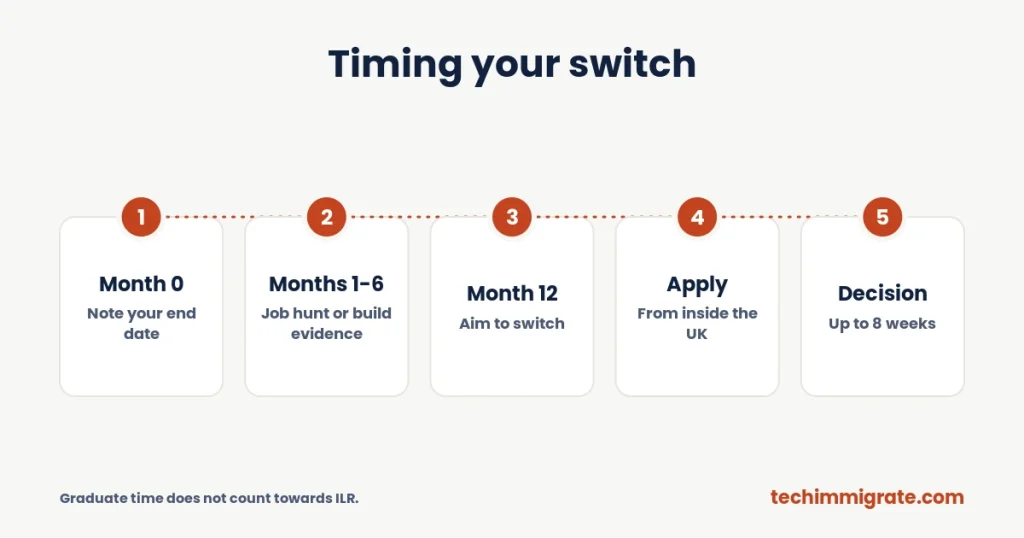
You can switch to Skilled Worker or Global Talent from inside the UK at any time while your Graduate visa is valid. Points to consider:
- Switching early starts your settlement clock sooner, because Graduate visa time does not count towards settlement.
- Switching early preserves new entrant time, because Graduate visa time counts towards the 4-year limit.
- Using more of your Graduate visa gives you freedom to explore roles or build a start-up.
- Allow time for the process: decisions on in-country applications usually take up to 8 weeks.
With an 18-month Graduate visa, which applies to most graduates who apply on or after 1 January 2027, aim to secure your next route within the first year.
The Skilled Worker Switch Step by Step
- Find a role with a licensed sponsor that meets the skill level and new entrant salary rules.
- Your employer assigns an undefined certificate of sponsorship, recording that you qualify as a new entrant.
- Apply online to switch, paying £943 for up to 3 years or £1,865 for longer, plus the health surcharge.
- Prove your identity with the ID Check app or at an appointment.
- Continue working under your Graduate visa while you wait, if your current role allows.
- Receive your decision, usually within 8 weeks.
Our guide to switching to a Skilled Worker visa has more detail.
The Global Talent Switch Step by Step
- Gather evidence and approach referees for recommendation letters.
- Apply to Tech Nation for endorsement under exceptional promise or exceptional talent.
- If endorsed, apply for the Global Talent visa from inside the UK, paying the visa stage fee and health surcharge.
- Receive your decision.
Our guide to switching to the Global Talent visa explains the process.
Settlement After the Switch
Under the current rules:
- Skilled Worker leads to ILR after 5 years on the route.
- Global Talent leads to ILR after 5 years for exceptional promise, or 3 years for exceptional talent.
Under the earned settlement proposals published on 2 November 2026, the default path becomes 10 years, with 5 years for people earning at least £50,271 and 3 years for those earning at least £125,141 or in the highest talent group, which is expected to include Global Talent. For a graduate on a new entrant salary of £38,000, this means salary growth matters a great deal on Skilled Worker. Our guide to the new ILR rules for Skilled Worker visa holders explains the details.
A Worked Example: Graduate to Skilled Worker
A data engineering master's graduate gets a 2-year Graduate visa in November 2026.
- In March 2027, she accepts a graduate role at a large consultancy at £39,000, under code 2134.
- As a new entrant, she needs about £38,300, so her salary qualifies.
- She switches in April 2027, about 5 months into her Graduate visa.
- She has about 3 and a half years of new entrant time left.
She plans for salary growth towards the full going rate, and towards £50,271, to stay on a shorter settlement path under the reforms.
A Worked Example: Graduate to Global Talent
A computer science graduate co-founded a developer productivity tool during his master's. By the time he finishes, it has thousands of active users, a pre-seed investment and coverage in recognised tech media.
- He applies for a Graduate visa to keep working on the start-up.
- He gathers letters from an investor, a well-known founder and a senior engineer at a major tech company who uses the tool.
- After 6 months, he applies to Tech Nation under exceptional promise and is endorsed.
- He switches to Global Talent and continues running his company without needing a sponsor.
A Worked Example: Skilled Worker First, Global Talent Later
A security graduate joins a fintech as a new entrant Skilled Worker. Over 3 years, she discovers and responsibly discloses significant vulnerabilities, speaks at recognised security conferences and leads an open-source security tool.
- She applies for Global Talent and is endorsed under exceptional talent.
- She switches from Skilled Worker to Global Talent, keeping her settlement time under the current rules.
- She now has freedom to move jobs or start consulting.
Common Mistakes
- Waiting until the last months of the Graduate visa. Switching takes time, and time on the Graduate visa does not count towards settlement.
- Not mentioning new entrant status to employers. Many employers assume you need the full going rate.
- Applying for Global Talent too early. A good graduate profile is not enough; you need recognised achievements.
- Ignoring the 4-year new entrant limit. Graduate visa time counts towards it.
- Not planning for salary growth. It matters for extensions and, under the reforms, for settlement.
Yes, from inside the UK, once you have a job offer from a licensed sponsor that meets the rules.
Usually 70% of the going rate for your occupation, with a minimum of £33,400, because you qualify as a new entrant.
Yes, if you get an endorsement from Tech Nation, usually under exceptional promise for early-career applicants.
Switching early starts your settlement clock and preserves new entrant time. Using more of the Graduate visa gives you freedom to explore. It depends on your plans.
No. Your settlement clock starts when you switch to a settlement route.
Yes, and time on both routes can usually be combined towards settlement under the current rules.
Plan Your Next Step Now
The best time to plan your move off the Graduate visa is the day it starts. Decide whether Skilled Worker or Global Talent fits your goals, use the new entrant rules to your advantage, and build your profile so that Global Talent becomes possible if it is not yet. Our role-specific Global Talent guides explain what Tech Nation looks for and how to build evidence from early in your career.
How We Checked This Article
We checked switching rules, new entrant salaries and fees against GOV.UK's pages for the Graduate visa, Skilled Worker and Global Talent in November 2026. Going rates are from the Immigration Rules Appendix Skilled Occupations as reported at the time of writing. Settlement reforms are from law firm summaries of the earned settlement response of 2 November 2026.
Tech Immigrate is independent of the Home Office. This article is general information, not legal advice. Check GOV.UK before you apply.
We write practical guides for tech professionals applying for the UK Global Talent visa. Tech Immigrate is independent of Tech Nation and the Home Office, and our articles are general information, not legal advice. Rules and fees change, so always check gov.uk before you apply.


