How to Apply for the Graduate Visa: Step-by-Step
How to apply for the UK Graduate visa: eligibility, completion reporting, the 2026 deadline, fees, identity checks, dependants and what comes next.


In this article
- Step 1: Check You Are Eligible
- Step 2: Confirm Your Course Completion Has Been Reported
- Step 3: Decide When to Apply
- Step 4: Prepare Your Documents
- Step 5: Fill In the Online Application
- Step 6: Pay the Fee and Health Surcharge
- Step 7: Prove Your Identity
- Step 8: Wait for a Decision
- Step 9: Once Your Visa Is Granted
- If You Had an Official Financial Sponsor
- ID Check App or Appointment?
- If Your Student Visa Has Already Expired
- If Your Application Is Refused
- Starting Work Once You Are Granted
- A Final Checklist Before You Submit
- What Happens to Your Student Visa
- Using Your University's Support
- How the Graduate Visa Fits Into Your Long-Term Plans
- Frequently Overlooked Details
- Choosing Your Start Date for Work
- Applying for Your Partner and Children
- Common Problems and How to Avoid Them
- A Worked Example: A Master's Graduate Applying in 2026
- A Worked Example: A Bachelor's Graduate Applying in 2027
- Planning Beyond the Application
- Get the Timing Right
- How We Checked This Article
Applying for the Graduate visa is one of the simpler UK visa applications. There is no job offer to secure, no salary to meet, no savings to prove and no English test to take. But simple does not mean foolproof. Every year, graduates apply too early, before their university has reported their completion, or too late, after their Student visa has expired. Others are caught out by identity checks, dependants' applications or the switch to an 18-month visa.
This guide walks you through how to apply for the Graduate visa step by step: checking eligibility, timing your application, what to prepare, filling in the online form, proving your identity, paying the fee and health surcharge, what happens while you wait, and what to do once your visa is granted. It also covers the 31 December 2026 deadline for getting a 2-year visa.
Key takeaways
- You must be in the UK, on a Student or Tier 4 (General) visa, and your education provider must have told the Home Office that you have completed your course.
- Apply online before your Student visa expires. You do not need to wait for your graduation ceremony or certificate.
- If you apply on or before 31 December 2026, you get 2 years. If you apply on or after 1 January 2027, you get 18 months. PhD graduates get 3 years.
- The application fee is £937, plus the Immigration Health Surcharge, usually £1,035 per year.
- You will need to prove your identity, either with the UK Immigration: ID Check app or at an appointment.
- Decisions usually take about 8 weeks, and you can stay in the UK while you wait.
- Your partner and children can apply only if they are already in the UK as your dependants.
Step 1: Check You Are Eligible
GOV.UK says you can apply for a Graduate visa if:
- you are in the UK when you apply;
- your current visa is a Student visa or Tier 4 (General) student visa;
- you studied an eligible UK bachelor's degree, postgraduate degree or other eligible course for a minimum period on that visa;
- your education provider has told the Home Office that you have successfully completed the course.
You cannot apply from outside the UK, and you cannot apply if your Student visa has already expired.
If you are not sure whether your course is eligible, or whether you studied for long enough on your Student visa, ask your university's international student advice team. They see these questions every day. Most full bachelor's and master's degrees completed on a Student visa are eligible, but some shorter courses, courses completed partly by distance learning, and some professional qualifications have special rules. If you changed course or took a break in your studies, it is especially worth checking, because the minimum period of study on your Student visa can be affected.
Step 2: Confirm Your Course Completion Has Been Reported
This is the step most often missed. Your university must report to the Home Office that you have successfully completed your course before you apply. You do not need to wait for your graduation ceremony or your degree certificate, but you do need to wait for this report.
To check:
- look for an email from your university confirming that it has reported your completion;
- check your university's international student pages for its reporting timelines;
- contact the international student team directly if you are unsure.
Applying before completion has been reported can lead to delays or refusal.
Step 3: Decide When to Apply
Timing matters in two ways.
Your Student visa expiry date. You must apply before your Student visa expires. Many Student visas end a few months after the course ends, which gives a window to apply. Do not leave it until the final days.
The 2-year vs 18-month change. GOV.UK says the Graduate visa lasts:
| When you apply | Length for bachelor's or master's | Length for PhD |
|---|---|---|
| On or before 31 December 2026 | 2 years | 3 years |
| On or after 1 January 2027 | 18 months | 3 years |
If your course has been completed and reported by late 2026, applying on or before 31 December 2026 secures the longer visa. If your completion will not be reported until 2027, you will get 18 months.
Step 4: Prepare Your Documents
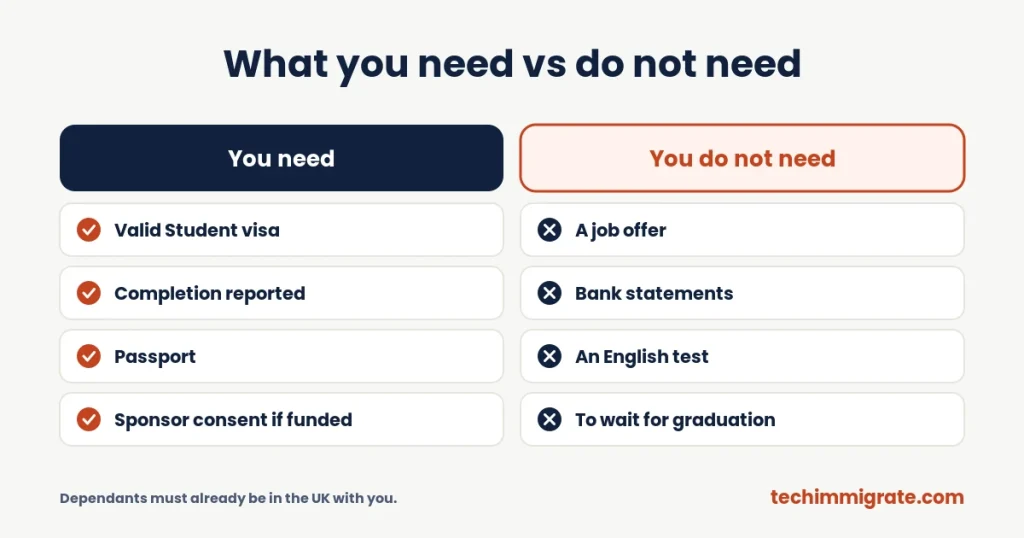
The Graduate visa needs fewer documents than most visas. You will usually need:
- your passport or other valid travel document;
- your Student visa details, available through your UKVI account and eVisa;
- your Confirmation of Acceptance for Studies (CAS) reference number from your Student visa application, if asked;
- evidence of any official financial sponsorship in the last 12 months, if your course was sponsored by a government or international scholarship agency, because you may need their consent.
You do not need:
- a job offer;
- bank statements or proof of funds;
- an English language test.

Step 5: Fill In the Online Application
You apply online on GOV.UK. The form asks for:
- your personal details and passport information;
- your current Student visa and course details;
- your immigration history;
- details of any dependants applying with you;
- your contact details in the UK.
Answer every question accurately and consistently with your previous applications. You can usually save the form and come back to it, so there is no need to rush. If you have had any refusals, breaches or convictions, declare them.
Step 6: Pay the Fee and Health Surcharge
GOV.UK lists:
| Item | Cost |
|---|---|
| Application fee | £937 |
| Immigration Health Surcharge | Usually £1,035 per year |
For a 2-year visa, the total is £937 plus £2,070, or £3,007. For an 18-month visa, the surcharge is usually calculated for one and a half years. For a 3-year PhD visa, the surcharge is £3,105.
You pay online by debit or credit card. If your application is refused or withdrawn before a decision, the surcharge is usually refunded, but the application fee is not.
Step 7: Prove Your Identity
GOV.UK explains that you will need to prove your identity and provide documents. Depending on your nationality and documents, you will either:
- use the UK Immigration: ID Check app on your phone to scan your passport and take a photo; or
- attend an appointment at a UK Visa and Citizenship Application Services centre to give your fingerprints and photo.
If you need an appointment, this can add time to the process, especially in busy periods. Book the earliest slot that suits you.
Step 8: Wait for a Decision
GOV.UK says a decision usually takes about 8 weeks after you have applied, proved your identity and provided your documents. You can stay in the UK while you wait.
While you wait:
- keep to the conditions of your Student visa, including any limits on working hours, until your Graduate visa is granted;
- avoid travelling outside the UK, Ireland, the Channel Islands and the Isle of Man, because leaving may cause your application to be treated as withdrawn;
- respond quickly if the Home Office asks for more information.
Step 9: Once Your Visa Is Granted
GOV.UK says the Graduate visa starts on the day your application is approved. Once it is granted:
- check your eVisa in your UKVI account to make sure the details are correct;
- generate a right-to-work share code for employers;
- note your visa end date and set reminders to plan your next route well before it;
- if you are working, tell your employer about your new status.
You can now work in most jobs, look for work and be self-employed, with no sponsor. Our guide to the UK Graduate visa explains what you can and cannot do.
If You Had an Official Financial Sponsor
If your course was paid for by a government or an international scholarship agency, you may need its written consent to apply for a Graduate visa. This usually applies if you were sponsored within the last 12 months. Check the terms of your scholarship, and ask your sponsor for a consent letter early, because some agencies take time to respond. If you were privately funded or paid your own fees, this does not apply.
ID Check App or Appointment?
The ID Check app is usually quicker and more convenient. You scan your passport chip and take a photo on your phone, and you do not need to travel to a centre. Whether you can use it depends on your nationality and documents, and the application will tell you which route applies.
If you need an appointment, book as soon as you have submitted your form. In busy periods, especially in the summer and around the end of the year when many students finish courses, appointments can be several weeks away. Premium appointments may be available for a fee.
If Your Student Visa Has Already Expired
If your Student visa has expired, you cannot apply for a Graduate visa. The route is only open to people who apply from inside the UK while their Student visa is still valid. If you are in this position, take advice quickly, because overstaying can affect future applications. You may need to leave the UK and consider applying for another route from abroad.
If Your Application Is Refused
Graduate visa refusals are uncommon when the eligibility conditions are met, but they do happen, for example if completion was not reported, the course was not eligible, or there is an immigration history issue. If you are refused:
- read the decision letter carefully to understand the reason;
- check whether you can ask for an administrative review, and note the deadline;
- talk to your university's international student team, especially if the issue relates to completion reporting;
- check whether your Student visa is still valid, because you may still have time to apply for another route.
Starting Work Once You Are Granted
Once your Graduate visa is granted, you can start working in most jobs without restrictions on hours. Practical points:
- National Insurance number. If you do not already have one, apply for it. Many students already have one from part-time work.
- Right-to-work checks. Employers will ask for a share code from your UKVI account and your date of birth.
- Contracts. Because the Graduate visa is time-limited, some employers will offer fixed-term contracts that end with your visa. Others will offer permanent contracts and plan to sponsor you later.
- Self-employment. If you work for yourself, register with HMRC for self-assessment.
A Final Checklist Before You Submit
- My university has reported my course completion to the Home Office.
- My Student visa has not expired, and I am in the UK.
- I have my passport and eVisa details ready.
- If I had an official financial sponsor in the last 12 months, I have its consent.
- I know whether I will use the ID Check app or need an appointment.
- I can pay £937 plus the health surcharge.
- If I have dependants already in the UK, I am applying for them too.
- I have no plans to travel outside the Common Travel Area for the next 8 weeks or so.
What Happens to Your Student Visa
When your Graduate visa is granted, it replaces your Student visa. Your Student visa conditions, such as limits on working hours during term time, stop applying, and the Graduate visa conditions take over. Your university's sponsorship of you ends.
If you decide to study again on a course that needs a Student visa, you would need to apply for a new Student visa, which would end your Graduate visa. Think carefully before doing this, because you cannot get a second Graduate visa.
Using Your University's Support
Universities in the UK have international student advice teams that help with visa questions. Before you apply, they can usually:
- confirm when your completion will be or has been reported;
- check that your course is eligible;
- explain how the 2-year to 18-month change affects you;
- help with questions about official financial sponsors;
- signpost you to careers services for the next stage.
This support is free and usually available until shortly after you graduate, so use it while you can.
How the Graduate Visa Fits Into Your Long-Term Plans
For tech graduates, the Graduate visa is usually the first of several visas. A common pattern is:
- Student visa for your degree.
- Graduate visa for 18 months to 3 years, gaining experience.
- Skilled Worker with a sponsor, or Global Talent if you build a strong track record.
- Indefinite leave to remain after the qualifying period on your settlement route.
- British citizenship, usually 12 months after ILR.
Because the Graduate visa does not count towards settlement, the sooner you move to step 3, the sooner your settlement clock starts.
Frequently Overlooked Details
A few smaller points catch graduates out every year:
- Your passport. If your passport is due to expire soon, consider renewing it before you apply, and update your UKVI account with the new details. Your eVisa needs to be linked to a valid passport for travel.
- Your name. Make sure the name on your application matches your passport exactly, including any middle names.
- Your address. Use a UK address where you can receive post during the application.
- Your email. Use a personal email address rather than your university one, which may be closed after you graduate.
- Your phone number. Make sure you can receive one-time codes for your UKVI account.
- Your course dates. Check the course end date your university has recorded, because it affects when you can apply.
These details seem minor, but mistakes can delay your application or cause problems with your eVisa later.
Choosing Your Start Date for Work
If you already have a job offer for after graduation, think about timing. Until your Graduate visa is granted, you must follow your Student visa conditions, which usually limit how many hours you can work during term time and may restrict certain types of work. Outside term time, after your course has officially ended, you may be able to work full-time on your Student visa in some cases, but check the rules carefully. Once the Graduate visa is granted, the restrictions fall away.
If your employer wants you to start full-time immediately, applying for the Graduate visa as early as possible after completion is reported is the best way to avoid a gap.
Applying for Your Partner and Children
Your partner and children can apply to stay with you on the Graduate route only if they are eligible, which usually means they are already in the UK as your dependants on your Student visa. Each needs their own application and pays the same fee and surcharge. Apply for them at the same time as your own application if possible, and before their current visas expire.
You cannot usually bring new dependants on a Graduate visa.
Common Problems and How to Avoid Them
| Problem | How to avoid it |
|---|---|
| Completion not yet reported | Check with your university before applying |
| Student visa about to expire | Apply well before the expiry date |
| Missing the 31 December 2026 deadline | If eligible, apply before the end of 2026 for 2 years |
| Identity appointment delays | Use the ID Check app if you can, or book early |
| Travelling during the application | Stay in the Common Travel Area until you get a decision |
| Forgetting dependants | Apply for them at the same time |
A Worked Example: A Master's Graduate Applying in 2026
A software engineering master's student finishes her course in September 2026. Her Student visa runs until January 2027.
- In October 2026, her university emails to confirm that it has reported her completion.
- She applies in November 2026, using the ID Check app.
- She pays £937 plus £2,070 health surcharge.
- Her visa is granted in December 2026 for 2 years, because she applied before 31 December 2026.
She now has until December 2028 to find a sponsored job or move to another route.
A Worked Example: A Bachelor's Graduate Applying in 2027
A computer science undergraduate finishes in June 2027.
- His university reports his completion in July 2027.
- He applies in August 2027 and receives an 18-month visa.
- He immediately starts planning his next step, aiming to switch to Skilled Worker within 12 months.
Because he only has 18 months, he targets employers that sponsor graduates and mentions in applications that he qualifies for the new entrant salary rate.
Planning Beyond the Application
The Graduate visa cannot be extended, and it does not lead to settlement. Under the earned settlement proposals published on 2 November 2026, time on the Graduate route would not count towards settlement at all. Use your time well:
- start looking for a sponsored role early if you want to move to Skilled Worker;
- build your portfolio and public profile if you are aiming for Global Talent;
- keep track of how much new entrant time you are using, because Graduate visa time counts towards the 4-year limit;
- switch to your next route well before your Graduate visa ends, allowing up to 8 weeks for a decision.
Our guides to switching to a Skilled Worker visa and the new entrant Skilled Worker rules explain the most common next step.
Once your education provider has told the Home Office you have completed your course, and before your Student visa expires.
No. You only need your provider to have reported your completion.
£937, plus the Immigration Health Surcharge, usually £1,035 per year.
2 years if you apply on or before 31 December 2026, 18 months if you apply on or after 1 January 2027, and 3 years for PhD graduates.
No. Neither is required.
You must keep to the conditions of your Student visa until your Graduate visa is granted.
Avoid travelling outside the Common Travel Area, because it may cause your application to be withdrawn.
Get the Timing Right
The Graduate visa application is straightforward if you get the timing right: wait for your completion to be reported, apply before your Student visa expires, and, if you can, apply before 31 December 2026 to secure 2 years. Then start planning your next route from day one. If you are building a strong profile in tech, our role-specific Global Talent guides explain what Tech Nation looks for.
How We Checked This Article
We checked eligibility, timing, fees, identity checks and decision times against GOV.UK's Graduate visa pages in November 2026. Settlement reforms are from law firm summaries of the earned settlement response of 2 November 2026.
Tech Immigrate is independent of the Home Office. This article is general information, not legal advice. Check GOV.UK before you apply.
We write practical guides for tech professionals applying for the UK Global Talent visa. Tech Immigrate is independent of Tech Nation and the Home Office, and our articles are general information, not legal advice. Rules and fees change, so always check gov.uk before you apply.