Graduate Jobs With Visa Sponsorship in the UK: How to Find Them
How to find graduate jobs with visa sponsorship in the UK: new entrant salary rules, which employers sponsor graduates, timing and how to approach them.


In this article
- How Sponsorship Works for Graduates
- New Entrant Salary Rules
- Where Graduates Find Sponsored Roles
- When to Start Looking
- Why Graduate Sponsorship Feels Hard
- How New Entrant Status Works
- Why New Entrant Rates Matter in Tech
- Degree-Level Roles
- English Requirement
- Graduate Schemes at Large Employers
- Scale-ups and Startups
- Using Your University Careers Service
- Using the Register of Licensed Sponsors
- How to Raise Sponsorship With Employers
- Switching Directly From a Student Visa
- Using the Graduate Visa First
- Internships and Placements
- Building a Strong Application
- Applicant-Reported Experiences
- Our Summary
- A Fictional Example
- A Timeline for Your Final Year
- Understanding Your Offer Letter
- What Employers Pay to Sponsor You
- Graduate Roles in Non-Tech Companies
- Regional Opportunities
- Handling Rejections
- What if No Sponsored Offer Comes
- Building Towards Global Talent From Your First Job
- Keeping Your Status in Order
- Questions to Ask at Interview
- Graduate Roles That Often Sponsor
- Postgraduate and PhD Graduates
- The Cost of Waiting Too Long
- Key Points to Remember
- Networking for Sponsored Roles
- Preparing Your Documents Early
- Final Thoughts
- Your Next Step
- How We Checked This Article
For international graduates, finding a first job that offers visa sponsorship can feel like the hardest part of building a career in the UK. Many graduate roles are advertised without mentioning sponsorship, some employers avoid it, and the rules on skill level, salary and English have tightened. But sponsored graduate jobs do exist, especially in tech, and the new entrant rules make it easier for employers to sponsor graduates at lower salaries than experienced hires.
This guide explains how graduate jobs with sponsorship work, which kinds of employers and roles usually sponsor graduates, how new entrant salary rules help, when to start looking and how to approach employers. For a broader view of tech roles, see our guide to tech jobs with visa sponsorship.
Key takeaways
- Graduate jobs can be sponsored under the Skilled Worker route if the employer holds a licence and the role meets the rules.
- New entrants can be paid 70% of the going rate for their occupation, with a floor of £33,400, for up to 4 years including time on a Graduate visa.
- Since July 2025, sponsored roles generally need to be at degree level, which most graduate tech roles are.
- New Skilled Worker applicants need English at B2 level, which many UK graduates can meet through their degree.
- Large graduate schemes in tech, finance and consulting are among the most reliable sponsors of graduates.
- Students can usually switch to Skilled Worker once their course is complete, without needing a Graduate visa first.
How Sponsorship Works for Graduates
The employer must hold a sponsor licence, assign a certificate of sponsorship and pay at least the required salary. You apply for the Skilled Worker visa, usually from inside the UK if you are on a Student or Graduate visa.
New Entrant Salary Rules
| Rule | What it means |
|---|---|
| Who qualifies | Under 26, recent graduates, people switching from Student or Graduate, and some others |
| Salary | At least 70% of the going rate, and at least £33,400 |
| Time limit | Up to 4 years in total, including Graduate visa time |
Where Graduates Find Sponsored Roles
- Graduate schemes at large tech firms, banks and consultancies.
- Scale-ups with sponsor licences and graduate hiring.
- University careers services and graduate job fairs.
- The register of licensed sponsors, combined with job boards.
When to Start Looking
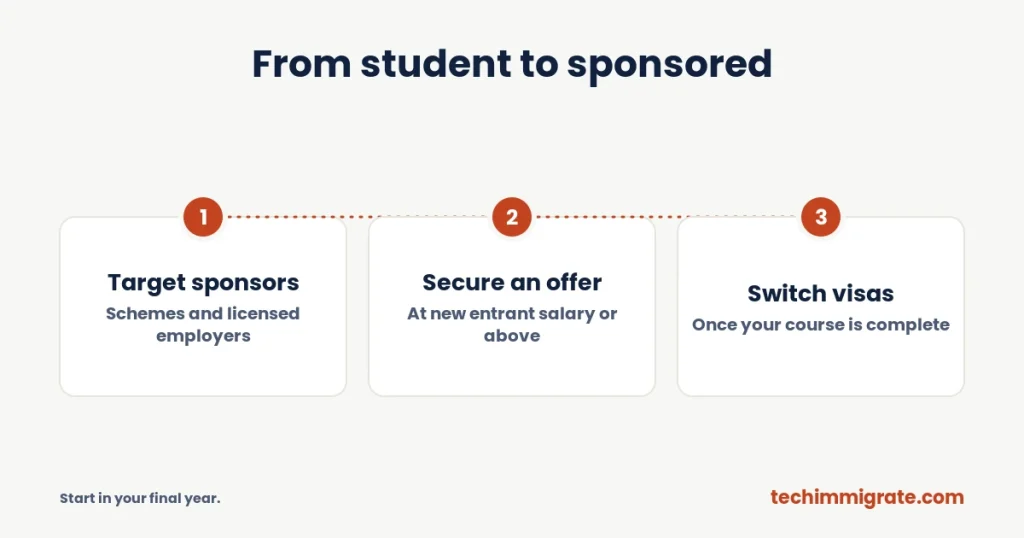
Many graduate schemes recruit a year ahead. Starting in your final year gives you the best chance of a sponsored offer before your course ends.
Yes, under Skilled Worker, if the employer is licensed and the role meets the rules.
New entrants usually need at least 70% of the going rate and at least £33,400.
No. Students can usually switch straight to Skilled Worker once their course is complete.
Often large graduate schemes in tech, finance and consulting, plus some scale-ups.
Ideally in your final year, as many schemes recruit early.
Why Graduate Sponsorship Feels Hard
Many international graduates apply for dozens of roles before finding one that offers sponsorship. Part of the reason is that sponsorship costs employers money and time, and some prefer candidates who already have the right to work. Another part is information: many adverts do not say whether sponsorship is available, so graduates waste time on roles that were never an option. The good news is that sponsorship for graduates is common in some sectors, and the rules have been designed to make it easier for employers to hire new entrants. With a focused search and good timing, many graduates do secure sponsored roles.
How New Entrant Status Works
New entrant status lets employers sponsor graduates at a lower salary than they would pay an experienced worker. You can usually qualify if you are under twenty-six on the date you apply, if you are switching from a Student or Graduate visa, if you have recently graduated or are working towards a recognised professional qualification, or in some other situations. As a new entrant, you can be paid at least seventy per cent of the going rate for your occupation, with a floor of thirty-three thousand four hundred pounds. New entrant status lasts up to four years in total, including any time on a Graduate visa.
Why New Entrant Rates Matter in Tech
Going rates for some tech occupations are high, reflecting the salaries of experienced professionals. Without new entrant rates, many graduate roles would not meet the salary rules. With them, a graduate software developer or data analyst can often be sponsored at a typical graduate salary. Check the going rate for your occupation code and work out seventy per cent of it, then compare with the offer. If the offer meets the higher of that figure and the floor, it is likely to satisfy the salary rules.
Degree-Level Roles
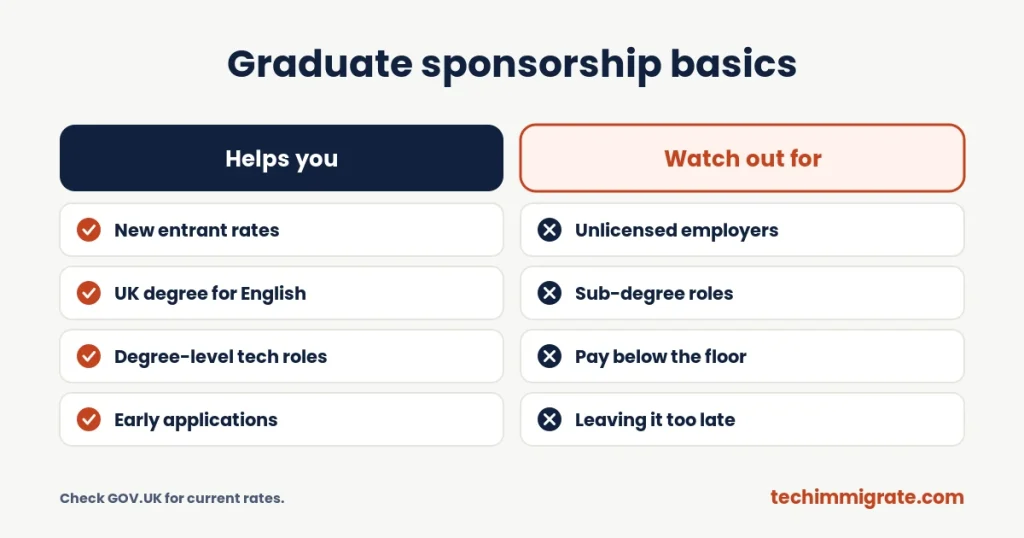
Since July 2025, new Skilled Worker applicants generally need a job at degree level, unless the role is on a shortage list. Most graduate tech roles, such as software development, data science, cyber security and IT business analysis, are at degree level. Some roles, such as IT support or helpdesk positions, may not be. Before accepting a role you hope will be sponsored, check that its occupation code is eligible.
English Requirement
New Skilled Worker main applicants need English at B2 level. Many UK graduates can meet this through their degree, but you may need confirmation from Ecctis that your degree was taught in English to the required level, or rely on other accepted evidence. Check how you will prove your English before you apply, so it does not delay your switch.
Graduate Schemes at Large Employers
Large employers with established graduate schemes are among the most reliable sponsors of graduates. Many banks, consultancies, technology companies and engineering firms sponsor graduates every year and have processes to handle it. Their schemes often recruit up to a year in advance, with applications opening in the autumn for roles starting the following summer or autumn. If you want a sponsored graduate scheme, start applying early in your final year.
Scale-ups and Startups
Some scale-ups and startups hold sponsor licences and hire graduates. They may recruit more flexibly than large schemes, sometimes filling roles within weeks. They may also offer more varied work and faster progression. Check whether a company holds a licence before investing time in its process, and ask early whether the role can be sponsored.
Using Your University Careers Service
University careers services often have lists of employers that sponsor international graduates, run events with those employers and offer advice on applications. Some host specific sessions on sponsorship and visas. These services are usually free for students and often for recent graduates too. Use them early.
Using the Register of Licensed Sponsors
The Home Office publishes a register of licensed sponsors. Combine it with job boards and industry lists to find employers in your field that can sponsor. Our guide to finding sponsor companies by sector explains how to turn the register into a useful shortlist.
How to Raise Sponsorship With Employers
Raise sponsorship early but positively. A simple line in your application or first conversation, explaining that you will need Skilled Worker sponsorship and that you qualify as a new entrant, can save time on both sides. Some application forms ask directly. Answer honestly, because misleading an employer can backfire later.
Switching Directly From a Student Visa
If you secure a sponsored offer before your Student visa ends, you can usually switch straight to Skilled Worker once your course is complete, or after at least twenty-four months of a PhD. That saves the cost of a Graduate visa and starts your settlement clock sooner. It also means your new entrant period starts earlier.
Using the Graduate Visa First
Many graduates use the Graduate visa to find a role, gain experience and then switch to Skilled Worker. This gives freedom to work for non-sponsoring employers at first. Remember that time on the Graduate visa counts towards the four-year new entrant limit, so do not leave the switch too late if you rely on new entrant rates.
Internships and Placements
Internships and placement years during your degree can lead to graduate offers, often with sponsorship if the employer holds a licence. Many large employers use internships as a pipeline for graduate hires. If your course allows a placement, target employers that sponsor graduates.
Building a Strong Application
Graduate roles are competitive. Show evidence of skills through projects, internships, hackathons, open-source contributions and relevant coursework. Tailor your CV to each role. Prepare for technical interviews and assessment centres. A strong application makes an employer more willing to invest in sponsorship.
Applicant-Reported Experiences
On forums, international graduates often report that persistence and early applications made the difference. Many say they found sponsored roles through graduate schemes, referrals or university careers events rather than general job boards. These are applicant-reported experiences, not official data, but they reflect common patterns.
Our Summary
Graduate jobs with sponsorship exist, especially in tech. Target licensed employers, understand new entrant rates, start early and be clear about your needs. With the right approach, a sponsored first role is achievable.
A Fictional Example
Consider a fictional computer science graduate who begins applying to graduate schemes in October of their final year. They target ten large employers known to sponsor and a handful of scale-ups from the register. By February, they have an offer from a fintech graduate scheme starting in September, at a salary above the new entrant floor. Their course ends in June and completion is reported in July. They switch from their Student visa to Skilled Worker in July, skipping the Graduate visa. The example is fictional, but it shows how early applications and targeting sponsors can lead to a smooth switch.
A Timeline for Your Final Year
A simple timeline can keep your search on track. At the start of your final year, research employers that sponsor graduates, check the register and make a target list. In the autumn, apply to graduate schemes, many of which close by the end of the year. Through the winter, prepare for online tests, interviews and assessment centres. In the spring, follow up on offers, check the occupation code and salary, and confirm that the employer will sponsor you. In the summer, once your course is complete and your university has reported it, work with your employer on the certificate of sponsorship and your Skilled Worker application. If you do not secure a sponsored offer by the end of your course, the Graduate visa can give you more time. Treat the timeline as a guide rather than a rule, but starting early almost always helps.
Understanding Your Offer Letter
When you receive an offer, read it carefully. Check the job title, duties, salary, working hours and start date. Ask the employer which occupation code they plan to use. Compare the salary with the going rate for that code and the new entrant floor. Make sure the offer says that sponsorship will be provided, or confirm it in writing. If anything is unclear, ask before you accept. A clear, accurate offer makes the certificate of sponsorship and your visa application straightforward.
What Employers Pay to Sponsor You
It helps to understand what sponsorship costs an employer. They need a sponsor licence and pay a fee for each certificate of sponsorship. They also pay the Immigration Skills Charge, which for large sponsors is over a thousand pounds for the first year alone, and cannot be passed to you. Some employers also pay your visa fee and health surcharge. Knowing these costs helps you appreciate why employers are selective, and why a strong application matters.
Graduate Roles in Non-Tech Companies
Tech graduates are not limited to tech companies. Banks, retailers, manufacturers, healthcare organisations and public bodies all hire software developers, data analysts and cyber security graduates. Many of these organisations hold sponsor licences. Broadening your search beyond pure tech firms can increase your chances, especially if you are interested in applying technology to a particular industry.
Regional Opportunities
Sponsored graduate roles are not only in London. Many tech and finance employers run graduate schemes in Manchester, Leeds, Birmingham, Bristol, Edinburgh, Glasgow, Belfast and other cities. Competition may be lower and living costs cheaper outside the capital. Use the register's town and city column to find sponsors in regions that interest you.
Handling Rejections
Rejection is a normal part of graduate job hunting, especially when sponsorship narrows the field. Ask for feedback where possible, adjust your applications and keep going. Track your applications so you can see patterns, such as which sectors respond best. Many graduates who eventually secure sponsored roles faced many rejections first.
What if No Sponsored Offer Comes
If you do not secure a sponsored offer before your course ends, the Graduate visa gives you more time to look while working for any employer. You can gain experience in a non-sponsoring role, then apply for sponsored roles with a stronger CV. If your time on the Graduate visa runs low, consider other routes, such as Global Talent if your record is strong, or roles in other countries. Keep your options open and plan ahead.
Building Towards Global Talent From Your First Job
Even in a sponsored role, you can build towards Global Talent. Contribute to open source, speak at meetups, write technical articles, mentor others and take on visible projects. Over a few years, this record can support an endorsement application. Global Talent would then free you from dependence on a sponsor, which can make changing jobs much easier.
Keeping Your Status in Order
Once sponsored, follow your visa conditions. Work in the role your employer sponsored you for, tell them about changes in your circumstances and keep your documents up to date. If you want to change employer, you will usually need a new certificate of sponsorship and a new application before you start the new job. Good records now make future applications, including settlement, much easier.
Questions to Ask at Interview
At interview, it is reasonable to ask practical questions about sponsorship. How many graduates has the company sponsored before? Who handles the process? Will they cover visa costs? What happens if the visa takes longer than expected? Asking shows you understand the process and helps you judge whether the employer is ready to support you.
Graduate Roles That Often Sponsor
Within tech, some graduate roles are sponsored more often than others. Graduate software engineers and developers are among the most common, because demand is high and the roles clearly sit at degree level. Graduate data analysts and data scientists are also frequently sponsored, especially in finance, retail and consulting. Cyber security graduate programmes, often run by large firms and consultancies, regularly hire international graduates. Technology consulting and IT business analyst schemes are another common route. Product and design graduate roles are sponsored less often, partly because there are fewer of them and partly because occupation codes vary. If you have flexibility in what you apply for, focusing on the roles most often sponsored can improve your odds, while still building towards the career you want in the long run.
Postgraduate and PhD Graduates
If you have a master's or PhD, you may still qualify as a new entrant, especially if you are switching from a Student or Graduate visa. PhD holders may also qualify for separate salary reductions if their doctorate is relevant to the job. Research-heavy roles at universities or research organisations may fall into different occupation codes with different going rates. If you hold a PhD in a relevant field, check whether a PhD reduction or new entrant rate gives the better outcome for your offer.
The Cost of Waiting Too Long
The new entrant period is limited, and time on the Graduate visa counts towards it. If you spend most of a Graduate visa in non-sponsored roles before seeking sponsorship, you may have less new entrant time left, which can mean your employer must pay a higher salary sooner. Planning your switch with the new entrant clock in mind helps keep your options open.
Key Points to Remember
Target licensed employers, start early, understand new entrant rates, check the occupation code and salary, prepare your English evidence and switch before your current visa expires. These simple points cover most of what makes graduate sponsorship succeed.
Networking for Sponsored Roles
Many graduate roles, including sponsored ones, are filled through networks rather than open applications. Attend employer events on campus, tech meetups, hackathons and industry conferences, many of which offer free or discounted student tickets. Connect with alumni from your university who work at companies that sponsor, and ask them about their experience of being hired. Engineers and recruiters are often happy to give advice to graduates who approach them thoughtfully. A referral from a current employee can move your application to the top of the pile and make an employer more comfortable investing in sponsorship. Networking takes time, so start during your studies rather than after your course ends, and keep in touch with the people you meet.
Preparing Your Documents Early
While you search, prepare the documents your Skilled Worker application will need. Check that your passport is valid for the length of the visa you expect. Arrange proof of English, such as Ecctis confirmation of your degree, if you need it. Keep your university completion confirmation and transcripts to hand. If you are applying from inside the UK and have held permission for at least twelve months, you usually do not need maintenance funds, but check the rules for your situation. Having these ready means you can apply as soon as your employer assigns your certificate.
Final Thoughts
Finding a sponsored graduate job takes effort, but it is very achievable in tech. Focus your energy on employers who sponsor, understand the rules that help you, and give yourself time. Each application, interview and connection builds towards the role that starts your UK career.
Your Next Step
If you build a strong record in your first roles, Global Talent could later give you freedom from sponsorship. Our role-specific Global Talent guides explain what Tech Nation looks for.
How We Checked This Article
We checked new entrant and sponsorship rules against GOV.UK's Skilled Worker visa pages and the Immigration Rules Appendix Skilled Worker in November 2026.
Tech Immigrate is independent of the Home Office. This article is general information, not legal advice. Check GOV.UK before you apply.
We write practical guides for tech professionals applying for the UK Global Talent visa. Tech Immigrate is independent of Tech Nation and the Home Office, and our articles are general information, not legal advice. Rules and fees change, so always check gov.uk before you apply.