
How Long Is the Global Talent Visa? Choosing Between 1 and 5 Years
Global Talent visa duration explained: how to choose 1 to 5 years, the health surcharge cost of each option, settlement timing and family visas.


In this article
- How Long Does the Global Talent Visa Last?
- The Cost of Each Visa Length
- How Visa Length Interacts With Settlement
- How to Choose the Right Length
- Visa Length and Absences From the UK
- Visa Length and Your Family
- Can You Change the Length Later?
- What You Pay When You Extend
- How the Surcharge Is Paid and What It Gives You
- Planning Backwards From Your Settlement Date
- Worked Examples
- Visa Length When You Switch From Inside the UK
- Visa Length and Your Career Plans
- What Happens to Your eVisa
- A Quick Decision Checklist
- Common Mistakes When Choosing a Visa Length
- Practical Tips
- Your Next Step
- How We Checked This Article
When you apply for the Global Talent visa, you choose how long you want it to last. You can ask for anything from 1 year up to 5 years in a single grant. It looks like a small box on a form, but it is one of the most expensive decisions in the whole process. The length you choose decides how much Immigration Health Surcharge you pay up front, how soon you need to extend, and whether you end up paying for years you never use.
This guide explains how long the Global Talent visa lasts, how to choose the right length for your plans, what each option really costs, how the choice interacts with settlement, and what happens to your family's visas. It focuses on the digital technology route, but the rules on visa length apply across all Global Talent fields.
Key takeaways
- You can choose a Global Talent visa of up to 5 years in a single grant, and you can extend as many times as you like.
- The Immigration Health Surcharge is the biggest cost that changes with visa length: usually £1,035 per year for an adult.
- GOV.UK says you will not get a surcharge refund if you apply for indefinite leave to remain before your visa ends. Unused years are lost.
- If you expect to settle after 3 years, a visa of around 3 years usually costs less than a 5-year visa.
- A longer visa gives you more security and fewer applications, which can be worth paying for if your plans are uncertain.
- Your dependants' visas usually end at the same time as yours, so their length follows your choice.
How Long Does the Global Talent Visa Last?
GOV.UK says you can stay in the UK for up to 5 years at a time on a Global Talent visa, and that there is no limit on how many times you can extend it. You choose the length when you apply for the visa at Stage 2, in whole years, from 1 to 5.
Your endorsement does not fix your visa length. Whether you are endorsed under Exceptional Talent or Exceptional Promise, you can choose any length up to 5 years. The level of endorsement affects how soon you can settle, not how long a single visa can last.
What happens when the visa ends
Before your visa ends, you have three main options:
- Extend it. You can apply to extend for up to another 5 years, as long as your endorsement has not been withdrawn.
- Settle. If you have been in the UK long enough and meet the requirements, you can apply for indefinite leave to remain.
- Leave or switch. You can leave the UK, or switch to another visa if you qualify.
Our guide to extending the Global Talent visa covers the extension process in detail.
The Cost of Each Visa Length
The visa fee itself does not change with length. The main applicant pays £205 for the visa (on top of the £561 endorsement fee). What changes is the Immigration Health Surcharge, which you pay up front for the full length of the visa.
| Visa length | Fees (endorsement + visa) | Health surcharge (adult) | Total up front |
|---|---|---|---|
| 1 year | £766 | £1,035 | £1,801 |
| 2 years | £766 | £2,070 | £2,836 |
| 3 years | £766 | £3,105 | £3,871 |
| 4 years | £766 | £4,140 | £4,906 |
| 5 years | £766 | £5,175 | £5,941 |
These figures are for one adult. Each dependant adds £766 in fees plus their own surcharge, usually £1,035 per year for an adult and £776 per year for a child under 18.
Why short visas can cost more in the long run
A 1-year visa looks cheap, but you will need to extend sooner. Each extension means another visa fee for each person, another application, another identity check and another wait for a decision. If you keep extending in short steps, the fees and the time add up. Check GOV.UK for the current extension fee before you plan around it.
Why long visas can waste money
A 5-year visa is the most convenient, but you pay the surcharge for all 5 years at once. If you settle before the visa ends, you lose the surcharge for the unused years. GOV.UK lists applying for indefinite leave to remain as one of the situations where you will not get a refund.
How Visa Length Interacts With Settlement
This is the most important part of the decision for most people.
Settling after 3 years
Under the current rules, you can apply for indefinite leave to remain after 3 years if you were endorsed under Exceptional Talent, or under Exceptional Promise by one of the research endorsing bodies (the Royal Society, British Academy, Royal Academy of Engineering or UKRI). If you are confident you will settle at 3 years, a 3-year visa is usually the most cost-effective choice.
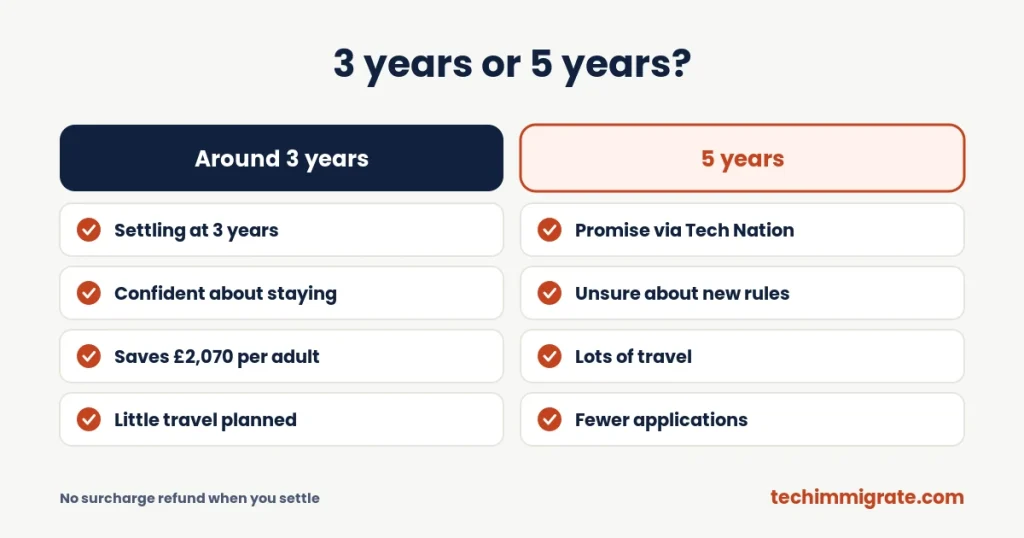
If you take a 5-year visa and settle at 3 years, the surcharge for the last 2 years is wasted. For one adult, that is £2,070. For a family of two adults and two children, it is over £7,200.
Settling after 5 years
If you were endorsed under Exceptional Promise by Tech Nation, you can currently settle after 5 years. In that case, a 5-year visa matches your settlement date and avoids an extension altogether. It is usually the simplest and cheapest option.
Applying early for settlement
You can usually apply for settlement up to 28 days before you complete the qualifying period. This gives you a small buffer, but it does not change the basic calculation. You still need your visa to last until you have completed enough time in the UK.
What the earned settlement reforms might mean
The government's response to the earned settlement consultation, published on 2 November 2026, sets out changes to settlement from 2027. Talent routes such as Global Talent are expected to keep a short path to settlement, but the details are still being defined, including exactly who will fall into the Highest Talent Group. If you are not sure whether you will be able to settle at 3 years under the new rules, a longer visa gives you a safety margin.
How to Choose the Right Length
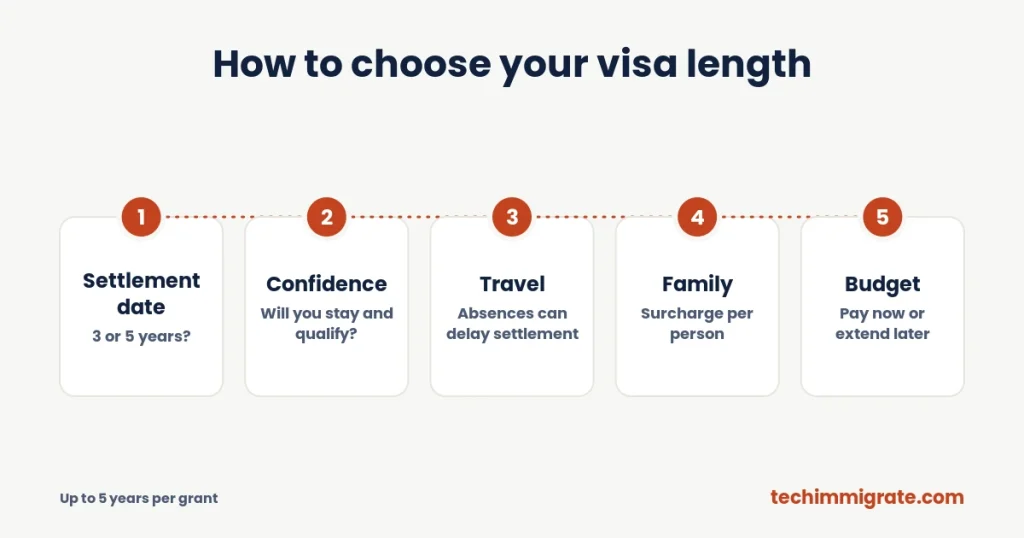
There is no single right answer. The best length depends on your settlement plans, your confidence in staying, your budget and your family.
Choose around 3 years if
- You were endorsed under Exceptional Talent, or under Exceptional Promise by a research body.
- You are confident you will stay in the UK and meet the settlement requirements.
- You want to avoid paying surcharge for years you will not use.
Choose 5 years if
- You were endorsed under Exceptional Promise by Tech Nation and expect to settle at 5 years.
- You are unsure about settlement, for example because the rules may change, or you may spend long periods abroad.
- You value certainty and want to avoid the cost and stress of extensions.
Choose a shorter visa if
- You are not sure you will stay in the UK long term.
- You want to test life in the UK before committing.
- Your budget is tight and you would rather spread the surcharge over time.
Think about the risk of falling short
A visa that ends just as you become eligible to settle is efficient, but it leaves little room for error. If something delays your settlement application, such as a long trip abroad that breaks the absence rules, or a change in the rules, you may need to extend at short notice. Some people deliberately choose 4 years when they expect to settle at 3, as a middle path between cost and security.
Visa Length and Absences From the UK
To settle, you normally must not spend more than 180 days outside the UK in any 12-month period. If you expect to travel a lot, for example for work, family or long holidays, there is a chance you will not meet the continuous residence requirement at the earliest possible date. In that case, a longer visa can save you from a rushed extension.
Keep a record of every trip from the day you arrive. It will help you decide when you can settle, and it will make the settlement application easier.
Visa Length and Your Family
If your partner and children come with you as dependants, their visas usually last until the same date as yours. If you choose a 3-year visa, their visas will also end after about 3 years. When you extend or settle, they will usually need to apply too.
This matters for the cost. The surcharge is charged per person, so for a family, the gap between a 3-year and a 5-year visa can be several thousand pounds.
| Family | 3-year visas: surcharge | 5-year visas: surcharge | Difference |
|---|---|---|---|
| One adult | £3,105 | £5,175 | £2,070 |
| Two adults | £6,210 | £10,350 | £4,140 |
| Two adults, one child | £8,538 | £14,230 | £5,692 |
| Two adults, two children | £10,866 | £18,110 | £7,244 |
The settlement timeline for dependants also matters. Partners of Global Talent holders currently usually settle after 5 years, even if the main applicant settles at 3. If your partner needs more time in the UK to settle, their visa may need to be extended after you settle. Our guide to Global Talent visa dependants explains how this works.
Can You Change the Length Later?
You cannot extend a visa simply by paying for more years. To stay longer, you must make an extension application. You also cannot shorten a visa to get a refund. If you leave the UK before your visa ends, GOV.UK says you will not get a surcharge refund.
If you switch to another visa in the UK and end up paying the surcharge twice for the same period, you may get a partial refund. GOV.UK says overlapping periods of 6 months or more are refunded, rounded down to the nearest 6 months, and shorter overlaps are not refunded.
What You Pay When You Extend
Extending a Global Talent visa means a new application with a visa fee and a new surcharge payment for the extra time. You do not need a new endorsement unless your endorsement has been withdrawn, but you must still meet the requirements, including that you have earned money in your field if you are on the digital technology route. Decisions on extensions usually take about 8 weeks, and you should not travel outside the UK while an extension is pending if you want to keep your application on track.
Our article on how to extend your Global Talent visa explains the process and the costs in full.
How the Surcharge Is Paid and What It Gives You
The Immigration Health Surcharge is paid online as part of your visa application, before you book your identity appointment. You pay the full amount for the whole visa length in one go, for yourself and each dependant. Once your visa is granted, you can use the NHS in broadly the same way as a UK resident, although you may still pay for some things, such as prescriptions in England, dental treatment and eye tests, as other residents do.
Because the surcharge is paid up front, the length you choose has a direct effect on your cash flow at the point of moving, which is often when costs are highest. Flights, a rental deposit, furniture and school uniforms all arrive at the same time. If cash is tight, a shorter first visa can ease the pressure, even if it costs a little more over time.
Planning Backwards From Your Settlement Date
A simple way to choose is to work backwards.
- Step 1: Write down the date you arrive in the UK, or the date your visa starts if you are switching.
- Step 2: Add 3 or 5 years, depending on your settlement period. This is your earliest settlement date.
- Step 3: Add a buffer for possible delays, such as travel that pushes you over the absence limits or changes to the rules.
- Step 4: Choose the visa length that covers this date with the buffer you are comfortable with.
- Step 5: Put reminders in your calendar for 6 months and 3 months before your visa ends, so you can prepare your settlement or extension application in good time.
This approach keeps you focused on the real goal, which for most people is settlement, rather than on the visa itself.
Worked Examples
These fictional examples show how different people might choose.
Aisha: Exceptional Talent, confident about staying
Aisha is a senior engineering manager endorsed under Exceptional Talent. She plans to stay in the UK permanently and rarely travels for long. She chooses a 3-year visa, saving £2,070 compared with a 5-year visa, and applies for settlement as soon as she reaches 3 years.
Ben: Exceptional Promise via Tech Nation
Ben is a product manager endorsed under Exceptional Promise by Tech Nation. Under the current rules, he can settle after 5 years. He chooses a 5-year visa, which avoids an extension and matches his settlement date.
Carla: Exceptional Talent, but unsure
Carla is endorsed under Exceptional Talent but may move back home if a family member's health changes. She also travels a lot for work. She chooses a 2-year visa to keep her up-front costs down, accepting that she may need to extend before she can settle.
The Okoro family: two adults and two children
The main applicant is endorsed under Exceptional Talent. The family chooses 4-year visas: long enough to cover the 3-year settlement date with a year of buffer in case of delays, while saving over £3,600 in surcharge compared with 5-year visas.
These examples are fictional and simplified. Surcharge figures are based on the current rates of £1,035 per year for adults and £776 per year for children.
Visa Length When You Switch From Inside the UK
If you are already in the UK on another visa, such as a Skilled Worker or Graduate visa, and switch to Global Talent, the length you choose works in the same way. But there are two extra points to consider.
First, time on some previous visas may count towards settlement. GOV.UK's continuous residence guidance allows time on certain routes, such as Skilled Worker, to be combined with Global Talent time in some circumstances. If you are close to settlement already, you may need a shorter Global Talent visa than you think. Check the rules for your situation before you choose.
Second, if you have already paid the surcharge for your current visa, switching means paying again for the new visa. If the two periods overlap by 6 months or more, GOV.UK says you may get a partial refund, rounded down to the nearest 6 months. Overlaps of less than 6 months are not refunded. Our guide to switching to the Global Talent visa explains the process.
Visa Length and Your Career Plans
Your work plans can also shape the right choice.
- If you are starting a company, a longer visa gives you stability while the business grows, and saves you from preparing an extension at a busy time.
- If you are contracting or freelancing, remember that you will need to show you have earned money in your field when you extend or settle. A longer visa gives you more time to build that record.
- If you expect a role abroad, such as a secondment, think about how the absence rules will affect settlement, and whether a longer visa would protect you.
- If you are joining a UK employer, your visa is not tied to them, so their plans do not limit your choice. But a stable job can make settlement more predictable.
What Happens to Your eVisa
Your Global Talent status is held as an eVisa in your UKVI account. It shows the date your permission ends. Employers and landlords check your status online using share codes, and they may need to recheck before your visa expires. A longer visa means fewer rechecks. When you extend or settle, your eVisa is updated with your new status. Our guide to the UK eVisa explains how this works.
A Quick Decision Checklist
Answer these questions in order, and the right length usually becomes clear.
- When can I settle under the current rules? 3 years or 5 years, depending on your level and endorsing body.
- How confident am I that I will stay and meet the settlement requirements? If very confident, match your visa to your settlement date.
- How much do I expect to travel? If a lot, add a buffer.
- How many dependants are coming with me? The more people, the more each extra year costs.
- What can I afford up front? If budget is tight, a shorter visa spreads the cost, at the price of an extra application later.
Common Mistakes When Choosing a Visa Length
- Choosing 5 years by default. If you will settle at 3 years, you may waste thousands in surcharge.
- Choosing exactly 3 years with no margin. If your settlement is delayed, you will need a rushed extension.
- Forgetting the family cost. The surcharge multiplies with every dependant.
- Assuming you can get a refund later. There is no refund for unused years when you settle or leave early.
- Ignoring absences. Long trips abroad can delay settlement, so a longer visa may be wiser.
- Assuming dependants settle when you do. Partners usually need 5 years, even if you settle at 3.
Practical Tips
- Decide on your settlement plan first. Then choose a length that fits it.
- Check your endorsing body's settlement period. It is 3 or 5 years depending on your level and body.
- Budget for the whole family. Work out the surcharge for everyone, not just you.
- Keep travel records from day one. They help you decide when you can settle.
- Recheck the rules before you decide. Fees and settlement rules change, and the earned settlement reforms are still being finalised.
You can choose a visa of up to 5 years in a single grant, and you can extend it as many times as you like.
Yes. You can choose any length from 1 to 5 years when you apply for the visa.
The visa fee is the same, but the Immigration Health Surcharge is charged for every year, so a longer visa costs more up front.
No. GOV.UK says you will not get a refund if you apply for indefinite leave to remain.
No. Both Exceptional Talent and Exceptional Promise holders can choose up to 5 years. The level affects when you can settle.
Usually until the same date as yours.
Your Next Step
Choosing a visa length is a nice problem to have, because it means you have been endorsed. If you are still working towards endorsement, our role-specific Global Talent guides explain what Tech Nation looks for in software developers, data and AI specialists, product managers, designers, founders and more, with checklists to help you build the strongest case.
How We Checked This Article
We checked visa length and extension rules against GOV.UK's Global Talent visa pages, surcharge amounts and refund rules against GOV.UK's Immigration Health Surcharge pages and settlement periods against GOV.UK's settlement guidance and law firm summaries, in November 2026. Settlement reforms are from summaries of the earned settlement response of 2 November 2026.
Tech Immigrate is independent of the Home Office and Tech Nation. This article is general information, not legal or financial advice. Check GOV.UK before you apply.
We write practical guides for tech professionals applying for the UK Global Talent visa. Tech Immigrate is independent of Tech Nation and the Home Office, and our articles are general information, not legal advice. Rules and fees change, so always check gov.uk before you apply.


