Global Talent Visa Stage 1: From Submission to Endorsement Decision
Global Talent visa Stage 1 explained: what happens after you submit, the 5 to 8 week wait, the 3-month deadline, and the free endorsement review.


In this article
- What Stage 1 Is, in One Paragraph
- What You Submit at Stage 1
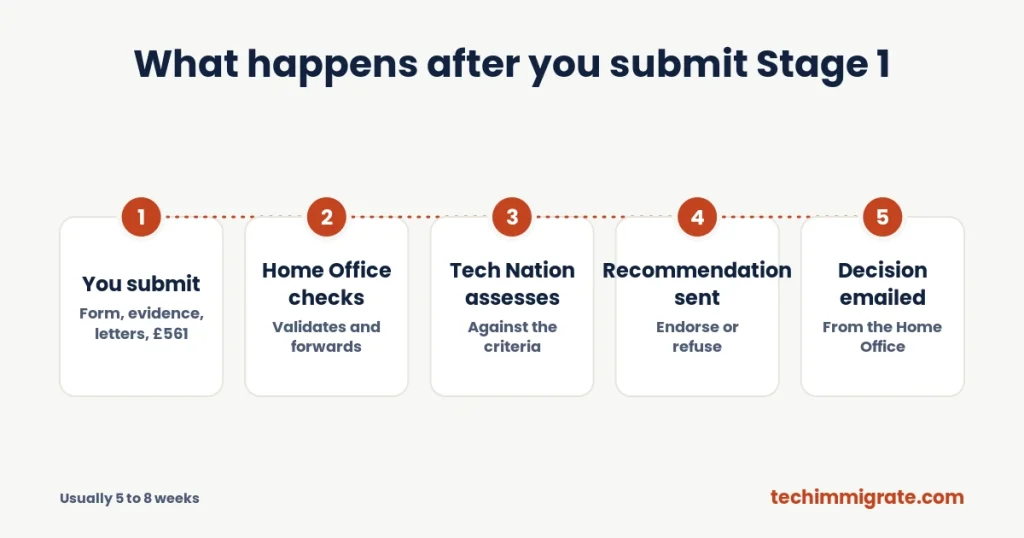
- What Happens After You Submit
- How Long Stage 1 Takes
- What to Do While You Wait
- What an Endorsement Decision Looks Like
- The 3-Month Deadline After Endorsement
- If You Are Refused: The Endorsement Review
- If You Are Refused: Applying Again
- Stage 1 if You Are Already in the UK
- Why Similar Applicants Get Different Decisions
- Stage 1 Costs in Context
- A Fictional Stage 1 Timeline
- Inside the Assessment: What Tech Nation Looks For
- Stage 1 and Your Family
- Keep a Record of Everything You Submit
- Five Questions to Ask Before You Press Submit
- Common Stage 1 Mistakes
- How Stage 1 Fits the Whole Journey
- Your Next Step
- How We Checked This Article
Stage 1 is the part of the Global Talent visa that decides everything. It is the endorsement application, where Tech Nation assesses whether you are a leader or an emerging leader in digital technology. Most of the effort goes into preparing it, but many applicants are surprised by what happens after they press submit: the long wait, the uncertainty about what is going on behind the scenes, and the short window for acting on the decision.
This guide follows Stage 1 from the moment you submit to the moment you hold a decision, and then beyond. It explains who handles your application and in what order, how long each part takes, what an endorsement decision looks like, what you must do within strict deadlines, and how the review process works if you are refused. If you want a step-by-step guide to filling in the form itself, read our separate article on how to apply for Global Talent endorsement.
Key takeaways
- Stage 1 is the endorsement application. It costs £561 and is assessed by Tech Nation for the digital technology route.
- GOV.UK says you will usually get an endorsement decision within 5 to 8 weeks.
- The Home Office receives your application, passes it to Tech Nation, and then issues the decision based on Tech Nation's recommendation.
- If you are endorsed, you must apply for the visa (Stage 2) within 3 months of the endorsement decision.
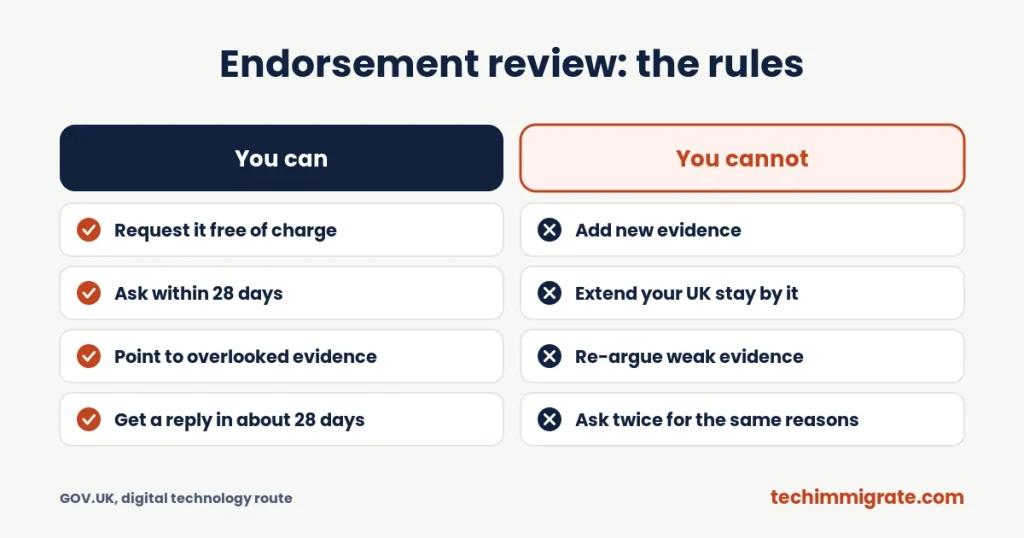
- If you are refused, you can request a free endorsement review within 28 days. You cannot add new evidence.
- A review decision usually arrives by email within 28 days. Requesting a review does not extend your permission to stay in the UK.
What Stage 1 Is, in One Paragraph
The Global Talent visa has two stages. Stage 1 is the endorsement application, where an expert body decides whether you meet the standard for exceptional talent or exceptional promise. Stage 2 is the visa application, where the Home Office checks your identity, your endorsement and your immigration history. You cannot apply for Stage 2 without a successful Stage 1, so Stage 1 is the real test. For the digital technology route, the endorsing body is Tech Nation, and the fee for Stage 1 is £561.
What You Submit at Stage 1
Before looking at the process after submission, here is a reminder of what goes in. For digital technology, your Stage 1 application includes:
- The online form on GOV.UK, including your personal details and the level you are applying for.
- Up to 10 pieces of evidence that show you meet the mandatory criterion and at least two optional criteria.
- Three letters of recommendation from established figures in digital technology.
- A personal statement, typed into the form.
- A CV of no more than 3 pages.
- Payment of the £561 endorsement fee.
Once you submit, you cannot add to or change your evidence. Make sure everything is final before you pay.
What Happens After You Submit
It helps to know who handles your application and in what order, because it explains why the wait can feel long and why some questions go unanswered.
Step 1: the Home Office receives your application
Your application and fee go to the Home Office first. It checks that the application is complete and valid, then forwards it to the endorsing body.
Step 2: Tech Nation assesses your application
Tech Nation's assessors review your evidence, letters, statement and CV against the published criteria. They decide whether you meet the mandatory criterion and at least two optional criteria, at the level you applied for. Tech Nation's guidance says it may carry out checks, which can include contacting your referees, and that false evidence can make you ineligible and be reported to the Home Office.
Step 3: Tech Nation makes a recommendation
When the assessment is complete, Tech Nation sends its recommendation to the Home Office. It recommends either endorsement or refusal.
Step 4: the Home Office issues the decision
The Home Office then issues the endorsement decision to you, based on Tech Nation's recommendation. The decision usually arrives by email.
How Long Stage 1 Takes
GOV.UK says you will usually get a decision about your endorsement within 5 to 8 weeks. Many applicants report decisions within this range, although some wait longer, especially at busy times or if checks take longer than usual.
| Part of Stage 1 | Typical time |
|---|---|
| Preparing evidence, letters, statement and CV | 1 to 3 months (in your control) |
| Home Office validation and forwarding | A few days |
| Tech Nation assessment and recommendation | Most of the waiting time |
| Home Office decision issued | Usually within 5 to 8 weeks of applying |
There is no paid fast-track option for endorsement on the digital technology route mentioned on GOV.UK. Paid faster services, where available, apply to the visa stage, not the endorsement stage.
What can make Stage 1 take longer
- High volumes of applications at certain times of year.
- Checks on your evidence or referees.
- Problems with the application, such as missing documents or unclear evidence.
- Public holidays and changes in processing arrangements.
Applicant-reported timelines on forums vary widely. Treat them as background, not as a promise.
What to Do While You Wait
The 5 to 8 weeks can be frustrating, but you can use the time well.
- Prepare for Stage 2. Gather your passport, check whether you need a tuberculosis test certificate, and work out the visa length you want.
- Budget for the health surcharge. For an adult, it is usually £1,035 per year of the visa. A five-year visa means £5,175 up front.
- Plan your dependants' applications. If your partner or children will come with you, gather their documents too.
- Check your current visa expiry. If you are in the UK, make sure your current permission will last long enough for both stages. A review request will not extend it.
- Keep building your profile. If you are refused, stronger evidence will help a new application.
- Do not keep emailing for updates. Unless there is a clear problem, chasing rarely speeds things up.
What an Endorsement Decision Looks Like
You will usually receive your decision by email from the Home Office. There are two possible outcomes.
If you are endorsed
You will receive confirmation that you have been endorsed, with an endorsement reference. You will need the reference and details when you apply for the visa. Check that your name and details are correct as soon as you receive it.
The decision will also show which level you were endorsed under: Exceptional Talent or Exceptional Promise. This matters for your settlement timeline. Under the current rules, Exceptional Talent can lead to settlement after 3 years and Exceptional Promise after 5 years.
If you are refused
You will receive a refusal decision explaining which criteria the assessors found you did not meet. Read it carefully. It is the most useful document you have for deciding whether to request a review or prepare a new application.
The 3-Month Deadline After Endorsement
Once you are endorsed, the clock starts. You must apply for the Global Talent visa within 3 months of the date of your endorsement decision. If you miss this window, your endorsement can no longer be used, and you would need to apply for a new endorsement and pay the fee again.
This deadline is easy to underestimate. If you plan to move later in the year, think carefully about when you submit Stage 1. You can apply for the visa and then travel later, within the validity of your visa, but you cannot hold an endorsement indefinitely without using it.
Our guide to Global Talent visa Stage 2 explains the visa application in detail, and our next steps after endorsement checklist walks through everything to do in the 3 months.
If You Are Refused: The Endorsement Review
A refusal is not necessarily the end. GOV.UK sets out an endorsement review process for digital technology applicants.
The key rules
- Deadline: You must request the review within 28 days of receiving the decision.
- Cost: There is no fee for the review.
- How: Complete the Global Talent endorsement review form and email it to the Home Office.
- Who reviews it: The same endorsing body that assessed your original application.
- What it covers: You can ask the endorsing body to look at specific issues, such as evidence that was not properly considered or an error in how your application was processed.
- New evidence: Not allowed. You cannot give new evidence as part of the review.
- Decision time: You will usually be told by email within 28 days whether the review was successful.
The possible outcomes
- Review successful: Your application is reconsidered.
- Refused for the same reasons: You cannot request another review. To try again, you must make a new application and pay the fee again.
- Refused for new reasons: You can request one further review, limited to those new reasons.
Is a review worth it?
A review is free, but it only helps if the assessors made a mistake, such as overlooking evidence or misreading a document. If your evidence simply was not strong enough, a review is unlikely to change the outcome, and a new, stronger application is the better path. Published data reported by Edgewater Legal suggests that only around 4% of reviews succeed, so think carefully before relying on one.
Our articles on what to do after a Global Talent refusal and the endorsement review go deeper, and our guide to challenging a Global Talent refusal covers every route.
If You Are Refused: Applying Again
There is no fixed waiting period before you reapply, but a new application must be meaningfully stronger than the last one. Start with the refusal decision. For each criterion you did not meet, ask what evidence would have convinced the assessors, and whether you have it now.
- If you lacked recognition beyond your employer, build it through talks, writing, open source or community work.
- If your evidence described activity rather than impact, collect metrics and independent validation.
- If your letters were weak, find referees who know your work in depth and can be specific.
- If you applied at the wrong level, consider whether the other level fits better.
You will pay the £561 fee again with a new application, so it is worth waiting until the gaps are genuinely closed.
Stage 1 if You Are Already in the UK
If you are in the UK on another visa, such as Skilled Worker, Graduate or Student, you can apply for Stage 1 while you are here. Your current visa continues as normal while Tech Nation assesses your application.
The important thing is timing. Stage 1 can take up to 8 weeks or more, and Stage 2 from inside the UK usually takes about 8 weeks. If your current permission is close to expiring, you may not have enough time for both stages. Requesting an endorsement review does not extend your stay. If time is tight, you may need to extend your current visa first, or plan to apply for the visa from outside the UK.
Our guide to switching to the Global Talent visa from inside the UK explains which visas you can switch from and how the timing works.
Why Similar Applicants Get Different Decisions
Applicants often compare notes on forums and are puzzled when two people with similar job titles get different outcomes. The explanation is usually in the evidence rather than the person. Job titles say little about recognition. Two senior engineers at similar companies can have very different records of external impact: one may have spoken at respected conferences, maintained a widely used library and been quoted in the trade press, while the other has done excellent work that nobody outside the company has seen.
The quality of presentation matters too. Evidence that is clearly labelled, linked to a criterion and explained in a sentence is easier to assess than a pile of documents. Letters that give specific examples carry more weight than letters that praise in general terms. Small differences in how a case is put together can make a large difference to the outcome.
This is why applicant-reported outcomes are only a rough guide. They tell you what happened to someone else's evidence, not what will happen to yours.
Stage 1 Costs in Context
The £561 endorsement fee is the only official cost of Stage 1. It is not refunded if you are refused, and you pay it again for a new application. The review is free. Your other Stage 1 costs depend on your choices: translations of documents that are not in English, any professional help you use, and the time you spend preparing. Most of the larger costs, including the £205 visa fee and the health surcharge, come at Stage 2. Our Global Talent visa cost breakdown sets out every fee from endorsement to settlement.
A Fictional Stage 1 Timeline
Here is how Stage 1 might look for a fictional applicant, Tom, a data engineer applying from abroad.
- Weeks 1 to 8: Tom gathers evidence, secures three letters and writes his statement and CV.
- Week 9: He submits Stage 1 and pays £561.
- Weeks 9 to 15: He waits. He uses the time to arrange a tuberculosis test and gather his family's documents.
- Week 15: He receives an email confirming endorsement under Exceptional Promise.
- Week 16: He applies for the visa, well within the 3-month window.
This example is fictional and simplified. Your timeline will depend on your preparation and the processing times when you apply.
Inside the Assessment: What Tech Nation Looks For
You cannot see the assessment happen, but you can understand what the assessors are asking. For each application, they work through the same structure.
- Is the applicant in digital technology? Your role and evidence must show that you work in a technical role, or a business role in a product-led digital technology company.
- Do they meet the mandatory criterion? Is there clear proof that you are recognised as a leading talent, or as having the potential to be one, beyond your own employer?
- Do they meet two optional criteria? Innovation, recognition outside your immediate occupation, significant technical, commercial or entrepreneurial contributions, or academic contributions.
- Is the evidence at the right level? Exceptional Talent needs evidence of established leadership; Exceptional Promise needs evidence of strong potential at an earlier career stage.
- Is the evidence credible and specific? Does it name you, show a result and come from someone independent where possible?
- Do the letters support the case? Are the referees established figures who know your work and give specific examples?
The refusal decision usually follows this structure too, which is why it is so useful for planning a new application. If the decision says you did not meet a particular criterion, that is where to focus.
Stage 1 and Your Family
Only the main applicant applies for Stage 1. Your partner and children do not need their own endorsement. They apply as dependants at Stage 2, either with you or later, and each pays £766 plus their own health surcharge. Our guide to Global Talent visa dependants explains who counts as a dependant and what they need. While you wait for your Stage 1 decision, it is sensible to gather their passports, relationship evidence and birth certificates, so that everyone can apply together once you are endorsed.
Keep a Record of Everything You Submit
Before you submit, save a complete copy of your application: the form answers, every piece of evidence, each letter, your personal statement and your CV. You will want this record for three reasons.
- If you are refused, you will need to compare the decision against exactly what you sent, especially if you request a review.
- If you reapply, you can build on what worked and replace what did not.
- When you settle, you may need to show that you have continued to work in your field, and your Stage 1 application is a useful baseline.
Keep your payment confirmation and any reference numbers too. They make it much easier to deal with queries.
Five Questions to Ask Before You Press Submit
- Does every piece of evidence clearly link to one of the criteria, and does it name me?
- Have I shown recognition from people outside my current employer?
- Are all three letters specific, signed, dated and from people who know my work well?
- Does my personal statement tell the same story as my evidence and CV?
- Am I ready to apply for the visa within 3 months if I am endorsed?
If the honest answer to any of these is no, it is usually worth taking a little more time. You cannot add evidence after you submit, and a refusal costs you the fee and several months.
Common Stage 1 Mistakes
- Submitting before your evidence is final. You cannot add evidence after you submit.
- Not planning for the 3-month window. An unused endorsement expires for visa purposes.
- Assuming a review can fix weak evidence. It cannot; it only corrects mistakes.
- Adding new evidence to a review request. It is not allowed and will not be considered.
- Missing the 28-day review deadline. After that, you would need a new application.
- Leaving too little time on your current UK visa. A review does not extend your permission to stay.
- Using AI to write the application. Tech Nation's guidance says this is not acceptable.
How Stage 1 Fits the Whole Journey
Stage 1 is usually the longest and hardest part of the Global Talent process, but it is not the end. After endorsement comes the visa application, then life in the UK, extensions and, eventually, settlement. If you want to see the whole journey in one place, our Global Talent visa guide maps every step and links to detailed articles for each one.
It is the endorsement application, where Tech Nation assesses whether you meet the standard for exceptional talent or exceptional promise in digital technology.
GOV.UK says you will usually get an endorsement decision within 5 to 8 weeks.
£561. The remaining £205 is paid when you apply for the visa at Stage 2.
You must apply for the visa within 3 months of your endorsement decision.
You can request a free endorsement review within 28 days. You cannot add new evidence, and the review only looks at whether a mistake was made.
Yes, if you are in the UK on another visa. Make sure your current permission lasts long enough for both stages.
Your Next Step
Stage 1 is won or lost on the strength of your evidence and letters. Our role-specific Global Talent guides show what strong Stage 1 evidence looks like for software developers, data and AI specialists, product managers, designers, cyber security specialists, founders and more, with checklists and examples you can follow.
How We Checked This Article
We checked the Stage 1 process, decision times and fees against GOV.UK's Global Talent digital technology pages, and the review rules against GOV.UK's page on what to do if your endorsement application is refused, in November 2026. Review success data comes from freedom of information figures reported by Edgewater Legal.
Tech Immigrate is independent of the Home Office and Tech Nation. This article is general information, not legal advice. Check GOV.UK before you apply.
We write practical guides for tech professionals applying for the UK Global Talent visa. Tech Immigrate is independent of Tech Nation and the Home Office, and our articles are general information, not legal advice. Rules and fees change, so always check gov.uk before you apply.