Tech Nation Evidence Preparation: A 6-Week Plan to Build Your 10 Documents
Tech Nation evidence preparation made simple: a week-by-week plan with templates to build your 10 documents. See the schedule, then check your fit.

In this article
- What Tech Nation Evidence Preparation Involves
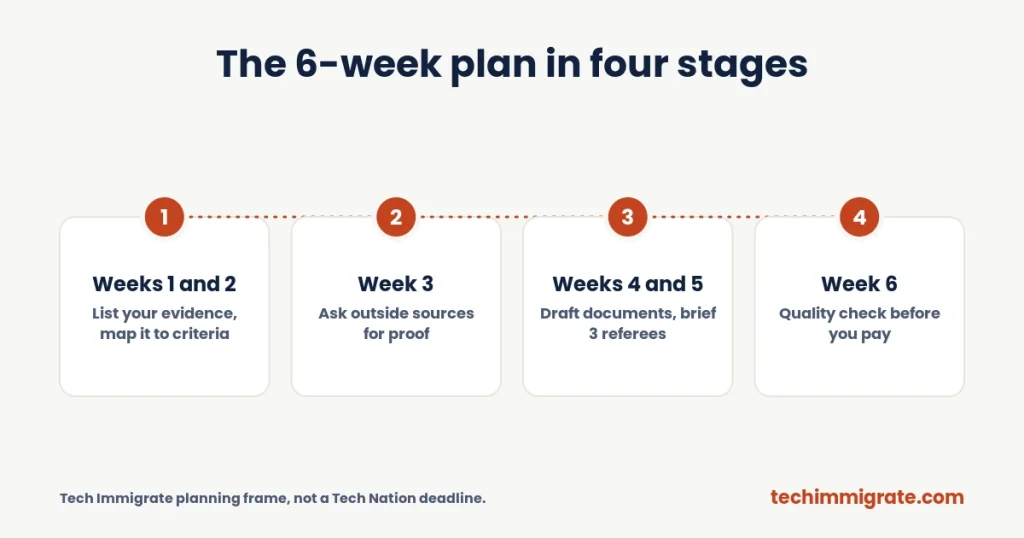
- The 6-Week Tech Nation Evidence Preparation Plan at a Glance
- Week 1: Build Your Evidence Inventory
- Week 2: Map Your Evidence to the Criteria
- Week 3: Request Third-Party Proof
- Week 4: Draft Your 10 Documents
- Week 5: Prepare Your Referee Letters
- Week 6: Run a Quality Check on Your Evidence Pack
- Evidence Collection Templates You Can Copy
- How to Judge Whether an Item Is Strong Enough
- What Tech Nation Evidence Preparation Looks Like for Different Roles
- Common Evidence Mistakes to Avoid
- How Long Does Tech Nation Evidence Preparation Take?
- Tech Nation Evidence Preparation FAQ
- Your Next Step
- How We Checked This Article
Tech Nation evidence preparation means collecting, mapping and writing up to 10 short documents that prove your claims. A six-week schedule can break the work into inventory, mapping, third-party proof, drafting, referee letters and quality checks.
This plan is for applicants in digital technology who feel stuck at the start. It gives you a calendar, templates and common traps, with no promises about the result.
Key takeaways
- Tech Nation evidence preparation works best as a schedule, because third-party proof and referee letters take the longest.
- You can submit up to 10 documents of up to 3 A4 sides each, and at least 2 must sit under each criterion you claim.
- One document cannot serve two criteria, so map each item before you write.
- Recognition evidence should come from outside your employer, and Tech Nation does not accept AI-written or templated documents.
- A final quality check against the official rules catches the errors that waste fees.
What Tech Nation Evidence Preparation Involves
Tech Nation evidence preparation is the work you do before applying to turn your career into a small, well-organised set of proofs. Your goal is to show one mandatory criterion and two optional criteria.
The mandatory criterion is recognition as a leading or emerging talent in digital technology. The four optional criteria cover innovation, recognition for work outside your day job, significant contributions to a product-led business, and academic contributions. You pick two of the four.
The official evidence rules in short
The gov.uk guidance on documents for endorsement sets the frame. You can send up to 10 pieces of evidence, and each can run to 3 sides of A4.
First, you need at least 2 documents for the mandatory criterion. Then you need at least 4 more that cover any two of the other criteria, with 2 documents for each. Your CV and recommendation letters sit outside the 10.
Why a plan beats a pile
Many applicants gather screenshots for weeks and then find that nothing maps to a criterion. A plan fixes that by deciding the target first and collecting second. Because each week has one job, you also know when you are done with a step.
It also protects your time. Referees and journalists answer slowly, so you need to ask early. For a closer look at the criteria themselves, read our Global Talent Visa criteria guide.
The 6-Week Tech Nation Evidence Preparation Plan at a Glance
A six-week plan gives each task a home: inventory, mapping, outreach, drafting, referee letters and review. Treat it as a planning frame, not a deadline set by Tech Nation.
Some people need eight or ten weeks, especially when proof must come from other organisations. Others already hold most of the material and move faster.
| Week | Focus | Main output | Watch out for |
|---|---|---|---|
| 1 | Inventory | A master list of achievements and links | Counting internal praise as recognition |
| 2 | Map to criteria | A grid of 10 slots and gaps | Using one item for two criteria |
| 3 | Request third-party proof | Emails sent to outside sources | Waiting for replies before moving on |
| 4 | Draft documents | First drafts of each document | Writing more than 3 sides |
| 5 | Referee letters | Three briefed referees and draft points | Letters that only praise |
| 6 | Quality check | A final pack reviewed line by line | Skipping the rules re-read |
Referee requests start in week 3 and finish in week 5. In practice, the busiest weeks are 3 and 4, because outreach and drafting overlap.
Week 1: Build Your Evidence Inventory
Week 1 is for listing everything you have done in the last five years that might count. Do not judge items yet, because judging comes in week 2.
Open one spreadsheet. Give each row a date, a project, your exact role, the result, a link or file, and who outside your employer could confirm it.
What to collect in week 1
Gather material in groups so nothing slips through. Start with these:
- Product launches, features you led and measurable results
- Press coverage, podcasts, interviews and conference programmes
- Open-source work, repositories and merged contributions
- Awards, judging roles and mentoring programmes
- Papers, talks, patents and peer-review invitations
- Company facts such as customers, revenue or funding rounds
Keep every source, not only the best one. A forgotten podcast can become a strong recognition document later.
Inventory template
Use plain columns so the sheet stays easy to scan:
- Date and year of the event
- What you did, in one sentence with a number
- Who outside your employer saw or verified it
- Link, file name or screenshot
- Likely criterion (guess only)
Check dates early. Evidence must come from the last five years, and you want to know your gaps now, while there is still time to close them.
Week 2: Map Your Evidence to the Criteria
Week 2 turns your list into a plan by placing each item under one criterion and noting what is missing. This is the most important week of Tech Nation evidence preparation.
Draw a grid with 10 slots. Put 2 slots under the mandatory criterion and 2 under each optional criterion you choose. That uses 8 slots, so you keep 2 spare for your strongest additions.
Choosing your two optional criteria
Pick the two criteria where your outside proof is strongest, not the ones that sound most impressive. Applicants in this situation often compare each criterion by counting independent sources.
If your best proof is a product you built, innovation may fit. If it is press and talks, work outside your day job may fit. Our guide on Exceptional Talent vs Exceptional Promise explains how the route you choose shapes the story.
The no-reuse rule
The official rules say you cannot use one piece of evidence for more than one criterion. That matters because a single conference talk may look useful twice.
Split the material instead. Use the programme listing as recognition evidence. Use the video of the talk, a different file, for another criterion only if it truly shows a different point.
Illustrative example (fictional)
Priya, a fictional data engineer, lists 22 items. After mapping, she finds three press mentions, one industry award and a conference talk under recognition. She has only one source for innovation, so she drops that criterion and chooses two others with deeper proof.
Week 3: Request Third-Party Proof
Week 3 is when you ask people outside your team for the proof that only they can give. Send these requests now because replies often take days or weeks.
Tech Nation expects recognition evidence to come from outside your employer. Internal awards and your own posts do not count on their own. Third-party proof is the heart of the application.
What third-party proof can look like
Think about who has already noticed your work. Common sources include these:
- A journalist or editor who covered your product
- An event organiser who invited you to speak
- A customer who can confirm your contribution in writing
- A judge or award body that named you
- Last, a standards group, publisher or open-source maintainer who knows your work
An immigration law firm notes that media evidence needs a reputable outlet, a clear link to digital technology, and verifiable details such as date and a working link. You can read their summary on media recognition for Tech Nation endorsement.
Template: request to a third party
Keep the message short and specific. Use this structure and write it in your own words:
Hello [name], I am preparing a visa application that needs independent confirmation of [specific item, date]. Could you send a short note or document that states [fact]? I can supply a draft of the facts to save you time, and you can change anything.
Always offer a deadline that is gentle but real. Then follow up once after a week.
Week 4: Draft Your 10 Documents
Week 4 turns raw material into documents that a reader can scan in two minutes. Each document should make one claim and prove it.
Remember the limit of 3 A4 sides. Most strong documents are shorter, because focus helps the reader.
A simple structure for each document
Use the same four parts every time:
- A one-line claim at the top, such as "Led the launch of a payments feature used by 40,000 customers"
- Your exact role and what you personally did
- The proof, such as a screenshot, press link, figure or letter
- The effect, with numbers where you can show them
Tech Nation rules rule out AI-written or templated documents, so write the claim lines yourself. Use tools only to check spelling.
Strong versus weak examples
Compare two ways to present the same fact.
| Weak | Stronger |
|---|---|
| "I built an app people loved." | "I led a team of four to build a booking app that reached 60,000 users in nine months, as shown in the company's published case study." |
| "Featured in tech media." | "Interviewed in a named trade outlet on 12 May, with link and screenshot of the article." |
The stronger line gives a number, a date and a place where a reader can check.
Week 5: Prepare Your Referee Letters
Week 5 is when you brief three referees so their letters add new detail instead of repeating your CV. Letters on their own are not enough, but they help support your evidence.
The gov.uk rules say each referee must be an established expert who has known your work for at least 12 months. The letter must be typed and dated, and it can run to 3 sides. You can read more in our guide to recommendation letters.
What to send each referee
Send a short pack, not a script. Include your draft CV, a one-page summary of your mapped evidence, and the official letter rules.
Then give each referee a different angle. One can speak on your technical skill, one on your impact on a business, and one on your wider standing in the field. That way the letters do not overlap.
Referee briefing checklist
- How the referee knows you and for how long
- Two or three specific things they saw you do
- Why those things matter to the digital technology field
- Their own credentials, with contact details
- A signature and a date
Do not write the letters for them. Tech Nation looks for genuine, individual voices, and templated letters can harm you. When a referee asks for help, offer facts and dates, but let them choose the words. Also give them at least three weeks, since busy experts need time.
Illustrative example (fictional)
Tomas, a fictional product manager, asks a former client, a conference chair and a university lecturer. Each gets his evidence grid and a note about the angle he hopes they can cover. He sends the requests in week 3, so the letters have time to arrive before the final review. Two letters arrive in ten days. The third needs a gentle reminder in week 6.
Week 6: Run a Quality Check on Your Evidence Pack
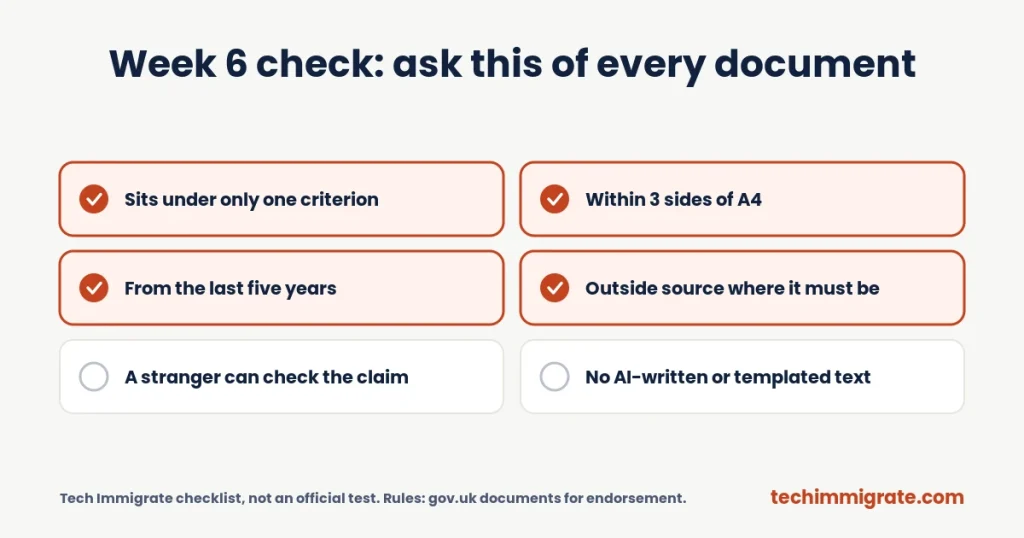
Week 6 is a hard review where you test each document against the official rules and fix errors before you pay the fee. Treat it as a mock audit.
The endorsement fee is £561 at the time of writing, so mistakes are expensive. A calm review costs far less than a refusal and a new application.
Your final checklist
Go through each point for every document:
- Does it sit under only one criterion?
- Is it within 3 sides of A4?
- Is the evidence from the last five years?
- Does it come from outside your employer where it must?
- Can a stranger check the claim from a link or a file?
- Is the text readable, without shrunk screenshots or collages?
- Is it free of AI-written or templated wording?
Then re-read the live rules on gov.uk's digital technology page. Rules can change, so confirm them on the day you apply.
Ask a stranger to read it
Hand the pack to someone outside your field. If they cannot say what you did and why it matters, rewrite that document. Then ask a second reader inside your field to check the technical claims. Finally, read every line aloud, because awkward sentences show up when you hear them. Our article on common Tech Nation endorsement mistakes can help you check the typical traps.
Evidence Collection Templates You Can Copy
Simple templates keep Tech Nation evidence preparation moving because you never start from a blank page. Copy the ones below into your own files.
Master evidence grid
| Slot | Criterion | Document title | Outside source | Status |
|---|---|---|---|---|
| 1 | Mandatory | Press feature | Trade outlet | Link saved |
| 2 | Mandatory | Conference programme | Event organiser | Requested |
| 3 | Optional A | Product case study | Customer | Draft |
| 4 | Optional A | Usage data | Analytics export | Draft |
Fill all 10 rows. Mark empty rows in red so gaps stand out.
Evidence record card
For each item keep a short card with five fields: the claim, the date, the proof link, the outside source and the file name. This card also helps later if the Home Office or Tech Nation asks a question.
Tracker for outreach
Log each request with the name, date sent, date followed up and result. A tracker stops you from losing a reply in a busy inbox. It also shows you at a glance which proof is still missing, so you can chase the right person on the right day.
How to Judge Whether an Item Is Strong Enough
A strong item is one that a stranger can verify and that shows a clear effect. Before you spend time drafting, run each item through three quick tests.
First, ask who said it. A review by a respected outside body counts for more than a line you wrote yourself. Second, ask what changed because of your work. Numbers, dates and named results help here. Third, ask whether the reader can check it in a minute, using a link or a file.
Quick scoring grid
Score each item from 0 to 2 on each test, then add the scores. Anything below 4 needs better proof or a replacement.
| Test | 0 points | 1 point | 2 points |
|---|---|---|---|
| Outside source | Only you or your employer | Colleague or partner | Independent body or outlet |
| Effect shown | Task list only | Some outcome stated | Clear numbers and dates |
| Easy to verify | No link or file | Link needs explaining | One click or one file |
This grid is a thinking aid, not an official scoring system. Tech Nation's panel decides overall, and meeting a criterion is necessary but not enough on its own.
What Tech Nation Evidence Preparation Looks Like for Different Roles
Evidence looks different for each role, but the same rules apply. Your task is to find the proof that fits your work.
Developers often draw on open-source work and technical talks. Our guides cover how to present repositories as evidence. Product managers lean on launches and measurable outcomes. Founders use company data and press coverage.
Designers, sales leaders and researchers each have their own patterns, which is why role-specific work helps. Tech Immigrate sells role-specific endorsement guides with an evidence checklist and planner, so you do not have to invent a structure.
When your work is private
Proprietary work is a common worry. Applicants in this situation often use public signals, such as a customer's written confirmation, a talk about the approach, or a published case study.
Never share confidential data. If you cannot prove a claim without breaking a contract, leave it out and use another item. Then ask your employer, in writing, what you may share before you draft anything.
Common Evidence Mistakes to Avoid
Most evidence mistakes come from rushing, so a schedule removes many of them. Applicants report the same patterns in community forums, although that material is not official guidance.
- Counting internal awards, your own posts or LinkedIn and Medium articles on their own
- Reusing one item under two criteria
- Submitting evidence older than five years
- Using a letter as the only proof of a claim
- Pasting shrunk screenshots or collages that are hard to read
- Submitting AI-written or templated text
- Leaving out your exact role in a team result
Each point is easy to fix in week 6, as long as you leave time for it.
How Long Does Tech Nation Evidence Preparation Take?
Most people plan for about six weeks of steady work, but the real time depends on how much outside proof you already hold. If you have to earn new recognition, it can take far longer.
One applicant who wrote about their own route described preparing material over many months before they applied, then receiving a decision within weeks. You can read that account on Sefik's blog. It is a single personal story, not a guide to your timing.
After you apply, the endorsement decision usually takes 5 to 8 weeks. Then you have 3 months to apply for the visa. Also check the current fees on gov.uk, because they change.
Tech Nation Evidence Preparation FAQ
You can send up to 10 documents. At least 2 must show recognition for the mandatory criterion, and at least 4 more must cover any two other criteria, with 2 for each. Each document can run to 3 sides of A4, and your CV and letters sit outside the limit.
No. The official guidance says one piece of evidence cannot support more than one criterion. If one event offers different proof, split it into separate documents, such as a programme listing and a video file, and place each under one criterion only.
Each letter should come from an established expert in digital technology who has known your work for at least 12 months. Choose referees who can speak to different parts of your work. Letters support your evidence but do not replace it.
Many people plan about six weeks of steady work, though it varies. If you already hold third-party proof, you may move faster. If you need new press, talks or letters, plan for more time and start outreach early.
Tech Nation's guidance says documents must not be AI-written or templated. Write your claims in your own words and keep each document specific to your work. Use tools only for spelling or layout, then confirm the current wording on the official pages.
Your Next Step
You now have a six-week frame for Tech Nation evidence preparation. Want the guide for your role? See the guides.
When you are ready to build, start with our guides hub. It lists role-specific endorsement guides with an evidence checklist and planner. Developers can open the software developers guide. Data and AI specialists can use the data and AI guide. Founders can read the startup founders guide.
How We Checked This Article
We checked the evidence limits, page limits, letter rules, fees and timings against the gov.uk page on documents for endorsement and the gov.uk digital technology page. We also read applicant and adviser articles to see what the wider guidance covers and where it leaves gaps. Reports of refusal patterns come from applicant communities and are not official guidance.
Tech Immigrate is independent of Tech Nation and the Home Office. This article is general information, not legal advice, and nobody can guarantee an endorsement. Always confirm current rules on gov.uk before you apply.
We write practical guides for tech professionals applying for the UK Global Talent visa. Tech Immigrate is independent of Tech Nation and the Home Office, and our articles are general information, not legal advice. Rules and fees change, so always check gov.uk before you apply.