Highly Skilled Worker Visas in the UK: Your Options Compared
UK visas for highly skilled workers compared: Skilled Worker, Global Talent, HPI, Scale-up, Innovator Founder and Global Business Mobility.


In this article
- The Routes at a Glance
- Skilled Worker
- Global Talent
- High Potential Individual
- Scale-up
- Innovator Founder
- Global Business Mobility
- Comparing the Routes Side by Side
- Where the Graduate Visa Fits
- Common Pathways Between Routes
- Family Rules Across the Routes
- Costs Compared Over 5 Years
- What Employers Think About Each Route
- How to Choose
- How the Earned Settlement Reforms Affect the Choice
- A Worked Example: A Senior Engineer
- A Worked Example: A Recent Graduate
- A Worked Example: A Founder
- A Worked Example: A Transferred Employee
- Routes That Are Not Designed for Tech Professionals
- Common Mistakes
- Find the Route That Fits Your Career
- How We Checked This Article
If you are a skilled tech professional looking at the UK, you have more options than most people realise. The Skilled Worker visa gets the most attention, but it is only one of several routes designed for highly skilled people. Some need a sponsor and some do not. Some lead to settlement and some do not. Some suit early-career graduates, others suit established leaders or founders.
This guide compares the main UK visas for highly skilled workers: Skilled Worker, Global Talent, High Potential Individual, Scale-up, Innovator Founder and Global Business Mobility. It explains who each route is for, what it requires, how flexible it is, what it costs and whether it leads to settlement, so you can work out which one fits your career.
Key takeaways
- The Skilled Worker visa needs a job offer from a licensed sponsor and a salary of at least £41,700 or the going rate. It currently leads to settlement after 5 years.
- The Global Talent visa needs an endorsement or qualifying prize, but no sponsor, no job offer and no salary threshold. Some holders can settle after 3 years.
- The High Potential Individual visa is for recent graduates of top-ranked universities. It needs no sponsor but lasts only 2 years, or 3 for PhD graduates, and does not lead to settlement.
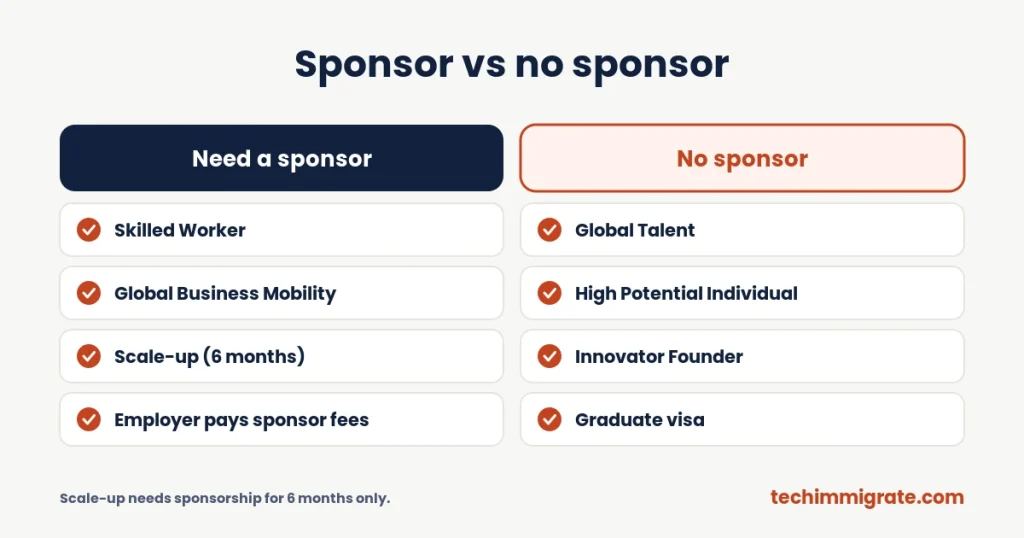
- The Scale-up visa needs sponsorship for the first 6 months only, from a qualifying fast-growing company.
- The Innovator Founder visa is for people starting an innovative business, with an endorsement from an approved body. It can lead to settlement after 3 years.
- Global Business Mobility routes are for employees transferred within the same company and do not lead directly to settlement.
- Under the earned settlement reforms, the path to settlement on every route may change from 2027.
The Routes at a Glance
| Route | Sponsor needed | Job offer needed | Leads to settlement |
|---|---|---|---|
| Skilled Worker | Yes | Yes | Yes |
| Global Talent | No | No | Yes |
| High Potential Individual | No | No | No |
| Scale-up | First 6 months only | Yes, at the start | Yes |
| Innovator Founder | No (endorsement instead) | No | Yes |
| Global Business Mobility | Yes | Yes, within the same company | No |
Skilled Worker
Who it is for: people with a job offer from a UK employer that holds a sponsor licence.
Key requirements:
- a certificate of sponsorship for an eligible job, usually at RQF level 6 or above;
- a salary of at least £41,700 or the going rate for the occupation, whichever is higher, with lower rates for new entrants and some PhD holders;
- English at B2 for new applicants.
Flexibility: low. You must work for your sponsor in the job on your certificate. Changing employer needs a new application.
Costs: visa fee from outside the UK of £819 for up to 3 years or £1,618 for more than 3 years, plus the health surcharge of £1,035 per year. The employer pays the certificate fee and Immigration Skills Charge.
Settlement: currently after 5 years. Under the earned settlement proposals, the default becomes 10 years, with 5 years for people earning at least £50,271.
Best for: people with a strong job offer, especially in well-paid roles. Our guide to Skilled Worker visa requirements has the details.
Global Talent
Who it is for: leaders and emerging leaders in digital technology, science, research, arts and culture. In tech, endorsement comes from Tech Nation.
Key requirements:
- an endorsement from an approved body, or a qualifying prize;
- for digital technology, evidence that you are recognised as a leader (exceptional talent) or a potential leader (exceptional promise).
Flexibility: high. You can work for any employer, be self-employed, start a business or change jobs without telling the Home Office.
Costs: £766 in total for the main applicant, split between the endorsement and visa stages, plus the health surcharge.
Settlement: under the current rules, after 3 years for exceptional talent and some other categories, or 5 years for exceptional promise. Under the reforms, recognised talent is expected to keep a shorter path.
Best for: experienced tech professionals with a strong public track record, founders and researchers. Our guide to Global Talent visa eligibility includes a self-check.
High Potential Individual
Who it is for: people who graduated in the last 5 years from a university on the Home Office's list of top-ranked institutions.
Key requirements:
- a qualifying degree from an eligible university;
- English at B2.
Flexibility: high while it lasts. You can work for any employer, be self-employed or look for work.
Limits: it lasts 2 years, or 3 years for PhD graduates, cannot be extended, and does not lead to settlement. The list of eligible universities was narrowed to institutions in the top 100 of at least two of three global rankings from 4 November 2025, and there is an annual cap.
Best for: recent graduates of top universities who want time to find the right job or build a profile before switching to another route. Our comparison of Global Talent vs HPI explains the differences.
Scale-up
Who it is for: people with a job offer from a UK company that qualifies as a scale-up, meaning a fast-growing business that meets the Home Office's growth criteria.
Key requirements:
- a job offer from a scale-up sponsor at the required skill level and salary;
- English at B2 for new applicants.
Flexibility: medium. You need sponsorship for the first 6 months. After that, you can change employer or work for more than one employer without further sponsorship, as long as you meet the route's income requirements.
Settlement: possible after 5 years under the current rules.
Best for: people joining fast-growing tech companies who want more freedom after an initial period. The pool of qualifying sponsors is much smaller than for Skilled Worker.
Innovator Founder
Who it is for: people who want to set up and run an innovative, viable and scalable business in the UK.
Key requirements:
- an endorsement from an approved endorsing body;
- a business idea that is new, innovative and scalable;
- English at B2.
Costs: visa fee of £1,357 from outside the UK or £1,693 from inside, plus an endorsement fee of £1,000 and £500 for each contact point meeting.
Settlement: possible after 3 years if the business meets at least two of the required achievements, such as creating jobs or reaching certain revenue.
Best for: founders with a business plan that can win an endorsement. Our comparison of Innovator Founder vs Global Talent explains which suits which founders.
Global Business Mobility
Who it is for: employees of multinational companies who are being transferred to the UK branch.
Key requirements:
- employment with the overseas part of the company for a set period, for most categories;
- sponsorship by the UK branch;
- a salary meeting the route's thresholds.
Flexibility: low. You work for your employer's UK branch in the specified role.
Settlement: these routes do not lead directly to settlement. People who want to stay long term usually switch to Skilled Worker or another route.
Best for: people whose employer is moving them to the UK for a specific assignment. If there is any chance you will want to stay longer, discuss a later switch to Skilled Worker with your employer before you move, so that the plan is agreed from the start.
Comparing the Routes Side by Side
| Feature | Skilled Worker | Global Talent | HPI | Scale-up | Innovator Founder |
|---|---|---|---|---|---|
| Salary threshold | £41,700 or going rate | None | None | Route threshold | None |
| Can change jobs freely | No | Yes | Yes | After 6 months | Runs own business |
| Can be self-employed | No | Yes | Yes | Limited | Yes, in own business |
| Can bring family | Yes | Yes | Yes | Yes | Yes |
| Maximum stay per grant | Up to 5 years | Up to 5 years | 2 or 3 years | Up to 2 years initially | 3 years |
| Settlement | 5 years now | 3 or 5 years now | No | 5 years now | 3 years if criteria met |
Where the Graduate Visa Fits
The Graduate visa is not a highly skilled worker route in the same sense, but it is how many tech professionals start their UK careers. It lets international students who have completed a UK degree stay and work, at any skill level and for any employer, without sponsorship. From 1 January 2027, it will last 18 months for most bachelor's and master's graduates, down from 2 years, and 3 years for PhD graduates.
Like HPI, it cannot be extended and does not lead to settlement on its own. Most graduates use it as a bridge to Skilled Worker or, for those who build a strong profile quickly, Global Talent. Under the earned settlement proposals, Graduate visa time would not count towards settlement, so moving onto a settlement route sooner may matter more than before.
Common Pathways Between Routes
Most people do not stay on a single route for their entire time in the UK. Common pathways for tech professionals include:
- Student, then Graduate, then Skilled Worker. The most common path for international students who stay on.
- Graduate or HPI, then Global Talent. For people who build a strong profile early, for example through a successful start-up or notable open-source work.
- Skilled Worker, then Global Talent. For experienced professionals who want to leave their sponsor, freelance or found a company. Time on both routes can usually be combined towards settlement under the current rules.
- Global Business Mobility, then Skilled Worker. For people transferred by their employer who decide to stay.
- Skilled Worker, then Innovator Founder. For people who leave employment to start a business, although Global Talent may be simpler if they qualify.
Each switch has its own requirements and costs. Think about where you want to be in 3 to 5 years, and choose routes that move you towards that goal.
Family Rules Across the Routes
All the main highly skilled routes let you bring your partner and children, but the details differ:
- Skilled Worker: partners and children can join, except for care workers and some medium-skilled roles. Dependants need their own applications and may need to show maintenance funds.
- Global Talent: partners and children can join. There is no financial requirement for dependants listed on the route.
- HPI: partners and children can join, but the family's time is limited to the length of the main visa.
- Scale-up and Innovator Founder: partners and children can join.
- Global Business Mobility: partners and children can usually join.
Partners can usually work for almost any employer on all these routes, which makes them attractive for dual-career tech households.
Costs Compared Over 5 Years
For a single applicant applying from outside the UK, the Home Office costs over 5 years look roughly like this:
| Route | Visa fees | Health surcharge | Approximate total |
|---|---|---|---|
| Skilled Worker (one 5-year visa) | £1,618 | £5,175 | £6,793 |
| Global Talent (one 5-year visa) | £766 | £5,175 | £5,941 |
| Innovator Founder (3 years, then extension) | £1,357 plus extension | £5,175 | Higher, plus endorsement fees |
HPI is shorter and cannot be extended, so it is not directly comparable. On every route, the health surcharge is the biggest single cost. For families, multiply the fees and surcharge for each person.
What Employers Think About Each Route
From an employer's point of view, the routes are very different:
- Skilled Worker requires the employer to hold a sponsor licence, assign a certificate, pay the certificate fee and Immigration Skills Charge, and meet ongoing compliance duties.
- Global Talent, HPI and Graduate holders need no sponsorship. The employer only carries out a right-to-work check.
- Scale-up requires sponsorship for 6 months, then nothing further.
For candidates, this matters. An employer that is hesitant to sponsor may happily hire someone who already has Global Talent or HPI. If you have a choice of routes, being able to say you do not need sponsorship can make you a more attractive candidate.
How to Choose
Ask yourself these questions:
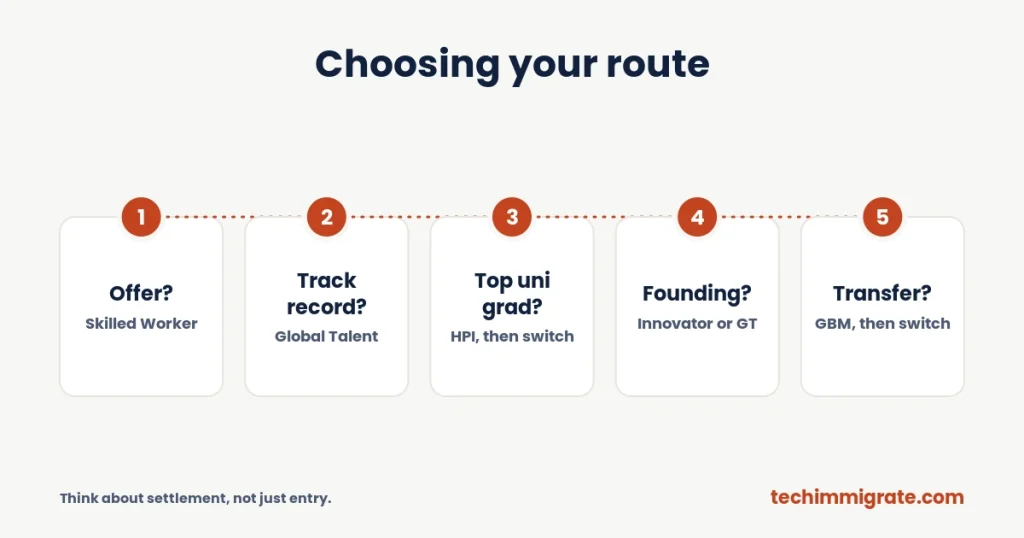
- Do you have a job offer from a licensed sponsor at a salary that meets the rules? If yes, Skilled Worker is the most straightforward route.
- Do you have a strong track record that others in tech recognise? If yes, Global Talent may give you more freedom.
- Did you graduate recently from a top-ranked university? If yes, HPI could give you 2 years to find your footing, but plan your next route early.
- Are you joining a fast-growing company? If it is a qualifying scale-up, the Scale-up route could give you more freedom after 6 months.
- Do you want to start a business? Compare Innovator Founder with Global Talent.
- Is your employer transferring you? Global Business Mobility may fit, but plan for a switch if you want to stay.
How the Earned Settlement Reforms Affect the Choice
The government's response to the earned settlement consultation, published on 2 November 2026, proposes a new framework for settlement:
- a 10-year default qualifying period;
- a 5-year path for people earning at least £50,271;
- a 3-year path for people earning at least £125,141, or in the highest talent group;
- time on Graduate, High Potential Individual, Student and some other routes not counting towards settlement.
If implemented as proposed, this makes the choice of route more important. HPI time would not count at all. Skilled Worker settlement would depend heavily on earnings. Recognised talent, such as Global Talent, is expected to keep a shorter path. The changes are expected to be implemented over 2027. Our guide to the new indefinite leave to remain rules explains the details.
A Worked Example: A Senior Engineer
A senior software engineer with 10 years of experience receives an offer from a London fintech at £95,000. She has also spoken at international conferences, maintains a widely used open-source library and has mentored engineers through a recognised programme.
- Skilled Worker: straightforward, with her salary far above the threshold. Settlement after 5 years now, and likely on a 5-year path under the reforms.
- Global Talent: she may qualify for exceptional talent. That would give her freedom to change jobs and potentially settle after 3 years.
She applies for Global Talent first, with the Skilled Worker offer as a fallback.
A Worked Example: A Recent Graduate
A machine learning graduate from a top-ranked university is deciding between HPI and waiting for a sponsored job.
- HPI: gives her 2 years to work anywhere, but does not lead to settlement, and under the reforms the time would not count.
- Skilled Worker: needs a sponsor, but starts her settlement clock, and as a new entrant she can be paid 70% of the going rate.
She takes HPI to start work quickly, while looking for a sponsored role she can switch into within a year.
A Worked Example: A Founder
A product-focused founder has built and sold a small SaaS company abroad and wants to start a new venture in London.
- Innovator Founder: she would need an endorsement from an approved body for her new business idea, pay endorsement and contact point fees, and meet business milestones to settle after 3 years.
- Global Talent: her track record as a founder, with a successful exit, press coverage and recognised impact, may qualify her for exceptional talent. That would let her start the new business, take on advisory roles and settle after 3 years under the current rules, without tying her status to one business.
- Skilled Worker: not a natural fit, because she would need to be employed by a sponsor.
She applies for Global Talent, because it gives her the most flexibility if her new venture changes direction.
A Worked Example: A Transferred Employee
A cloud architect working for a US software company is transferred to its London office for 2 years on a Global Business Mobility visa.
- The route does not lead to settlement.
- After a year, he decides he wants to stay in the UK permanently.
- His employer agrees to sponsor him as a Skilled Worker. He switches from inside the UK.
His settlement clock starts on the Skilled Worker route. If he had a strong enough public profile, Global Talent could have been another option.
Routes That Are Not Designed for Tech Professionals
You may come across other UK routes in your research. Most are not suitable for tech professionals looking for a long-term career:
- Youth Mobility Scheme: available to young people from certain countries, usually for 2 or 3 years. It allows work but does not lead to settlement.
- Visitor visas: do not allow you to work for a UK employer, although some limited business activities are permitted.
- Temporary Worker routes: cover specific activities, such as some charity and creative work, rather than mainstream tech jobs.
If you are on one of these routes and want to build a tech career in the UK, plan your move to one of the main highly skilled routes early. Some, such as visitor visas, do not allow switching from inside the UK, so you would need to apply from abroad.
Common Mistakes
- Assuming Skilled Worker is the only option. Several routes do not need a sponsor.
- Using HPI without a plan for what comes next. It cannot be extended and does not lead to settlement.
- Overlooking Global Talent. Many experienced tech professionals qualify but never apply.
- Ignoring settlement. The route you choose now may decide how long it takes to settle.
- Choosing a route for speed alone. Flexibility and settlement often matter more in the long run.
It depends on your situation. Skilled Worker suits people with a sponsored job offer, Global Talent suits people with a strong track record, and HPI suits recent graduates of top universities.
Global Talent, High Potential Individual and Innovator Founder do not need an employer sponsor. Scale-up needs sponsorship only for the first 6 months.
Skilled Worker, Global Talent, Scale-up and Innovator Founder can lead to settlement. HPI and Global Business Mobility do not lead directly to settlement.
No. Global Talent has no salary threshold.
Often yes, from inside the UK, as long as you meet the new route's requirements and your current visa allows switching.
Under the proposals, the default path becomes 10 years, with shorter paths for higher earners and recognised talent, and HPI time would not count.
Find the Route That Fits Your Career
The UK offers more than one route for highly skilled tech workers, and the right choice depends on your experience, your job offer, your plans and how quickly you want to settle. Compare the options carefully before you commit. If you have built a strong profile in tech, Global Talent may give you the most freedom. Our role-specific Global Talent guides explain what Tech Nation looks for.
How We Checked This Article
We checked route requirements, fees and settlement rules against GOV.UK's pages for Skilled Worker, Global Talent, High Potential Individual, Scale-up and Innovator Founder in November 2026. Settlement reforms are from law firm summaries of the earned settlement response of 2 November 2026.
Tech Immigrate is independent of the Home Office. This article is general information, not legal advice. Check GOV.UK before you apply.
We write practical guides for tech professionals applying for the UK Global Talent visa. Tech Immigrate is independent of Tech Nation and the Home Office, and our articles are general information, not legal advice. Rules and fees change, so always check gov.uk before you apply.