Temporary vs Long-Term UK Work Visas: Which Route Fits You?
Temporary vs long-term UK work visas: which routes can be extended, which count towards settlement, the trade-offs and how to switch between them.


In this article
- The Two Groups at a Glance
- What Makes a Route Temporary
- What Makes a Route Long-Term
- Moving From Temporary to Long-Term
- Why the Distinction Matters
- The Graduate Route
- The High Potential Individual Route
- The Youth Mobility Scheme
- Global Business Mobility Routes
- Temporary Work Routes
- The Skilled Worker Route
- The Global Talent Route
- The Scale-up Route
- The Innovator Founder Route
- Flexibility Versus Security
- Family Considerations
- Settlement Considerations
- Switching Between Routes
- Planning Your Path
- Our Summary
- A Fictional Example
- Common Misunderstandings
- How to Decide: Five Questions
- Costs of Temporary Versus Long-Term Routes
- Work Conditions on Each Type
- Travel and Absences
- How Employers View Each Type
- Settlement Under Earned Settlement
- Researchers and Temporary Routes
- Founders and Temporary Routes
- Planning Ahead for a Switch
- A Second Fictional Example
- Which Routes Allow Switching From Inside the UK
- What Happens if You Reach the End of a Temporary Route
- Long-Term Routes Are Not Permanent
- Summary Table of Key Differences
- How Tech Professionals Typically Choose
- Getting Advice
- Your Next Step
- How We Checked This Article
UK work visas fall into two broad groups. Long-term routes, such as Skilled Worker and Global Talent, can be extended and usually count towards settlement. Temporary routes, such as the Youth Mobility Scheme, Graduate, High Potential Individual and the Temporary Work routes, give you a fixed period to work in the UK but usually cannot be extended beyond a set limit and do not count towards settlement. Choosing between them shapes not just your first visa but your whole path in the UK.
This guide explains the difference between temporary and long-term UK work visas, which routes fall into each group, the trade-offs, and how to move from a temporary route to a long-term one. For an overview of how to get started, see our guide on how to get a UK work permit.
Key takeaways
- Long-term work routes can usually be extended and lead towards settlement. Examples are Skilled Worker, Global Talent, Scale-up and Innovator Founder.
- Temporary routes give a fixed period and usually do not count towards settlement. Examples are Graduate, High Potential Individual, Youth Mobility Scheme, Global Business Mobility and the Temporary Work routes.
- Temporary routes often need no sponsor or job offer, which makes them flexible.
- Long-term routes usually need a sponsor or an endorsement.
- Many people start on a temporary route and switch to a long-term one from inside the UK.
- Time on temporary routes does not usually count towards settlement.
The Two Groups at a Glance
| Route | Type | Sponsor or endorsement? | Counts to settlement? |
|---|---|---|---|
| Skilled Worker | Long-term | Sponsor | Yes |
| Global Talent | Long-term | Endorsement | Yes |
| Scale-up | Long-term | Sponsor at first | Yes |
| Innovator Founder | Long-term | Endorsement | Yes |
| Graduate | Temporary | Neither | No |
| High Potential Individual | Temporary | Neither | No |
| Youth Mobility Scheme | Temporary | Neither | No |
| Global Business Mobility | Temporary | Sponsor | No |
| Temporary Work routes | Temporary | Sponsor | No |
What Makes a Route Temporary
Temporary routes usually have a maximum total stay, cannot be extended beyond it and do not lead directly to settlement.
What Makes a Route Long-Term
Long-term routes can usually be extended, have no fixed maximum and count towards settlement, subject to the rules.
Moving From Temporary to Long-Term
Most temporary visa holders can switch to Skilled Worker or Global Talent from inside the UK, if they qualify.
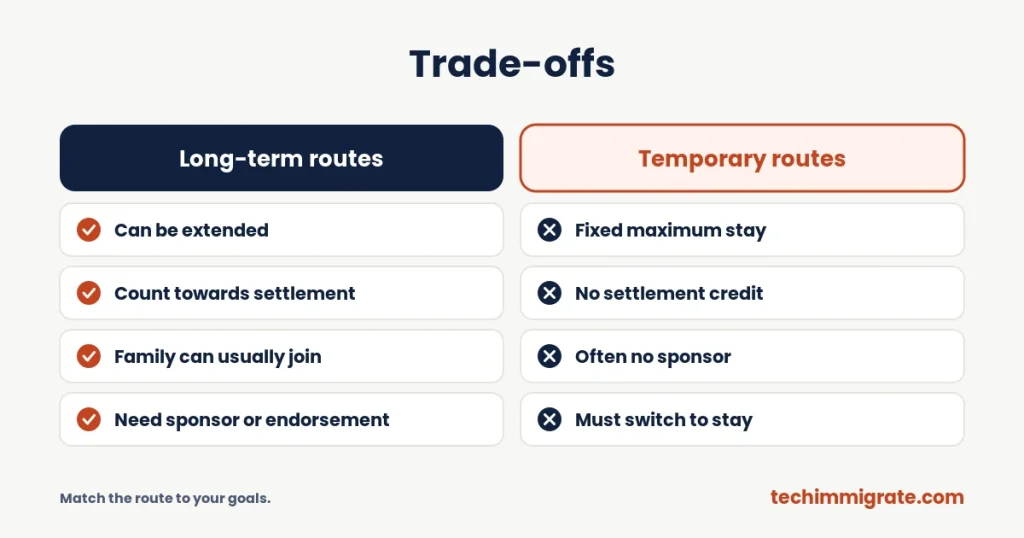
Long-term routes can be extended and count towards settlement. Temporary routes have a fixed limit and usually do not.
Yes. It cannot be extended and does not count towards settlement.
Yes. It can be extended and usually leads towards settlement.
Usually yes from most routes, if you meet the requirements.
It depends on your goals. Temporary routes are flexible; long-term routes offer security.
Why the Distinction Matters
The difference between temporary and long-term routes matters because it determines what happens when your visa ends. On a long-term route, you can usually extend, and your time builds towards settlement. On a temporary route, you reach a fixed end point and must either switch to another route or leave. Many people choose a temporary route without realising this, then find themselves under pressure near the end. Understanding the difference from the start helps you choose a route that matches your goals and plan your next step in good time.
The Graduate Route
The Graduate route lets people who have completed an eligible UK degree on a Student visa stay and work for two years, or eighteen months for most applications from 1 January 2027, or three years for doctoral graduates. It needs no sponsor or job offer. It cannot be extended and does not count towards settlement. It is designed as a bridge between study and a longer-term route.
The High Potential Individual Route
The High Potential Individual route is for recent graduates of universities on a list of top global institutions. It lasts two years, or three for doctoral graduates, needs no sponsor and cannot be extended. It does not count towards settlement. Like the Graduate route, it is often used to find a role and then switch to Skilled Worker or Global Talent.
The Youth Mobility Scheme
The Youth Mobility Scheme is for young people from participating countries and territories. Age limits, length of stay and whether a ballot is needed depend on the country. Holders can work for most employers without sponsorship. It does not count towards settlement and cannot usually be extended beyond the allowed period. Check GOV.UK for the list of participating countries and their specific terms.
Global Business Mobility Routes
Global Business Mobility covers routes for people moving within multinational organisations, setting up UK branches, providing services under trade agreements or completing graduate training. These routes need a sponsor and are designed for temporary assignments. Time on them does not usually count towards settlement, and there are maximum periods of stay.
Temporary Work Routes
The Temporary Work routes include Creative Worker, Charity Worker, Religious Worker, Government Authorised Exchange, International Agreement and Seasonal Worker. Each serves a specific purpose and has its own maximum length. Most need a sponsor. None count towards settlement. They are less relevant to most tech professionals, but some exchange and research schemes run under the Government Authorised Exchange route.
The Skilled Worker Route
Skilled Worker is the main long-term work route. It needs a job offer from a licensed sponsor in an eligible occupation, at an appropriate salary, with English at the required level. It can be granted for up to five years at a time and extended. Time on Skilled Worker usually counts towards settlement, although the rules are changing under the earned settlement model.
The Global Talent Route
Global Talent is a long-term route for leaders and potential leaders in fields including digital technology, science, research and the arts. It needs endorsement from an approved body rather than a sponsor. It can be granted for up to five years at a time and extended without limit. It counts towards settlement and, for some endorsements, offers a faster route than Skilled Worker.
The Scale-up Route
The Scale-up route needs a job offer from an authorised scale-up sponsor for the first six months. After that, holders can work for any employer, provided they meet income requirements when extending. It counts towards settlement.
The Innovator Founder Route
Innovator Founder is for people setting up innovative businesses in the UK, with endorsement from an approved body. It counts towards settlement, subject to business milestones and the rules in force when you apply to settle.
Flexibility Versus Security
Temporary routes often offer more day-to-day flexibility: no sponsor, no salary threshold and freedom to change jobs. Long-term routes usually offer more security: extensions, family rights and a path to settlement. The best choice depends on whether you value flexibility now or security later. Many people use both, starting with flexibility and moving to security once they have found the right role.
Family Considerations
Long-term routes usually allow partners and children to join you, including new partners. Temporary routes vary. Some, like the Graduate route, only allow family members who were already your dependants. Others, like the Youth Mobility Scheme, do not allow dependants at all. If family is a priority, check the rules for each route before choosing.
Settlement Considerations
If settlement is your goal, time spent on temporary routes is usually time not counting towards it. Under earned settlement, routes such as Graduate, High Potential Individual, Global Business Mobility, Youth Mobility and Temporary Work are listed as not counting. The sooner you move onto a long-term route, the sooner your settlement clock starts.
Switching Between Routes
Most temporary routes allow switching to Skilled Worker or Global Talent from inside the UK. Some do not, such as visitor and seasonal worker routes. Check the switching rules for your current route before relying on an in-country switch. Switching involves a new application, new fees and new requirements.
Planning Your Path
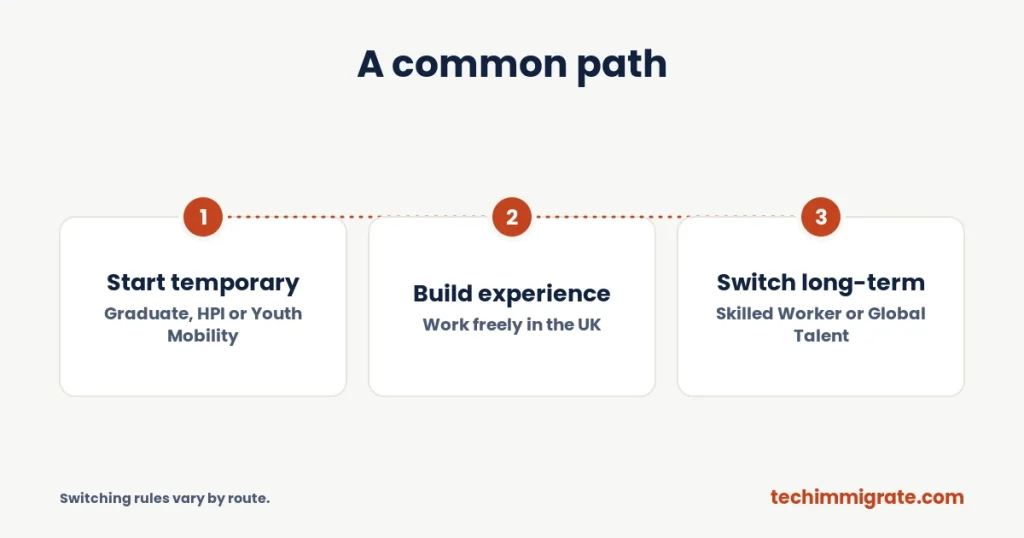
A common path for tech professionals is to start on a temporary route, build experience and then switch to a long-term route. Another is to start directly on a long-term route if a sponsor or endorsement is available. Neither is wrong. Plan your path with your career, family and settlement goals in mind.
Our Summary
Temporary routes offer flexibility and a way in. Long-term routes offer security and a way to stay. Understanding which is which, and how to move between them, helps you build a stable future in the UK.
A Fictional Example
Consider a fictional product designer who comes to the UK on the Youth Mobility Scheme. They work for two different startups, building a strong portfolio and a network of contacts. Towards the end of their permitted stay, they secure a role at a company with a sponsor licence and switch to Skilled Worker, if switching is allowed from their route, or apply from abroad if it is not. Several years later, with a record of recognised design work, they consider Global Talent through the design endorsement route. The example is fictional, but it shows how a temporary start can lead to a long-term future.
Common Misunderstandings
One common misunderstanding is that time on any visa counts towards settlement. It does not. Another is that temporary routes can always be extended if you find a job. They cannot. A third is that long-term routes are always harder. Some, like Global Talent, are demanding to qualify for but very flexible once granted. Clearing up these misunderstandings helps you choose wisely.
How to Decide: Five Questions
If you are unsure which type of route suits you, five questions can help. First, how long do you want to stay in the UK: a couple of years for experience, or indefinitely? Second, do you already have a job offer from a licensed sponsor, or would you rather look for work once you arrive? Third, do you have a record of achievement strong enough for an endorsement-based route such as Global Talent? Fourth, will your partner or children be coming with you, now or later? Fifth, how important is it to start your settlement clock as soon as possible? If your answers point towards a long stay, family and early settlement, a long-term route is usually the better fit. If they point towards flexibility, exploration and no current offer, a temporary route may be the better first step. Many people find their answers change over time, which is why switching between routes is so common.
Costs of Temporary Versus Long-Term Routes
Temporary routes often look cheaper because they are shorter and need no sponsor. But because they cannot be extended, you will usually need to pay for a second visa if you want to stay, which can make the total cost higher over several years. Long-term routes can be more expensive up front, especially for five-year grants with five years of health surcharge, but they spread the cost over a longer period and may avoid repeated applications. When comparing, think about the total cost of your likely path, not just the first application.
Work Conditions on Each Type
Work conditions differ. Temporary routes such as Graduate, High Potential Individual and Youth Mobility generally let you work for almost any employer, at any skill level, and be self-employed in many cases. Sponsored temporary routes, such as Global Business Mobility and Temporary Work, restrict you to the role and sponsor on your certificate. Long-term routes vary too: Skilled Worker ties you to your sponsor and occupation, while Global Talent lets you work for anyone or for yourself. Check your conditions carefully, because breaching them can affect future applications.
Travel and Absences
On temporary routes, long absences from the UK do not usually shorten your visa, but they reduce the time you have to gain experience. On long-term routes, absences matter more, because settlement rules limit how much time you can spend outside the UK during your qualifying period. If you travel a lot for work or family, keep careful records from the start of any long-term route.
How Employers View Each Type
Employers often find temporary unsponsored routes attractive, because hiring someone on a Graduate, High Potential Individual or Youth Mobility visa involves no sponsorship cost or paperwork. However, some employers hesitate if they know the visa will end soon. Being open about your plans, including whether you would need sponsorship later, helps employers make decisions. Employers who hold sponsor licences are often happy to hire on a temporary route and sponsor later if the fit is right.
Settlement Under Earned Settlement
The government's earned settlement reforms set out which routes count towards settlement and which do not. Under the published plans, temporary routes including Graduate, High Potential Individual, Global Business Mobility, Youth Mobility and Temporary Work do not count. Long-term routes such as Skilled Worker and Global Talent do, with qualifying periods that depend on factors such as income, occupation and contribution. Some routes, such as Global Talent, may offer faster settlement for certain applicants. These changes are being implemented through 2027, so check GOV.UK for the latest position.
Researchers and Temporary Routes
Researchers sometimes come to the UK on temporary schemes, such as government authorised exchange programmes for visiting researchers. These can be valuable for short projects, but they do not lead to settlement. Researchers who want to stay longer often move to Skilled Worker or Global Talent through a research endorsing body. Global Talent can offer research-endorsed applicants a relatively quick path to settlement.
Founders and Temporary Routes
Founders sometimes start their UK journey on a temporary route, using the freedom to test ideas and meet investors before applying for Innovator Founder or Global Talent. This can work well, but because temporary routes cannot be extended, founders need to move quickly. Building evidence of traction, investment and recognition early makes the switch to a long-term route more likely to succeed.
Planning Ahead for a Switch
If you are on a temporary route and plan to switch, start preparing at least six months before your visa ends. For Skilled Worker, that means securing a job offer and giving your employer time to assign a certificate of sponsorship. For Global Talent, it means preparing your endorsement application, which can take weeks to decide. Applying before your current visa expires usually lets you stay while the new application is decided.
A Second Fictional Example
Consider a fictional machine learning engineer who receives a job offer from a UK company before arriving. The company holds a sponsor licence and assigns a certificate of sponsorship. The engineer applies for a five-year Skilled Worker visa from abroad, moves with their partner and starts work. Because they started on a long-term route, their settlement clock begins on arrival. A few years later, they consider Global Talent to gain more freedom. The example is fictional, but it shows how starting on a long-term route can give stability from day one.
Which Routes Allow Switching From Inside the UK
Most people on temporary routes can switch to Skilled Worker from inside the UK if they meet the requirements. The main exceptions are visitors, short-term students, parents of child students, seasonal workers, domestic workers in a private household and some people with leave outside the rules or on immigration bail. Global Talent also allows in-country applications from most routes, again with some exceptions. If you are on a route that does not allow switching, you will usually need to leave the UK and apply from abroad, which adds time, cost and disruption. Check the switching rules for your current route on GOV.UK before relying on an in-country switch, and allow plenty of time before your current permission ends.
What Happens if You Reach the End of a Temporary Route
If you reach the end of a temporary route without switching, you must leave the UK before your permission expires. Staying beyond that date makes you an overstayer, which can lead to re-entry bans and harm future applications. If you have applied for another visa before your permission ends, you are usually protected while that application is decided. If your application is refused, check whether you can request an administrative review and what your status is while it is pending.
Long-Term Routes Are Not Permanent
It is worth remembering that long-term routes are not permanent status. A Skilled Worker or Global Talent visa still has an end date and must be extended until you qualify for settlement. You must continue to meet the route's requirements, such as staying with a sponsor on Skilled Worker. Settlement, through indefinite leave to remain, is what gives permanent status. Long-term routes simply lead there; they do not replace it.
Summary Table of Key Differences
In short, temporary routes trade length and settlement credit for flexibility and easy access. Long-term routes trade some flexibility, or a harder qualification, for extensions, family rights and a path to settlement. Use this distinction as a lens when you compare routes, and revisit your choice as your career and family plans develop.
How Tech Professionals Typically Choose
Among tech professionals, a few patterns are common. Recent graduates of UK universities usually start on the Graduate route because it is simple and needs no sponsor. Graduates of top overseas universities sometimes use the High Potential Individual route for the same reason. Experienced engineers with a firm offer often go straight to Skilled Worker, which starts their settlement clock immediately. People with strong public records, such as open-source maintainers, conference speakers, published researchers or founders of notable products, often aim for Global Talent, which combines freedom with a long-term path. Intra-company transfers are common for staff of large multinationals on fixed assignments. None of these patterns is a rule, and many people move between them over time. The key is knowing which type of route you are on, what it allows and when you will need to act.
Getting Advice
If your situation is complex, for example you have a mixed immigration history, dependants on different routes or a time-sensitive switch, consider speaking to a regulated immigration adviser. GOV.UK remains the official source for the rules on every route discussed here.
Your Next Step
If you want a long-term route without a sponsor, Global Talent may suit you. Our role-specific Global Talent guides explain what Tech Nation looks for.
How We Checked This Article
We checked route rules against GOV.UK's work visas overview and individual route pages in November 2026.
Tech Immigrate is independent of the Home Office. This article is general information, not legal advice. Check GOV.UK before you apply.
We write practical guides for tech professionals applying for the UK Global Talent visa. Tech Immigrate is independent of Tech Nation and the Home Office, and our articles are general information, not legal advice. Rules and fees change, so always check gov.uk before you apply.