
Skilled Worker Visa Requirements: The Plain-English Guide
Every Skilled Worker visa requirement in plain English: licensed sponsor, eligible job, salary, B2 English, savings, TB test, suitability and costs.


In this article
- The Requirements at a Glance
- Requirement 1: An Employer With a Sponsor Licence
- Requirement 2: A Genuine Job Offer and Certificate of Sponsorship
- Requirement 3: An Eligible Job at the Right Skill Level
- Requirement 4: Salary
- Requirement 5: English Language
- Requirement 6: Money to Support Yourself
- Requirement 7: Tuberculosis Test, if Applicable
- Requirement 8: Criminal Record Certificate, for Some Jobs
- Requirement 9: Suitability
- Requirements for Your Family
- Costs
- Processing Times
- A Worked Example: Checking Every Requirement
- A Worked Example: A Requirement Not Met
- Requirements That Have Changed Recently
- Requirements That Do Not Apply
- How the Home Office Checks the Requirements
- Requirements and Settlement
- A Simple Self-Check Before You Apply
- Requirements After You Arrive
- Common Mistakes
- Meet the Requirements, Then Plan Ahead
- How We Checked This Article
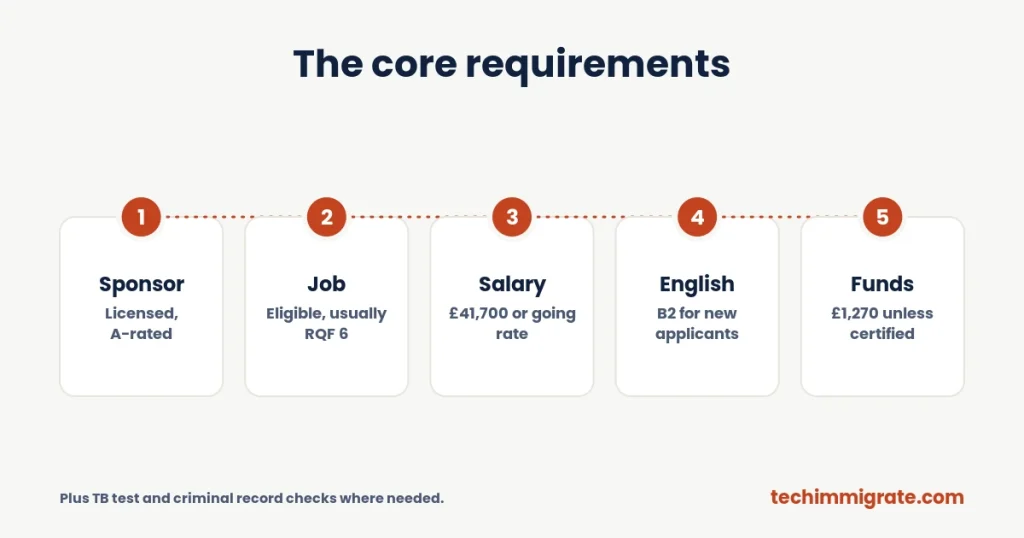
The Skilled Worker visa is the UK's main work visa, and the rules behind it run to many pages of Immigration Rules, appendices and guidance. But the core requirements can be explained simply. You need a real job, with a licensed employer, at the right skill level, paid enough, and you need to speak English well enough. Almost everything else is detail around those points.
This guide sets out every Skilled Worker visa requirement in plain English, in the order the Home Office checks them. For each one, it explains what it means, how you prove it, and where people most often go wrong. It is written with tech professionals in mind, with examples from software, data, cyber security and design, but the requirements are the same for every occupation.
Key takeaways
- You need a confirmed job offer from a UK employer that holds a sponsor licence, and a certificate of sponsorship from that employer.
- The job must be in an eligible occupation, usually at RQF level 6 or above, roughly degree level.
- You must be paid at least £41,700 or the going rate for your occupation, whichever is higher, unless a lower rate applies to you.
- New applicants need English at B2.
- You may need to show £1,270 in savings, unless your employer certifies maintenance or you have been in the UK for 12 months.
- Applicants from some countries need a tuberculosis test certificate, and some roles need a criminal record certificate.
- You must meet the general suitability rules, such as no serious criminality and no previous immigration breaches.
The Requirements at a Glance
| Requirement | In plain English | How you prove it |
|---|---|---|
| Sponsor | Your employer has a Home Office licence | Employer is on the register of licensed sponsors |
| Job offer | A real job, genuinely needed | Certificate of sponsorship |
| Skill level | Degree-level work, usually | Occupation code on the certificate |
| Salary | Enough pay for the job and the route | Salary on the certificate |
| English | Upper-intermediate English | Degree, nationality or test |
| Money | Enough to support yourself at first | Bank statements or employer certification |
| Health | No active tuberculosis, if applying from a listed country | TB test certificate |
| Criminal record | Clean record, for some jobs | Criminal record certificate |
| Suitability | No serious issues in your history | Your answers in the application |
Requirement 1: An Employer With a Sponsor Licence
Your employer must be approved by the Home Office as a sponsor. Only licensed sponsors can offer you a Skilled Worker job. You can check any employer on the register of licensed sponsors on GOV.UK, which lists every licensed organisation, the routes it can sponsor and its rating.
What to check: the employer is listed, it is licensed for the Skilled Worker route, and it has an A rating. A B-rated sponsor usually cannot assign new certificates.
Where people go wrong: searching for a brand name rather than the company's legal name, or trusting an offer from an organisation that is not on the register. Our guide to the register of licensed sponsors explains how to search it.
Requirement 2: A Genuine Job Offer and Certificate of Sponsorship
You need a confirmed job offer, and your employer must assign you a certificate of sponsorship. The certificate is an electronic record with a reference number, setting out the details of your job.
Since March 2026, Home Office sponsor guidance requires the role on the certificate to be an eligible role: one that genuinely exists and that requires you to do the duties and hours set out on the certificate. The job description must accurately reflect what you will actually do.
What to check: your name, passport number, job title, job description, occupation code, salary, hours and start date are all correct on the certificate.
Where people go wrong: applying with errors on the certificate, letting it expire (you must apply within 3 months of it being assigned), or paying for a certificate, which is a sign of a scam. Our guide to the certificate of sponsorship covers the details.
Requirement 3: An Eligible Job at the Right Skill Level
Your job must be in an eligible occupation listed in the Immigration Rules Appendix Skilled Occupations. Since 22 July 2025, most new applicants need a job skilled to RQF level 6 or above, which is broadly equivalent to bachelor's degree level.
You do not personally need a degree. The skill level is about the job, not your qualifications. But you must have the skills to do the job.
Tech roles that usually qualify:
- programmers and software development professionals (2134);
- IT business analysts, architects and systems designers (2133);
- IT project and programme managers (2131);
- cyber security professionals (2135);
- IT network professionals (2137);
- web design professionals, including UI and UX designers (2141).
Tech roles that usually do not qualify for new applicants: IT support and operations technician roles below RQF 6.
People sponsored in medium-skilled roles before 22 July 2025 can usually continue on the route. Our guide to occupation codes for tech roles explains how to match your job to the right code.
Requirement 4: Salary
You must be paid at least the higher of:
- the general threshold of £41,700 a year; or
- the going rate for your occupation code.
Going rates for common tech roles include £54,700 for programmers and software developers, £54,900 for IT business analysts and architects, £58,200 for IT project and programme managers, £48,500 for cyber security professionals and £43,800 for web design professionals.
You can be paid less in some situations:
- New entrants, such as people under 26, recent graduates, or people working towards a professional qualification, can be paid 70% of the going rate, with a minimum of £33,400. This is limited to 4 years in total, including any time on a Graduate visa.
- People with a relevant PhD can be paid 80% of the going rate for a STEM PhD, or 90% for a non-STEM PhD, with minimums.
- Jobs on the immigration salary list have a lower general threshold of £33,400, but must still meet the going rate.
Only guaranteed basic gross pay counts. Bonuses, overtime and most allowances do not. Since 8 April 2026, sponsor guidance requires the required salary to be paid in every pay period.
Where people go wrong: accepting a salary that meets £41,700 but not the going rate for their code, or counting bonuses. Our guide to the new entrant rules explains the reduced rates.
Requirement 5: English Language
Since 8 January 2026, new Skilled Worker applicants need English at B2 level of the Common European Framework of Reference. You can usually prove this by:
- being a national of a majority English-speaking country on the Home Office list;
- having a degree taught in English, confirmed by Ecctis if awarded outside the UK;
- passing an approved Secure English Language Test at B2.
If you already proved English in an earlier Skilled Worker application, you usually do not need to prove it again when you extend, and people extending usually keep the B1 requirement.
Where people go wrong: assuming that working in English is enough evidence, or using a test that is not on the approved list.
Requirement 6: Money to Support Yourself
You must usually have at least £1,270 in your bank account, held for 28 days in a row, with day 28 falling within 31 days of your application. If your partner and children are coming, you need more: £285 for a partner, £315 for the first child and £200 for each additional child.
You do not need to show this money if:
- you have been in the UK on a valid visa for at least 12 months; or
- your employer certifies maintenance on your certificate of sponsorship.
Where people go wrong: letting the balance drop below the required amount on any day in the 28-day period, or not checking whether the employer has certified maintenance.
Requirement 7: Tuberculosis Test, if Applicable
If you have lived for 6 months or more in a country on the Home Office's tuberculosis test list, and you are coming to the UK for more than 6 months, you need a TB test certificate from an approved clinic. Countries on the list include Nigeria, Ghana, Kenya, Pakistan and India, among many others.
Where people go wrong: using a clinic that is not approved, or letting the certificate expire before applying. Certificates are usually valid for 6 months.
Requirement 8: Criminal Record Certificate, for Some Jobs
Some jobs need a criminal record certificate from every country you have lived in for 12 months or more in the last 10 years. These are mainly roles in health, education and social care. Most tech roles do not need one, but check your occupation code.
Requirement 9: Suitability
Like all UK visas, the Skilled Worker visa has suitability requirements. Your application can be refused if, for example, you:
- have serious criminal convictions;
- have previously breached immigration rules, such as overstaying;
- have used deception in a previous application;
- owe significant debts to the NHS;
- are subject to a deportation order or exclusion.
Answer every question honestly. Failing to disclose something is often treated more harshly than the original issue.
Requirements for Your Family
If your partner and children are coming with you, each needs to meet the dependant requirements:
- your partner must be your spouse, civil partner, or unmarried partner who has lived with you for at least 2 years;
- children must be under 18, or already in the UK as your dependants;
- each dependant needs their own application, fee and health surcharge;
- dependants may need to show maintenance funds, unless your employer certifies it;
- care workers and senior care workers cannot bring new dependants.
Our guide to the Skilled Worker dependant visa explains the family rules.
Costs
| Item | Cost |
|---|---|
| Visa fee from outside the UK | £819 (up to 3 years) or £1,618 (more than 3 years) |
| Visa fee from inside the UK | £943 (up to 3 years) or £1,865 (more than 3 years) |
| Health surcharge | £1,035 per adult per year, £776 per child per year |
| Certificate of sponsorship (employer pays) | £525 |
| Immigration Skills Charge (employer pays) | £1,320 per year (large) or £480 per year (small) |
Our guide to Skilled Worker visa fees has the full breakdown.
Processing Times
GOV.UK says you will usually get a decision within 3 weeks if you apply from outside the UK, and within 8 weeks if you apply from inside the UK. Faster services may be available for a fee.
A Worked Example: Checking Every Requirement
A data engineer living abroad receives an offer from a London healthtech company at £60,000 as a data engineer under code 2134.
- Sponsor: the company is on the register, licensed for Skilled Worker, A-rated.
- Job offer: the company requests a defined certificate, which is granted, and assigns it with an accurate job description.
- Skill level: 2134 is at RQF 6.
- Salary: £60,000 exceeds both £41,700 and the £54,700 going rate.
- English: her degree was taught in English, confirmed by Ecctis.
- Money: the employer certifies maintenance, so she does not need to show savings.
- TB test: she lives in a listed country, so she gets a certificate from an approved clinic.
- Criminal record: not required for her role.
- Suitability: no issues.
She applies within a month of the certificate being assigned and gets a decision in about 3 weeks.
A Worked Example: A Requirement Not Met
A QA engineer is offered a role at £39,000 under code 2136, which has a going rate of £41,200.
- Because the going rate is below £41,700, the general threshold of £41,700 applies.
- His salary of £39,000 does not meet it.
- He is 28, has not been a student or graduate in the last 2 years, and is not working towards a professional qualification, so he does not qualify as a new entrant.
The employer would need to raise the salary to £41,700 for the application to succeed.
Requirements That Have Changed Recently
If you looked at the Skilled Worker rules a few years ago, several requirements are now different:
- Skill level moved up from RQF 3 to RQF 6 for most new applicants on 22 July 2025.
- The general salary threshold rose to £41,700, with £33,400 for new entrants.
- English rose from B1 to B2 for new applicants on 8 January 2026.
- The Immigration Skills Charge paid by employers rose by 32% on 16 December 2025.
- Visa fees changed on 8 April 2026.
- Sponsor guidance introduced the eligible role requirement in March 2026, and from 8 April 2026 the required salary must be paid in every pay period.
People already on the route before some of these changes benefit from transitional protection, especially on salary and skill level. Our guide to the new Skilled Worker rules explains who is protected.
Requirements That Do Not Apply
Some things people worry about are not requirements for the Skilled Worker visa:
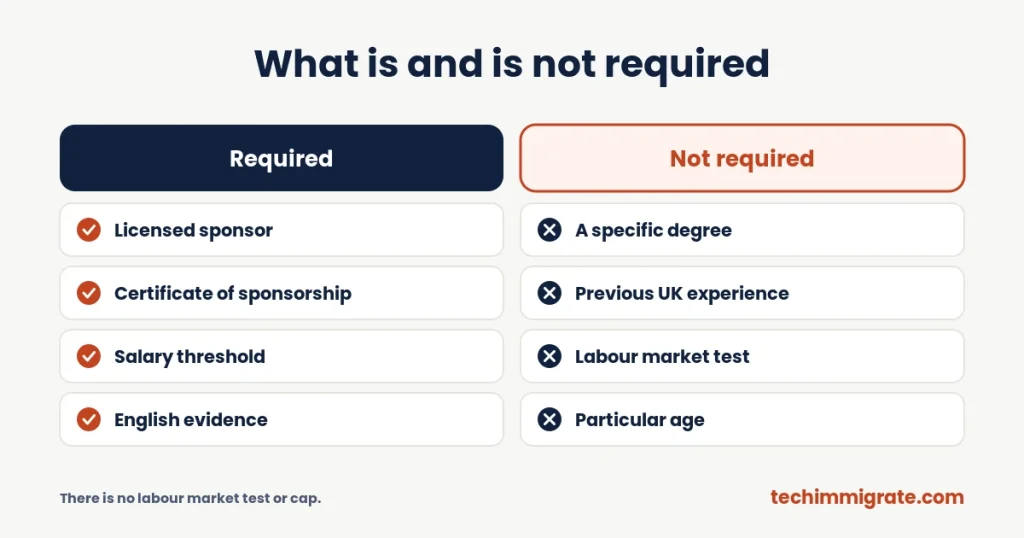
- You do not need a specific degree, as long as you have the skills for the job and the job is at the right level.
- You do not need to pass a points test in the old sense. The route still uses points internally, but in practice the points come from meeting the job, salary and English requirements.
- There is no labour market test. Employers do not have to advertise the role to UK workers first.
- There is no overall cap on the number of Skilled Worker visas.
- You do not need to be a particular age, although being under 26 can help you qualify for new entrant salary rates.
- You do not need previous UK experience.
How the Home Office Checks the Requirements
Caseworkers assess Skilled Worker applications by checking your application form, your certificate of sponsorship and your supporting evidence against each requirement. They may also:
- check the sponsor's records and compliance history;
- look for consistency between the certificate, your CV and your job title;
- ask for more information if something is unclear;
- in some cases, interview you or contact your employer.
The most common reasons for delay are missing documents, inconsistencies between the certificate and your evidence, and questions about whether the role is genuine. A clear, consistent application avoids most of these.
Requirements and Settlement
Meeting the requirements for your first visa is only the start. If you plan to stay long term, the requirements for settlement matter too. Under the current rules, Skilled Workers can usually apply for indefinite leave to remain after 5 years, if they are still sponsored and meet the salary rules at the time.
Under the government's earned settlement response of 2 November 2026, the default path becomes 10 years, with a 5-year path for people earning at least £50,271 and a 3-year path for the highest earners. New requirements, including English at B2 and no debts to public bodies, would apply to everyone. The changes are expected to be implemented over 2027.
For tech workers, this means your salary is not just a visa requirement. It may also decide how long it takes you to settle. If your starting salary is close to the minimum, plan for progression. Our guide to the new ILR rules for Skilled Worker visa holders explains the proposals.
A Simple Self-Check Before You Apply
Work through these questions in order. If you can answer yes to each, you are likely ready to apply:
- Is my employer on the register of licensed sponsors, licensed for Skilled Worker, with an A rating?
- Has my employer assigned a certificate of sponsorship, and have I checked every detail?
- Is my occupation code eligible, and does the job description match my real duties?
- Does my salary meet £41,700 and the going rate, or a reduced rate I genuinely qualify for?
- Do I have English evidence at B2?
- Do I have savings held for 28 days, or has my employer certified maintenance?
- Do I need a TB test or criminal record certificate, and do I have them?
- Have I answered every suitability question honestly?
If any answer is no or unsure, fix it before you pay the fee.
Requirements After You Arrive
Once you have your visa, you must keep meeting the conditions:
- work for your sponsor in the job described on your certificate;
- be paid at least the salary on the certificate;
- tell your employer about changes to your circumstances;
- apply for a new visa before changing employer or occupation code;
- not claim most public funds.
Your employer also has duties, such as reporting if you leave or if your role changes significantly.
Common Mistakes
- Not checking the employer is licensed. Always verify on the register.
- Missing the going rate. £41,700 is not always enough.
- Using old English rules. B2 applies to new applicants since January 2026.
- Moving money during the 28-day period. The balance must not drop below the required amount.
- Forgetting the TB test. Check whether your country is on the list.
- Paying for sponsorship. Genuine sponsors pay their own fees.
A job offer from a licensed sponsor, a certificate of sponsorship, an eligible job usually at RQF 6, a salary of at least £41,700 or the going rate, English at B2, and sometimes savings, a TB test and a criminal record certificate.
Not personally. The job must usually be at degree level, but you need the skills to do it rather than a specific qualification.
Usually £41,700 or the going rate for your occupation, whichever is higher. New entrants can qualify at £33,400 or 70% of the going rate.
B2 for new applicants since 8 January 2026.
Usually £1,270 for 28 days, unless your employer certifies maintenance or you have been in the UK for 12 months.
No. A job offer and certificate of sponsorship are essential. Routes like Global Talent do not need a job offer.
Usually 3 weeks from outside the UK and 8 weeks from inside.
Meet the Requirements, Then Plan Ahead
The Skilled Worker requirements are strict but clear. If you have a genuine offer from a licensed sponsor, at the right skill level and salary, and your English evidence is ready, most applications are straightforward. Think beyond the first visa too: your salary over the coming years may decide how long it takes to settle under the earned settlement reforms. If you have a strong track record in tech and want a route without a sponsor, our role-specific Global Talent guides explain what Tech Nation looks for.
How We Checked This Article
We checked requirements against GOV.UK's Skilled Worker visa pages and the Home Office sponsor guidance glossary in November 2026. Going rates are from the Immigration Rules Appendix Skilled Occupations as reported at the time of writing; check the current table for your code.
Tech Immigrate is independent of the Home Office. This article is general information, not legal advice. Check GOV.UK before you apply.
We write practical guides for tech professionals applying for the UK Global Talent visa. Tech Immigrate is independent of Tech Nation and the Home Office, and our articles are general information, not legal advice. Rules and fees change, so always check gov.uk before you apply.


