
Can You Extend the Graduate Visa? Your Options When It Ends
Can you extend the UK Graduate visa? No. Your options when it ends: Skilled Worker, Global Talent, HPI and more, plus timing and what happens if you wait.


In this article
- Why the Graduate Visa Cannot Be Extended
- How Long Your Graduate Visa Lasts
- Your Options When the Graduate Visa Ends
- A 12-Month Plan for an 18-Month Graduate Visa
- Keeping Your Options Open
- Telling Your Employer
- Your Family
- Comparing Your Options
- Common Questions About Timing
- Making the Most of the Time You Have
- Why the 18-Month Change Matters
- Getting Help
- Questions to Ask Yourself Now
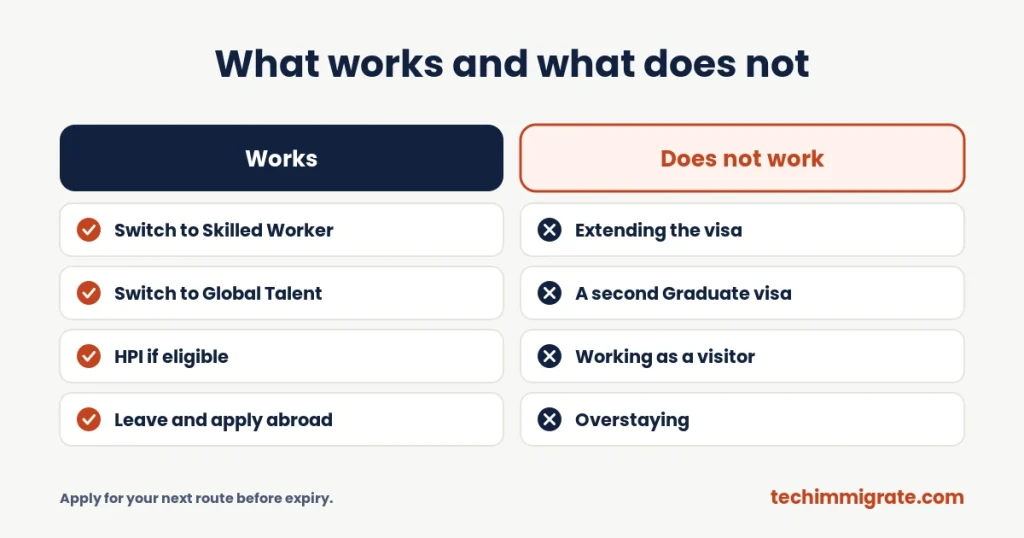
- Options That Do Not Work
- Timing: When to Switch
- What Happens if You Do Not Switch in Time
- Leaving and Coming Back
- Settlement: Why Switching Early Matters
- A Worked Example: Switching in Good Time
- A Worked Example: Running Out of Time
- A Worked Example: Using HPI as a Bridge
- Common Mistakes
- Plan Your Exit From the Graduate Visa
- How We Checked This Article
One of the most common questions from people on a Graduate visa is whether they can extend it. The answer, confirmed plainly on GOV.UK, is no. The Graduate visa is a one-time, fixed-length visa. When it ends, you must either have moved onto another route or leave the UK. There is no second Graduate visa, no extension and no grace period.
That does not mean your time in the UK has to end. It means you need a plan. This guide explains why the Graduate visa cannot be extended, how long it lasts, every realistic option for staying in the UK when it ends, what happens if you do nothing, and how to plan your move in time. It is written for tech graduates, but the options apply to graduates in any field.
Key takeaways
- You cannot extend a Graduate visa. GOV.UK says so directly.
- It lasts 2 years if you applied on or before 31 December 2026, 18 months if you applied on or after 1 January 2027, and 3 years for PhD graduates.
- To stay in the UK after it ends, you must switch to another route before it expires.
- The main options for tech graduates are Skilled Worker and Global Talent. Others include High Potential Individual, Innovator Founder, Scale-up, family routes and further study.
- You can switch from inside the UK while your Graduate visa is valid. Allow up to 8 weeks for a decision.
- If your Graduate visa expires without a new application, you must leave the UK. Overstaying can seriously harm future applications.
- Graduate visa time does not count towards settlement on work routes, so switching earlier starts your settlement clock sooner.
Why the Graduate Visa Cannot Be Extended
The Graduate route was designed as a single, time-limited period of post-study work. The Immigration Rules for the route do not allow an extension, and you cannot apply for a second Graduate visa, even if you complete another degree. GOV.UK's Graduate visa page states plainly that you cannot extend your Graduate visa.
The idea is that graduates use the period to gain experience and then move onto a longer-term route, such as Skilled Worker or Global Talent. The government has also made the route shorter for most graduates who apply from 1 January 2027, which suggests the direction of policy is towards less time on the Graduate visa, not more. Planning on the basis that the rules might relax is not a safe strategy.
How Long Your Graduate Visa Lasts
| When you applied | Bachelor's or master's | PhD |
|---|---|---|
| On or before 31 December 2026 | 2 years | 3 years |
| On or after 1 January 2027 | 18 months | 3 years |
The visa starts on the day your application is approved. Check your eVisa for your exact end date and put it in your calendar, with reminders at 12, 6 and 3 months before. Many graduates are surprised by how quickly the time goes once they start working.
Your Options When the Graduate Visa Ends
Option 1: Skilled Worker
The most common next step. You need a job offer from a licensed sponsor, in an eligible occupation, at a qualifying salary. As a recent Graduate visa holder, you usually qualify as a new entrant, so the salary can be 70% of the going rate, with a minimum of £33,400. For a software developer, that is about £38,300 rather than £54,700.
You can switch from inside the UK at any time while your Graduate visa is valid. The fee is £943 for up to 3 years or £1,865 for more than 3 years, plus the health surcharge. Skilled Worker leads to settlement. Our guide to switching to a Skilled Worker visa explains the process.
Option 2: Global Talent
For graduates with standout, recognised achievements, such as a start-up with traction, widely used open-source work or recognised awards. You need an endorsement from Tech Nation, usually under exceptional promise early in your career. There is no sponsor, no salary threshold and you can work for anyone or run your own business. Global Talent leads to settlement. Our guide to switching to the Global Talent visa explains how.
Option 3: High Potential Individual
If your degree is from a university on the Home Office's list of top-ranked institutions and was awarded in the last 5 years, you may be able to switch to HPI. It gives 2 years, or 3 for PhD graduates, with no sponsor. But like the Graduate visa, it cannot be extended and does not lead to settlement. It buys time, but you will still need a long-term route afterwards.
Option 4: Innovator Founder
If you have started a business with an innovative, scalable idea, you may be able to win an endorsement from an approved body. Innovator Founder leads to settlement after 3 years if the business meets the required milestones.
Option 5: Scale-up
If you get a job offer from a company that qualifies as a scale-up, you need sponsorship for the first 6 months only, after which you can change employer.
Option 6: Family routes
If your partner is British or settled, you may be able to switch to a partner visa under the family rules. This has its own requirements, including a financial requirement of £29,000 since April 2024.
Option 7: Further study
You can apply for a new Student visa for a further course, such as a PhD. This ends your Graduate visa, and you cannot get a second Graduate visa afterwards. Study may make sense for academic or career reasons, but it is rarely the best way simply to stay in the UK.
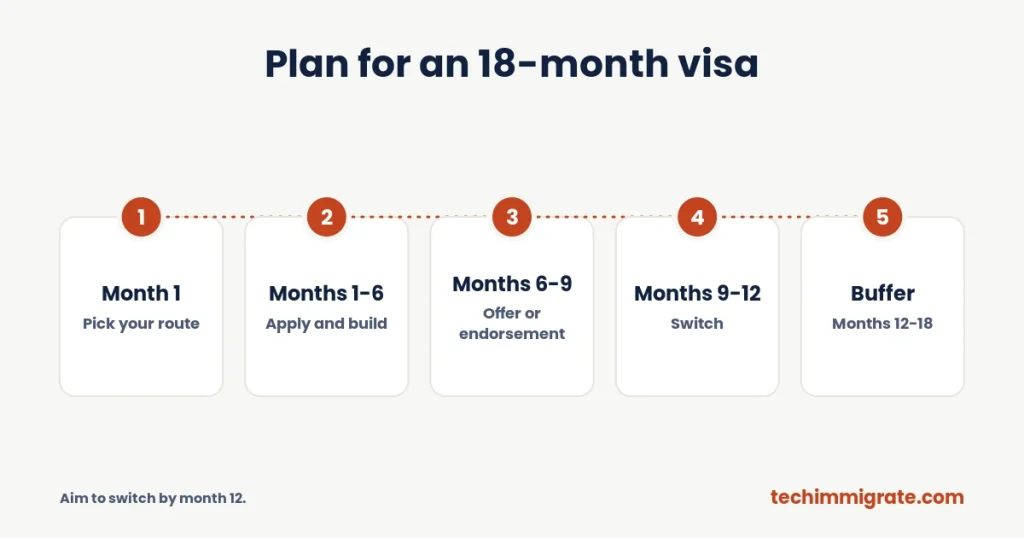
A 12-Month Plan for an 18-Month Graduate Visa
If you have an 18-month visa, a structured plan helps you switch with time to spare:
- Month 1: note your end date and new entrant allowance. Decide your target route.
- Months 1 to 3: if aiming for Skilled Worker, apply to sponsors, especially graduate schemes and large employers. If aiming for Global Talent, audit your evidence and approach potential referees.
- Months 3 to 6: gain experience in a role, even if unsponsored. Build your portfolio and public profile.
- Months 6 to 9: secure a sponsored offer, or submit your Global Talent endorsement application.
- Months 9 to 12: switch to your new route.
- Months 12 to 15: buffer for problems, such as a refused endorsement or a withdrawn offer.
- Months 15 to 18: last-resort window. If you have not switched by now, consider leaving before expiry and applying from abroad.
With a 2-year or 3-year visa, stretch the plan, but keep the same principle: switch well before the end.
Keeping Your Options Open
The safest approach is to pursue more than one option at once:
- apply for sponsored roles while building a Global Talent case;
- if eligible, keep HPI in mind as a bridge;
- if your partner is British or settled, understand the family route requirements;
- if you are building a business, explore both Global Talent and Innovator Founder.
Having a backup reduces the risk of reaching the end of your Graduate visa with no route, and it gives you more negotiating power with employers.
Telling Your Employer
If you are working on a Graduate visa, your employer knows your visa has an end date, because it carried out a right-to-work check. Have an early conversation about your plans:
- ask whether the company holds a sponsor licence, or would consider getting one;
- explain that you qualify for new entrant salary rates;
- agree a timeline, so the employer can assign a certificate well before your visa ends;
- if you are applying for Global Talent, explain that you would not need sponsorship if endorsed.
Many graduates switch to Skilled Worker with an employer they already work for, because the employer already knows their work.
Your Family
If your partner and children are with you on your Graduate visa, their permission ends with yours. When you switch to a new route, they usually need to apply to switch too, as your dependants on that route. If you leave the UK, they must leave as well, unless they have their own permission.
Comparing Your Options
| Option | Needs | Leads to settlement | Can extend |
|---|---|---|---|
| Skilled Worker | Sponsored offer, new entrant salary | Yes | Yes |
| Global Talent | Tech Nation endorsement | Yes | Yes |
| High Potential Individual | Eligible top-ranked university degree | No | No |
| Innovator Founder | Business endorsement | Yes | Yes |
| Scale-up | Offer from a qualifying scale-up | Yes | Yes |
| Partner visa | British or settled partner, financial requirement | Yes | Yes |
| Student | Offer of a new course | No | Depends on course |
For most tech graduates who want to stay long term, Skilled Worker or Global Talent will be the main choice, with the others as alternatives for particular situations.
Common Questions About Timing
Can I apply to switch on the last day of my Graduate visa? Technically yes, as long as you apply before it expires, but it leaves no margin for error. If your application is invalid or you have made a mistake, you may not have time to fix it.
What if my sponsor is slow to assign a certificate? Start the conversation early and give your employer a clear deadline. If the deadline approaches and the certificate is not ready, ask whether a priority service is available or consider alternatives.
What if my Global Talent endorsement is still pending when my visa ends? You cannot rely on a pending endorsement to stay. You need to apply for a visa before your Graduate visa expires. If the endorsement has not been decided, consider switching to Skilled Worker as a fallback, or leaving the UK and applying for Global Talent from abroad once endorsed.
Does applying for a new visa let me stay after my Graduate visa expires? If you apply for a new visa before your Graduate visa expires, your existing permission usually continues until the new application is decided. That is why applying in time matters so much.
Making the Most of the Time You Have
Because you cannot extend, every month of your Graduate visa is valuable. Graduates who make the most of it usually:
- work in roles that build skills sponsors want, such as cloud, data, security or full-stack development;
- keep a record of their achievements, including metrics, feedback and recognition, which helps with both job applications and Global Talent;
- network deliberately, through meetups, alumni groups and online communities;
- save money for the next visa fee and health surcharge;
- pass the Life in the UK test early, because the pass does not expire and will be needed for settlement later.
These steps do not extend your visa, but they make the next step much easier.
Why the 18-Month Change Matters
From 1 January 2027, most bachelor's and master's graduates get 18 months instead of 2 years. For tech graduates, this means:
- less time to find a sponsor, especially if you are targeting competitive graduate schemes;
- less time to build a Global Talent case, if you are starting from scratch;
- the same 4-year new entrant limit, but more of it available after you switch, because you spend less time on the Graduate visa.
The shorter visa makes early planning even more important. If you applied before 31 December 2026 and secured 2 years, you have a little more breathing space, but the same principles apply.
Getting Help
Your university's international student team can usually help while you are still a student or recently graduated, and its careers service can help with finding sponsored roles. For complex situations, such as a previous refusal, a gap in your immigration history or a deadline you are worried about missing, consider advice from a regulated immigration adviser or solicitor. Be cautious of anyone who promises to extend a Graduate visa or guarantees a sponsored job for a fee, because neither is possible legitimately.
Questions to Ask Yourself Now
- What is the exact end date of my Graduate visa?
- Which route am I aiming for, and what do I need to qualify?
- What is my backup if my main plan does not work out?
- How much new entrant time will I have left if I switch at different points?
- What will I do if I reach the last 2 months without a route?
Write the answers down and review them regularly.
Options That Do Not Work
- Extending the Graduate visa: not possible.
- Applying for a second Graduate visa: not possible.
- Staying as a visitor to keep working: visitor visas do not allow work for UK employers, and you cannot usually switch to a visitor visa from inside the UK.
- Overstaying while you look for work: this can lead to bans on returning and refusals of future applications.
Timing: When to Switch
You must apply for your next visa before your Graduate visa expires. In practice:
- Start planning from day one. Decide which route you are aiming for.
- Aim to switch with time to spare. In-country applications usually take up to 8 weeks. If you apply in time, your existing permission continues while your application is decided.
- Do not wait for the final weeks. If something goes wrong, such as a job offer falling through or a certificate error, you need time to fix it.
- Remember new entrant time. Graduate visa time counts towards the 4-year limit on new entrant salaries, so switching earlier keeps more of that time available.
With an 18-month visa, aim to secure your next route within the first 12 months.
What Happens if You Do Not Switch in Time
If your Graduate visa expires and you have not applied for another visa, you have no permission to be in the UK. You must leave. Staying after your visa expires makes you an overstayer, which can:
- lead to refusal of future UK visa applications;
- in some cases, lead to a ban on returning for a period;
- create problems with employers and landlords, who must check your status.
If you are close to the end of your Graduate visa without a plan, take advice quickly. Applying for another route in time, even if the outcome is uncertain, is far better than overstaying.
Leaving and Coming Back
If you cannot switch in time, leaving the UK and applying for a new route from abroad is an option. For example, you could apply for a Skilled Worker visa from your home country once you have an offer, or for Global Talent once you have an endorsement. Leaving before your visa expires protects your immigration record.
Applying from outside the UK has its own requirements, such as a tuberculosis test if you live in a listed country and, for Skilled Worker, a defined certificate of sponsorship.
Settlement: Why Switching Early Matters
Time on the Graduate visa does not count towards the qualifying period for settlement on Skilled Worker or Global Talent. Under the earned settlement proposals published on 2 November 2026, it would not count towards settlement at all. Your settlement clock starts when you switch to a settlement route.
Under the proposals, the length of your path will depend on earnings: 5 years for people earning at least £50,271, 3 years for those earning at least £125,141 or in the highest talent group, and a 10-year default for others. Our guide on whether the Graduate visa counts towards ILR explains this in detail.
A Worked Example: Switching in Good Time
A cyber security graduate has a 2-year Graduate visa ending in December 2028.
- In month 8, he receives a sponsored offer as a security analyst at £36,000, above the new entrant rate for his occupation.
- He switches to Skilled Worker in month 9, well before his Graduate visa ends.
- His settlement clock starts, and he still has over 2 years of new entrant time.
A Worked Example: Running Out of Time
A product designer's 18-month Graduate visa ends in 6 weeks, and her sponsored offer has just fallen through.
- She contacts other employers she had interviewed with, and one agrees to sponsor her.
- The employer assigns a certificate within a week, and she applies to switch before her Graduate visa expires.
- Because she applied in time, she can stay in the UK while her application is decided.
If no employer had been able to sponsor her in time, her safest option would have been to leave the UK before her visa expired and apply from abroad later.
A Worked Example: Using HPI as a Bridge
A data science graduate from an eligible top-ranked university is coming to the end of his Graduate visa without a sponsored offer.
- He switches to HPI, which gives him 2 more years without sponsorship.
- He uses the time to build a stronger profile and find a sponsored role.
- He understands that HPI cannot be extended and does not lead to settlement, so he plans his next switch early.
Common Mistakes
- Assuming the Graduate visa can be extended. It cannot.
- Leaving the switch to the final weeks. Problems take time to fix.
- Forgetting new entrant time. It runs down while you are on the Graduate visa.
- Overstaying. This can damage future applications.
- Using HPI without a plan. It also cannot be extended.
- Starting a new course just to stay. It ends your Graduate visa and you cannot get another.
No. GOV.UK states that you cannot extend a Graduate visa.
No. You can only have one Graduate visa.
Skilled Worker, Global Talent, High Potential Individual, Innovator Founder, Scale-up, family routes and Student visas, if you meet the requirements.
Before your Graduate visa expires, ideally with at least 8 weeks to spare. Switching earlier starts your settlement clock sooner.
You must leave the UK unless you have applied for another visa in time. Overstaying can harm future applications.
Yes. Leaving before your visa expires protects your immigration record.
Plan Your Exit From the Graduate Visa
The Graduate visa cannot be extended, so treat its end date as a fixed deadline. Decide your next route early, use the new entrant rules if you are aiming for Skilled Worker, and build your profile if Global Talent is your goal. Our role-specific Global Talent guides explain how to build an application Tech Nation will endorse.
How We Checked This Article
We checked the Graduate visa rules, including that it cannot be extended, against GOV.UK's Graduate visa pages, and the switching options against GOV.UK's pages for Skilled Worker and Global Talent, in November 2026. Settlement reforms are from law firm summaries of the earned settlement response of 2 November 2026.
Tech Immigrate is independent of the Home Office. This article is general information, not legal advice. Check GOV.UK before you apply.
We write practical guides for tech professionals applying for the UK Global Talent visa. Tech Immigrate is independent of Tech Nation and the Home Office, and our articles are general information, not legal advice. Rules and fees change, so always check gov.uk before you apply.


