Global Talent Visa for VCs and Angel Investors: Who Qualifies and What Counts
Can VCs and angel investors get the Global Talent visa? The seniority line, what leading a deal means, which evidence counts, and 2026 costs.


In this article
- Can Investors Get the Global Talent Visa?
- What Does "Leading" an Investment Mean?
- Which Investor Profiles Usually Fit?
- How Do the Criteria Apply to Investors?
- What Recognition Looks Like for an Investor
- How Do You Show a Deal Was Yours?
- Which Investor Evidence Is Strong, and Which Is Weak?
- What Investor Applications Show
- Exceptional Talent or Exceptional Promise for Investors?
- Who Should Write an Investor's Letters?
- How Do You Handle Confidential Fund Information?
- What Does the Visa Cost for an Investor?
- Global Talent or Another Route for Investors?
- What Happens If an Investor Is Refused?
- How Should an Investor Start?
- Get the Guide for Tech Investors
- Frequently Asked Questions
- How We Checked This Article
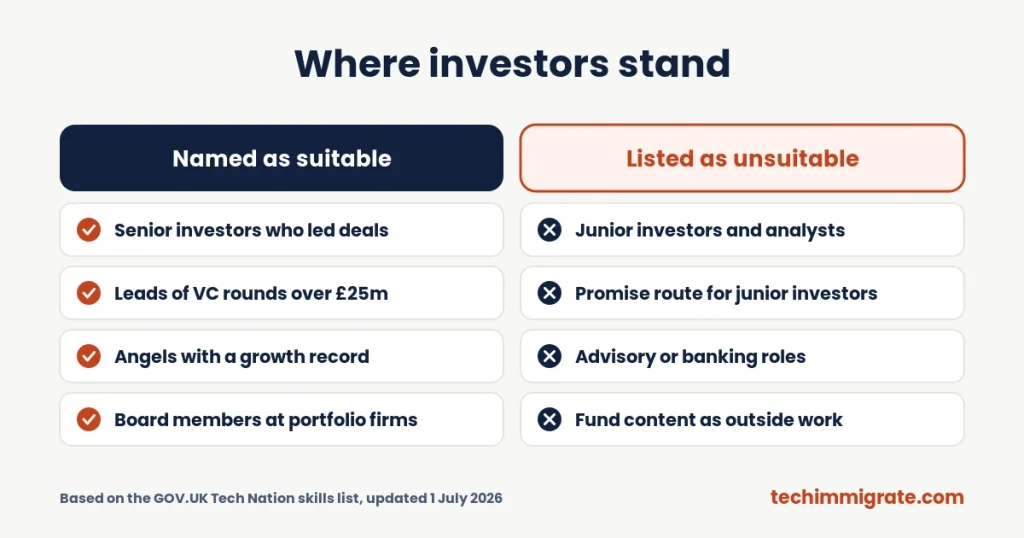
Venture capital investors and angel investors can get the UK Global Talent visa, but the bar for investors is set unusually clearly. The government's list of skills covered by Tech Nation, updated on 1 July 2026, names experienced and senior VC or private equity analysts with a track record of leading investments in digital businesses, and leaders of VC investment rounds over £25 million. The same list says junior investors and analysts are unsuitable unless backed by a senior investment track record, and not suitable for Exceptional Promise. On top of that, you need recognition outside your fund as a leader in digital technology investing.
This article is for VC partners, principals and associates, angel investors, corporate venture investors, private equity professionals focused on tech, and scouts or operators who invest on the side. It explains how Tech Nation sees investors, why seniority matters so much, which criteria investment work fits, what recognition means for an investor, how to show a deal was yours, and what applications reported on the Tech Nation Visa Forum show.
Key takeaways
- Senior VC or PE investors with a track record of leading investments in digital businesses, and leaders of VC rounds over £25 million, are named on the GOV.UK Tech Nation skills list, updated 1 July 2026.
- Junior investors and analysts are listed as unsuitable unless backed by a senior track record, and not suitable for Exceptional Promise.
- Investors are assessed as business applicants. Your contribution needs to show in product-led digital technology companies, usually your portfolio.
- A fund's results are a team's results. You need to show which investments you sourced, led or shaped.
- Work you do for your fund, such as reports and newsletters, is part of your job and is weak evidence for work outside your occupation, according to forum reviewers in October 2026.
- Endorsement costs £561 and the visa £205, plus the £1,035 yearly health surcharge.
Can Investors Get the Global Talent Visa?
Yes. The digital technology route covers business skills, and investment in digital businesses is one of them. The GOV.UK list of technical and business skills covered by Tech Nation, last updated on 1 July 2026, includes, in paraphrase:
- Experienced and senior VC or PE analysts with track records of leading investments in digital businesses
- Leaders of VC investment rounds over £25 million
It also lists, as unsuitable, junior investors and analysts unless backed by a senior-level investment track record, and says they are not suitable for Exceptional Promise.
This is the clearest seniority line Tech Nation draws for any role. For engineers and product managers, an early-career person with strong external signs can apply for Exceptional Promise. For investors, the skills list says junior investors are not suitable for Promise at all. In practice, the investor route is mainly for people who have led investments, not supported them.
The visa itself suits investors well. There is no sponsor, so you can move between funds, invest your own money, join a portfolio company or start a fund. Our article on the benefits of the Global Talent visa covers the advantages and trade-offs.
What Does "Leading" an Investment Mean?
The skills list talks about leading investments and leading rounds, and this word matters more than any other in an investor's application.
In venture capital, a lead investor usually sets the terms of a round, takes the largest share, often takes a board seat and does most of the diligence. Within a fund, the person who leads a deal usually sourced it or championed it, ran the investment case through the committee and owns the relationship afterwards.
For your application, leading means you can show:
- You sourced or championed the deal, not only analysed it.
- You made the case to the investment committee, with your name on the memo or the recommendation.
- You took responsibility afterwards, for example a board seat, an observer seat or ownership of the portfolio relationship.
Analysts and associates often do vital work on many deals without leading any of them. That work matters, but it is what the skills list describes as junior unless backed by a senior track record. If you are at that stage, the honest path is usually to lead deals first, then apply.
Which Investor Profiles Usually Fit?
| Investor profile | Typical fit | What usually decides it |
|---|---|---|
| Partner or principal who led several digital investments | Strong | The deals you led and how those companies performed |
| Lead investor in a round over £25 million | Strong | Named on the skills list; show you led it |
| Angel with a record of early investments in tech companies that grew | Good | Your role in their growth, and recognition by founders and co-investors |
| Corporate venture investor at a tech company | Mixed | Show leading investments, not supporting corporate strategy |
| Private equity professional focused on tech | Mixed | Show digital business focus and leading roles |
| VC associate or analyst | Weak | Listed as unsuitable unless backed by a senior record |
| Scout or operator-angel with a few small cheques | Weak to mixed | Usually needs other evidence, such as operating career |
| Investment banker or adviser on tech deals | Weak | Advisory work is service work, not investing |
If you have an operating career as well as investing, such as a former founder or product leader who now invests, your strongest evidence may come from the operating side. Our article on the Global Talent visa for start-up founders covers founder evidence.
How Do the Criteria Apply to Investors?
You need the Mandatory Criterion plus two of four optional criteria. Investors are assessed as business applicants, and business skills apply to work in product-led digital technology companies. For investors, that usually means showing your contribution to the companies you backed.
| Criterion | What it asks | Investor evidence that fits |
|---|---|---|
| Mandatory | Recognition as a leading talent in digital technology | Industry rankings with independent selection, invited talks, expert roles, media naming you, recognition by founders and co-investors |
| OC1: Innovation | A track record of innovation as a founder, senior executive or employee working on a new digital field or concept | Founding a fund or programme with a new model, or backing a new category early |
| OC2: Beyond your job | Recognition for work outside your occupation that advances the field | Voluntary, structured founder mentoring outside your fund; open resources the ecosystem uses |
| OC3: Significant contribution | Commercial or entrepreneurial contribution as a founder, senior executive, board member or employee of a product-led company | Board roles where you shaped strategy, follow-on funding, exits or growth at companies you led investments in |
| OC4: Academic | Research contributions | Rarely relevant |
OC3 mentions board members, which makes it a natural fit for investors who sit on portfolio boards. Most investors pair OC3 with OC1 or OC2.
What Recognition Looks Like for an Investor
The Mandatory Criterion asks for recognition of you as a leader in digital technology. For investors, recognition often looks like:
- Independent rankings or lists of leading investors, where selection is by an editorial team or panel and the criteria are published.
- Invitations to speak or judge at major technology and start-up events, because of your investing expertise.
- Expert roles, such as sitting on a government or industry advisory group on technology investment, or chairing a selection panel for a recognised accelerator.
- Media that seeks your view as an investor in technology publications with editorial selection.
- Recognition by founders and co-investors, for example letters from well-known founders you backed early, or from lead investors who followed your conviction.
What rarely carries it: your fund's size or brand, your job title, deal announcements that name the fund but not you, and content you produce for your fund. A forum reviewer told one applicant in October 2026 that a market report and newsletter written for a VC firm were weak as outside work if they were part of the job, and that reach alone does not show the field advancing. Our article on why tech investors get refused covers this and the other refusal patterns.
How Do You Show a Deal Was Yours?
A fund's portfolio is a team's work. Partners vote, associates build the model, the platform team helps portfolio companies, and co-investors share the risk. Assessors need to see your part.
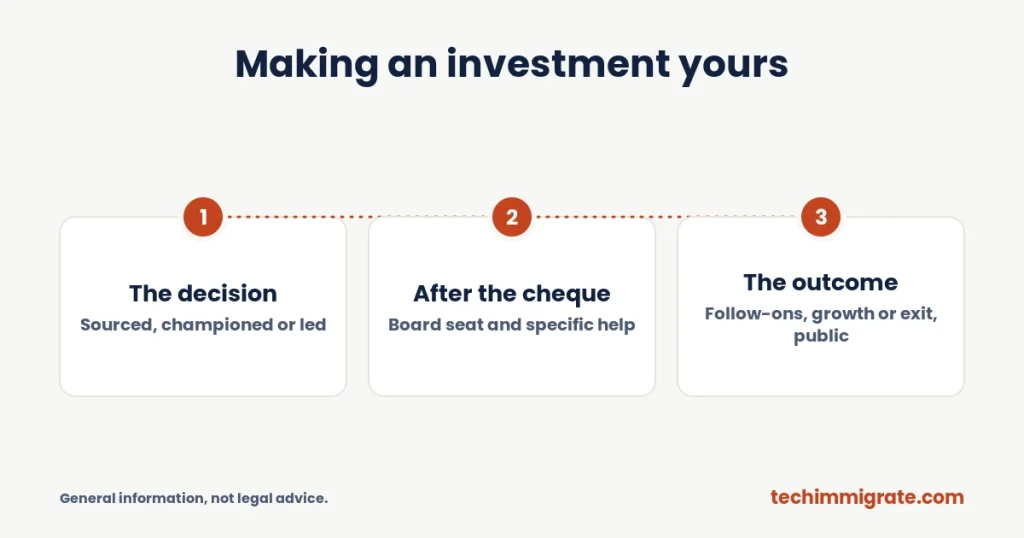
Three things make an investment attributable to you:
- Your role in the decision. Sourced, championed or led, with evidence such as your name on the investment memo, a committee record you are permitted to share, or a partner's letter.
- Your role after the investment. A board or observer seat, specific help you gave the company, introductions that led to customers or follow-on rounds.
- The outcome. Follow-on funding at higher valuations, revenue growth, exits, or the company becoming a recognised leader, confirmed by public sources or the founders.
Public sources are especially valuable for investors because so much is announced: funding rounds, board appointments, acquisitions. A press release or company filing that names you is stronger than a description you write yourself. Self-reported fund performance, such as returns figures you compile, is the investor equivalent of a self-reported dashboard and is often discounted.
Which Investor Evidence Is Strong, and Which Is Weak?
This is general guidance based on the criteria and forum reports, not an official scoring system.
| Evidence | Usually strong when | Usually weak when |
|---|---|---|
| A deal you led | Public announcement names you as lead; partner or founder confirms | Fund named, your role unclear |
| Portfolio company growth | Follow-on rounds and growth confirmed publicly | Fund-wide figures you compiled |
| Board seat | Shows decisions you influenced and their result | A title with no described contribution |
| Investor rankings | Independent panel, published criteria | Paid or self-nominated lists |
| Talks and judging | Invited for investing expertise, credible events | Fund-organised events |
| Fund content | Widely cited by others, clearly outside your job | Reports and newsletters for your fund |
| Mentoring | Structured, voluntary, outside your fund | Portfolio support, which is your job |
One point catches many investors: helping your own portfolio companies is part of an investor's job. It belongs in OC3 as contribution, not in OC2 as work outside your occupation. A 2022 forum thread made a similar point about a paid advisory role with a VC fund, where reviewers said being an adviser alone did not show enough contribution to the sector.
What Investor Applications Show
Investor applications are less common on the Tech Nation Visa Forum than engineering or product ones, so the record is thinner. What it shows is consistent with the skills list.
- 2022, business applicant with VC advisory work. An applicant planned to use a paid-in-kind advisory role with a VC fund and accelerator mentoring as outside work. Reviewers said mentoring must be structured and unpaid, and that an advisory role alone did not show enough contribution to the sector.
- 2023, senior operator-investor. An applicant with decades in digital health and government technology, who had co-founded and sold companies and led large venture investments, shared how daunting the criteria felt even with that record. Their case relied on operating and investing evidence together.
- 2026, investor endorsed under Talent. A forum member reported that a tech investor in their network, applying as a non-technical applicant from the UK, applied on 22 May and was endorsed on 8 June, then received the visa within weeks after requesting a faster decision.
- October 2026, VC-adjacent work reviewed. A product manager who wrote a market report and newsletter for a VC firm was told that work done for the firm may count as their occupation rather than outside work, and that its value to the wider ecosystem had to be shown.
The pattern: senior investors with clear leading roles and public evidence do get endorsed, sometimes quickly. Investors who rely on fund branding, junior roles or fund content struggle. Our article on the Global Talent visa success rate shows how much stricter Tech Nation has become across all roles.
Exceptional Talent or Exceptional Promise for Investors?
For investors, this choice is mostly made for you. The skills list says junior investors and analysts are not suitable for Exceptional Promise, so the route in practice is Exceptional Talent for senior investors.
| Exceptional Talent | Exceptional Promise | |
|---|---|---|
| Investor fit | Senior investors who have led investments | Junior investors are listed as not suitable |
| Experience | Usually many years, with a leading track record | Not the usual route for investors |
| Settlement | After 3 years | After 5 years |
If you are an early-career investor with a strong operating background, such as an engineer or product manager who moved into venture recently, your operating career may give you a Promise case on its own terms. In that situation, build the application around the role you are strongest in. Our article on Exceptional Talent vs Exceptional Promise explains the choice.
Who Should Write an Investor's Letters?
You need three letters from established leaders in digital technology. Strong letters for investors usually come from:
- Founders you backed, ideally of well-known companies, who can describe what you did beyond writing the cheque.
- Co-investors or lead investors at other funds, who can describe your role in deals you shared.
- A senior partner at your own fund or a former fund, who can confirm the deals you led and your standing.
Letters from inside your fund alone can look like the fund recommending its own staff. Letters from founders and other investors show the ecosystem's view of you. Every letter should name specific deals and explain your part in them. Letters must be signed documents; the Home Office does not accept web links. Our guide to recommendation letters covers who to ask.
How Do You Handle Confidential Fund Information?
Funds hold confidential information about portfolio companies, limited partners and returns. You should not share it, and Tech Nation does not need it.
The public record usually gives you enough: funding announcements naming you as the lead, board appointments in company filings, acquisitions, and founders' public statements. Where you need private facts, such as your role in an investment committee decision, a letter from a senior partner confirming the facts in general terms is better than an internal document. Ask your fund early what it will confirm in writing; compliance teams can take weeks. Never send documents marked confidential, and remember that every document you send is read by Home Office staff and Tech Nation assessors.
What Does the Visa Cost for an Investor?
Figures checked on GOV.UK in November 2026:
| Item | Cost or time |
|---|---|
| Endorsement (Stage 1) | £561 |
| Visa (Stage 2) | £205 |
| Immigration Health Surcharge | £1,035 per adult per year |
| Each partner or child | £766 each, plus their surcharge |
| Endorsement decision | Usually 5 to 8 weeks |
| Visa decision | About 3 weeks outside the UK, 8 weeks inside; faster service may be available for a fee |
| Settlement | After 3 years (Talent) or 5 years (Promise) |
The government's earned settlement response of 2 November 2026 keeps 3 years for a highest talent group that includes Global Talent, while setting a 10-year baseline for most routes. New rules are expected from December 2026. The Migration Advisory Committee's review of talent routes, published 17 November 2026, also suggested a light-touch income check at settlement; this is advice, not yet a rule. Our cost breakdown has worked examples.
Global Talent or Another Route for Investors?
The old Tier 1 Investor visa closed in 2022, and there is no direct replacement for people who simply want to invest their own money in the UK. For working investors in technology, Global Talent is the main route that does not need a sponsor.
The alternatives are a sponsored work visa through a fund with a sponsor licence, which ties you to that fund, or the Innovator Founder visa, which is for people starting a business rather than investing in others. Global Talent's flexibility, to move between funds, invest personally, join a portfolio company or raise your own fund, makes it the best fit for most senior investors who qualify.
What Happens If an Investor Is Refused?
You can ask for a free endorsement review within 28 days of a refusal, but you cannot add new evidence. A review helps when the panel overlooked something you sent, such as a public announcement naming you as lead investor. It does not help when the evidence itself is the problem, for example fund-level results without your role, or junior investing experience.
For most investors refused on seniority or attribution, the better path is a new application once you have led more deals or gathered public evidence of your role. Each application is assessed independently, so build the new one around the criteria and current guidance, not only around the last refusal. Our article on how to challenge a Global Talent refusal explains every route.
How Should an Investor Start?
Before paying £561:
- Check the seniority line. List the investments you led, not those you worked on.
- Gather public evidence for each led deal: announcements, filings, board appointments.
- Separate portfolio support from outside work. Portfolio help is OC3; only voluntary work outside your fund fits OC2.
- List recognition of you, not of your fund: rankings, invitations, expert roles.
- Choose letter writers from founders and other investors as well as your fund.
- Read the current Tech Nation guide and GOV.UK pages. Since August 2025 you apply on GOV.UK and email documents to the Home Office.
Our article on how much evidence is enough helps you judge whether you are ready.
Get the Guide for Tech Investors
The Global Talent Visa Endorsement Guide for Tech Investors is 108 pages, aligned with Tech Nation's applicant guide. It covers how to turn investing work into evidence Tech Nation accepts, with 20 evidence checklists, a 12-week planner, 30 refusal fixes and 4 anonymised refusal cases with the wording decoded.
I was refused the first time I applied for Global Talent, then reapplied and was endorsed. The guide is built on what changed between those two applications.
Frequently Asked Questions
Yes. Senior VC or PE investors with a track record of leading investments in digital businesses, and leaders of VC rounds over £25 million, are named on the GOV.UK Tech Nation skills list, updated 1 July 2026.
It is unlikely to work on investing evidence alone. The skills list describes junior investors and analysts as unsuitable unless backed by a senior track record, and not suitable for Exceptional Promise.
Yes, if they have a record of investments in digital businesses and can show their role in those companies' growth and recognition by founders and other investors.
Usually not. Supporting your portfolio is part of an investor's job, so it fits OC3 as contribution rather than OC2 as outside work.
They are weak if written as part of your job. Forum reviewers in October 2026 said such work may count as your occupation, and reach alone does not show the field advancing.
Usually Exceptional Talent. The skills list says junior investors are not suitable for Promise, so the investor route in practice is for senior investors.
GOV.UK says endorsement decisions usually take 5 to 8 weeks. One investor reported in 2026 being endorsed in about two and a half weeks.
How We Checked This Article
We checked eligibility, fees, timings and settlement periods on the GOV.UK digital technology Global Talent pages and the list of technical and business skills covered by Tech Nation, updated 1 July 2026, in November 2026. Process details draw on the Home Office Global Talent caseworker guidance published 3 August 2026, and the Migration Advisory Committee's review of talent routes, published 17 November 2026.
Applicant cases come from the Tech Nation Visa Forum: a 2026 report of an investor endorsed under Talent, an October 2026 review of VC-related evidence, a 2022 business applicant with VC advisory work and a 2023 senior operator-investor's application. Forum material is applicant-reported or member opinion, not official guidance.
Tech Immigrate is independent of Tech Nation and the Home Office. This article is general information, not legal advice.
We write practical guides for tech professionals applying for the UK Global Talent visa. Tech Immigrate is independent of Tech Nation and the Home Office, and our articles are general information, not legal advice. Rules and fees change, so always check gov.uk before you apply.