Tech Nation Hidden Guidelines: 8 Unwritten Expectations Applicants Report
Tech Nation hidden guidelines explained: what the guidance states, what applicants report, and how to meet 8 easy-to-miss expectations. Check your evidence.

In this article
- Are There Really Tech Nation Hidden Guidelines?
- How Do You Tell Stated Guidance From Reported Expectations?
- Why Do Applicants Miss the Stated Tech Nation Hidden Guidelines?
- Expectation 1: Outside Evidence, the Most Missed of the Tech Nation Hidden Guidelines
- Expectation 2: The Product-Led Test
- Expectation 3: Evidence Inside the Last Five Years
- Expectation 4: Letters Support Evidence and Never Replace It
- Expectation 5: Each Document Must Stand Alone and Be Readable
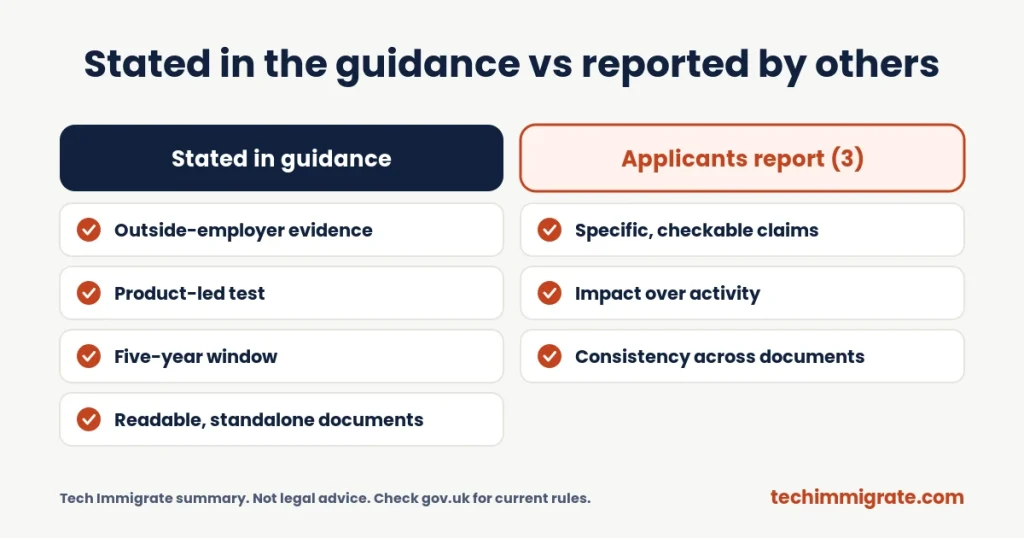
- A Table of Tech Nation Hidden Guidelines by Status
- Expectation 6: Specific Claims You Can Check
- Expectation 7: Impact Over Activity in Tech Nation Hidden Guidelines
- Expectation 8: Consistency Across Every Document
- Do the Expectations Change Between Talent and Promise?
- A Worked Example: Auditing a Draft Against the Eight Expectations
- Tech Nation Hidden Guidelines Checklist Before You Submit
- What Should You Not Read Into Tech Nation Hidden Guidelines?
- How Long Does It Take to Meet These Expectations?
- Tech Nation Hidden Guidelines FAQ
- Your Next Step
- How We Checked This Article
There are no secret Tech Nation hidden guidelines, but some expectations are easy to miss in the written guidance, and applicants report others. This article separates what is stated from what is reported, across eight expectations.
It is for applicants who have read the rules and still wonder what the panel really wants. We claim no insider knowledge of Tech Nation or its assessors. Everything here comes from public sources.
Key takeaways
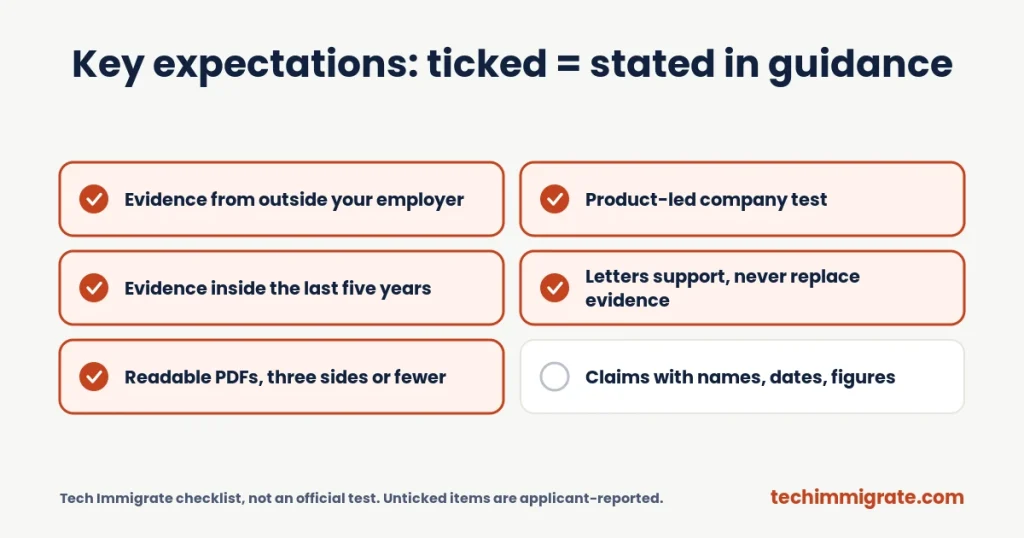
- Nothing here is secret: five expectations are in the written guidance and three come from applicant reports.
- Independent evidence, the product-led test and a five-year window are stated, but many applicants still miss them.
- Specific claims, impact over activity and consistency across documents are reported expectations, not official rules.
- Tech Nation's panel decides overall, so meeting the criteria alone is not enough.
- Label each expectation in your own plan as stated or reported, then test every document against it.
Are There Really Tech Nation Hidden Guidelines?
No, there is no hidden rulebook, but there is a gap between what people read and what the guidance says. Most so-called hidden guidelines are written down in places applicants skim.
The guidance sits across gov.uk, Tech Nation's own pages and its application guide. Tech Nation's panel decides overall whether to endorse you. Meeting the criteria is necessary, but it is not enough. That "overall" judgment is why applicants talk about unwritten expectations.
Three levels of confidence
We use three labels. Stated in the guidance means gov.uk or Tech Nation says it. Adviser-reported means a law firm or consultancy describes it. Applicants report means people who applied say they saw it. Please treat the last two as hints, not rules.
How Do You Tell Stated Guidance From Reported Expectations?
Ask where the sentence lives. If you can point to it on gov.uk or on a Tech Nation page, it is stated. If you only find it on a blog, a forum or a law firm page, it is reported.
This matters because rules change. One adviser's summary of recent updates may be right today and wrong after the next guidance change. Always check the current page. Our own list of facts, such as the evidence limits, comes from the sources we name in "How We Checked This Article."
Where the written guidance lives
The gov.uk page on the digital technology route covers eligibility, fees and timing. The gov.uk page on skills covered by Tech Nation describes who suits the route. Tech Nation's application guide holds the detailed evidence rules. Read all three before you build a plan.
Why Do Applicants Miss the Stated Tech Nation Hidden Guidelines?
Applicants miss them because the rules sit in three places and read as separate notes. A rule on gov.uk, a line in a Tech Nation page and a detail in the application guide can all matter to one document.
Habit plays a part too. Most people start by gathering what they have, not by testing it against each rule. As a result, they find the limits late, when they must cut or rebuild.
Three habits that hide the rules
First, skim reading: people read the criteria and skip the evidence rules. Second, trusting summaries: a blog post may be out of date. Third, building before checking: the evidence exists, so it feels finished. The cure for all three is to write each rule on one page and test every document against it before you polish anything.
Expectation 1: Outside Evidence, the Most Missed of the Tech Nation Hidden Guidelines
Status: stated in the guidance. Recognition evidence should come from outside your employer, and internal awards and your own posts alone do not count.
Many applicants miss this because internal evidence feels strong. A promotion letter, an internal award or a company blog about you proves something real. It does not show that the wider sector sees you as a leader. One law firm notes that reviewers can accept a document exists yet call it internal or promotional.
What to do: Lead each recognition criterion with an independent source: press that names you, an invited talk, an award with a public shortlist, or a statement from an outside expert. Use internal documents only for facts that nobody else can show. Our criteria guide shows where each criterion expects outside proof.
Expectation 2: The Product-Led Test
Status: stated in the guidance. The gov.uk page says business skills apply to in-house work within product-led digital technology companies. It excludes service and tech-enabled companies such as agencies, outsourcers and marketing firms.
This is easy to miss because the word "technology" appears in so many job titles. A company can use software heavily and still not sell its own digital product. Applicants who work in consultancy or service delivery often discover the test late.
What to do: Test your last five years before you collect evidence. Ask whether the company builds and sells its own digital product, and whether you worked on that product. If not, look for product work or contributions outside work. Tech Nation's own page also names non-product-led roles as a common weak point.
Illustrative example (fictional)
Omar works for a firm that builds custom software for clients. His code is excellent, but every project belongs to a customer. He decides to wait. Over a year he joins a core team on an open-source project that other companies use, and he is invited to speak about it. His evidence now shows product-level work and outside recognition.
Expectation 3: Evidence Inside the Last Five Years
Status: stated in the guidance, with adviser-reported extras. The criteria ask for evidence from the last five years. That part is plain.
Some advisers add a second layer. One reads the guidance as saying that material created only for the application faces stricter scrutiny. We could not confirm that wording in an official page, so treat it as an adviser's reading. It fits common sense, though, because a talk given once last month has no track record behind it.
What to do: Date every document. Keep older work only as context in your CV. Then build a trail rather than a spike. A steady record of talks, releases or mentoring across several years looks more credible than a burst before you apply. One case on the public record shows a reviewer worrying that recent work was only six months old. That is one case, not a rule.
Expectation 4: Letters Support Evidence and Never Replace It
Status: stated in the guidance. Letters alone are not enough for any criterion. You must add other evidence. Tech Nation's own page also lists vague, generic letters as a common weak point.
Applicants often put their best hopes in three strong letters. Strong letters help, but they cannot carry a criterion. Referees must be established experts who have known your work for at least 12 months, and each letter should cover a different focus.
What to do: Plan each criterion with at least one non-letter document. Brief referees on different achievements: one on a product, one on a talk, one on a contribution. Never write their letters for them. Our recommendation letters guide shows how to brief them.
Expectation 5: Each Document Must Stand Alone and Be Readable
Status: stated in the guidance. Evidence must be legible, each document can run to three A4 sides, and documents should not be bare web links. One adviser quotes the guidance as asking for a scanned copy of a web page that clearly shows the hyperlink.
Applicants miss this because they build evidence in tools that look fine on a screen. The panel sees an exported file with fixed pages. A shrunk collage or a link that leads nowhere fails the reader.
What to do: Export each document as a PDF and read it at normal size. Put a short cover note first that names the criterion and says what the document proves. Extract only the key pages from long reports. Our GitHub evidence guide shows one way to turn code into readable proof.
A Table of Tech Nation Hidden Guidelines by Status
A table keeps the labels straight. Use it as your working checklist.
| # | Expectation | Status | Easy-to-miss detail |
|---|---|---|---|
| 1 | Outside-employer evidence | Stated | Internal awards do not count alone |
| 2 | Product-led test | Stated | Services and agencies are excluded |
| 3 | Five-year window | Stated | Last-minute evidence draws questions (adviser) |
| 4 | Letters support evidence | Stated | Vague letters are a common weak point |
| 5 | Readable, standalone documents | Stated | No bare links, 3 sides each |
| 6 | Specific, checkable claims | Applicants report | Dates, names, figures |
| 7 | Impact over activity | Applicants report | Results, not duties |
| 8 | Consistency across documents | Applicants report | Same dates and titles everywhere |
Expectation 6: Specific Claims You Can Check
Status: applicants report it, and Tech Nation's page supports part of it. Tech Nation lists vague or unverifiable material as a common weak point. Applicants and advisers go further and say the panel judges only what it can verify.
Phrases such as "recognised internationally" or "led a major launch" give the reader nothing to check. One adviser's guide says strong evidence is independent, attributable, relevant and verifiable. That list is a useful test, even though it is not an official text.
What to do: For every claim, add a name, a date and a number, then point to the document that proves it. Replace "mentored many engineers" with "18 sessions with a named programme," as long as it is true. If you cannot prove a claim, cut it.
Illustrative example (fictional)
Tunde claims his team "improved reliability." That is vague. He adds that error rates fell from 3% to 1% over six months, shows a monitoring export, and gets his director to confirm his role in a letter. The claim now has a figure, a source and a named confirmer.
Expectation 7: Impact Over Activity in Tech Nation Hidden Guidelines
Status: applicants and advisers report it. Reviewers appear to care less about how busy you were and more about what changed because of you. One law firm describes cases where articles and talks were first read as promotional, not as a contribution to the sector.
This links to the criterion on contribution to a product-led business. An adviser says the panel looks for a clear line between a specific contribution and the person who made it. Team results do not draw that line.
What to do: Turn activity into outcome. Instead of "gave five talks," write "gave five talks at independent events, and the open-source library I presented was adopted by two named companies." Show the change and who confirms it. Our personal statement guide shows how to tie each claim to a document.
Expectation 8: Consistency Across Every Document
Status: applicants and advisers report it. If your CV, statement, letters and evidence give different dates, titles or figures, doubt spreads to the rest of the application. Applicant accounts and adviser checklists both stress that dates, titles and figures should match.
Consistency is not in the written criteria. It is a practical expectation, because a panel reading dozens of pages notices mismatches fast. A gap in your career also raises a question that a short note can answer.
What to do: Build one master timeline and check every document against it. Fix errors in your own text. Never alter original evidence to make it match. You may redact confidential details, but changing content is not allowed.
Do the Expectations Change Between Talent and Promise?
The stated rules apply to both routes, but the weight of your evidence differs. Exceptional Talent is for people recognised as established leaders. Exceptional Promise is for emerging leaders, and Tech Nation assesses you against the route you choose.
In practice, a Talent case leans harder on independent recognition over time. A Promise case can lean more on early signs of impact and strong referees. Both still need outside proof, specific claims and consistent documents. Read Exceptional Talent vs Exceptional Promise to compare what each route asks for.
One applicant account on the public record describes applying for Talent and being endorsed under Promise. That is one story and not a pattern, so treat it with care.
A Worked Example: Auditing a Draft Against the Eight Expectations
An audit turns the list into decisions. Here is one fictional run.
Illustrative example (fictional)
Elena is a data engineer at a software company that sells its own analytics product. She has eight draft documents for a Talent application. She tests each against the eight expectations.
Her first recognition document is an internal "innovator of the year" certificate. It fails expectation 1, so she moves it to a supporting role and looks for outside proof. She finds a conference programme that lists her talk and a trade article that names her. Her second problem is a letter that says she "drove results." It fails expectation 6. She asks her referee to add the pipeline, the date and the cost saving.
Next she checks dates. Her CV says she led the project from March, while a letter says April. She fixes her CV after checking her records. Finally she exports each file and finds a collage of four screenshots that is unreadable. She replaces it with two clear pages. After one afternoon her set is smaller, clearer and consistent.
Tech Nation Hidden Guidelines Checklist Before You Submit
Use this list once your documents are ready. Each line points back to one expectation.
- Does each recognition document come from outside your employer?
- Does your role sit at a product-led company?
- Is each item dated within the last five years?
- Does each criterion have a non-letter document?
- Is each PDF readable, three sides or fewer, and not a bare link?
- Does every claim have a name, a date or a number?
- Does each document show a result, not just effort?
- Do all dates, titles and figures match across the set?
Keep the list short on purpose, because a checklist you use beats a long one you skip. Print it, tick each line for each document, and note the fix next to any failure. A second reader helps a lot here, since you know your own work too well to see its gaps.
If any line fails, fix it before you pay the fee. Then ask a peer in your field to read the set without help and tell you what each document proves.
What Should You Not Read Into Tech Nation Hidden Guidelines?
Do not read them as a way to beat the system. They are plain expectations that the written guidance and applicant reports both point to: show independent, specific, recent proof of impact.
Also do not read reported expectations as rules. Adviser numbers, such as audience sizes for talks, may not match the current official text. If a number matters to your case, check the current guidance, and when unsure, treat it as a target to exceed, not a line to meet.
What this article cannot tell you
We cannot say how an individual case will go. Nobody can guarantee an endorsement. We also cannot see how assessors work inside Tech Nation, and we do not claim to.
How Long Does It Take to Meet These Expectations?
Some expectations take an afternoon, and others take months. Readability, consistency and specific claims are quick fixes. Independence, product-led fit and a five-year record take longer, because you cannot create recognition overnight.
Applicants who are short on outside proof often spend six months or more on it first. They speak at an independent event, publish with an outlet, or take a visible role in a project. Then they build the application. One public applicant account makes the same point: the application only organises work you have already done.
A simple order of work
- Test your role against the product-led rule.
- List your independent proof and its dates.
- Choose the criteria where your proof is strongest.
- Brief your referees on different achievements.
- Write claims with names, dates and figures.
- Export, read and cross-check every document.
If step 1 or 2 fails, pause. Fixing the build is easier than fixing a refusal.
Tech Nation Hidden Guidelines FAQ
No published secret rules exist. The written guidance on gov.uk and Tech Nation's pages covers most expectations, but applicants skim them. The panel also decides overall, so judgment plays a part. Treat anything outside official pages as an adviser's reading or an applicant's report.
Independent evidence comes from outside your employer, such as press that names you, invited talks, awards with a public shortlist or statements from outside experts. Tech Nation's guidance says internal awards and your own posts alone do not count as recognition.
The criteria ask for evidence from the last five years. Some advisers add that material made only for the application faces stricter scrutiny. That extra point is an adviser's reading, so check the current guidance and build a record over time.
A company is product-led if it builds and sells its own digital product. The gov.uk guidance excludes tech-enabled or service companies such as agencies, outsourcers and marketing firms. Check what your company sells and whether you worked on that product.
Letters support evidence but cannot replace it. Tech Nation's guidance says letters alone are not enough for any criterion. Pair each letter with a document, such as an article, a patent or a metrics export, that shows the same achievement.
Your Next Step
Start by labelling each of your documents with one of the eight expectations, and mark any that fail. Our role-specific endorsement guides give you an evidence checklist and planner for your specialism. Browse them all in the guides hub.
Developers can start with the software developers guide. Product people can use the product managers guide. Data and AI applicants can read the data and AI specialists guide. Security specialists can use the cybersecurity specialists guide. Want the guide for your role? See the guides.
How We Checked This Article
We checked stated rules on the gov.uk digital technology page, the gov.uk page on skills covered by Tech Nation, and Tech Nation's what to consider page. For adviser quotes on web links and AI tools, we read a legal adviser's summary of the guidance. For the independent, attributable test we read an adviser's portfolio guide.
Tech Nation's full application guide could not be opened by our tools, so we cross-checked its rules with the sources above and our own verified notes. Items labelled adviser-reported or applicants report are not official.
Tech Immigrate is independent of Tech Nation and the Home Office. This article is general information, not legal advice, and nobody can guarantee an endorsement. Always confirm current rules on gov.uk before you apply.
We write practical guides for tech professionals applying for the UK Global Talent visa. Tech Immigrate is independent of Tech Nation and the Home Office, and our articles are general information, not legal advice. Rules and fees change, so always check gov.uk before you apply.