Global Talent Visa Recommendation Letters: Who to Ask and What They Must Cover (3 Letters)
Global Talent Visa recommendation letters explained: who qualifies, what each of the 3 must cover, how to ask and the mistakes to avoid. Plan yours today.


In this article
- What are Global Talent Visa recommendation letters?
- The rules for Global Talent Visa recommendation letters at a glance
- Who counts as an established expert?
- Who should write your Global Talent Visa recommendation letters?
- Who should not write your letters?
- What must each letter cover?
- How to ask a referee for a letter
- How to stop three letters repeating each other
- Can you write the letter yourself?
- What if you have few contacts or an NDA?
- Mistakes that weaken Global Talent Visa recommendation letters
- Final check before you upload your letters
- Global Talent Visa recommendation letters FAQ
- Your Next Step
- How We Checked This Article
Global Talent Visa recommendation letters are three typed, dated and signed letters from established digital technology experts who have known your work for at least 12 months. Each one must cover five set points, in the author's own words, within three sides of A4.
Letters matter because they are the only place where outsiders vouch for you in writing. This guide is for applicants who must choose referees, brief them and check the result. It also covers how to write or review a single letter.
Key takeaways
- You need exactly three letters. Each author must be an established expert who has known your work for 12 months or more.
- Every letter covers five points: how they know you, your achievements, UK benefit, UK contribution and your future plans.
- Pick referees who see you from different angles, and give each a different main focus.
- Letters support your evidence documents. They do not replace them, and they sit outside the 10-document limit.
- Tech Nation rules out templated and AI-written documents, so each referee writes in their own words.
- Ask early, send a short brief and check every claim against your CV before you upload.
What are Global Talent Visa recommendation letters?
Global Talent Visa recommendation letters are third-party statements that confirm you are a leader, or a potential leader, in digital technology. Tech Nation's panel reads them next to your evidence, so they act as an outside check on your own story.
The rules come from the gov.uk list of documents you need to apply for endorsement. That page says you must provide three letters. It also says the letters must be about your Global Talent application, so an old job reference will not do.
In practice, the letters do three jobs. First, they prove that real experts know your work. Second, they add detail that your own documents cannot, such as how a decision was made. Third, they link your past work to your plans in the UK.
Letters work best when your evidence is already strong. Our criteria guide explains the mandatory and optional criteria, and a good letter points at them without repeating your documents.
The rules for Global Talent Visa recommendation letters at a glance
Each of your three letters must be typed, dated, signed and no longer than three single sides of A4, not counting the author's credentials. The table below sums up the rules that gov.uk lists.
| Rule | What gov.uk says |
|---|---|
| Number of letters | Three |
| Author | An established expert in digital technology |
| Time known | The author has known your work for at least 12 months |
| Format | Typed and dated, up to 3 single sides of A4 |
| Signature | By the author, or by someone for their organisation |
| Contact details | Phone number and email, plus logo and registered address if they apply |
| Credentials | The author's CV or other proof of their standing |
| Purpose | Written for this application, not for another reason |
| Content | Five set points (covered below) |
These points are easy to meet, but they are also easy to miss when you collect letters from busy people. As a result, many applicants check the format at the very end, which leaves no time to fix a missing signature.
Do the letters count toward the 10 evidence documents?
No. Your CV and your three letters sit outside the maximum of 10 evidence documents. Each evidence document can run to three sides of A4, and one document cannot support two criteria.
So the letters are free extra support. However, they do not replace evidence. Tech Nation's own guidance warns that vague or generic letters weaken an application, and a letter that makes claims your documents do not back up can hurt you.
Who counts as an established expert?
An established expert is someone whose standing in digital technology is clear from their own record, not just their job title. The endorsing body judges this, so the author's CV or credentials must make it obvious.
That is why every letter must come with the author's CV or other proof. A reader who has never heard of your referee should still see within a minute why their view carries weight.
Advisers disagree on how senior is senior enough. Some say a mid-level person at a very large firm can qualify, while a small company needs a founder or technical lead. Gov.uk gives no seniority table, so treat that as adviser opinion, not a rule.
What credentials make a referee convincing?
Strong credentials are public, checkable and relevant to your field. Applicants in this situation often find that the following help most:
- A senior role at a product-led technology company, such as CTO, VP or head of product.
- A founder role at a funded or growing technology company.
- Senior research or academic standing in computer science or a related field.
- Open-source standing, such as core maintainer of a widely used project.
- Invited talks, patents, publications or awards in their own right.
Gov.uk's See the guides asks for recognition as a leading or potential talent, so a long job title alone is not enough. Instead, ask the referee to add two or three lines on their own background, so the panel does not have to guess.
Does a referee have to live in the UK?
Gov.uk does not say that referees must be UK-based, and we found no such rule in the text we read. Some adviser pages claim that at least one letter should come from the UK. Treat that as unverified, and do not turn down a strong overseas expert because of it.
What matters is knowledge of your work, standing in the field and the 12-month rule. If a UK-based expert knows your work well, that is a bonus. If not, an overseas leader is fine.
Who should write your Global Talent Visa recommendation letters?
The best Global Talent Visa recommendation letters come from three experts who see you from three different angles. A set of three managers from one company reads like one voice repeated, which wastes two of your strongest documents.
Think of your three referees as three lenses: the person who saw your work from inside, the person who saw its reach outside, and the person who can judge your future. The table gives a simple map.
| Lens | Typical referee | What they prove best |
|---|---|---|
| Inside view | CTO, VP, head of product or founder you worked with | Your role, decisions and measurable impact |
| Outside view | Open-source maintainer, conference organiser, customer lead or peer leader at another firm | Recognition beyond your employer |
| Forward view | Investor, senior academic, founder or product leader | Your significance and your potential to lead |
Under this plan, no two letters share the same source of knowledge. As a result, the panel sees one person who managed you, one who watched you from outside and one who looks ahead.
Illustrative example (fictional): choosing three referees
Illustrative example (fictional): Mira is a backend engineer at a payments scale-up. She has led a fraud-detection service, maintains an open-source rate-limiting library and spoke at two industry events. She has about eight possible referees.
Her CTO gives the inside view, because he approved her service design and saw the fraud losses fall. She picks a core maintainer of a popular framework for the outside view, because he reviewed her library and invited her to speak. She picks an investor in her company for the forward view, because he has watched her lead two launches.
Two people stay off her list: a team lead who joined four months ago, and a friend who works at a bank. Neither meets the 12-month rule in a strong way, and a friend cannot judge her work with authority.
How many people should you approach?
You need three letters, so approach four or five people. Some will say no or run late. Gov.uk asks for three, so keep the spare contact as a backup, not as a fourth letter.
Who should not write your letters?
Do not ask people who lack first-hand knowledge of your work, who sit at your own level, or who have a personal link that undermines their independence. Gov.uk asks for established experts who know your work, so these people fail at least one test.
Avoid these groups:
- Family members and close friends, because they cannot judge your work with authority.
- Peers or juniors with no wider standing, because they cannot compare you with the field.
- Anyone who has known your work for less than 12 months.
- Senior people who barely know you, because their letter will be generic.
- Immigration advisers or lawyers who are helping with your application, because their view is not independent.
- People outside digital technology, because gov.uk asks for experts in the field.
Letters from outsourcing or agency firms are a grey area. Tech Nation's product-led test applies to your own company, not to your referees. Even so, a referee should speak to work that fits the criteria, so choose people who saw the product-led work.
What must each letter cover?
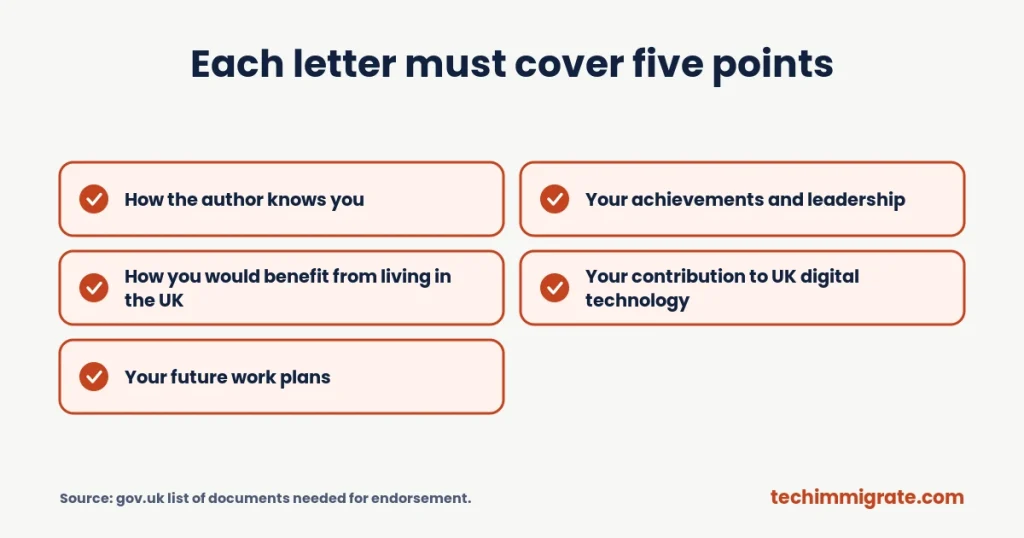
Each letter must cover five points: how the author knows you, your achievements and leadership, how you would benefit from living in the UK, how you would contribute to UK digital technology, and your future work plans. Gov.uk lists all five.
A letter that skips a point is weaker, however warm its praise. The table shows what a strong answer looks like for each.
| Required point | What a strong paragraph does |
|---|---|
| How the author knows you | Names the project, the dates and the author's role, and shows at least 12 months of knowledge |
| Your achievements and leadership | Names real projects, numbers and outcomes, and says why you lead or could lead |
| Benefit from living in the UK | Explains what the UK offers your work, such as talent, funding or research links |
| Contribution to UK digital technology | Says what you will add, such as skills, products, mentoring or jobs |
| Future work plans | Describes your next steps in the UK in plain, believable terms |
For a deeper look at how one letter should read, see our guide on writing a recommendation letter for the Global Talent Visa. For the full author question, see who should write your letter of recommendation.
Talent or Promise: does the wording change?
Yes, slightly. Under Exceptional Talent the letter shows you are an established leader. Under Exceptional Promise it shows you are an emerging leader with clear potential. The two routes differ in how far ahead the referee looks.
Gov.uk says the achievement point covers how you are a leader or potential leader. So a Promise letter leans on trajectory, early results and the referee's confidence, while a Talent letter leans on track record and standing.
How to ask a referee for a letter
The best way to ask is to be clear, kind and specific: explain the visa in two lines, say why you chose them, and give a deadline that leaves room for edits. A short request gets a faster yes.
Ask in person or by call first when you can. Then follow up in writing, so the referee has the details to hand.
What should your first message say?
Keep it short. A good first message does five things:
- Says who you are and how you worked together, with dates.
- Says that you are applying for the UK Global Talent Visa in digital technology.
- Explains that you need a letter written for this application, with a due date.
- Offers a one-page brief and a 15-minute call.
- Makes it easy to say no.
Making it easy to say no is not rude. A polite no is useful, because it leaves time to ask someone else. A late yes that leads to a rushed letter is much worse.
What should your brief include?
Most referees have never written a letter like this, so a brief removes the guesswork. It should fit on one page and include:
- The five points the letter must cover, copied from gov.uk.
- The format rules: typed, dated, signed, up to three sides, with credentials attached.
- Two or three projects they saw, with dates, numbers and public links.
- Your CV, and your personal statement if it is ready.
- The focus you hope they will take, and why.
- The deadline and the format you need, such as a signed PDF.
Do not tell them what to conclude. The panel wants an honest view, and a referee who feels pushed may write a stiff letter. Instead, ask what they saw, what changed and why it mattered, then let them choose the words.
Your personal statement and your letters should tell the same story without copying each other.
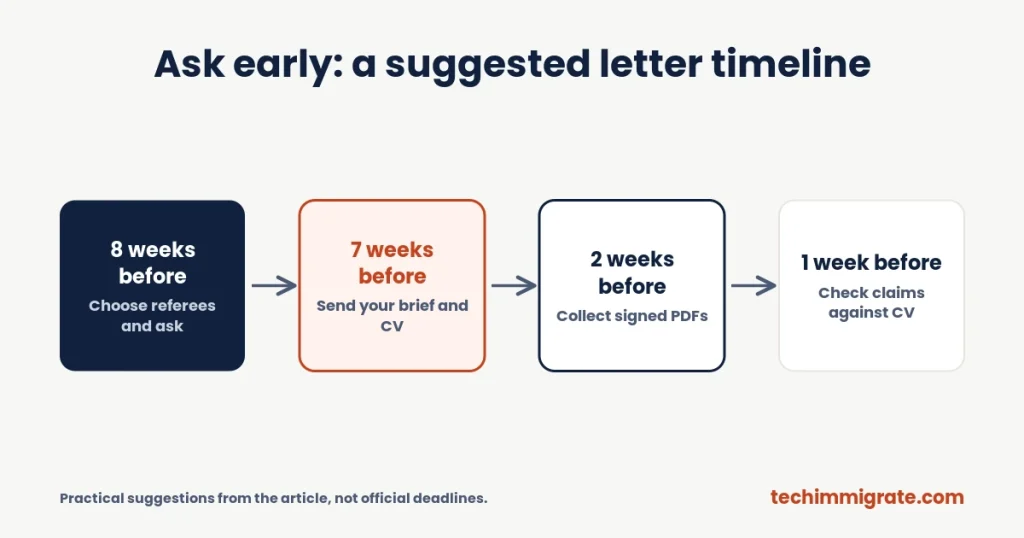
A realistic timeline
These timings are practical suggestions, not official deadlines.
| When | What to do |
|---|---|
| 8 weeks before upload | Choose four or five possible referees and ask them |
| 7 weeks before | Send your brief, CV and project notes to the ones who agree |
| 5 weeks before | Offer a call, and answer questions |
| 3 weeks before | Check progress gently and confirm the format rules |
| 2 weeks before | Collect signed PDFs and the authors' CVs |
| 1 week before | Check every claim against your CV and evidence |
Senior experts are busy, so build in slack. Tech Nation does not review documents before you submit, so you cannot get a pre-check on a letter.
How to stop three letters repeating each other
Give each referee a different main focus, but ask every one to cover all five required points. Gov.uk says the letters should give different examples of your achievements, so overlap is a real risk.
Three letters that all say "a talented engineer who built our platform" waste your strongest documents. Instead, match each letter to the criteria you are claiming. The table shows one way to do it.
| Referee | Main focus | Criteria it supports |
|---|---|---|
| Inside view | Your contribution and impact at a product-led company | Mandatory criterion and the technical contribution criterion |
| Outside view | Recognition beyond your employer, such as open source, talks or mentoring | Mandatory criterion and the outside-work criterion |
| Forward view | Your significance and potential, such as research or innovation | Mandatory criterion and the innovation or academic criterion |
Tell each referee which area you hope they will cover. That makes their job easier. It also helps you check that the three letters, taken together, back up each criterion you claim.
Can you write the letter yourself?
No. Tech Nation's guidance rules out templated and AI-written documents, and the letter must reflect the referee's own views. A letter that you drafted and a referee only signed is a clear risk.
You can give a referee facts, dates, links, a structure and the five required points. You cannot supply finished sentences. The referee must write from what they know and sign what they have written.
Watch for warning signs:
- The same phrases in two or three letters.
- Wording that matches your personal statement line by line.
- Claims the referee could not know first-hand.
- Odd generic phrases that fit any applicant.
If a referee asks for a draft, offer a bullet list of facts instead, then ask them to write in their own voice.
What if you have few contacts or an NDA?
If you have few senior contacts, build the three lenses from the people who know your work best, and look for experts outside your company. If an NDA limits what you can say, ask referees to describe the work in general terms.
Few contacts
Many applicants think they have no suitable referee, yet there are often more options. Consider:
- A client or partner lead who used your work.
- A maintainer or community lead who reviewed your contributions.
- Your former manager, now at another company.
- The organiser of a talk or meetup that invited you.
- An academic who supervised, reviewed or cited your work.
List everyone who has seen your work in the last five years. Then rank them by standing and by how well they know you.
NDAs and confidential work
A referee can describe your role, the scale of the work and the outcome without sharing secrets. For example, they can say "a system that processes millions of payments a day" without naming a client or sharing code.
Never ask a referee to break an employment contract or NDA. Ask your own employer for permission when in doubt. Also, keep your own evidence documents consistent with what the letters say, so the panel sees a single story.
Mistakes that weaken Global Talent Visa recommendation letters
The most common mistakes are vague praise, copied wording, weak credentials and letters that do not match the evidence. Each one is avoidable if you plan early.
- Vague praise. Fix it by asking for named projects, dates and numbers.
- Templated or AI-written text. Fix it by letting each referee write from scratch.
- Three similar referees. Fix it by choosing three lenses, not three managers.
- Reusing an old reference. Gov.uk says letters must be written for this application.
- Missing credentials. Attach the author's CV or proof of standing to every letter.
- Unsupported claims. Check each claim against your CV and your evidence.
- Late asks. Start about eight weeks early, not two.
Applicants report that weak letters come up often in refusal stories on forums such as the Tech Nation Visa Forum. That is applicant-reported, not official data, so use it as a warning and not a statistic. Our guide to Tech Nation endorsement mistakes covers the wider pattern.
Final check before you upload your letters
Check each letter against the gov.uk rules before you upload anything, because a short edit now costs little. Use this list for each of the three.
- Is the letter typed, dated and signed?
- Is it within three single sides of A4?
- Does it show the author has known your work for 12 months or more?
- Does it cover all five required points?
- Are real projects, numbers and outcomes named?
- Are the phone number, email, logo and registered address present where they apply?
- Is the author's CV or proof of credentials attached?
- Do the three letters give different examples?
- Do the titles, dates and figures match your CV and evidence?
- Was it written for this application, in the referee's own words?
If any answer is no, ask the referee to fix it in their own words. Do not edit their letter yourself, because that changes whose view it is.
Global Talent Visa recommendation letters FAQ
You must provide three letters. Each author must be an established expert in digital technology who has known your work for at least 12 months. The letters should give different examples of your achievements, so each one adds something new for the panel to weigh.
Any established expert in digital technology who has known your work for 12 months or more can write it. Typical choices are a senior manager, a founder, an investor, a maintainer or an academic. Family, friends and people who barely know your work are poor choices.
Yes, if your manager is an established expert and knows your work well. However, pair that letter with at least one referee from outside your company, so the panel sees recognition beyond your employer and not three voices from one workplace.
Each letter can run to three single sides of A4, not counting the author's credentials and contact details. Many strong letters are shorter. Spend the space on named projects, results and the UK points, because detail matters more than length.
This is risky. Tech Nation's guidance rules out templated and AI-written documents, and each letter must reflect the referee's own view. Give them facts, dates and the required points, then let them write and sign the letter in their own words.
Your Next Step
Strong Global Talent Visa recommendation letters sit on top of strong evidence. Our role-specific endorsement guides give you an evidence checklist and planner, so you know what each referee can back up. Start at the guides hub and pick your role.
Engineers can open the software developers guide, and product leaders have the product managers guide. Data and security applicants can use the data and AI specialists guide or the cybersecurity specialists guide. Want the guide for your role? See the guides.
How We Checked This Article
We checked the letter rules against the gov.uk page on documents you need to apply for endorsement: the number of letters, the 12-month rule, the format, the five required points and the attached credentials. We read the gov.uk eligibility page and the main Global Talent digital technology page for the criteria. Tech Nation's published guidance also helped, especially its notes on vague or generic letters.
Advice on seniority, how many people to approach and UK-based referees comes from adviser websites and applicant communities, so it is not official. We have labelled it as such. The people and projects in the examples are fictional.
Tech Immigrate is independent of Tech Nation and the Home Office. This article is general information, not legal advice, and nobody can guarantee an endorsement. Always confirm current rules on gov.uk before you apply.
We write practical guides for tech professionals applying for the UK Global Talent visa. Tech Immigrate is independent of Tech Nation and the Home Office, and our articles are general information, not legal advice. Rules and fees change, so always check gov.uk before you apply.