9 Tech Nation Endorsement Mistakes That Get Global Talent Applications Refused (And Fixes)
Tech Nation endorsement mistakes explained: 9 causes of refusal, each with a fix and a worked example. Audit your evidence before you pay the fee.

In this article
- Why Tech Nation Endorsement Mistakes Cost So Much
- Tech Nation Endorsement Mistakes 1: Applying From a Role Tech Nation Does Not Accept
- Tech Nation Endorsement Mistakes 2: Evidence That Shows Your Job, Not Your Recognition
- Tech Nation Endorsement Mistakes 3: Breaking the Document Rules
- Tech Nation Endorsement Mistakes 4: Generic Letters From the Wrong Referees
- Tech Nation Endorsement Mistakes 5: Choosing the Wrong Route
- Tech Nation Endorsement Mistakes 6: A Personal Statement That Repeats Your CV
- Tech Nation Endorsement Mistakes 7: Documents With No Link to the Criteria
- Tech Nation Endorsement Mistakes 8: Dates and Details That Do Not Line Up
- Tech Nation Endorsement Mistakes 9: An Innovation No One Outside Has Noticed
- Do the Same Mistakes Appear at Every Criterion?
- How Applicants Often Spot These Problems Early
- Why Strong Applicants Still Get Refused
- Your Pre-Submission Audit: A Checklist for Tech Nation Endorsement Mistakes
- What To Do If You Were Already Refused
- Tech Nation Endorsement Mistakes FAQ
- Your Next Step
- How We Checked This Article
The Tech Nation endorsement mistakes that matter most are not missing talent but weak proof. Nine problems recur: the wrong role, thin recognition, rule breaks, generic letters, the wrong route, a CV-style statement, unlinked documents, mismatched details and unnoticed innovation.
This guide gives each mistake a fix, an evidence example and a short fictional case. It is for applicants who want to audit their own application before paying the fee.
Key takeaways
- Tech Nation's panel judges only what is on the page, and meeting the criteria is necessary but not sufficient.
- Recognition must come from outside your employer, so internal praise and your own posts rarely carry a criterion.
- Stay inside the rules: up to 10 documents, up to 3 A4 sides each, and no document used for two criteria.
- Letters must come from established experts who have known your work for 12 months or more, and they support evidence rather than replace it.
- Refusal patterns reported by applicants are not official guidance, so treat them as signals, not rules.
Why Tech Nation Endorsement Mistakes Cost So Much
Mistakes cost money and months, because the endorsement fee is GBP 561 at the time of writing and a fresh application means paying again. The panel also decides overall whether to endorse, so a weak application cannot be rescued by one good document.
Decisions usually take five to eight weeks. A free endorsement review exists, but you must ask within 28 days of a refusal, and you cannot add new evidence. That is why getting the first submission right matters more than most people expect.
What counts as official and what does not
Official rules come from gov.uk and Tech Nation's own guidance. Patterns such as "applicants report that letters were the problem" come from forums and law firm blogs. They are useful, but they are not official, and nobody outside the panel can say why a specific case failed.
Our other guides cover the same ground from different angles. See what to leave out of your application and the common rejection reasons when you finish this one.
Tech Nation Endorsement Mistakes 1: Applying From a Role Tech Nation Does Not Accept
The first mistake is applying from a role outside Tech Nation's product-led focus, because no amount of evidence fixes that. Tech Nation endorses people who work in or with product-led digital technology companies.
Gov.uk lists profiles that do not suit the route. They include consultancy and service delivery, IT support and infrastructure management, and business skills used in-house at agencies or outsourcers. Read the official list of skills covered by Tech Nation before you collect anything.
Fix: Compare your last five years with the list. If most of your work sits in a service role, look for product work you did, or sector contributions you made outside work. If you cannot find enough, many applicants spend six to eighteen months building it.
Illustrative example (fictional)
Lena (fictional) works at an IT services firm and builds custom systems for clients. Her titles say "engineer", but she never owned a product.
An applicant in this situation often looks for product-company work, such as open source she maintains or a side product with real users. Without it, the role itself is the problem, not the quality of her work.
Tech Nation Endorsement Mistakes 2: Evidence That Shows Your Job, Not Your Recognition
The second mistake is submitting proof that you had a job instead of proof that others recognise you. The mandatory criterion asks whether you are a leading or emerging talent, and a job description cannot show that.
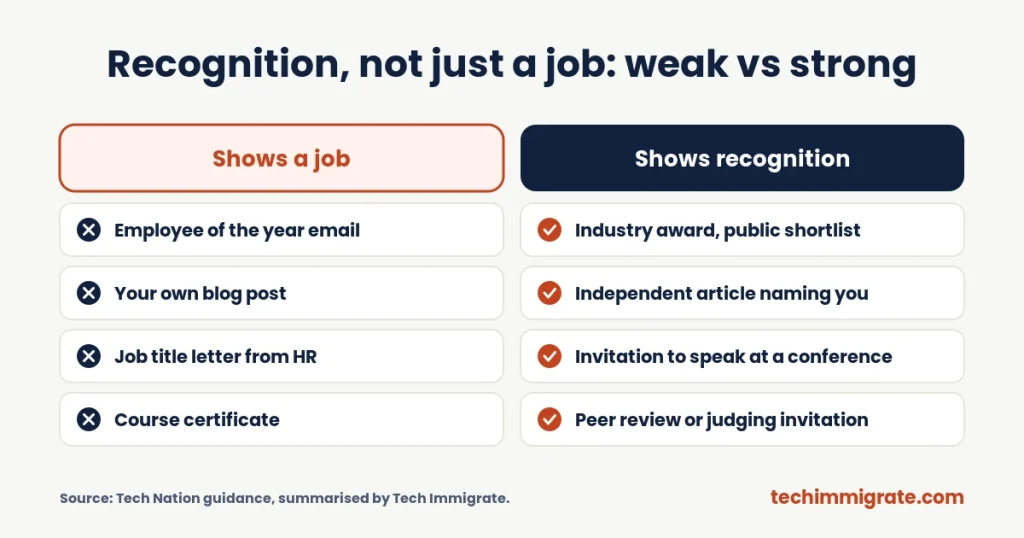
Tech Nation's guidance says recognition should come from outside your employer. Internal awards, course certificates and unexplained screenshots show effort, but not standing in the sector. Likewise, LinkedIn or Medium posts on their own do not count.
Fix: Lead with independent proof. Strong examples include press coverage that names you, invited talks at significant events, awards with a public shortlist, wide adoption of something you built, and invited roles such as judging.
Evidence examples: weak against strong
| Weak (shows a job) | Stronger (shows recognition) |
|---|---|
| Employee of the year email | Industry award with a public shortlist |
| Your own blog post | Article by an independent outlet that names you |
| Job title letter from HR | Invitation to speak at an independent conference |
| Internal tool you built | Tool adopted by outside companies, with evidence |
| Course certificate | Peer review or judging invitation |
Tech Nation Endorsement Mistakes 3: Breaking the Document Rules
The third mistake is ignoring the format rules, which makes the panel's job harder before it reaches your best proof. You can submit up to 10 documents, each up to three A4 sides.
You need at least two documents per criterion, and one document cannot be reused for two criteria. Evidence should come from the last five years, and shrunk or collage screenshots are not accepted.
Fix: Plan your 10 documents before you write. Map each one to a single criterion, and check the page count of the exported PDF, not the count in your editor.
Common format traps
- A web link with no scanned copy that shows the page and the link.
- A fourth page hidden by shrinking text.
- One article used for the mandatory criterion and an optional one.
- Evidence older than five years included "for context".
- A cover note that runs longer than the evidence it describes.
Illustrative example (fictional)
Marcus (fictional) has strong press coverage. He uses the same interview for the mandatory criterion and for innovation, so he has only one document for the second criterion.
The fix is to find a second, different document for each, such as a customer case study for innovation. Reusing one document does not double its value, and it can leave a criterion short.
Tech Nation Endorsement Mistakes 4: Generic Letters From the Wrong Referees
The fourth mistake is weak letters, and applicants report it as one of the most common problems. You need three letters from established experts who have known your work for at least 12 months.
Letters alone are not enough, because they support your evidence. Tech Nation's guidance also says its team checks for AI-written or templated text. Three letters with the same structure and praise look copied.
Fix: Choose referees who see you from different angles, for example a customer, a senior peer and an outside expert. Brief each one on the specific achievements you would like them to confirm, then let them write in their own words. Never write the letter for them.
What a strong letter contains
- How the referee knows you and for how long.
- Specific achievements, with numbers they can confirm personally.
- Why you are a leading or emerging talent in digital technology.
- Why your work matters to UK digital technology.
- Their own credentials, with a short CV or proof of standing.
Read our guide to recommendation letters for who to ask and how to brief them.
Illustrative example (fictional)
Keisha (fictional) asks her manager, her teammate and a friend in marketing. All three write warm but vague notes: "she is great to work with".
A better set would include an outside customer who used her product, a senior expert in her field, and a leader who watched her work for a year. Each would name something concrete. That mix shows breadth, not repetition.
Tech Nation Endorsement Mistakes 5: Choosing the Wrong Route
The fifth mistake is picking Exceptional Talent when your evidence only supports Exceptional Promise, or the reverse. Tech Nation assesses you against the route you choose.
Exceptional Talent is for established leaders, while Exceptional Promise is for emerging leaders. Tech Nation's guidance says Talent suits applicants with more than five years of experience, and Promise suits those with five years or less. Promise also needs backing from senior people in product-led digital technology.
Fix: Judge the evidence you hold, not your hopes. If most of it shows potential, a Promise application matches what you can prove. Our guide to Exceptional Talent vs Exceptional Promise helps you decide.
Note that Promise holders can usually settle after five years, and Talent holders after three. Even so, the faster settlement date is a poor reason to choose a route your evidence does not support.
Tech Nation Endorsement Mistakes 6: A Personal Statement That Repeats Your CV
The sixth mistake is using the personal statement to retell your career. The panel already has your CV, so retelling it wastes the space.
Fix: Structure the statement around the criteria. For each one, state your claim, point to documents by number and explain why they matter. Then cover why the UK and what you plan to contribute.
Our personal statement guide shows a structure you can adapt. Keep the claims modest, because every claim must match a document.
Illustrative example (fictional)
Tomás (fictional) writes 900 words in date order, from his first job to his current one. The panel learns his history but not which documents prove which criterion.
By contrast, a stronger version opens with the mandatory criterion, cites Documents 1 and 2, and then moves to the optional criteria. Each paragraph carries one claim and its proof.
Tech Nation Endorsement Mistakes 7: Documents With No Link to the Criteria
The seventh mistake is submitting strong documents that the panel must interpret alone. A long PDF with no explanation can be ignored, even if it holds good proof.
Fix: Start every document with a short cover note of three to six lines. Name the criterion, describe the document, say what it proves and show where it can be verified. Highlight the key line, such as your name in an article.
Name your files in order so the panel sees the structure at once, for example 01_MC_Press-coverage.pdf. Keep any cover note short, because it also counts toward the three-page limit.
A cover note template
- Criterion: which one this document supports.
- What it is: the document type and date.
- What it proves: one sentence that links it to the criterion.
- How to verify: a link, a named person or a public record.
Tech Nation Endorsement Mistakes 8: Dates and Details That Do Not Line Up
The eighth mistake is mismatched facts across your documents. If your CV says you led a team from one date, a referee gives another and your LinkedIn shows a different title, the panel starts to doubt the rest.
Unexplained gaps in your career raise the same questions. Applicants report that small inconsistencies can sink otherwise strong applications, though only the panel knows how it weighs them.
Fix: Before you submit, check every date, title, company name and figure across your CV, statement, letters and evidence. Explain any gap in one line of your CV. Never alter original evidence to make it match. Redacting confidential details is fine, but changing content is not.
A quick consistency table
| Item | Check it appears the same in |
|---|---|
| Job titles and dates | CV, statement, letters, LinkedIn |
| Company names | CV, statement, evidence, letters |
| Numbers (users, revenue, downloads) | Statement, letters, evidence |
| Your role in a project | Statement, letters, cover notes |
Tech Nation Endorsement Mistakes 9: An Innovation No One Outside Has Noticed
The ninth mistake is calling your work innovative when nobody else has said so. Building something new is not the same as being recognised for it.
Applicants report that innovation claims fail when the proof comes only from the company. Tech Nation's guidance also points to impact beyond your organisation, and to evidence such as patents, open source and novel applications.
Fix: Show outside proof: coverage in the tech press, patents or other intellectual property, adoption by well-known companies, awards, or statements from independent experts. If that proof does not exist yet, it may be worth building before you apply.
Illustrative example (fictional)
Chidi (fictional) built a scheduling feature that his company calls "industry-first". His only evidence is the company's launch blog post.
A stronger file would add an independent review, usage figures a customer can confirm and a code repository that others use. The same product then has outside voices, not just inside ones.
Do the Same Mistakes Appear at Every Criterion?
Many mistakes repeat across criteria, but each one fails in its own way. Think of the mistakes as patterns, not a checklist of separate problems.
For the optional criteria, applicants report these patterns:
- Innovation (OC1): a derivative product, or an employee who cannot show a new field.
- Outside the day job (OC2): career-development content instead of work that advances the sector.
- Contribution to a business (OC3): company results with no personal share shown.
- Academic (OC4): papers with no sign of peer review or reach.
Our criteria guide explains what each one asks for.
How Applicants Often Spot These Problems Early
Most problems show up if you test the application from the panel's side. The panel reads many files, so it needs each one to be clear within minutes.
Three tests to run on your own file
First, the stranger test. Hand your cover notes to someone outside your field and ask what each document proves. If they cannot say, the panel may struggle too.
Next, the search test. Search your own name and company with the keywords in your claims. If nothing independent appears, your recognition criterion may be thin.
Finally, the referee test. Ask each referee what they would say you are best known for. If the answers differ from your statement, fix the gap before they write.
Illustrative example (fictional)
Amara (fictional) runs these tests on a Friday. The stranger test shows that two of her cover notes describe the document but do not say what it proves.
The search test turns up a conference page that lists her talk, which she had not included. She swaps a weak internal slide deck for it, and rewrites her notes. The whole file now reads as a set of claims with proof, rather than a pile of papers.
Why Strong Applicants Still Get Refused
Even strong applicants can be refused, because the panel decides overall and meeting the criteria is not enough. Tech Nation's own guidance names weak documentation, wrong role types, limited impact beyond the organisation and early-career applications as common causes.
That means a good career does not guarantee a good file. In practice, the gap is often between what you did and what you can prove to a stranger. Closing that gap is the work of the application.
Your Pre-Submission Audit: A Checklist for Tech Nation Endorsement Mistakes
Run this audit the week before you submit, with fresh eyes or a trusted outside reader. It takes about an hour.
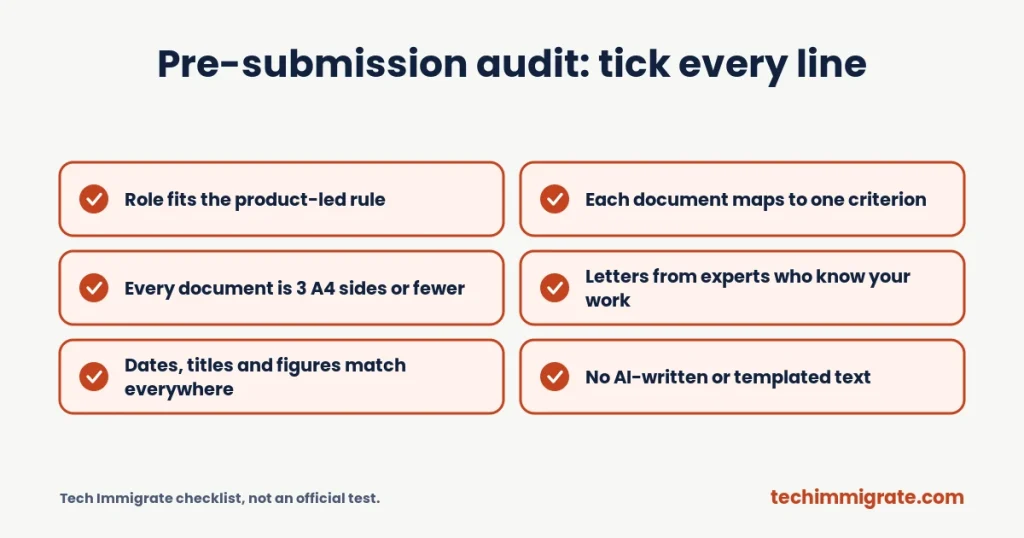
- Does your role fit the product-led rule?
- Does every document map to exactly one criterion, with at least two per criterion and no more than 10 in total?
- Is every document three A4 sides or fewer as an exported PDF?
- Is every item from the last five years and from outside your employer?
- Does each letter come from an established expert who has known your work for 12 months or more?
- Does each letter use its own words and specific facts?
- Do dates, titles and figures match everywhere?
- Does the statement cite documents by number?
- Is any text written by AI or copied from a template?
If you answer no to any of these, fix it first. Then ask someone who does not know your work to read your cover notes and tell you what each document proves.
What To Do If You Were Already Refused
If you were refused, read the decision carefully before you do anything else. A free review exists, but you must request it within 28 days and you cannot add new evidence.
Otherwise, a fresh application is possible, and it needs a new fee and stronger evidence. Do not simply reword the same documents, because the panel will see the same proof. Instead, change what you submit, or build more recognition first.
Illustrative example (fictional)
Sofia (fictional) is refused because her letters were generic and two documents ran to four pages. She has 28 days to ask for a review, but she knows a review cannot add new evidence.
She decides her main fix is replacing letters, so she plans a fresh application instead. Over three months, she briefs new referees and trims her documents. Her new file shows different proof, not reworded old proof. Applicants in this position often take a similar path, though each case differs. Because the evidence changes, the panel sees a genuinely new case.
Tech Nation Endorsement Mistakes FAQ
Applicants and advisers commonly report the wrong role, evidence that only shows a job, broken document rules, generic letters and mismatched dates. These are reported patterns, not official statistics. Tech Nation's panel decides overall, so one fix rarely settles a case.
On their own, they usually do not count, because Tech Nation's guidance says recognition should come from outside your employer and your own posts are self-published. They can help if others cite, republish or respond to them, and you show that clearly.
No. Tech Nation's rules say one document cannot be used for two criteria. You need at least two different documents for each criterion, so plan your 10 documents before you start writing.
No. The limit is 10, and fewer strong documents beat a full set of weak ones. Each document should add new proof for one criterion, and every extra page makes your best evidence harder to find.
Yes. You can ask for a free review within 28 days, with no new evidence allowed, or make a fresh application with a new fee. Fix what was weak instead of rewording the same documents.
Your Next Step
Want the guide for your role? See the guides. Then audit your documents against the nine mistakes above.
Our guides hub lists role-specific endorsement guides with an evidence checklist and planner. Good places to begin are the software developers guide, the product managers guide, the data and AI specialists guide and the startup founders guide.
How We Checked This Article
We checked the evidence limits, criteria, fees and timings against the gov.uk Global Talent digital technology page and gov.uk's list of skills covered by Tech Nation. We checked the common rejection reasons and the product-led focus against Tech Nation's own guidance on what to consider.
Patterns marked as reported by applicants come from law firm and adviser articles, such as those from EP Advisory and an immigration barrister. They are not official guidance. The example people are fictional.
Tech Immigrate is independent of Tech Nation and the Home Office. This article is general information, not legal advice, and nobody can guarantee an endorsement. Always confirm current rules on gov.uk before you apply.
We write practical guides for tech professionals applying for the UK Global Talent visa. Tech Immigrate is independent of Tech Nation and the Home Office, and our articles are general information, not legal advice. Rules and fees change, so always check gov.uk before you apply.