
Is Your Tech Job Eligible for a Skilled Worker Visa? How to Check an Offer
Is your Skilled Worker visa job eligible? How to check the sponsor licence, occupation code, skill level and salary rules before you accept a tech offer.


In this article
- Check 1: Is the Employer a Licensed Sponsor?
- Check 2: What Is the Occupation Code?
- Check 3: Is the Skill Level High Enough?
- Check 4: Does the Salary Meet the Rules?
- Check 5: Are You a New Entrant?
- Check 6: Is the Job Genuine and the Paperwork Right?
- Common Tech Roles and How They Usually Fit
- What to Do if the Job Does Not Qualify
- Questions to Ask the Employer Before You Accept
- Hours and Part-Time Roles
- Remote and Hybrid Roles
- Contract and Agency Roles
- The Salary at Settlement
- A Fictional Example: Checking an Offer
- Red Flags in Sponsored Offers
- What Happens After You Accept
- The English Requirement
- The Bottom Line
- Getting Help
- Comparing Two Sponsored Offers
- How Occupation Codes Are Chosen
- Going Rates Versus Market Salaries
- The Temporary Shortage List
- What If You Are Already in the UK?
- Keeping Your Job Eligible After You Arrive
- Why Employers Sometimes Get It Wrong
- Keeping Records of Your Offer
- Salary Bands and Pay Reviews
- When to Walk Away
- Checking the Latest Tables
- Your Next Step
- How We Checked This Article
Getting a job offer from a UK tech company is exciting. But if you need a Skilled Worker visa, the offer is only useful if the job itself qualifies. Many offers fall at this hurdle: the employer is not a licensed sponsor, the salary is below the going rate for the occupation, the role sits in the wrong occupation code, or the job is below the required skill level. Some candidates only find out weeks later, when the employer's HR team tries to assign a certificate of sponsorship.
This guide explains how to check whether a tech job qualifies for a Skilled Worker visa before you accept it. It covers the employer, the occupation code, the skill level, the salary rules, the new entrant discount, the hours and the paperwork, with examples for common tech roles. For where to find sponsored roles in the first place, see our guide to tech jobs with visa sponsorship.
Key takeaways
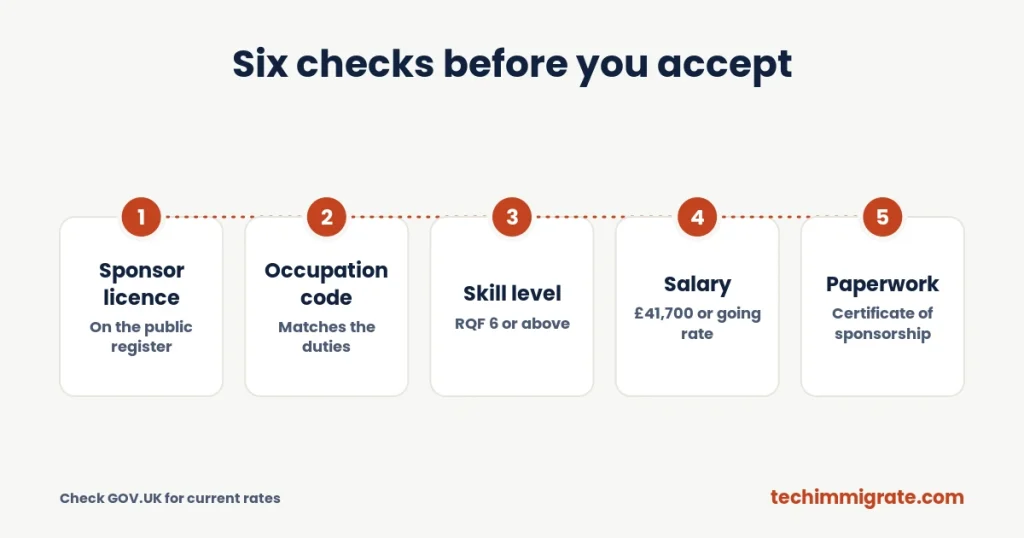
- The employer must hold a valid sponsor licence. You can check the public register of licensed sponsors.
- The job must match an eligible occupation code, usually at RQF level 6 or above for new applicants.
- The salary must usually meet the higher of the general threshold of £41,700 or the going rate for the occupation.
- Common tech going rates include £54,700 for programmers and software developers (2134) and £48,500 for cyber security professionals (2135).
- New entrants can be paid 70% of the going rate, with a floor of £33,400, for a limited time.
- If the job does not qualify, ask whether the employer can change the role, the salary or the occupation code, or consider other routes.
Check 1: Is the Employer a Licensed Sponsor?
Only employers with a valid Skilled Worker sponsor licence can sponsor you. The Home Office publishes a register of licensed sponsors on GOV.UK. Search for the company's legal name, which may differ from its trading name, and check that it is licensed for the Skilled Worker route. If the company is not on the register, it cannot sponsor you unless it applies for and receives a licence, which can take weeks or months.
Our article on the register of licensed sponsors explains how to search it.
Check 2: What Is the Occupation Code?
Every Skilled Worker job must match an occupation code in the Immigration Rules. The code decides the skill level and the going rate. For tech roles, the most common codes are:
| Code | Occupation | Going rate |
|---|---|---|
| 2131 | IT project and programme managers | £58,200 |
| 2132 | IT managers | £55,000 |
| 2133 | IT business analysts, architects and systems designers | £54,900 |
| 2134 | Programmers and software development professionals | £54,700 |
| 2135 | Cyber security professionals | £48,500 |
| 2136 | IT quality and testing professionals | £41,200 |
| 2137 | IT network professionals | £45,600 |
| 2139 | Information technology professionals not elsewhere classified | £52,300 |
| 2141 | Web design professionals | £43,800 |
The employer chooses the code, but it must genuinely match the job. Ask which code the employer plans to use, and check the current going rate on GOV.UK, because the tables change. Our article on Skilled Worker occupation codes for tech roles explains the codes in detail.
Check 3: Is the Skill Level High Enough?
Since 22 July 2025, new Skilled Worker roles usually need to be at RQF level 6 or above, which is roughly graduate level. Most software engineering, data, security and product roles meet this. Some support, technician and helpdesk roles do not. Roles below RQF level 6 may only be possible in limited cases, such as occupations on the temporary shortage list, which ends on 31 December 2026, and those roles generally cannot bring dependants.
Check 4: Does the Salary Meet the Rules?
For most new applicants, your salary must be at least the higher of:
- The general threshold: £41,700 a year.
- The going rate for your occupation code, based on a 37.5-hour week, pro-rated if your hours differ.
For example, a software developer under code 2134 usually needs at least £54,700, because the going rate is higher than the general threshold. A QA engineer under code 2136, with a going rate of £41,200, usually needs at least £41,700, because the general threshold is higher.
Only guaranteed basic pay counts. Bonuses, overtime, allowances and equity usually do not count towards the threshold.
Check 5: Are You a New Entrant?
If you qualify as a new entrant, your employer can pay you less: 70% of the going rate for your occupation, with a floor of £33,400. You may be a new entrant if, for example, you are under 26, are switching from a Student or Graduate visa, are working towards a recognised professional qualification, or are in postdoctoral research. New entrant status is time-limited, with a maximum of 4 years including time on a Graduate visa.
For a software developer under code 2134, the new entrant rate is about £38,300, rather than £54,700. Our article on the new entrant Skilled Worker visa explains who qualifies.
Check 6: Is the Job Genuine and the Paperwork Right?
The job must be a genuine vacancy that the employer needs filled. Your employer will assign you a certificate of sponsorship, which costs it £525, and must pay the Immigration Skills Charge. It must also follow sponsor duties, such as reporting changes to your role or salary. Ask your employer when it will assign your certificate and what details it will include: occupation code, salary, hours, start date and job title.
Common Tech Roles and How They Usually Fit
| Role | Likely code | Usual minimum salary |
|---|---|---|
| Software engineer | 2134 | £54,700 (or new entrant rate) |
| Data engineer | 2134 or 2139 | £54,700 or £52,300 |
| Cyber security engineer | 2135 | £48,500 |
| QA or test engineer | 2136 | £41,700 |
| Network engineer | 2137 | £45,600 |
| Solutions architect | 2133 | £54,900 |
| IT project manager | 2131 | £58,200 |
| UI or UX designer | 2141 | £43,800 |
These are general patterns. The right code depends on the actual duties. Always check the current tables on GOV.UK.
What to Do if the Job Does Not Qualify
- Ask about the code. Sometimes a different, more accurate code applies.
- Ask about the salary. The employer may be able to increase the basic salary to meet the threshold.
- Check new entrant rules. You may qualify for the lower rate.
- Consider other routes. If you have strong evidence of recognition, the Global Talent visa needs no sponsor or salary threshold. Recent graduates of eligible universities may qualify for the High Potential Individual visa.
Check that the employer is a licensed sponsor, the role matches an eligible occupation code at the right skill level, and the salary meets the threshold.
Usually the higher of £41,700 or the going rate for the occupation, such as £54,700 for software developers.
Usually not. Only guaranteed basic pay counts.
Yes, 70% of the going rate, with a £33,400 floor, for a limited time if you qualify.
It would need to apply for a licence before it could sponsor you.

Questions to Ask the Employer Before You Accept
Before you accept a sponsored offer, it is reasonable to ask the employer a few direct questions. Most experienced sponsors will be able to answer them quickly.
- Is the company a licensed Skilled Worker sponsor, and under which legal name?
- Which occupation code do you plan to use for this role?
- What guaranteed basic salary will appear on the certificate of sponsorship?
- What are the contractual hours?
- Will I be treated as a new entrant, and if so, what happens to my salary when that period ends?
- When will you assign the certificate of sponsorship, and who will manage the process?
- Will you contribute to my visa costs or my family's?
Clear answers suggest an employer that understands sponsorship. Vague answers are a reason to check carefully before you resign from your current job.
Hours and Part-Time Roles
Going rates are based on a 37.5-hour working week. If your contract is for fewer hours, the going rate is pro-rated, but the general threshold of £41,700 is not reduced for part-time work in the same way. In practice, part-time Skilled Worker roles in tech are uncommon, because the salary often fails to meet the threshold. If your contract is for more than 37.5 hours, the going rate may be adjusted upwards, and only pay for up to 48 hours a week counts. Ask your employer to confirm the hours and how they have calculated the salary.
Remote and Hybrid Roles
Skilled Worker roles can be hybrid or largely remote, but you must be working for your sponsor in the UK, and the sponsor must be able to meet its duties, such as knowing where you work. Fully remote roles where you would live outside the UK are not suitable for a Skilled Worker visa. If a role is advertised as remote-first, ask how the employer manages sponsored workers and where your normal place of work will be recorded.
Contract and Agency Roles
Skilled Worker sponsorship usually requires the sponsor to be your actual employer. Roles where you would be supplied to a third-party client through an agency, often called third-party labour supply, are generally not permitted unless specific conditions are met. Contract roles through umbrella companies are also usually unsuitable. If a recruiter offers a sponsored role, check who the sponsor will be and whether you will work directly for them.
The Salary at Settlement
An offer that meets today's threshold may not automatically meet the threshold when you apply for indefinite leave to remain. The salary requirement for settlement depends on your occupation and when you joined the route, and new entrants usually need to reach the full rate later. Under the earned settlement reforms, earnings may also affect how long you need to qualify for settlement. When comparing offers, think about your likely salary path as well as the starting figure. Our article on ILR for Skilled Worker visa holders explains the settlement requirements.
A Fictional Example: Checking an Offer
Leo receives an offer as a backend engineer at a fintech start-up. He checks the register and finds the company's legal name listed as a licensed sponsor. The employer plans to use code 2134. The offer is £52,000 basic plus bonus. Because Leo is 27 and not switching from a student route, he is not a new entrant, so the going rate of £54,700 applies, and the bonus does not count. He raises this with the employer, which increases the basic salary to £55,000. The offer now qualifies. This example is fictional and simplified.
Red Flags in Sponsored Offers
- The employer asks you to pay the certificate of sponsorship fee or Immigration Skills Charge. Sponsors are not allowed to recover these from you.
- The salary on the certificate differs from your contract. The two should match.
- The job title does not match the duties. The occupation code must genuinely fit the work.
- You would work for a client rather than the sponsor. This may not be permitted.
- Pressure to resign before the certificate is assigned. Wait until you have the certificate and, ideally, the visa.
What Happens After You Accept
Once you accept a qualifying offer, your employer assigns your certificate of sponsorship, which has a reference number you use in your visa application. You then apply online, pay the visa fee and surcharge, prove your identity and wait for a decision, usually about 3 weeks from outside the UK or 8 weeks from inside. Our step-by-step guide to the Skilled Worker visa application walks through each stage.
The English Requirement
Since 8 January 2026, new Skilled Worker main applicants, including people switching into the route, need English at B2 level, unless they are exempt. Check your English evidence early, because a missing test can delay your visa even when the job itself qualifies. Our article on the English requirement for Skilled Worker visas explains the options.
The Bottom Line
A job offer is only the start. Before you accept, check the sponsor licence, the occupation code, the skill level, the salary against the going rate and general threshold, and your new entrant status. Ask the employer direct questions, watch for red flags, and if the job does not qualify, explore whether the role can be adjusted or whether another route fits you better.
Getting Help
If you are unsure whether a role fits a particular occupation code, or whether you qualify as a new entrant, ask the employer's sponsor management team first. For complex situations, a regulated immigration adviser can review the offer before you accept.
Comparing Two Sponsored Offers
If you have more than one sponsored offer, compare them on more than salary. Look at whether each employer is experienced with sponsorship, how quickly it can assign your certificate, whether it contributes to visa costs, how long it will sponsor you for, and how secure the role feels. A slightly lower salary with an experienced, supportive sponsor can be better in practice than a higher figure from a company that has never sponsored anyone.
How Occupation Codes Are Chosen
Occupation codes come from the Standard Occupational Classification, which groups jobs by the work they involve rather than by job title. A job called "developer advocate" or "solutions engineer" might fit several codes, depending on the actual duties. The employer must choose the code that best matches the main duties of the role, not simply the one with the lowest going rate. Caseworkers can check whether the code fits the job description, and if they think it does not, they can refuse the application. If you are offered a role with an unusual title, ask the employer to explain why it chose the code, and compare the duties with the descriptions in the classification.
Going Rates Versus Market Salaries
Going rates are the minimum salaries the Home Office accepts for each occupation code. They are not the same as market rates. In London and other tech hubs, many tech salaries are well above the going rate, so the rules are rarely the deciding factor for senior roles. They matter most for junior and mid-level roles, roles outside major cities, and roles at early-stage companies with tight budgets. If an offer only just meets the going rate, think about whether it reflects your market value too, not just the visa rules.
The Temporary Shortage List
The temporary shortage list allowed some roles below RQF level 6 to be sponsored, with lower fees and in some cases lower salaries. It is due to end on 31 December 2026. Very few mainstream tech roles relied on it, but if you are being offered a technician or support role that depends on the list, check carefully whether it will still be available when your certificate is assigned, and whether you could bring dependants. Our article on Skilled Worker visa new rules explains the recent changes.
What If You Are Already in the UK?
If you are already in the UK on another visa, such as a Graduate visa, the same checks apply. You will usually switch to a Skilled Worker visa from inside the UK, paying the inside-UK fee. If you are switching from a Graduate visa, you may qualify as a new entrant, which can make it easier to meet the salary rules. Check the timing too: you must apply before your current visa expires, and decisions from inside the UK usually take about 8 weeks. Our guide to switching to a Skilled Worker visa covers the process.
Keeping Your Job Eligible After You Arrive
Eligibility is not only checked once. Your sponsor must report certain changes, such as a significant change in your job or salary, and some changes require a new visa application. If you are promoted into a different occupation code, or your salary falls below the threshold, check whether a new application is needed. Since 8 April 2026, sponsor guidance has also required salaries to be paid in every pay period. Keeping your job eligible protects both your current visa and your path to settlement.
Why Employers Sometimes Get It Wrong
Most licensed sponsors handle the process correctly, but mistakes do happen, especially at smaller companies sponsoring for the first time. Common errors include choosing a code because of its job title rather than its duties, counting bonuses towards the salary, forgetting to pro-rate for hours, or assuming a candidate is a new entrant when they are not. These mistakes usually surface when the visa application is assessed, which can mean a refusal and lost time. Asking the right questions early protects both you and the employer.
Keeping Records of Your Offer
Keep copies of your offer letter, contract, job description and certificate of sponsorship details. If there is ever a question about whether your job matches the code or salary, these documents will help. They are also useful when you later apply to extend or settle, because they show your role and pay history.
Salary Bands and Pay Reviews
If your role sits in a salary band, the figure that matters for the visa is the guaranteed basic salary on your certificate of sponsorship, not the top of the band. Annual pay reviews can help you stay above the threshold over time, which matters for extensions and settlement. If your employer freezes pay, check that your salary will still meet the rules when you next apply.
When to Walk Away
If an employer cannot confirm its sponsor licence, cannot explain the occupation code, or will not put the salary in writing, think carefully before you resign from your current job or make plans to move. A qualifying offer from a well-organised sponsor is worth far more than an attractive offer that cannot be sponsored.
Checking the Latest Tables
Going rates and thresholds are set out in the Immigration Rules and updated from time to time. The figures in this article are those in force in November 2026. Before you accept an offer, check the current going rate for your occupation code on GOV.UK, and ask your employer to confirm the figure it is using. A small change in the tables can turn a qualifying offer into one that falls short.
Your Next Step
If sponsorship is proving difficult, the Global Talent visa may be an alternative for tech professionals with strong evidence of recognition. Our role-specific Global Talent guides explain what Tech Nation looks for.
How We Checked This Article
We checked sponsor licensing, occupation codes, going rates, salary thresholds and new entrant rules against GOV.UK's Skilled Worker visa pages and the Immigration Rules' Appendix Skilled Occupations, in November 2026. Going rates change, so check the current tables before relying on them.
Tech Immigrate is independent of the Home Office. This article is general information, not legal advice. Check GOV.UK before you accept an offer or apply.
We write practical guides for tech professionals applying for the UK Global Talent visa. Tech Immigrate is independent of Tech Nation and the Home Office, and our articles are general information, not legal advice. Rules and fees change, so always check gov.uk before you apply.


