
Skilled Worker Occupation Codes for Tech Roles (Software, Data, Cyber)
Skilled Worker occupation codes for tech: eligible codes, going rates for software, data, cyber, UX and IT management, and how to pick the right code.


In this article
- What Occupation Codes Are
- Eligible Tech Occupation Codes and Going Rates
- How the Salary Rule Works
- Matching Your Job to the Right Code
- Common Tech Roles and Their Likely Codes
- Roles That Are Not Eligible for New Applicants
- How to Read Appendix Skilled Occupations
- How Going Rates Are Set
- Hourly Rates and Working Hours
- Occupation Codes on Other Work Routes
- Questions to Ask Your Employer About the Code
- What Happens if the Code Is Wrong
- When Your Job Changes
- A Worked Example: A Machine Learning Engineer
- A Worked Example: A UX Researcher
- A Worked Example: A DevOps Engineer
- A Worked Example: A Technical Product Manager
- Codes, Settlement and Your Long-Term Plans
- Common Mistakes
- Get the Code Right From the Start
- How We Checked This Article
Every Skilled Worker application rests on a four-digit occupation code, and most people never see it until something goes wrong. The code your employer chooses decides whether your job is eligible, what salary you must be paid, and how your role is described to the Home Office. Choosing the wrong code is one of the most common reasons sponsored applications run into trouble, and since the 2026 sponsor guidance put more weight on accurate job descriptions, the stakes are higher than ever.
This guide explains how Skilled Worker occupation codes work for tech roles: what the codes are, which tech occupations are eligible, their going rates, how to match your job to the right code, and what to do if your job seems to fit more than one. It focuses on software development, data, cyber security, design, product and IT management roles.
Key takeaways
- Skilled Worker jobs are classified using SOC 2020 occupation codes, listed in the Immigration Rules Appendix Skilled Occupations.
- Since 22 July 2025, most new roles must be in codes skilled to RQF level 6 or above, roughly degree level.
- Most professional tech roles are eligible, including 2131, 2133, 2134, 2135, 2137, 2139 and 2141.
- You must be paid the higher of £41,700 or the going rate for your code, unless a salary concession applies.
- Going rates include £54,700 for programmers and software developers (2134) and £48,500 for cyber security professionals (2135).
- Your employer chooses the code, but the job description must genuinely match it.
- IT technician and support roles below RQF 6 are generally not eligible for new applicants.
What Occupation Codes Are
The UK uses the Standard Occupational Classification (SOC) to group jobs by the work they involve. The current version is SOC 2020. Each occupation has a four-digit code and a title, along with example job titles and a description of typical tasks.
For immigration, the relevant list is the Immigration Rules Appendix Skilled Occupations. It sets out:
- which SOC 2020 codes are eligible for the Skilled Worker route;
- the skill level of each code;
- the going rate for each code, as an annual salary and an hourly rate;
- any lower rates that apply in special cases, such as new entrants.
Your employer selects the code when assigning your certificate of sponsorship. The caseworker then checks that your job genuinely fits that code and that your salary meets its rate.
Eligible Tech Occupation Codes and Going Rates
The main tech codes, with going rates reported from Appendix Skilled Occupations, are:
| Code | Occupation | Typical job titles | Going rate |
|---|---|---|---|
| 2131 | IT project and programme managers | IT project manager, programme manager, delivery manager | £58,200 |
| 2132 | IT managers | IT manager, head of IT, infrastructure manager | £55,000 |
| 2133 | IT business analysts, architects and systems designers | Business analyst, solutions architect, systems designer | £54,900 |
| 2134 | Programmers and software development professionals | Software engineer, developer, programmer | £54,700 |
| 2135 | Cyber security professionals | Security analyst, penetration tester, security engineer | £48,500 |
| 2136 | IT quality and testing professionals | QA engineer, test analyst | £41,200 |
| 2137 | IT network professionals | Network engineer, network architect | £45,600 |
| 2139 | IT professionals not elsewhere classified | Specialist IT roles not covered elsewhere | £52,300 |
| 2141 | Web design professionals | UI designer, UX designer and researcher, web designer, application designer | £43,800 |
Where a code's going rate is below £41,700, as with 2136, the £41,700 general threshold applies instead. These rates are as reported at the time of writing. Always check the current table in Appendix Skilled Occupations for your code, because rates are updated periodically.
How the Salary Rule Works
Your salary must usually be at least the higher of:
- £41,700 a year; or
- the going rate for your occupation code.
So for a software developer under 2134, the minimum is £54,700. For a QA engineer under 2136, it is £41,700, because the going rate is lower than the general threshold.
Salary concessions can reduce the minimum:
- New entrants, such as people under 26 or recent graduates, can be paid 70% of the going rate, with a minimum of £33,400.
- Relevant PhD holders can be paid 80% (STEM) or 90% (non-STEM) of the going rate, with minimums.
Our guide to the new entrant Skilled Worker rules explains these in detail.

Matching Your Job to the Right Code
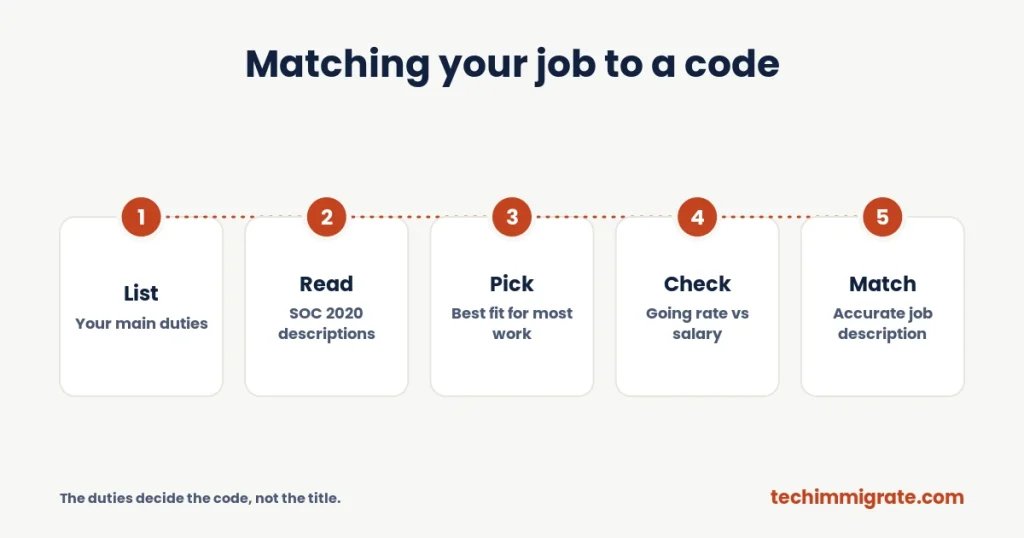
The right code depends on what you actually do, not just your job title. The Home Office looks at the main duties of the role. To choose the right code:
- List your main duties. Focus on what you spend most of your time doing.
- Read the SOC 2020 descriptions for the candidate codes, including example job titles and typical tasks.
- Pick the code that best fits the majority of the work. A job title alone is not enough.
- Make sure the job description on the certificate reflects the real role. Under the eligible role requirement introduced in the March 2026 sponsor guidance, the certificate must accurately reflect what the worker does.
Common Tech Roles and Their Likely Codes
Software engineers and developers
Most software engineering roles fit 2134, programmers and software development professionals. This includes backend, frontend, full-stack, mobile and embedded developers. Senior engineers and tech leads usually stay in 2134 if most of their work is development.
Solutions architects and business analysts
Roles focused on designing systems, analysing business requirements or defining architecture usually fit 2133.
Engineering managers and heads of engineering
This depends on the balance of duties. A manager who spends most of their time managing people and delivery may fit 2131 or 2132. A hands-on tech lead who mainly writes code may fit 2134.
Data scientists, data engineers and machine learning engineers
There is no single code called data scientist. Data engineers who build pipelines and infrastructure often fit 2134 or 2139. Data scientists and machine learning engineers may fit 2134, 2133 or 2139, depending on whether the work is mainly software development, analysis and design, or specialist IT work. Some roles focused mainly on statistical analysis may fit statistician or analyst codes outside the 213x group. The key is to match the real duties.
Cyber security roles
Security analysts, security engineers, penetration testers and security architects usually fit 2135. Its going rate, £48,500, is lower than many other tech codes.
DevOps and cloud engineers
These roles can fit 2134 if the work is mainly software and automation, 2137 if it is mainly networks, or 2139 for specialist infrastructure roles. Choose based on the main duties.
UX, UI and product designers
UI designers, UX designers and researchers, and application designers usually fit 2141, web design professionals, with a going rate of £43,800. Graphic and multimedia designers fall under 2142, which has a lower rate but may not reflect product design work.
Product managers
Product management can be hard to classify. Technical product managers working closely with engineering may fit 2133 or 2131, depending on duties. Product roles focused mainly on marketing or commercial strategy may fit codes outside the 213x group. Make sure the code matches the real job. If you are unsure, ask your employer to explain why they chose a particular code and how your duties match its description.
QA and test engineers
Test analysts and QA engineers usually fit 2136. Because its going rate is below £41,700, the general threshold applies.
Roles That Are Not Eligible for New Applicants
Since 22 July 2025, roles below RQF level 6 are generally not eligible for new Skilled Worker applicants. In tech, this includes many IT technician and support roles, such as IT user support technicians and IT operations technicians. A temporary shortage list allows some medium-skilled roles to be sponsored, with restrictions such as no dependants, and it is currently scheduled to end on 31 December 2026 unless extended.
People already sponsored in these roles before 22 July 2025 can usually continue to extend and change employer within the same occupation, as long as they keep Skilled Worker permission continuously.
How to Read Appendix Skilled Occupations
Appendix Skilled Occupations is part of the Immigration Rules and is published on GOV.UK. It is organised into tables. The most important for tech workers is the table of occupations skilled to RQF level 6 or above, which lists each eligible code with:
- the occupation code and title;
- related job titles, which help you check whether your job fits;
- the standard going rate, as an annual figure and an hourly rate;
- lower rates that apply in particular situations, such as new entrants or PhD holders.
Other tables cover occupations on the temporary shortage list, the immigration salary list, and codes with special rules, such as health and education roles. If your code is not in the main table and not on a temporary list, it cannot be used for a new Skilled Worker application.
When you look up your code, read the related job titles carefully. They are examples, not a complete list, but they show the kind of work the code is meant to cover.
How Going Rates Are Set
Going rates are based on official earnings data for each occupation, published through the Annual Survey of Hours and Earnings. The Home Office uses this data, with advice from the Migration Advisory Committee, to set a rate that reflects typical pay for experienced workers in the occupation across the UK.
Two points follow from this:
- Going rates are UK-wide. They do not change by region, so the same rate applies in London and in smaller cities. In London, market salaries for tech roles are often well above the going rate. Elsewhere, the going rate can be harder to meet, especially for mid-level roles.
- Going rates change. They are updated periodically as new earnings data is published, often alongside wider changes to the rules. A rate that applied when you first came may be different when you extend.
Hourly Rates and Working Hours
Each code also has an hourly going rate, usually calculated on a 37.5-hour week. Your salary must meet both the annual figure and the hourly rate. This matters if you work part-time or your contract has unusual hours.
For example, if you work 30 hours a week, your annual salary must still meet the annual threshold, and your hourly pay must meet the hourly rate. In practice, part-time roles rarely work on the Skilled Worker route for tech, because the annual thresholds are high.
Only the first 48 hours a week count towards the salary calculation. Overtime above that does not help you meet the threshold.
Occupation Codes on Other Work Routes
Occupation codes are also used on related routes:
- Global Business Mobility: Senior or Specialist Worker uses occupation codes and its own salary thresholds for staff transferred within a company.
- Scale-up uses occupation codes for the initial sponsored role at a qualifying fast-growing company.
Global Talent does not use occupation codes at all. Instead, applicants need an endorsement or a qualifying prize, and there is no salary threshold.
Questions to Ask Your Employer About the Code
- Which occupation code will you use for my role, and why?
- What is the current going rate for that code, and does my salary meet it?
- Does the job description on the certificate reflect my main duties?
- If my role grows, for example into management, will the code need to change?
- Are you relying on any salary concession, such as new entrant, and is it recorded correctly?
A sponsor that can answer these questions clearly is likely to manage your application well.
What Happens if the Code Is Wrong
If the code does not fit your job, several things can go wrong:
- Refusal. The caseworker may refuse your application if they are not satisfied the job matches the code.
- Salary problems. A different code may have a higher going rate that your salary does not meet.
- Problems later. Even if your first application is granted, an inconsistency can cause problems at extension or settlement.
- Sponsor compliance action. The sponsor can face action if the role on the certificate does not reflect the real job.
Some employers are tempted to choose a code with a lower going rate to make the salary work. This is a serious compliance risk. The code must reflect the job, not the salary.
When Your Job Changes
If your duties change significantly while you are on a Skilled Worker visa, you may move into a different occupation code. A change of code usually needs a new certificate of sponsorship and a new application. Small changes within the same code, such as a promotion from developer to senior developer, usually do not.
Under the March 2026 sponsor guidance, if your role changes in a way that does not require a new application, your sponsor must report it within 10 working days. Talk to HR before a significant change of role takes effect.
A Worked Example: A Machine Learning Engineer
A machine learning engineer spends most of her time writing production code to train and deploy models, building data pipelines, and integrating models into applications. A smaller part of her role involves experiment design and analysis.
- Her main duties are software development, so 2134 is the best fit.
- The going rate is £54,700, and her salary is £72,000.
- Her employer uses 2134, with a job description that reflects her actual work.
If her role were mainly research and statistical modelling, with little production code, a different code might fit better, and the employer would need to check its going rate.
A Worked Example: A UX Researcher
A UX researcher plans and runs user research, analyses findings and works with designers and product managers.
- UX researchers are listed under 2141, web design professionals.
- The going rate is £43,800, and his salary is £46,000.
- His employer uses 2141.
If the employer had tried to use 2142, graphic and multimedia designers, the code would not have matched his duties, even though its going rate is lower.
A Worked Example: A DevOps Engineer
A DevOps engineer spends most of his time writing infrastructure-as-code, building deployment pipelines and automating cloud environments. Some of his time goes on monitoring and incident response.
- Because most of his work is writing and maintaining code and automation, 2134 is a reasonable fit, with a going rate of £54,700.
- If his role were mainly designing and managing networks, 2137 might fit better, with a going rate of £45,600.
- His salary is £62,000, which meets either rate, so the choice comes down to the real duties.
His employer chooses 2134 and writes a job description focused on automation and infrastructure code. Because it matches what he does, the application goes through without questions.
A Worked Example: A Technical Product Manager
A technical product manager at a SaaS company defines product requirements, writes specifications with engineers, prioritises the roadmap and analyses usage data. She does not manage people and does not write production code.
- Her work is closest to analysing business needs and designing systems to meet them, so 2133 is a reasonable fit, with a going rate of £54,900.
- If her role were mainly managing delivery of IT projects, 2131 might fit, with a higher going rate of £58,200.
- If her role were mainly commercial, such as pricing, marketing and sales strategy, a code outside the IT group might be more accurate.
Her salary is £68,000. Her employer chooses 2133, with a job description that reflects her real work. The example shows why product roles need particular care: the title is the same across companies, but the duties vary widely.
Codes, Settlement and Your Long-Term Plans
Your occupation code matters beyond your first visa. Under the current rules, Skilled Workers applying for indefinite leave to remain must usually still be sponsored and meet the salary rules for their code at the time of application. If the going rate for your code has risen, or you have moved into a code with a higher rate, your salary needs to keep up.
Under the earned settlement reforms published on 2 November 2026, earnings become central to the length of the settlement path, with a 5-year path for people earning at least £50,271 and a 3-year path for those earning at least £125,141. For many tech codes, the going rate is already above £50,271, so people paid at or above the going rate may be well placed. People in codes with lower going rates, such as 2135, 2136, 2137 or 2141, may need salary growth to reach the 5-year path. Our guide to the new ILR rules for Skilled Worker visa holders explains the proposals.
Keeping a record of your code, job description and salary at each stage makes extension and settlement applications much easier. Save a copy of each certificate summary your employer gives you, alongside your payslips.
Common Mistakes
- Choosing a code by job title alone. The duties decide the code.
- Choosing a code to fit the salary. This is a compliance risk and can lead to refusal.
- Ignoring the going rate. Many tech codes have going rates well above £41,700.
- Assuming all IT roles are eligible. Technician and support roles below RQF 6 generally are not.
- Not updating the code after a big role change. A change of code usually needs a new application.
- Using out-of-date rates. Check the current Appendix Skilled Occupations before applying.
2134, programmers and software development professionals, with a going rate of £54,700.
2135, cyber security professionals, with a going rate of £48,500.
Usually 2141, web design professionals, which includes UI and UX designers and researchers, with a going rate of £43,800.
There is no single data scientist code. Depending on duties, data roles may fit 2134, 2133, 2139 or a statistician code.
Most IT technician and support roles are below RQF 6 and are not eligible for new applicants.
The employer, but it must genuinely match the job's main duties.
You usually need a new certificate of sponsorship and a new application.
Get the Code Right From the Start
The occupation code is a small detail with a big impact. Make sure your employer chooses a code that matches your real duties, check the going rate, and keep your job description accurate as your role develops. If the code and salary rules make sponsorship difficult and you have a strong track record in tech, Global Talent may be worth considering, because it has no occupation codes or salary thresholds. Our role-specific Global Talent guides explain what Tech Nation looks for.
How We Checked This Article
We checked eligibility and going rates against the Immigration Rules Appendix Skilled Occupations as reported by legal and specialist sources in November 2026, and the eligible role requirement against the Home Office sponsor guidance glossary. Going rates change periodically; check the current table on GOV.UK for your code.
Tech Immigrate is independent of the Home Office. This article is general information, not legal advice. Check GOV.UK before you apply.
We write practical guides for tech professionals applying for the UK Global Talent visa. Tech Immigrate is independent of Tech Nation and the Home Office, and our articles are general information, not legal advice. Rules and fees change, so always check gov.uk before you apply.


