
Skilled Worker Visa Salary Thresholds and Going Rates for Tech Roles
Skilled Worker salary rules for tech: the £41,700 threshold, going rates for software, data, cyber and UX, new entrant and PhD discounts, and what counts.


In this article
- The Two Thresholds
- Going Rates for Tech Roles
- How Going Rates Are Set
- New Entrant Rates
- PhD Discounts
- Immigration Salary List
- Hourly Rates
- What Counts as Salary
- Transitional Thresholds for People Already on the Route
- Salary When You Change Employer or Extend
- Salary and Settlement
- A Worked Example: Total Compensation vs Base Salary
- A Worked Example: A Graduate on a New Entrant Rate
- A Worked Example: A Security Engineer Outside London
- Salary Sacrifice Schemes
- Pay Rises and Pay Cuts During Your Visa
- Contractors and Day Rates
- What Happens if Your Employer Underpays You
- How Salary Rules Compare Across Routes
- Regional Reality Check
- Questions to Ask Before You Accept an Offer
- Keeping Records for Later
- Negotiating Salary as a Sponsored Candidate
- Common Mistakes
- Get the Numbers Right
- How We Checked This Article
Salary is the single requirement that decides most Skilled Worker applications in tech. The skill level is rarely a problem for professional tech roles, and English evidence can usually be sorted out. But if the salary on your certificate of sponsorship is even a few hundred pounds below the right figure, the application fails. And working out the right figure is not as simple as it looks, because the Skilled Worker route uses two thresholds at once, plus discounts, hourly rates and transitional rules.
This guide explains the Skilled Worker salary rules for tech roles in plain English: the general threshold, going rates for tech occupations, how the two interact, the new entrant and PhD discounts, hourly rates, what counts as salary, the transitional thresholds for people already on the route, and how salary will shape your path to settlement under the earned settlement reforms.
Key takeaways
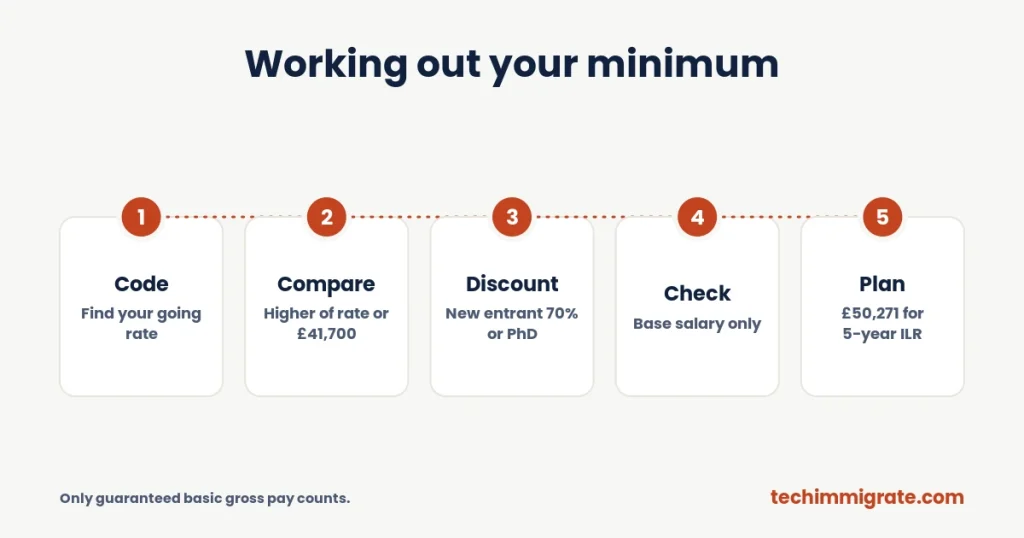
- You must usually be paid the higher of the general threshold, £41,700, and the going rate for your occupation code.
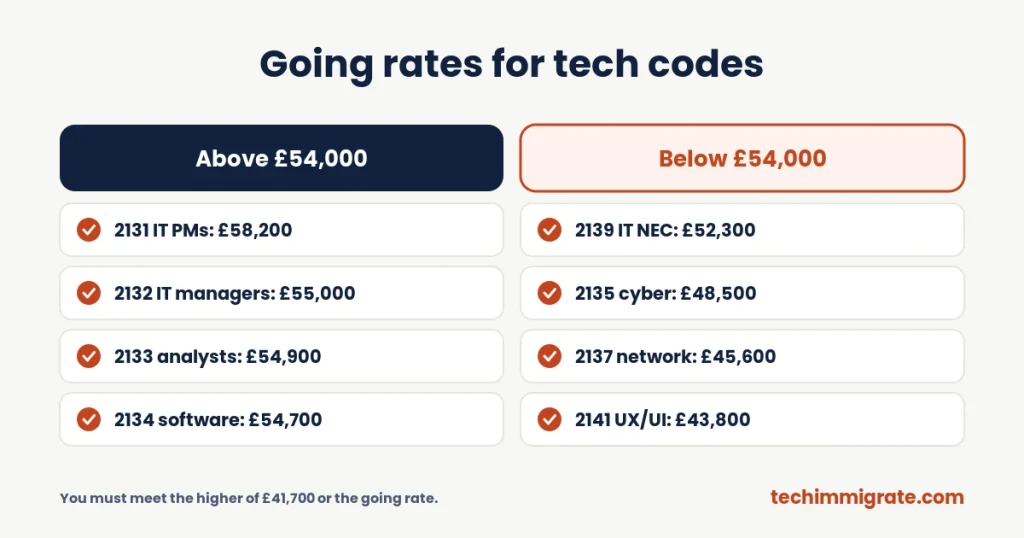
- Going rates for tech roles include £54,700 for software developers (2134), £54,900 for IT business analysts and architects (2133), £58,200 for IT project and programme managers (2131) and £48,500 for cyber security professionals (2135).
- New entrants can be paid 70% of the going rate, with a minimum of £33,400, for up to 4 years in total.
- People with a relevant PhD can be paid 80% (STEM) or 90% (non-STEM) of the going rate, with minimums of £33,400 and £37,500.
- Only guaranteed basic gross pay counts, and since April 2026 the required salary must be paid in every pay period.
- People first sponsored before 4 April 2024 can benefit from lower transitional thresholds when they extend or change employer.
- Under the earned settlement proposals, earnings of £50,271 or more could mean a 5-year path to settlement rather than 10.
The Two Thresholds
Every Skilled Worker salary is tested against two figures:
- The general salary threshold: £41,700 a year for most applicants since 22 July 2025.
- The going rate for your occupation code: a figure set for each eligible occupation in the Immigration Rules Appendix Skilled Occupations.
You must usually be paid at least the higher of the two. For most professional tech roles, the going rate is higher than £41,700, so the going rate is the figure that matters. The general threshold acts as a floor for the few tech codes whose going rate is lower, such as IT quality and testing professionals. If you only remember one thing from this guide, it should be this: £41,700 is rarely enough on its own for a tech role.
Going Rates for Tech Roles
The going rates reported for the main tech occupation codes are:
| Code | Occupation | Going rate | Higher of £41,700 or going rate |
|---|---|---|---|
| 2131 | IT project and programme managers | £58,200 | £58,200 |
| 2132 | IT managers | £55,000 | £55,000 |
| 2133 | IT business analysts, architects and systems designers | £54,900 | £54,900 |
| 2134 | Programmers and software development professionals | £54,700 | £54,700 |
| 2139 | IT professionals not elsewhere classified | £52,300 | £52,300 |
| 2135 | Cyber security professionals | £48,500 | £48,500 |
| 2137 | IT network professionals | £45,600 | £45,600 |
| 2141 | Web design professionals, including UI and UX | £43,800 | £43,800 |
| 2136 | IT quality and testing professionals | £41,200 | £41,700 |
These figures are as reported from Appendix Skilled Occupations at the time of writing. Rates are updated periodically, so always check the current table for your code before you apply. Our guide to occupation codes for tech roles explains how to match your job to the right code.
How Going Rates Are Set
Going rates are based on official earnings data for each occupation across the UK, published through the Annual Survey of Hours and Earnings. The Home Office, advised by the Migration Advisory Committee, sets a rate intended to reflect pay for experienced workers in that occupation.
Two consequences matter for tech workers:
- Going rates are UK-wide. They do not vary by region. A software developer in Manchester must meet the same £54,700 as one in London, even though London salaries are often higher.
- Going rates are not the market rate. In London, many tech salaries are well above the going rate. In some regions, mid-level roles may struggle to meet it.
New Entrant Rates
New entrants can be paid 70% of the going rate, with a minimum of £33,400. You count as a new entrant if you:
- are under 26 on the date you apply;
- are on a Student visa, or were in the last 2 years, studying at bachelor's level or above;
- are on a Graduate visa, or were in the last 2 years;
- are working towards a recognised qualification in a UK regulated profession;
- are working towards full registration or chartered status in your sponsored job.
The new entrant rate is limited: your total stay on this basis cannot be more than 4 years, including any time on a Graduate visa.
| Code | Going rate | 70% for new entrants (approx.) |
|---|---|---|
| 2131 | £58,200 | £40,700 |
| 2133 | £54,900 | £38,400 |
| 2134 | £54,700 | £38,300 |
| 2135 | £48,500 | £33,950 |
| 2141 | £43,800 | £33,400 floor applies |
The official tables publish a rounded new entrant rate for each code, so check the exact figure. Our guide to new entrant Skilled Worker rules explains the details.
PhD Discounts
If you have a PhD relevant to the job, and the job is eligible for a PhD discount, you can be paid:
- 80% of the going rate for a relevant STEM PhD, with a minimum of £33,400;
- 90% of the going rate for a relevant non-STEM PhD, with a minimum of £37,500.
Your employer must confirm the PhD is relevant to the job, and overseas doctorates need Ecctis confirmation. Unlike the new entrant rate, the PhD discount does not have a 4-year limit. For data scientists and machine learning engineers with a relevant doctorate, this can be useful over the long term.
Immigration Salary List
Jobs on the immigration salary list have a lower general threshold of £33,400, but you must still be paid at least the going rate. Very few tech roles are on the current list, so this rarely helps tech workers.
Hourly Rates
Each going rate also has an hourly equivalent, usually calculated on a 37.5-hour week. Your pay must meet both the annual and hourly figures. This mainly matters if:
- you work part-time, in which case your annual pay must still meet the annual threshold;
- your contract has unusual hours;
- you work more than 48 hours a week, since only pay for the first 48 hours counts.
For most full-time tech roles on a standard contract, the annual figure is the one to focus on.
What Counts as Salary
Only guaranteed basic gross pay counts. That means:
Usually counts:
- your contractual basic salary, before tax and National Insurance.
Usually does not count:
- bonuses, including signing bonuses and performance bonuses;
- overtime;
- most allowances, such as London weighting paid as a separate allowance, although some guaranteed allowances may count in certain circumstances;
- equity, share options or restricted stock units;
- employer pension contributions;
- benefits in kind, such as health insurance.
For tech workers, this is important. A role advertised at a total compensation of £75,000 may have a base salary of £55,000, with the rest in bonus and equity. The £55,000 base is what counts.
Since 8 April 2026, Home Office sponsor guidance also requires the required salary to be paid in every pay period, not just on average across the year.
Transitional Thresholds for People Already on the Route
People first sponsored before 4 April 2024 can benefit from lower transitional salary thresholds when they extend or change employer. The earned settlement response says these transitional thresholds have been extended to 2035. The exact figures depend on your history on the route and are set out in the Immigration Rules. If you have been on Skilled Worker since before April 2024, ask your employer or adviser which threshold applies to you.
People sponsored in medium-skilled roles before 22 July 2025 also have transitional protection on skill level, and different salary rules may apply to them.
Salary When You Change Employer or Extend
When you change employer or extend, your salary is tested again under the rules that apply to you at that point:
- if you are protected by transitional thresholds, those apply;
- if you were a new entrant and your 4 years are up, you must meet the full going rate;
- if your new role uses a different occupation code, its going rate applies.
Always check the salary rules before accepting a new offer or agreeing an extension. Our guide to extending a Skilled Worker visa covers the process.
Salary and Settlement
Under the current rules, Skilled Workers applying for ILR after 5 years must usually meet the settlement salary requirement for their occupation at the time they apply.
Under the government's earned settlement response of 2 November 2026, earnings will also decide how long it takes to settle:
- 3 years for people earning at least £125,141 in three of the last four years;
- 5 years for people earning at least £50,271 in three of the last five years;
- 10 years as the default, with earnings of at least £12,571 in five of the last seven years.
For most tech codes, the going rate is already above £50,271, so people paid at the going rate or above may be well placed for a 5-year path. People paid at new entrant rates, or in codes with lower going rates such as 2135, 2137 and 2141, may need salary growth to reach the 5-year path. Our guide to the new ILR rules for Skilled Worker visa holders explains the proposals.
A Worked Example: Total Compensation vs Base Salary
A senior frontend engineer receives an offer from a London scale-up: £52,000 base, £8,000 annual bonus and share options, under code 2134.
- The going rate for 2134 is £54,700.
- Only the £52,000 base counts. The bonus and options do not.
- £52,000 is below £54,700, and he does not qualify as a new entrant.
He negotiates the base up to £55,000, with a smaller bonus. The offer now meets the rules.
A Worked Example: A Graduate on a New Entrant Rate
A data engineering graduate on a Graduate visa receives an offer of £39,000 under code 2134.
- As a recent Graduate visa holder, she qualifies as a new entrant.
- The new entrant rate for 2134 is about £38,300, and the floor is £33,400. Her £39,000 meets it.
- She has spent 1 year on her Graduate visa, so she has up to 3 more years on the new entrant rate.
To extend after that, she must meet the full £54,700. She agrees a salary review timeline with her manager to make sure she gets there.
A Worked Example: A Security Engineer Outside London
A cyber security engineer in Leeds is offered £49,000 under code 2135.
- The going rate for 2135 is £48,500, and the general threshold is £41,700.
- £49,000 meets both.
Under the earned settlement proposals, though, £49,000 is just below £50,271. If his pay does not rise, he could face a 10-year path rather than 5. He plans for salary growth and also explores whether his public research work could support a Global Talent application.
Salary Sacrifice Schemes
Many tech employers offer salary sacrifice for pensions, cycle-to-work schemes or electric cars. Salary sacrifice reduces your contractual gross pay in exchange for a benefit. If your salary is close to a threshold, joining a scheme could take you below it for immigration purposes.
The treatment of salary sacrifice in the Immigration Rules is technical, and some arrangements are treated differently from others. Before you join a scheme, ask your employer's immigration team whether it affects the salary on your certificate of sponsorship. If you are well above the threshold, it is unlikely to matter. If you are close, it could.
Pay Rises and Pay Cuts During Your Visa
Your salary is not only tested when you apply. Your sponsor must pay you at least the salary on your certificate throughout your employment, and since April 2026 in every pay period. Points to keep in mind:
- Pay rises are good news and do not usually need a new application, although your sponsor may report significant changes.
- Pay cuts below the required level can put your sponsorship at risk. If your employer proposes a pay cut, check whether you would still meet the threshold.
- Unpaid leave reduces your pay in the affected periods. Some types of authorised absence, such as statutory parental leave or sick leave, are allowed, but long unpaid absences can cause problems.
- Moving to part-time hours reduces your annual pay. If the reduced pay falls below the threshold, it may not be allowed.
If you are planning a change to your working pattern, talk to HR about the immigration impact first.
Contractors and Day Rates
The Skilled Worker route is for employees. You cannot be sponsored as an independent contractor paid a day rate through your own company or an umbrella company. Your sponsor must employ you directly and pay you a salary through its payroll.
This matters in tech, where contracting is common. If you want to work as a contractor, routes such as Global Talent, which allow self-employment, are a better fit. If you are a contractor now and want a Skilled Worker visa, you would need to move to a permanent or fixed-term employed role with a sponsor.
What Happens if Your Employer Underpays You
If your employer pays you less than the salary on your certificate, or less than the required threshold, it is the sponsor's compliance failure. But it can also affect you:
- your next extension or settlement application may be refused if your pay history does not meet the rules;
- your employer could face compliance action, including licence suspension or revocation, which can shorten your visa.
If you notice a problem with your pay, raise it with HR immediately and keep records. Most underpayments are payroll errors that can be corrected quickly.
How Salary Rules Compare Across Routes
Salary rules differ a lot between UK work routes, which matters if you are weighing your options:
- Skilled Worker: the higher of £41,700 and the going rate, with discounts for new entrants and PhD holders.
- Scale-up: its own salary threshold for the initial sponsored role, with income requirements after the first 6 months.
- Global Business Mobility: separate thresholds for intra-company transfers.
- Global Talent: no salary threshold at all.
- High Potential Individual and Graduate: no salary threshold.
- Innovator Founder: no salary threshold, but business milestones for settlement.
If a sponsor cannot meet the going rate for your code, it is worth checking whether another route could work for you instead.
Regional Reality Check
Because going rates are UK-wide, the salary rules feel very different depending on where the job is. In London, a mid-level software developer may well be paid above £54,700, so the going rate is rarely a barrier. In smaller cities, the same role might be advertised at £45,000 to £50,000, which falls short.
If you are looking for sponsored roles outside London, focus on senior positions, roles in higher-paying sectors such as fintech, or employers with a track record of sponsorship who already budget for the going rate. If you qualify as a new entrant, the 70% rate opens up many more regional roles.
Questions to Ask Before You Accept an Offer
Before you accept a sponsored offer, ask the employer:
- Which occupation code will you use, and what is its current going rate?
- Is the base salary at or above that rate, without counting bonuses or equity?
- Am I being sponsored at the full rate or under a discount, such as new entrant or PhD?
- If I am a new entrant, how will my salary progress before my 4 years run out?
- Will joining a salary sacrifice scheme affect my visa?
- How do you handle pay reviews for sponsored staff, and when do they happen?
A sponsor that answers these clearly is likely to have thought carefully about compliance, which protects you too.
Keeping Records for Later
Your salary history will matter at every future stage: extensions, changes of employer, settlement and, under the reforms, the length of your path to ILR. Keep:
- every payslip, or at least monthly records of base pay;
- your P60 for each tax year;
- copies of your employment contract and any letters confirming pay rises;
- the certificate of sponsorship details for each grant.
Store them in one place, ideally with your other immigration documents, so you can find them quickly when you need them.
Negotiating Salary as a Sponsored Candidate
Knowing the rules helps you negotiate:
- Check the going rate for the code before you discuss salary. If the offer is below it, the employer must raise it or the application will fail.
- Focus on base salary, not total compensation, because only base pay counts.
- Think about settlement. If an offer is close to £50,271, a modest increase could make a big difference to your future path.
- Ask about progression, especially if you are on a new entrant rate with a 4-year limit.
Common Mistakes
- Comparing the offer only with £41,700. The going rate is usually higher for tech roles.
- Counting bonuses or equity. Only guaranteed basic pay counts.
- Choosing a code to fit the salary. The code must match the job.
- Forgetting the new entrant time limit. It is 4 years in total, including Graduate visa time.
- Using out-of-date rates. Check the current Appendix Skilled Occupations.
- Ignoring settlement. Your salary may decide how long it takes to settle.
The higher of £41,700 or the going rate for your occupation code, unless a discount applies.
£54,700 for code 2134, programmers and software development professionals.
70% of the going rate, with a minimum of £33,400. For code 2134, that is about £38,300.
No. Only guaranteed basic gross pay counts.
No. Going rates are UK-wide.
Yes. 80% of the going rate for a relevant STEM PhD, or 90% for a non-STEM PhD, with minimums.
Under the earned settlement proposals, earnings of at least £50,271 in three of the last five years could mean a 5-year path, and £125,141 a 3-year path.
Get the Numbers Right
For most tech roles, the going rate is the number that matters, and only base salary counts towards it. Check the code, check the rate, check that your base pay meets it, and think about where your salary needs to be for settlement. If salary thresholds are the main barrier and you have built a strong track record, Global Talent has no salary threshold at all. Our role-specific Global Talent guides explain what Tech Nation looks for.
How We Checked This Article
We checked the general threshold, new entrant and PhD rules against GOV.UK's Skilled Worker pages in November 2026. Going rates are from the Immigration Rules Appendix Skilled Occupations as reported by legal and specialist sources at the time of writing; check the current table for your code. Settlement thresholds are from law firm summaries of the earned settlement response of 2 November 2026.
Tech Immigrate is independent of the Home Office. This article is general information, not legal advice. Check GOV.UK before you apply.
We write practical guides for tech professionals applying for the UK Global Talent visa. Tech Immigrate is independent of Tech Nation and the Home Office, and our articles are general information, not legal advice. Rules and fees change, so always check gov.uk before you apply.


