What Does Indefinite Leave to Remain Mean? ILR Explained Simply
Indefinite leave to remain meaning in plain English: what ILR is, how it differs from settled status and citizenship, and how it can be lost.


In this article
- The Phrase, Word by Word
- Related Terms and How They Differ
- What ILR Lets You Do
- What ILR Does Not Do
- How ILR Is Shown Today
- How People Get ILR
- The Earned Settlement Reforms
- How ILR Can Be Lost
- ILR and Your Family
- ILR and Tax
- ILR in Everyday Life
- ILR and Travel
- ILR and Public Funds
- ILR and Home Fees for University
- A Short Glossary
- Why the Distinction Matters in Practice
- When ILR Becomes Citizenship
- Common Misunderstandings
- A Short History of the Idea
- Who Does Not Need ILR
- Questions to Ask Yourself About ILR
- The Bottom Line
- ILR and Your Employer
- ILR and Renting a Home
- Your Next Step
- How We Checked This Article
Indefinite leave to remain is one of the most important phrases in UK immigration, and one of the most confusing. People call it ILR, settlement, settled status, permanent residence or simply "getting your indefinite". Some of those terms mean the same thing, and some mean something slightly different. If you are working towards it, or trying to understand a friend's or colleague's status, it helps to know exactly what it means.
This guide explains, in plain English, what indefinite leave to remain is, what each word in the phrase means, how it differs from related terms, how it is shown, what it lets you do, what it does not do, and how it can be lost. It is a starting point for anyone new to the UK system, and links to our detailed guides for each part of the journey.
Key takeaways
- Indefinite leave to remain (ILR) is permission to stay in the UK with no time limit on your stay.
- It is often called settlement or being settled. It is close to what other countries call permanent residence.
- ILR is not British citizenship. You keep your other nationality and passport, and you do not get a British passport or the right to vote in UK general elections.
- Today, ILR is usually shown as an eVisa in a UKVI account rather than as a physical document.
- ILR can lapse if you spend more than 2 years continuously outside the UK, and can be revoked in limited circumstances.
- Most people reach ILR after 3, 5 or 10 years on a qualifying route, and the rules are changing from 2027.
The Phrase, Word by Word
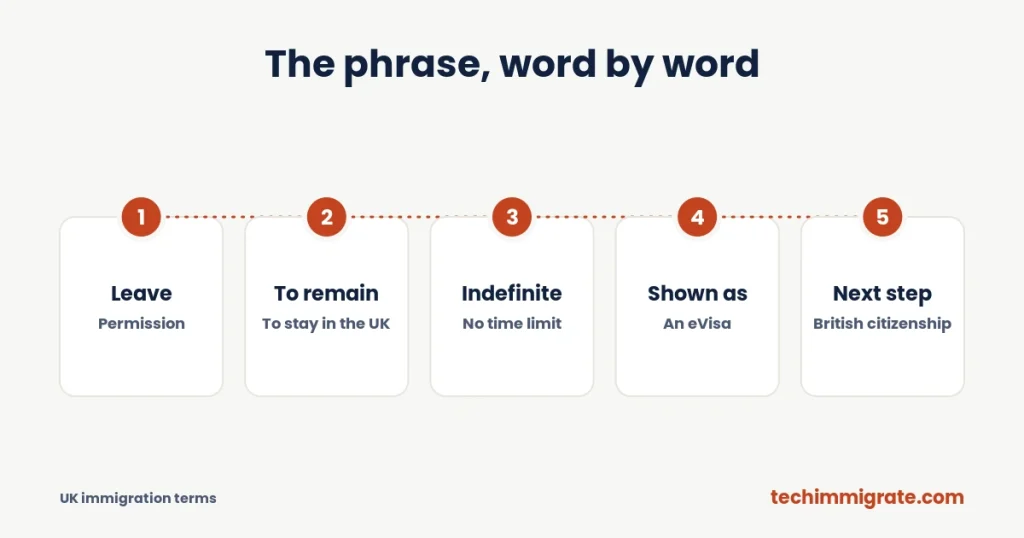
Breaking the phrase into parts makes its meaning clearer.
Leave
In UK immigration law, "leave" means permission. "Leave to enter" is permission to come into the UK, and "leave to remain" is permission to stay. If you hold a visa, you have leave of some kind.
To remain
This refers to permission to stay in the UK, as opposed to permission to enter. People who were granted settlement from outside the UK, which is unusual, may have "indefinite leave to enter", which has the same practical effect once they are in the UK.
Indefinite
This is the key word. Most visas give you limited leave, which ends on a set date. Indefinite leave has no end date. You do not need to renew it, and there are no conditions on the work you do or where you live.
Put together, indefinite leave to remain means permission to stay in the UK with no time limit.
Related Terms and How They Differ
| Term | What it means | Same as ILR? |
|---|---|---|
| Settlement or being settled | Being free from immigration time limits in the UK | Usually used to mean ILR |
| Indefinite leave to enter (ILE) | Indefinite permission granted before or on arrival | Same practical effect |
| Settled status (EU Settlement Scheme) | Indefinite leave granted under the EU Settlement Scheme | Similar effect, different scheme |
| Pre-settled status | Limited leave under the EU Settlement Scheme | No |
| Permanent residence | A term used in other countries, and under old EU law | Similar idea, not the UK legal term today |
| No time limit (NTL) | A Home Office service confirming existing ILR | Confirms ILR |
| British citizenship | Nationality, with a British passport and full voting rights | No |
ILR and settled status
Settled status under the EU Settlement Scheme is a form of indefinite leave for EU, EEA and Swiss citizens and their family members who were living in the UK by the end of 2020. It is similar to ILR in what it lets you do, but it comes from a different scheme with its own rules, including a more generous absence rule. Our article on ILR vs settled status explains the differences.
ILR and permanent residence
Many countries call their equivalent status permanent residence. In the UK, the legal term is indefinite leave to remain, but people often use "permanent residence" informally. Under old EU law, there was also a separate permanent residence document for EU citizens, which no longer applies.
ILR and British citizenship
This is the most important distinction. ILR is an immigration status. British citizenship is a nationality. With ILR, you are still a citizen of your own country, travel on your own passport and are subject to immigration control in some respects. With British citizenship, you can hold a British passport and vote in all UK elections. Most people need ILR before they can apply for citizenship. Our article on ILR to British citizenship explains the next step.
What ILR Lets You Do
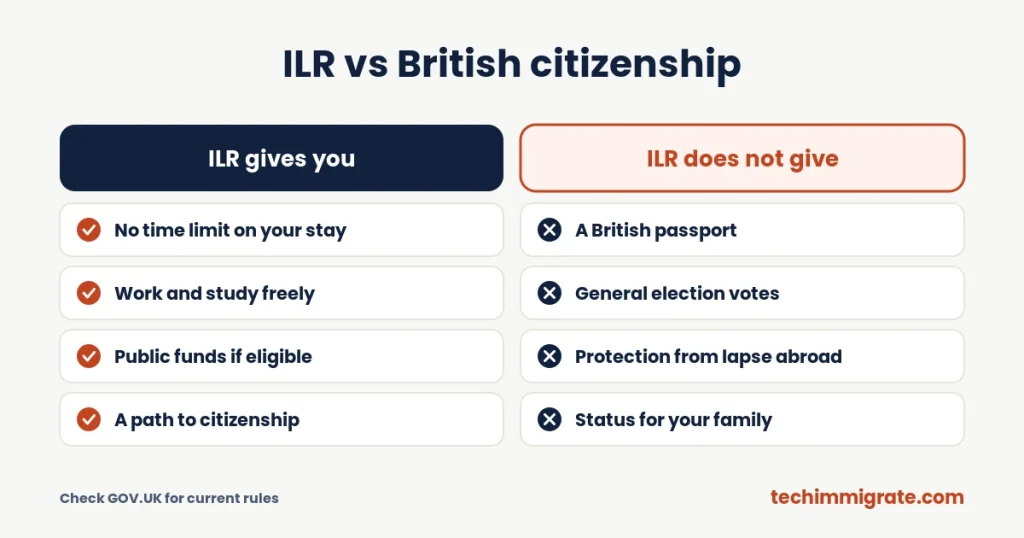
With ILR, you can:
- Live in the UK permanently, without renewing a visa.
- Work for any employer, in any job, or be self-employed, without sponsorship.
- Study, usually with access to home fees after meeting residence requirements.
- Access public funds, such as benefits, if you are eligible.
- Use the NHS without paying the Immigration Health Surcharge.
- Bring family members under the family rules, if you meet the requirements.
- Apply for British citizenship, usually after a further period.
In addition, children born in the UK after you settle are usually British at birth. Our article on the benefits of ILR goes through each in detail.
What ILR Does Not Do
ILR has limits that surprise some people.
- It does not give you a British passport. You travel on the passport of your own country.
- It does not let you vote in UK general elections, unless you are a Commonwealth or Irish citizen, who can vote anyway. Rules for local elections vary across the UK.
- It is not completely permanent. It can lapse after a long absence, and can be revoked in limited circumstances.
- It does not automatically pass to family members. Your partner and children need their own status.
- It does not stop you being deported if you commit serious crimes.
How ILR Is Shown Today
The UK has moved to digital immigration status. Most people now prove their ILR with an eVisa, held in a UK Visas and Immigration (UKVI) account. You can generate share codes to prove your status to employers, landlords and others.
People who were granted ILR many years ago may have it shown in older documents, such as a stamp or vignette in an old passport, or a biometric residence permit. The Home Office has encouraged everyone with older documents to move to an eVisa. If your ILR is in an older document, you may be able to use the free No Time Limit (NTL) application to confirm your status and get an eVisa. Our article on the UK eVisa explains how it works.
How People Get ILR
Most people get ILR after spending a set period in the UK on a route that leads to settlement, and meeting the requirements at the end.
- Global Talent: currently 3 or 5 years, depending on endorsement.
- Innovator Founder: currently 3 years.
- Skilled Worker: currently 5 years.
- Partner of a British citizen or settled person: usually 5 years.
- Long residence: 10 years of lawful residence, although this route is due to close.
On most routes, you also need to pass the Life in the UK test, meet the English requirement, stay within the absence limits and pay the fee, currently £3,226 per person. Our ILR requirements checklist explains each requirement, and our article on ILR rules by visa route maps each route.
The Earned Settlement Reforms
The government's response to the earned settlement consultation, published on 2 November 2026, plans significant changes from 2027. The default qualifying period will become 10 years, with shorter paths of 3 or 5 years for some people, such as high earners and those in the Highest Talent Group, which is expected to include Global Talent. New requirements, such as B2 English from 26 March 2027 and a sustained contribution of at least £12,571 a year, are planned for everyone.
These reforms change how you get ILR. They do not change what ILR is. Once granted, ILR is expected to give the same rights as before. Our article on ILR new rules explains the reforms.
How ILR Can Be Lost
ILR is indefinite, but it is not unbreakable.
Lapsing after 2 years abroad
If you spend more than 2 years continuously outside the UK, your ILR usually lapses. If that happens, you may be able to apply for a Returning Resident visa, which currently costs £726, if you can show strong ties to the UK. Our article on whether ILR expires explains the rule.
Revocation
ILR can be revoked in limited circumstances, such as serious criminality, deception in obtaining it, or if you are liable to deportation. Our article on when ILR can be revoked covers this.
ILR and Your Family
ILR is personal. If you settle, your partner and children do not automatically settle too. They usually settle as your dependants, either at the same time as you, if they meet the requirements, or later, once they have completed their own qualifying period. Children born in the UK after you settle are usually British at birth. Children born before you settle may be able to register as British citizens once you settle. Our guide to ILR for dependants explains the rules.
ILR and Tax
Your immigration status and your tax position are separate. Getting ILR does not change your tax residence by itself. Most people living in the UK long enough to settle are already UK tax resident. If you have income or assets abroad, tax planning around settlement and citizenship can be complex, so get advice.
ILR in Everyday Life
For most people, the biggest change after getting ILR is not legal but practical. Visa renewals stop. There is no more health surcharge to pay. Changing jobs no longer involves an employer's sponsor licence. Landlords and employers still check your right to rent and right to work, but the check shows that you have no time limit, which makes those conversations simpler. Applying for a mortgage often becomes easier too, because lenders see you as a long-term resident.
For tech professionals, ILR also means complete freedom in your career. You can join a start-up that does not sponsor visas, go freelance, take a career break or start a company, all without immigration consequences.
ILR and Travel
With ILR, you can travel in and out of the UK freely, as long as you do not spend more than 2 years continuously abroad. You travel on your own passport, and your eVisa is linked to it. If you get a new passport, update your UKVI account so that your status is linked to the right document. Some countries treat UK residents with ILR differently from British citizens for their own visa requirements, so check the rules for each destination.
ILR and Public Funds
Most visas come with a condition of no recourse to public funds. ILR removes this condition. If you meet the eligibility rules for a benefit, you can claim it. Under the earned settlement reforms, receiving public funds before settlement is one of the factors that can lead to a 20-year path, so it is important not to claim benefits you are not entitled to while you are still on a visa.
ILR and Home Fees for University
Once you have ILR and have been ordinarily resident in the UK for the required period, usually 3 years, you and your children may qualify for home fee status at university and for government student loans. The rules differ between England, Scotland, Wales and Northern Ireland, so check the rules for where you plan to study.
A Short Glossary
- Qualifying period: the time you must spend on a route before you can apply for ILR.
- Continuous residence: living in the UK without breaks longer than the absence rules allow.
- Absence rule: on most work routes, no more than 180 days outside the UK in any 12-month period.
- Life in the UK test: a test of British history, culture and government, required for most ILR applications.
- KoLL: knowledge of language and life, the combined English and Life in the UK requirement.
- eVisa: your digital immigration status, held in a UKVI account.
- Share code: a code you generate to prove your status to someone else.
- NTL: No Time Limit, the free application to confirm existing ILR.
Why the Distinction Matters in Practice
Mixing up ILR, settled status and citizenship can cause real problems. People sometimes assume they can apply for a British passport as soon as they have ILR, or that their children are automatically British, or that their status cannot be lost however long they stay abroad. Each of these assumptions can lead to costly mistakes, such as missed citizenship deadlines, children without the right documents, or status lapsing after a long period overseas. Knowing exactly what ILR is, and what it is not, helps you plan the next steps for yourself and your family with confidence.
When ILR Becomes Citizenship
For most people, ILR is a step on the way to British citizenship rather than the final destination. Once you have held ILR for the required period, usually 12 months for most applicants, and meet the other requirements, including residence and good character, you can apply to naturalise. Naturalisation currently costs £1,709 plus £130 for the citizenship ceremony. People married to British citizens can often apply as soon as they have ILR. Check whether your other country allows dual citizenship before you apply, because some countries do not.
Common Misunderstandings
- "ILR is the same as citizenship." It is not. ILR is an immigration status; citizenship is a nationality.
- "ILR lasts forever, no matter what." It can lapse after 2 years abroad and be revoked in limited cases.
- "ILR comes as a card." It is now usually shown as an eVisa.
- "My family is automatically settled when I am." Each person needs their own status.
- "The reforms will take away existing ILR." The reforms change how people get ILR, not the status of people who already have it.
It means permission to stay in the UK with no time limit on your stay.
It is the UK equivalent of what many countries call permanent residence.
No. ILR is an immigration status. Citizenship is a nationality, with a British passport and full voting rights.
Usually with an eVisa in your UKVI account, using share codes for employers and landlords.
Yes. It usually lapses if you spend more than 2 years continuously outside the UK, and can be revoked in limited circumstances.
Usually 3, 5 or 10 years depending on your route, under the current rules. The reforms plan a 10-year default from 2027.
A Short History of the Idea
The idea of indefinite leave has been part of UK immigration law for decades. Over time, the routes to it have changed many times: different visa categories have come and gone, qualifying periods have moved between 4, 5 and 10 years, and new requirements such as the Life in the UK test and English language have been added. What has stayed constant is the core meaning: permission to stay without a time limit. The earned settlement reforms are the latest and one of the largest changes to how people get there, but they leave that core meaning intact.
Who Does Not Need ILR
Some people living in the UK do not need ILR at all. British citizens obviously do not. Irish citizens have a special status under the Common Travel Area and do not need permission to live in the UK. Some Commonwealth citizens have the right of abode. EU, EEA and Swiss citizens who were living in the UK by the end of 2020 were able to apply for settled status under the EU Settlement Scheme instead. If you are unsure whether you need ILR, check your status on GOV.UK before you apply.
Questions to Ask Yourself About ILR
- Which route am I on, and does it lead to ILR?
- When will I complete my qualifying period?
- Have I stayed within the absence limits?
- Do I meet the English requirement, and will I need B2 if I apply after 26 March 2027?
- Have I passed, or booked, the Life in the UK test?
- Do my partner and children have their own path to settlement?
- What will I do after ILR: stay settled, or apply for citizenship?
Working through these questions early helps you plan, budget and avoid surprises.
The Bottom Line
Indefinite leave to remain means permission to stay in the UK with no time limit. It is the UK's version of permanent residence and the usual step before British citizenship. It gives you freedom to live, work and study as you choose, but it is personal, it is shown digitally, and it can be lost after a long absence. Understanding exactly what it is helps you make the most of it, and plan the next steps for you and your family.
ILR and Your Employer
When you get ILR, tell your employer so they can update their records. They will usually do a fresh right to work check using a share code. Because ILR has no time limit, they will not need to repeat the check later, which removes one more piece of admin from your working life. If you were on a Skilled Worker visa, your employer's sponsorship duties for you also end once you settle.
ILR and Renting a Home
Landlords in England must check that tenants have the right to rent. With ILR, you prove this with a share code, and the check shows that your permission has no time limit. This often makes renting easier, because landlords do not need to plan follow-up checks before a visa expires.
Your Next Step
For tech professionals, the Global Talent visa offers one of the shortest paths to ILR. Our role-specific Global Talent guides explain what Tech Nation looks for in software developers, data and AI specialists, product managers, designers, founders and more.
How We Checked This Article
We checked the meaning and effect of indefinite leave to remain against GOV.UK's pages on indefinite leave to remain, the EU Settlement Scheme and the Returning Resident visa, in November 2026. Earned settlement reforms are from summaries of the government's response of 2 November 2026.
Tech Immigrate is independent of the Home Office. This article is general information, not legal advice. Check GOV.UK before you apply.
We write practical guides for tech professionals applying for the UK Global Talent visa. Tech Immigrate is independent of Tech Nation and the Home Office, and our articles are general information, not legal advice. Rules and fees change, so always check gov.uk before you apply.