Does Indefinite Leave to Remain Expire? The 2-Year Absence Rule
Does indefinite leave to remain expire? The 2-year absence rule, expired BRPs, EU settled status, the Returning Resident visa and how to protect ILR.


In this article
- Does ILR Have an Expiry Date?
- The 2-Year Absence Rule
- If You Have Been Away for Less Than 2 Years
- If You Have Been Away for More Than 2 Years
- The Returning Resident Visa
- Settled Status Under the EU Settlement Scheme
- ILR Can Also Be Revoked
- Protecting Your ILR if You Plan to Live Abroad
- Absences and Citizenship
- Common Situations That Put ILR at Risk
- Does Remote Work Count as Living in the UK?
- What Counts as Strong Ties
- Families and the 2-Year Rule
- What to Do Before You Leave
- Returning After a Long Absence on a Work Route
- Keeping Your eVisa Up to Date
- A Worked Example: An Overseas Assignment
- A Worked Example: A Lapsed ILR
- Common Misunderstandings
- Protect What You Have Worked For
- How We Checked This Article
Indefinite leave to remain (ILR) is called indefinite for a reason: it does not have an expiry date, and you never need to renew it. But that does not mean it lasts forever regardless of what you do. The most common way people lose ILR is not through anything dramatic. It is simply by spending too long outside the UK. The rule is easy to understand but easy to break by accident, especially for tech workers who take overseas assignments, care for family abroad or relocate for a few years.
This guide explains whether ILR expires, the 2-year absence rule, how it differs from documents that do expire, what happens if your ILR lapses, how the Returning Resident visa works, and how to protect your status if you plan to spend time abroad. It also covers the differences for people with settled status under the EU Settlement Scheme.
Key takeaways
- ILR itself does not expire. There is no end date and nothing to renew.
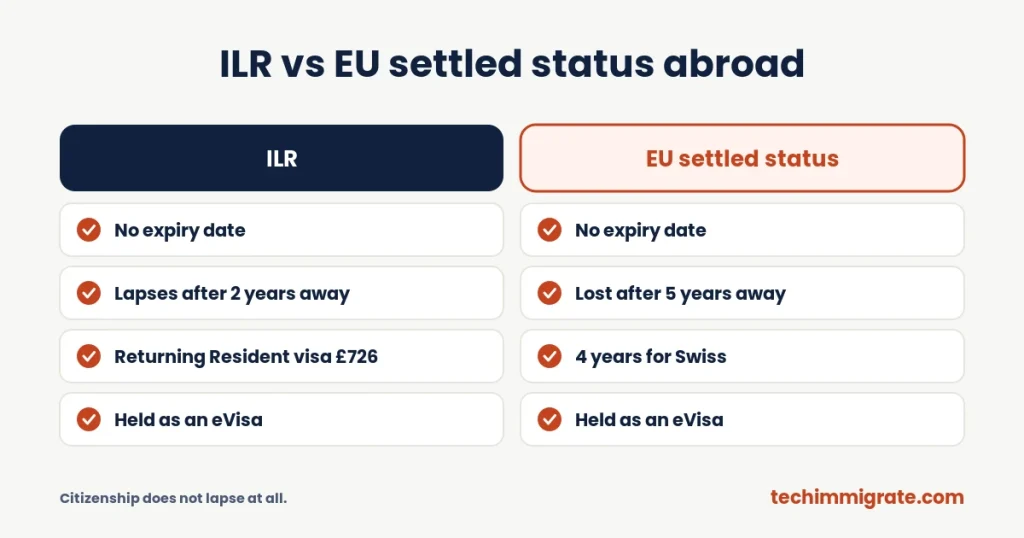
- ILR usually lapses if you spend more than 2 continuous years outside the UK.
- If you have been away for less than 2 years, you keep your ILR and can re-enter, as long as you had ILR when you left and did not receive Home Office financial support to leave.
- Settled status under the EU Settlement Scheme lasts longer abroad: it is usually lost after 5 continuous years, or 4 for Swiss citizens and their family members.
- If your ILR has lapsed, you may be able to return as a returning resident. The visa costs £726, and you must show strong ties to the UK.
- Old documents such as biometric residence permits did expire, but that did not end your ILR. Your status is now held as an eVisa.
- The safest way to protect your right to live in the UK long term is to become a British citizen, because citizenship does not lapse.
Does ILR Have an Expiry Date?
No. ILR is permanent permission to stay in the UK. Once granted, there is no date on which it ends and nothing you need to renew. You do not need to apply for extensions, pay further visa fees or meet the requirements of the route you settled on ever again.
The confusion usually comes from documents. Many people with ILR had a biometric residence permit (BRP), and most BRPs had an expiry date, often the end of 2024. When a BRP expired, the ILR did not. The card was just a way of proving your status. Since the UK moved to eVisas, ILR is now held as a digital record in your UKVI account, which does not expire.
Some people have ILR shown only by a stamp or vignette in an old passport. The passport may have expired, but the ILR did not. GOV.UK says you can make a free no time limit application to get an eVisa if you want digital proof of your status.
The 2-Year Absence Rule
GOV.UK says that for most people, ILR is lost after 2 continuous years outside the UK. The key words are continuous and outside the UK:
- Continuous means without returning. If you leave for 18 months, return for a genuine visit, and then leave again, the clock usually restarts. But visits made only to avoid the rule may be looked at closely.
- Outside the UK includes everywhere except the UK. Time in Ireland, the Channel Islands or the Isle of Man is still outside the UK for this purpose.
The rule exists because ILR is meant for people who live in the UK, and it applies whatever route you settled on, whether Skilled Worker, Global Talent, family or long residence. Someone who has made their home elsewhere for more than 2 years is treated as no longer settled here.
If You Have Been Away for Less Than 2 Years
GOV.UK says you keep your ILR and can re-enter the UK if:
- you had ILR when you left; and
- you did not receive financial support from the Home Office to leave the UK.
When you return, the border officer may ask about your time away. Carry evidence of your ties to the UK, such as a home, a job or family here, especially if you have been away for a long time. A recent payslip, a tenancy agreement or a council tax bill is usually enough to answer any questions quickly.
If You Have Been Away for More Than 2 Years
If you have spent more than 2 continuous years outside the UK, your ILR will usually have lapsed. You cannot simply fly back and resume living in the UK. Your options are:
- Apply for a Returning Resident visa, if you can show strong ties to the UK.
- Apply under another route, such as Skilled Worker, Global Talent or a family route, and build up to settlement again.
- Apply as a visitor for short trips, although this does not let you live or work in the UK.
The right choice depends on how long you have been away, why, and how strong your ties to the UK still are.
The Returning Resident Visa
GOV.UK says you may be able to come back to live permanently in the UK as a returning resident if you previously had ILR and have been away too long to keep it. Key points:
- Eligibility: you must show strong ties to the UK, such as family who have lived here most of your life, and explain your current circumstances and why you lived abroad.
- Fee: £726.
- Documents: a current passport, previous passports, a passport-sized photo, evidence of UK ties such as UK income or property, and other documents depending on your circumstances.
- Process: apply online and give fingerprints and a photo at a visa application centre.
- Outcome: if successful, you can re-enter the UK and get indefinite leave to remain.
- Family: your partner and children must apply separately, if eligible.
The Returning Resident visa is not automatic. Decisions depend on the strength of your ties and the reasons for your absence. People who left for reasons outside their control, such as caring for a sick relative, or who kept strong links with the UK, such as a home, a job or close family, usually have stronger cases than people who simply moved abroad.
Some people are exempt from needing the visa, including certain members of the British armed forces and their partners, and some UK government and British Council staff working overseas.
Settled Status Under the EU Settlement Scheme
If you have settled status under the EU Settlement Scheme, the rule is different. GOV.UK says settled status is lost after 5 continuous years outside the UK, or 4 years for Swiss citizens and their family members. This longer period is one of the protections under the Withdrawal Agreement.
If you have pre-settled status, the rules on absences are different again and are linked to continuous residence. Check the EU Settlement Scheme guidance if this applies to you. Our guide to ILR vs settled status explains the differences.
ILR Can Also Be Revoked
Lapse through absence is the most common way to lose ILR, but it is not the only one. ILR can also be revoked in limited circumstances, for example if you:
- commit a serious criminal offence and become liable to deportation;
- obtained your ILR by deception;
- are a stateless person who no longer meets the conditions.
Revocation is rare for people who obtained ILR honestly and stay out of serious trouble.
Protecting Your ILR if You Plan to Live Abroad
If you expect to spend a long period abroad, plan ahead:
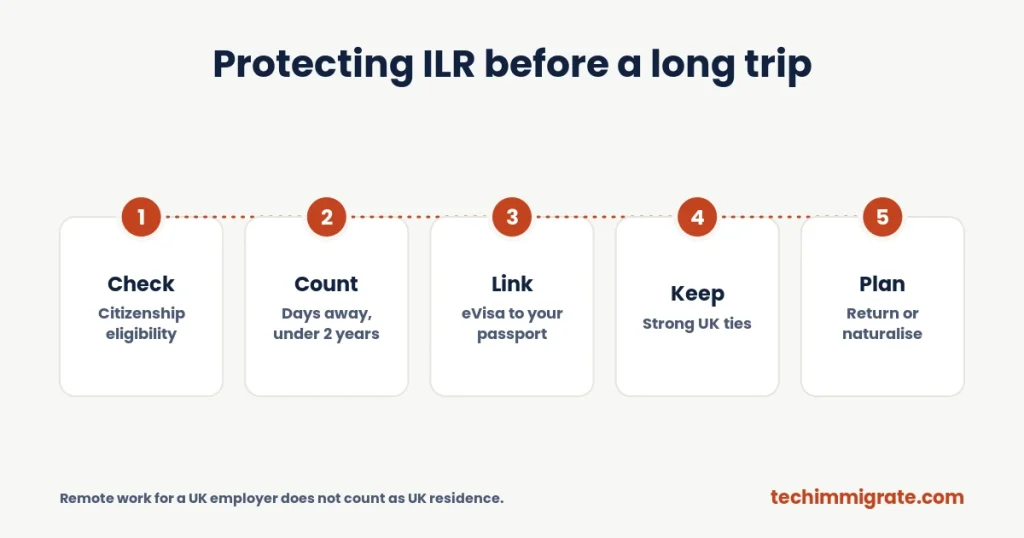
- Apply for British citizenship first, if you are eligible. Citizenship does not lapse, so you can live abroad for as long as you like. You can usually apply 12 months after getting ILR, or straight away if you are married to a British citizen.
- Keep the absence under 2 years. If you cannot naturalise first, structure your plans so that you return to the UK before 2 continuous years have passed.
- Keep strong ties. Keep a UK home, bank accounts, tax records and family links, so that if your ILR does lapse, you have the best chance of a Returning Resident visa.
- Keep records. Note your exit and entry dates, so you know exactly how long you have been away.
Our guide to moving from ILR to British citizenship explains the naturalisation requirements, including the absence limits for citizenship, which are stricter than the ILR lapse rule.
Absences and Citizenship
Even if your ILR is safe, long absences can affect your eligibility for British citizenship. For naturalisation, you usually must not have spent more than 450 days outside the UK in the 5 years before applying, and no more than 90 days in the last 12 months. So a year-long assignment abroad will not cost you your ILR, but it may delay your citizenship application.
If citizenship is part of your plan, think about the timing of overseas work carefully.
Common Situations That Put ILR at Risk
Most people who lose ILR did not plan to. They found themselves abroad for longer than expected. Common situations include:
- Overseas assignments that get extended. An 18-month posting becomes 2 and a half years because a project runs late.
- Caring for family. A parent's illness means a stay abroad that was meant to be a few months becomes several years.
- The pandemic or other crises. People who were stranded abroad during travel disruption sometimes found their absence passing 2 years. Exceptional circumstances can be relevant to a Returning Resident application, but they do not automatically protect ILR.
- Studying abroad. A master's degree or PhD overseas can easily take more than 2 years.
- Remote working. Some tech workers with ILR move abroad to work remotely for UK companies, assuming their UK job protects their status. It does not. The rule is about where you are, not who you work for.
- Children who grew up in the UK and moved away. Young adults who settled as children and then lived abroad with a parent can lose ILR without realising.
If any of these could apply to you, plan your return or your citizenship application before the 2-year point.
Does Remote Work Count as Living in the UK?
No. Working remotely for a UK employer while living abroad does not count as being in the UK for ILR purposes. The 2-year rule depends on your physical presence. If you live in another country for more than 2 continuous years, your ILR will usually lapse, even if you were paid by a UK company, paid UK tax and kept a UK address.
Those ties may help a Returning Resident application, but they do not stop the lapse. If you want to work remotely from abroad for a long period, becoming a British citizen first is the safest option.
What Counts as Strong Ties
For a Returning Resident visa, the Home Office looks at the whole picture of your connection to the UK. Factors that can help include:
- the length of time you lived in the UK before leaving;
- close family members living in the UK, especially a partner or children;
- a home in the UK that you own or rent;
- ongoing UK employment, business interests or pension contributions;
- UK tax returns and National Insurance contributions;
- the reason you left and the reason you stayed away longer than 2 years;
- your intention to return to live permanently.
The strongest cases usually combine a long period of residence before leaving, close family in the UK and a clear, compelling reason for the long absence.
Families and the 2-Year Rule
Each family member's ILR is assessed separately. If you and your partner both have ILR and move abroad together, you are both subject to the 2-year rule. If one of you returns to the UK regularly and the other does not, one person's ILR may lapse while the other's does not.
Children are particularly easy to overlook. A child who settled with their parents and then lived abroad with one parent for several years may lose ILR without anyone noticing until they try to return, for example to go to university in the UK. If your family is spending time abroad, track each person's absences separately, and consider registering children as British citizens where they qualify, because citizenship protects them for life.
What to Do Before You Leave
If you are about to leave the UK for a long period with ILR, a short checklist helps:
- Check whether you are eligible for British citizenship now, and apply before leaving if you can.
- Write down the date you leave and set a reminder well before the 2-year point.
- Make sure your eVisa is linked to the passport you will travel on.
- Keep copies of documents showing your ties to the UK.
- Tell close family where your immigration documents and UKVI login details are kept, in case you need help.
- If you might stay abroad longer, research the Returning Resident visa before you go, so you know what evidence to keep.
Returning After a Long Absence on a Work Route
If your ILR has lapsed and a Returning Resident visa is unlikely to succeed, the practical way back is often a work route. For tech professionals, the main options are:
- Skilled Worker, if you have a job offer from a licensed sponsor that meets the salary and skill rules;
- Global Talent, if you have built a strong track record while abroad, for example by leading teams, founding a company or contributing to widely used technology;
- Innovator Founder, if you want to start a business in the UK.
You would need to build up to settlement again under the rules in force at the time. Under the earned settlement reforms, that may take longer than it did before, depending on your earnings and the route you use. Before choosing, compare the routes carefully. Our comparison of highly skilled worker visas sets out the options.
Keeping Your eVisa Up to Date
Because ILR is now held as an eVisa, you need to keep your UKVI account up to date, especially when you travel:
- Update your passport details whenever you get a new passport, so carriers and border staff can link your status to the document you travel on.
- Keep your contact details current, so you can sign in and generate share codes.
- Check your eVisa before long trips, and make sure it shows indefinite leave to remain.
If your eVisa is not linked to your current passport, you may have problems boarding a flight to the UK, even though your ILR is valid.
A Worked Example: An Overseas Assignment
A site reliability engineer with ILR is offered an 18-month assignment in Singapore by his London employer.
- 18 months is less than 2 years, so his ILR will not lapse if he returns on time.
- He keeps his London flat, his UK bank accounts and his UK employment contract.
- He comes back for a week at Christmas, although this is not needed to protect his ILR.
- He returns to London after 18 months and re-enters with his eVisa.
His ILR is safe. However, the 18 months abroad means he will need to wait before applying for citizenship, because of the naturalisation absence limits.
A Worked Example: A Lapsed ILR
A product manager with ILR moved abroad to care for a parent and stayed for 3 years. She now wants to return to the UK.
- Her ILR has lapsed, because she was away for more than 2 continuous years.
- She applies for a Returning Resident visa, paying £726.
- She provides evidence of her strong ties to the UK: she lived here for 12 years, her adult children live here, she kept a UK bank account, and she left to care for a seriously ill parent.
Her application has a reasonable chance of success because of the reasons for her absence and the strength of her ties. If it is refused, she may need to return on a work route, such as Skilled Worker or Global Talent.
Common Misunderstandings
- "My ILR expired when my BRP expired." It did not. The card expired, not the status.
- "ILR lasts forever no matter what." It usually lapses after 2 continuous years outside the UK.
- "A quick trip back every 2 years keeps my ILR safe." It may restart the clock, but visits made only to avoid the rule may be scrutinised, and your ties to the UK still matter.
- "Settled status and ILR have the same rule." EU settled status allows 5 years abroad, or 4 for Swiss citizens.
- "If my ILR lapses, I can never come back." You may be able to return as a returning resident or on another route.
No. ILR has no expiry date and does not need renewing. It can, however, lapse if you spend more than 2 continuous years outside the UK.
Usually up to 2 continuous years. After that, your ILR will usually lapse.
Your ILR is still valid. You now prove your status with an eVisa through your UKVI account.
You may be able to apply for a Returning Resident visa, which costs £726 and requires strong ties to the UK.
Settled status under the EU Settlement Scheme is usually lost after 5 continuous years outside the UK, or 4 for Swiss citizens and their family members.
Apply for British citizenship first if you are eligible, because citizenship does not lapse.
Yes. Naturalisation usually requires no more than 450 days outside the UK in 5 years and 90 days in the last 12 months.
Protect What You Have Worked For
ILR is permanent, but only if you keep living in the UK. If your career might take you abroad for a long period, plan ahead: naturalise if you can, keep your absences under 2 years if you cannot, and keep strong ties to the UK. If you are still working towards settlement in tech, our role-specific Global Talent guides explain how a faster route could help.
Related reading: Can ILR Be Revoked? When You Could Lose Settled Status.
How We Checked This Article
We checked the absence rules, the Returning Resident visa and EU Settlement Scheme differences against GOV.UK's Returning Resident visa page and ILR guidance, and the no time limit process against GOV.UK's eVisa settlement page, in November 2026.
Tech Immigrate is independent of the Home Office. This article is general information, not legal advice. Check GOV.UK before you travel or apply.
We write practical guides for tech professionals applying for the UK Global Talent visa. Tech Immigrate is independent of Tech Nation and the Home Office, and our articles are general information, not legal advice. Rules and fees change, so always check gov.uk before you apply.