ILR vs Settled Status: What’s the Difference?
Is indefinite leave to remain the same as settled status? How ILR and EU settled status differ on absences, rights, fees, family and citizenship.


In this article
- The Short Answer
- Side-by-Side Comparison
- Who Has Settled Status
- Who Has ILR
- What Both Statuses Let You Do
- The Key Difference: Absences
- Rights Under the Withdrawal Agreement
- Pre-Settled Status vs a Work Visa
- Citizenship
- Mixed Households: When Partners Have Different Statuses
- Before a Long Trip: Questions to Ask
- How the Earned Settlement Reforms Fit In
- A Worked Example: Two Engineers, Two Statuses
- A Worked Example: Choosing Between ILR and Citizenship Before a Move Abroad
- Proving Your Status: eVisas for Both
- Losing Status: Lapse, Revocation and Curtailment
- Employers and Right-to-Work Checks
- Common Misunderstandings
- Know Which Path You Are On
- How We Checked This Article
"Indefinite leave to remain" and "settled status" sound like two names for the same thing, and in some ways they are. Both let you live in the UK without a time limit. Both can lead to British citizenship. Both are proved through an eVisa. But they come from different legal schemes, they have different rules on absences, and they protect different rights. Mixing them up can lead to bad decisions about travel, family and citizenship.
This guide explains the difference between indefinite leave to remain (ILR) and settled status under the EU Settlement Scheme, who has which, what each allows, how long you can spend abroad, how each leads to citizenship, and what it means for tech workers and their families in mixed situations, such as a household where one partner has settled status and the other is on a Skilled Worker or Global Talent visa.
Key takeaways
- Settled status is a form of indefinite leave granted under the EU Settlement Scheme to eligible EU, EEA and Swiss citizens and their family members.
- ILR is the general form of permanent residence granted under the Immigration Rules, for example after 5 years on a Skilled Worker visa or 3 years on Global Talent in some cases.
- Both let you live, work and study in the UK without time limits, and both can lead to British citizenship.
- Settled status can usually be lost after 5 continuous years outside the UK. ILR can lapse after more than 2 continuous years outside the UK.
- Settled status also carries rights protected by the Withdrawal Agreement, such as some family reunion rights.
- The EU Settlement Scheme closed to most new applicants on 30 June 2021. Late applications are only accepted in limited circumstances.
- If you are in tech and arriving now, you will almost certainly be on the ILR path, not the settled status path.
The Short Answer
Settled status is a type of indefinite leave to remain. In legal terms, people granted settled status under the EU Settlement Scheme have indefinite leave to enter or remain under Appendix EU of the Immigration Rules. So in one sense, the answer to "is ILR the same as settled status?" is yes: both are indefinite leave.
But in everyday use, the two terms describe different statuses:
- Settled status usually means indefinite leave under the EU Settlement Scheme, for EU, EEA and Swiss citizens and their families who were living in the UK by 31 December 2020.
- ILR usually means indefinite leave under other parts of the Immigration Rules, such as the work routes, family routes or long residence.
The practical differences are in the details.
Side-by-Side Comparison
| ILR | Settled status (EUSS) | |
|---|---|---|
| Who gets it | People on routes such as Skilled Worker, Global Talent, family and long residence | Eligible EU, EEA and Swiss citizens and family members resident by 31 December 2020 |
| Legal basis | Various parts of the Immigration Rules | Appendix EU and the Withdrawal Agreement |
| Typical qualifying period | 5 years, or 3 for some routes, under current rules | 5 years' continuous residence |
| Application fee | £3,226 | Free |
| English and Life in the UK test | Required, unless exempt | Not required |
| Absence before it can be lost | More than 2 continuous years | More than 5 continuous years (4 for Swiss citizens) |
| Proof of status | eVisa | eVisa |
| Citizenship | Usually 12 months after ILR | Usually 12 months after settled status |
| Open to new applicants | Yes | Closed to most since 30 June 2021 |
Who Has Settled Status
The EU Settlement Scheme was set up for EU, EEA and Swiss citizens, and their family members, who were living in the UK before the end of the Brexit transition period on 31 December 2020. People with 5 years of continuous residence got settled status. People with less than 5 years got pre-settled status, which can lead to settled status once they reach 5 years.
The main deadline for applications was 30 June 2021. Since then, late applications have only been accepted where there are reasonable grounds for missing the deadline. Close family members of people with EUSS status can still apply to join them in some circumstances.
If you are an EU, EEA or Swiss citizen arriving in the UK now, you are not eligible for the EU Settlement Scheme. You need a visa, such as Skilled Worker or Global Talent, like everyone else, and your path to permanent residence will be ILR.
Who Has ILR
ILR is granted under many parts of the Immigration Rules. For tech workers, the most common routes are:
- Skilled Worker, after 5 years under the current rules.
- Global Talent, after 3 years for people endorsed under exceptional talent and some other cases, or 5 years for exceptional promise.
- Innovator Founder, after 3 years if the business criteria are met.
- Family routes, such as a partner of a British citizen or settled person.
- Long residence, after 10 years of lawful residence, although the government has said this route will close under the earned settlement reforms.
Our ILR requirements checklist explains what you need to qualify.

What Both Statuses Let You Do
With either ILR or settled status, you can:
- live in the UK without a time limit;
- work for any employer, or be self-employed, without restrictions;
- study;
- access public funds and benefits, if you meet the usual eligibility rules;
- use the NHS without paying the Immigration Health Surcharge;
- apply for British citizenship once you meet the requirements;
- travel in and out of the UK, within the absence limits.
You do not need a sponsor, and you do not need to renew your status.
The Key Difference: Absences
The biggest practical difference is how long you can spend outside the UK before you lose your status.
- ILR usually lapses if you spend more than 2 continuous years outside the UK. If that happens, you may be able to apply for a Returning Resident visa, but it is not guaranteed.
- Settled status can usually be lost after 5 continuous years outside the UK, or 4 years for Swiss citizens and their family members.
For tech workers who might take a long overseas assignment, this difference matters. An ILR holder who accepts a 3-year posting abroad risks losing their status. A settled status holder in the same situation would usually keep theirs.
If you have ILR and are planning a long period abroad, consider applying for British citizenship first, because citizenship does not lapse.
Rights Under the Withdrawal Agreement
Settled status holders have rights protected by the Withdrawal Agreement between the UK and the EU. These include:
- the right for certain close family members, such as existing partners and children, to join them in the UK under the EU Settlement Scheme;
- protections around access to some benefits and services;
- an independent monitoring authority that oversees how the UK applies these rights.
ILR holders do not have these extra protections. Their family members usually need to apply under the family rules, which have a financial requirement and other conditions.
Pre-Settled Status vs a Work Visa
Pre-settled status is a time-limited status under the EU Settlement Scheme for people who had not reached 5 years by the time they applied. It is often compared with work visas, but it is more flexible:
- pre-settled status holders can work for any employer without a sponsor;
- there is no salary threshold;
- status is extended automatically in many cases, and people are moved to settled status once they reach 5 years.
A Skilled Worker visa, by contrast, ties you to a sponsor and a minimum salary. Global Talent is closer to pre-settled status in flexibility, because it needs no sponsor and has no salary threshold.
Citizenship
Both statuses can lead to British citizenship. GOV.UK says people with settled status can usually apply 12 months after getting it, and people with ILR usually need to live in the UK for 12 months after getting ILR before applying. If you are married to a British citizen, you can usually apply as soon as you have either status, after 3 years in the UK.
The other requirements, such as good character, absences, English and the Life in the UK test, apply to both. People who got settled status without an English test or Life in the UK test will need to meet those requirements when they apply for citizenship. Our guide to moving from ILR to British citizenship explains the process.
Mixed Households: When Partners Have Different Statuses
Tech households often include people with different statuses. Common examples include:
A partner with settled status and a partner on a work visa
If one partner has settled status and the other is on a Skilled Worker or Global Talent visa, the visa holder may be able to switch to a family route as the partner of a settled person, or, if they meet the requirements, apply under the EU Settlement Scheme as a family member. The right option depends on when the relationship started and whether the EUSS family rules are met. Take advice before switching, because the requirements differ.
A partner with ILR and a partner on a dependant visa
If one partner has ILR through a work route and the other is their dependant, the dependant partner can usually apply for ILR at the same time or once they reach the qualifying period themselves. Under the earned settlement reforms, partners who arrived with the main applicant may be able to settle on the same timeline.
Children
A child born in the UK to a parent with settled status or ILR at the time of birth is usually British automatically. A child born before the parent got either status may be able to register as a British citizen later.
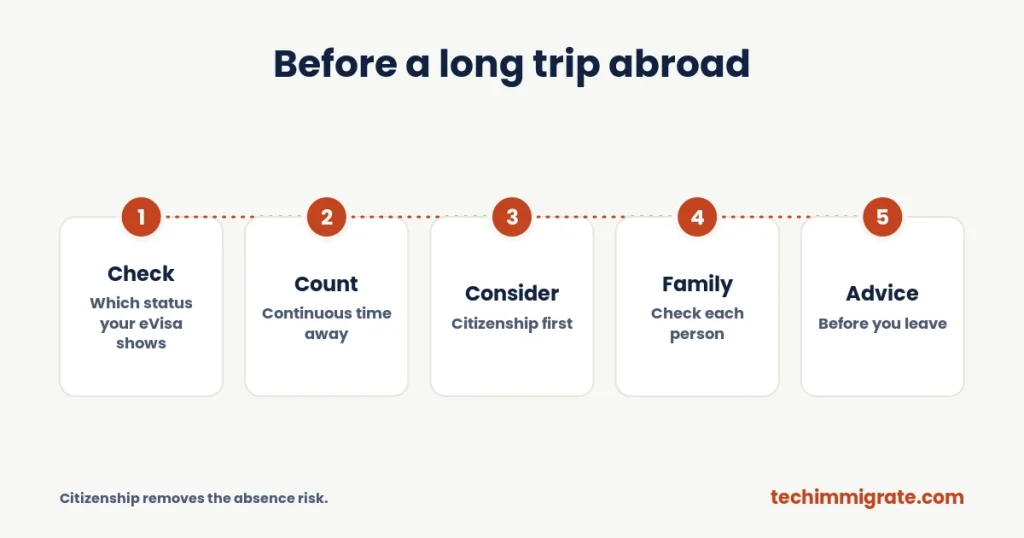
Before a Long Trip: Questions to Ask
Whichever status you hold, a long period abroad deserves planning. Before you accept an overseas assignment, take a sabbatical or move abroad to care for family, ask yourself:
- Which status do I hold? Check your eVisa. It will say whether you have indefinite leave under the EU Settlement Scheme or under another part of the Immigration Rules.
- How long will I be away continuously? Short visits back to the UK can reset the clock for lapse purposes, but they need to be genuine returns, not a way to avoid the rule.
- Am I eligible for citizenship now? If so, naturalising before you leave removes the risk entirely.
- What about my family? Each family member's status is assessed separately. A child or partner may have a different status and different limits.
- What happens to my citizenship timeline? Absences count against the citizenship residence requirements, so a long trip can delay naturalisation even if your status survives.
If the answers point to a risk, it is worth taking advice before you go. Recovering lost status from abroad is much harder than protecting it in advance.
How the Earned Settlement Reforms Fit In
The government's response to the earned settlement consultation, published on 2 November 2026, changes how people qualify for ILR. It proposes a 10-year default qualifying period, with a 5-year path for people earning at least £50,271, a 3-year path for the highest earners and recognised talent, and new requirements such as English at B2 and no debts to public bodies. These changes are expected to be implemented over 2027.
People with settled status under the EU Settlement Scheme are protected by the Withdrawal Agreement, and the reforms are focused on the routes under the main Immigration Rules. People on pre-settled status should check how any changes affect them, but their path is set by the EU Settlement Scheme rather than the new settlement framework.
For tech workers arriving now, the reforms mean ILR may take longer to reach than settled status did. Our guide to the new indefinite leave to remain rules explains the details.
A Worked Example: Two Engineers, Two Statuses
Two senior engineers work at the same London start-up.
- The first is a Spanish citizen who moved to London in 2015 and got settled status in 2019. She does not need a visa, did not pay an application fee for her status, and can spend up to 5 continuous years abroad without losing it.
- The second moved from Brazil in 2022 on a Skilled Worker visa. He will be eligible for ILR in 2027 under the current rules, will pay £3,226, needs to pass the Life in the UK test and prove English, and could lose ILR after more than 2 continuous years abroad.
Both can work for the start-up without restriction once the second engineer has ILR. Both can apply for citizenship 12 months after their status, if they meet the other requirements. The differences show up when they think about long overseas assignments or bringing family members.
A Worked Example: Choosing Between ILR and Citizenship Before a Move Abroad
A product lead with ILR is offered a 3-year role at his company's New York office. He wants to keep the option of returning to the UK.
- With ILR, a 3-year absence would likely cause his status to lapse.
- He has held ILR for more than 12 months and meets the other naturalisation requirements, so he applies for British citizenship before leaving.
- Once he is British, he can take the overseas role without risking his right to return.
If he had settled status instead of ILR, he could spend up to 5 continuous years abroad, so the pressure to naturalise before leaving would be lower.
Proving Your Status: eVisas for Both
Both ILR and settled status are now proved digitally through an eVisa in your UKVI account. Physical documents, such as biometric residence permits and old vignette stickers, have been replaced. To prove your status to an employer, landlord or other organisation, you generate a share code online and give it to them along with your date of birth. Share codes are valid for 90 days and are specific to the purpose, such as right to work or right to rent.
The practical steps are the same for both statuses:
- keep your UKVI account details secure and up to date;
- update your passport details whenever you renew your passport, so that your eVisa is linked to the document you travel on;
- check your status before travelling, because carriers check eVisas at check-in;
- keep a record of when you were granted status, because you will need the date for citizenship.
Our guide to the UK eVisa explains how to access your account and generate share codes.
Losing Status: Lapse, Revocation and Curtailment
Both statuses are designed to be permanent, but neither is guaranteed in every circumstance. The main ways status can be lost are:
- Lapse through absence. After more than 2 continuous years abroad for ILR, or 5 for settled status.
- Revocation for criminality or deception. If you commit a serious crime, or if your status was obtained by deception, the Home Office can take action to revoke it.
- Deportation. A deportation order cancels any leave you hold.
People with settled status have some extra protection because decisions to remove their status must comply with the Withdrawal Agreement. People with ILR rely on the protections in UK law and the Immigration Rules.
If you have either status and expect to spend long periods abroad, or have any concerns about your record, citizenship offers the most secure position.
Employers and Right-to-Work Checks
From an employer's point of view, ILR and settled status work the same way. Both give an unlimited right to work, so the employer only needs to carry out a right-to-work check once, using the share code you provide, and does not need to repeat it. Pre-settled status, by contrast, is time-limited, so employers usually need to recheck before it expires, unless the person has moved to settled status.
If you are hiring in tech, this is worth knowing. A candidate with settled status or ILR needs no sponsorship and no follow-up checks. A candidate with pre-settled status needs no sponsorship either, but you should diary a recheck. A candidate on a Skilled Worker visa needs your sponsorship and ongoing compliance, while a Global Talent holder needs no sponsorship but will need a recheck before their visa expires.
Common Misunderstandings
- "Settled status and ILR have the same absence rules." They do not. Settled status allows longer absences.
- "EU citizens arriving now can get settled status." Most cannot. The scheme closed to most new applicants on 30 June 2021.
- "I don't need an English test for citizenship because I didn't need one for settled status." You will need to meet the English and Life in the UK requirements for citizenship.
- "ILR cannot be lost." It can lapse after long absences and can be revoked in limited circumstances.
- "Pre-settled status is the same as a work visa." It is more flexible, with no sponsor or salary requirement.
Settled status is a type of indefinite leave granted under the EU Settlement Scheme. In everyday use, ILR refers to indefinite leave under other parts of the Immigration Rules.
Settled status allows longer absences and carries Withdrawal Agreement rights, but it is only available to people eligible for the EU Settlement Scheme. For most people arriving now, ILR is the only option.
ILR usually lapses after more than 2 continuous years outside the UK.
Usually up to 5 continuous years, or 4 years for Swiss citizens and their family members.
Only in limited circumstances, such as late applications with reasonable grounds or eligible family members joining someone with EUSS status.
Yes, usually 12 months after getting the status, or immediately if you are married to a British citizen, once you meet the other requirements.
No, but you will need it if you later apply for British citizenship.
Know Which Path You Are On
For most tech workers arriving in the UK today, the path to permanent residence is ILR, through routes such as Skilled Worker or Global Talent. Understanding how ILR differs from settled status helps you make better decisions about travel, family and citizenship. If you want a faster, more flexible route to ILR, our role-specific Global Talent guides explain what Tech Nation looks for.
How We Checked This Article
We checked the EU Settlement Scheme rules against GOV.UK's EU Settlement Scheme pages, the ILR rules against GOV.UK's indefinite leave to remain pages, and the citizenship timing against GOV.UK's British citizenship pages, in November 2026. Settlement reforms are from law firm summaries of the earned settlement response of 2 November 2026.
Tech Immigrate is independent of the Home Office. This article is general information, not legal advice. Check GOV.UK before you apply.
We write practical guides for tech professionals applying for the UK Global Talent visa. Tech Immigrate is independent of Tech Nation and the Home Office, and our articles are general information, not legal advice. Rules and fees change, so always check gov.uk before you apply.