
Extending a Skilled Worker Dependant Visa: Cost, Timing and Documents
How to extend a Skilled Worker dependant visa for your partner and children: when to apply, fees, IHS, documents, special cases and settlement.


In this article
- Why Dependant Extensions Are Separate
- When Dependants Need to Extend
- Who Can Extend as a Dependant
- How Much It Costs
- Do Dependants Need to Show Money?
- Documents You Will Need
- How to Apply Step by Step
- Working and Studying While You Wait
- Special Situations
- Dependant Extensions and Settlement
- A Worked Example: Extending Together
- A Worked Example: A Partner Who Joined Later
- Evidence of Living Together: What Works
- Switching Into the Dependant Route From Another Visa
- Timing Strategy: When to Submit
- Common Mistakes
- Planning Checklist
- Keep Your Family's Status Aligned
- How We Checked This Article
When a Skilled Worker extends their visa, many families assume that the partner's and children's visas extend along with it. They do not. Each dependant has their own permission, with its own expiry date, and each needs their own application to stay in the UK beyond that date. Missing a dependant's extension is one of the most common and most stressful mistakes families on work visas make, because it can leave a partner without the right to work or a child without lawful status.
This guide explains how to extend a Skilled Worker dependant visa: when you need to apply, what it costs, the documents you need, what happens in special cases such as a child turning 18 or a baby born in the UK, and how dependant extensions fit into your family's path to settlement.
Key takeaways
- Dependants' visas do not extend automatically when the main applicant extends. Each partner and child needs their own application.
- Dependants can apply at the same time as the main applicant, or later, as long as it is before their own visa expires.
- The fee from inside the UK is £943 for up to 3 years or £1,865 for more than 3 years, per person.
- Each dependant also pays the Immigration Health Surcharge: £1,035 per year for adults and £776 per year for children.
- Dependants' new permission will usually end on the same date as the main applicant's.
- You must still meet the relationship requirements, and children must not be leading an independent life.
- Decisions usually take up to 8 weeks, and dependants must stay in the Common Travel Area while they wait.
Why Dependant Extensions Are Separate
Under UK immigration law, every person has their own grant of permission. Your partner and children were given permission as your dependants, but that permission has its own start and end date, shown in each person's eVisa.
GOV.UK is clear that a partner's or child's visa does not automatically extend with the main applicant's. If they do not apply, their visa stays valid until its original end date. After that date, they have no permission to be in the UK unless they have applied in time.
This matters most when the main applicant extends early, changes employer, or receives a longer grant than before. In each case, the dependants' visas may end before the main applicant's.
When Dependants Need to Extend
Dependants need to apply for an extension if they want to stay in the UK beyond the expiry date on their eVisa. Common situations include:
- The main applicant extends with the same employer. The dependants' visas usually end at around the same time as the old permission, so they need to extend too.
- The main applicant changes employer. The new grant may be longer or shorter than the old one, so dependants usually apply at the same time to match the new end date.
- The main applicant applied for a longer visa. For example, a 5-year certificate after a 3-year one. Dependants need to apply to cover the extra time.
- A dependant joined later. If your partner arrived a year after you, their visa may still end on the same date as yours, but check each eVisa to be sure.
Dependants can apply at the same time as the main applicant, as part of a linked family application, or separately, at any point before their own visa expires.
Who Can Extend as a Dependant
To extend, a dependant must still meet the requirements for the route.
Partners
Your partner can extend if:
- you are still married, in a civil partnership, or living together in a relationship similar to marriage;
- the relationship is genuine and continuing;
- you intend to continue living together in the UK;
- the main applicant has, or is applying for, Skilled Worker permission.
Children
A child can extend if:
- they are your child, and you have, or are applying for, Skilled Worker permission;
- they were under 18 when first granted permission as a dependant, or are under 18 now;
- they are not married, in a civil partnership, or living an independent life;
- both parents are in the UK lawfully, or are applying at the same time, unless the parent applying has sole responsibility or there are serious reasons.
A child who turns 18 while on the route can usually extend as a dependant, as long as they still live with you, are financially dependent on you and are not leading an independent life.
Care worker dependants
Since 11 March 2024, care workers and senior care workers cannot bring new dependants on the Skilled Worker route. Dependants who already had permission before that change can usually extend, as long as the main applicant remains in the same type of role. If you are in this situation, check GOV.UK carefully before applying.
How Much It Costs
Dependants pay the same fees as the main applicant. For applications made from inside the UK:
| Length of visa | Standard fee | Immigration salary list role |
|---|---|---|
| Up to 3 years | £943 | £628 |
| More than 3 years | £1,865 | £1,235 |
The lower fees apply when the main applicant's job is on the immigration salary list. Each dependant also pays the Immigration Health Surcharge for the length of their new permission:
| Dependant | Annual IHS |
|---|---|
| Adult partner | £1,035 |
| Child under 18 | £776 |
Example: a partner and two children extending for 3 years
| Item | Calculation | Cost |
|---|---|---|
| Visa fees | 3 × £943 | £2,829 |
| IHS partner | 3 × £1,035 | £3,105 |
| IHS children | 2 × 3 × £776 | £4,656 |
| Total | £10,590 |
Add the main applicant's own extension, and the family's total can easily exceed £14,000. Our guide to Skilled Worker visa fees explains how to budget for the whole family.
Do Dependants Need to Show Money?
Usually not for an extension. Dependants do not need to show maintenance funds if they have been in the UK with permission for at least 12 months on the date of application. Most dependants extending will have been here longer than that.
If a dependant has been in the UK for less than 12 months, for example because they joined you recently, they may need to show funds unless your employer certifies maintenance for them. The amounts are £285 for a partner, £315 for the first child and £200 for each additional child, held for 28 days.

Documents You Will Need
The documents depend on your family's situation, but most dependant extensions need:
- each person's current passport;
- the main applicant's application reference or eVisa details;
- evidence of the relationship, such as a marriage or civil partnership certificate, or evidence that you have lived together, such as joint bills or tenancy agreements;
- for children, full birth certificates showing both parents' names;
- evidence that you live together, such as council tax bills, bank statements or a tenancy agreement at the same address;
- for children aged 16 or over, evidence that they live with you and are not leading an independent life;
- if only one parent is in the UK, evidence of sole responsibility or the other parent's consent.
If any document is not in English or Welsh, include a certified translation.
How to Apply Step by Step
- Check each person's expiry date in their eVisa.
- Decide whether to apply together with the main applicant. In most cases, applying together keeps everyone's dates aligned.
- Apply online for each dependant using the Skilled Worker dependant extension form on GOV.UK. You can link the applications.
- Pay the fee and IHS for each person.
- Prove identity. Some dependants can use the UK Immigration: ID Check app. Others need a UKVCAS appointment. Children may need to attend with a parent.
- Upload documents.
- Wait for a decision. GOV.UK says you will usually get a decision within 8 weeks.
- Check each eVisa once approved, to make sure the new end date is correct.
Working and Studying While You Wait
If a dependant applies before their visa expires, their existing permission continues while the application is decided. A partner can usually keep working, and children can keep going to school.
Dependants must stay in the UK, Ireland, the Channel Islands or the Isle of Man until they get a decision. Leaving the Common Travel Area will usually mean the application is treated as withdrawn. Plan family holidays around the application. If an urgent trip abroad cannot be avoided, take advice before travelling, because withdrawing and reapplying costs another full set of fees.
Special Situations
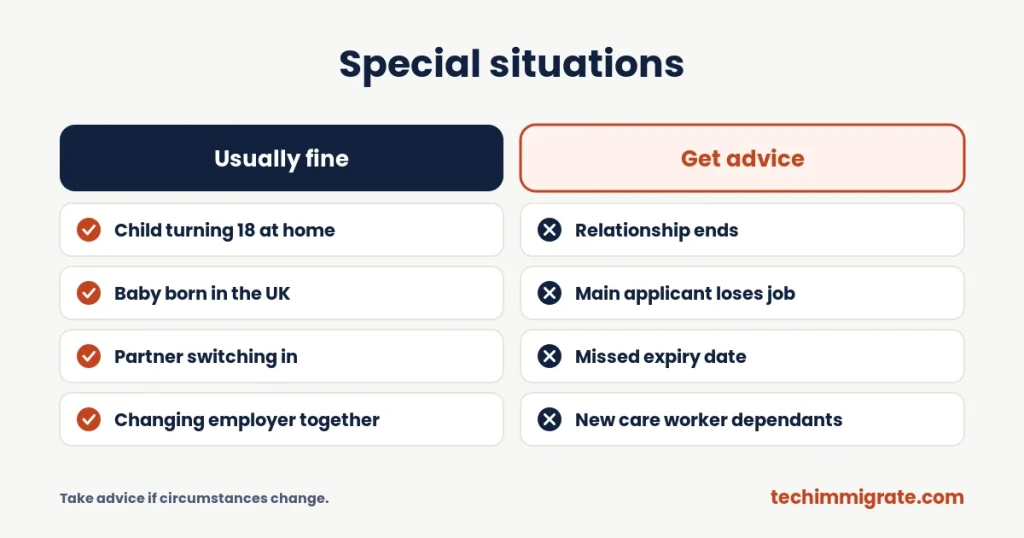
A baby born in the UK
A child born in the UK to a Skilled Worker is not automatically a British citizen, unless one parent is British or settled at the time of birth. The baby needs to apply for permission as a dependant, from inside the UK. There is no penalty for applying after birth, but it is best to apply promptly, especially before any international travel, because the baby will need permission to re-enter the UK.
A child turning 18
A child who was granted permission as your dependant before they turned 18 can usually continue to extend after 18, if they still live with you and are not leading an independent life. If they want to work full-time, study at university, or live away from home, they may still qualify, depending on the circumstances, but it is worth checking the rules before applying.
A partner who wants their own visa
Some partners prefer to switch to their own visa, such as Skilled Worker with their own sponsor, or Global Talent. This protects them if the main applicant's circumstances change. A partner can usually switch from inside the UK. If your partner works in tech and has a strong track record, the Global Talent eligibility guide is a good place to start.
The relationship ends
If the relationship breaks down, the partner can no longer extend as a dependant. They should take advice quickly, because their permission may be cut short. Options may include switching to their own work visa, or other routes depending on the circumstances.
The main applicant loses their job
If the main applicant's sponsorship ends, the Home Office will usually shorten the family's permission, typically to 60 days. The family can use that time to find a new sponsor, switch to another route, or prepare to leave. Dependants cannot extend independently on the strength of a main applicant whose sponsorship has ended.
Dependant Extensions and Settlement
Under the current rules, dependants of Skilled Workers can usually apply for indefinite leave to remain at the same time as the main applicant, once they have completed 5 years as a dependant, or later once they reach 5 years themselves. Each extension keeps their continuous time on the route intact.
Under the earned settlement reforms, partners who arrived with the main applicant may be able to settle on the same timeline, while partners who joined later may need to complete the same qualifying period separately. Children are expected to remain exempt from the income, English and Life in the UK requirements. Planning dependant extensions so that there are no gaps in anyone's permission is essential for settlement.
Our ILR requirements checklist explains the settlement requirements for main applicants and dependants.
A Worked Example: Extending Together
A machine learning engineer came to the UK in 2023 on a 3-year Skilled Worker visa, with her husband and their 7-year-old son. Her visa, and her family's, end in early 2026. Her employer offers a 3-year extension.
- She applies for her extension in late 2025.
- At the same time, she submits linked applications for her husband and son.
- Each pays £943 plus IHS for 3 years.
- All three applications are decided together, and the family's new visas end on the same date.
Because the family applied together, they avoided the risk of the dependants' permission ending before the main applicant's. When she reaches 5 years in 2028, they plan to apply for ILR together.
A Worked Example: A Partner Who Joined Later
A cloud engineer arrived in 2024. His partner joined in 2025 on a dependant visa ending on the same date as his. In 2027, he changes employer, and his new certificate runs for 5 years.
- He applies to update his permission with the new sponsor.
- His partner applies at the same time, to match the new end date.
- Because she has been in the UK for more than 12 months, she does not need to show maintenance funds.
Under the current rules, she would reach 5 years as a dependant later than he does. Under the reforms, her qualifying period may be calculated separately, so the couple keeps careful records of her dates.
Evidence of Living Together: What Works
Caseworkers want to see that you and your partner, and your children, live at the same address. Strong evidence usually comes from official or financial sources, dated across the period you are relying on. Good examples include:
- a joint tenancy agreement or mortgage statement;
- council tax bills showing both names, or one name and the address;
- bank or credit card statements for each adult, sent to the same address;
- utility bills, such as energy, water or broadband;
- GP registration letters or NHS correspondence;
- school letters for children, showing your home address.
Aim for documents from different sources and different dates, rather than several copies of the same type. If you moved house during the period, include evidence from both addresses. If one partner works away from home for long periods, for example on a long contract in another city, explain this in a short covering note and include evidence that you still share a main home.
Switching Into the Dependant Route From Another Visa
Sometimes a partner is already in the UK on a different visa, such as a Student or Graduate visa, and wants to switch to being a Skilled Worker dependant. This is usually possible from inside the UK, except from certain routes, such as visitor visas. Points to check:
- the main applicant must have, or be applying for, Skilled Worker permission;
- the partner must meet the relationship requirements;
- the fee and IHS are the same as for an extension;
- time spent on the Graduate or Student route does not count towards settlement on a work route, so the partner's settlement clock usually starts from the dependant grant.
Switching can make sense when the partner's current visa is about to expire or has more restrictive conditions. A Graduate visa, for example, cannot be extended, so moving to dependant status can provide continuity. Under the earned settlement reforms, time on Graduate, High Potential Individual and Student routes would not count towards settlement, which makes the timing of a switch worth thinking about.
Timing Strategy: When to Submit
The safest approach is to submit dependant applications at the same time as the main applicant's extension, and well before the earliest expiry date in the family. A few practical points help:
- Apply early, not late. You can usually apply up to 3 months before expiry. Applying 6 to 8 weeks before gives a buffer for appointments and document requests.
- Match the end dates. If the main applicant's new permission ends later than the dependants' current visas, apply for the dependants at the same time so that everyone's dates align.
- Book identity appointments for children with a parent. UKVCAS centres usually need a parent or guardian present.
- Avoid school holidays. If you are planning to travel abroad in the holidays, apply early enough to get decisions first, or postpone travel.
If one family member's visa is about to expire and the main applicant is not ready to extend, the dependant can apply on their own before their expiry date. Their new permission will usually be granted in line with the main applicant's current permission.
Common Mistakes
- Assuming dependants extend automatically. They never do.
- Missing a dependant's expiry date. Check every eVisa, not just the main applicant's.
- Travelling while applications are pending. Leaving the Common Travel Area withdraws the application.
- Forgetting UK-born children. A baby born in the UK needs their own application.
- Weak evidence of living together. Make sure documents show the same address for the period required.
- Not planning for settlement. Gaps in a dependant's permission can affect their path to ILR.
Planning Checklist
- Put every family member's visa expiry date in a shared calendar.
- Start planning extensions 6 months before the earliest date.
- Gather relationship and residence evidence early.
- Budget for each person's visa fee and IHS.
- Avoid international travel during the application window.
- Keep copies of every decision letter and eVisa record.
- Update each person's UKVI account if a passport is renewed, so that eVisa records stay linked to the right document.
- Generate a fresh share code for your partner's employer after each new grant, because employers must check right to work again when permission is renewed.
- Keep a simple spreadsheet of absences from the UK for every adult, because each person's continuous residence is assessed separately at settlement.
No. Each partner and child needs their own extension application before their visa expires.
£943 for up to 3 years or £1,865 for more than 3 years per person, plus IHS of £1,035 per year for adults and £776 per year for children.
Yes, as long as it is before their own visa expires. Most families apply together to keep dates aligned.
Yes, if they applied before their visa expired. They must stay in the Common Travel Area until a decision.
Usually yes, if they were granted permission before 18, still live with you and are not leading an independent life.
Yes, unless a parent is British or settled. Apply from inside the UK as a dependant.
Usually up to 8 weeks.
Keep Your Family's Status Aligned
The simplest way to avoid problems is to treat every family member's visa as its own deadline, and to apply together whenever the main applicant extends or changes employer. If you work in tech and want a route that gives your whole family more flexibility, Global Talent may be worth considering. Our role-specific Global Talent guides explain how to build a strong application.
How We Checked This Article
We checked dependant rules, fees and processing times against GOV.UK's Skilled Worker extension page, Skilled Worker partner and children page and costs page in November 2026. Settlement reforms are from law firm summaries of the earned settlement response of 2 November 2026.
Tech Immigrate is independent of the Home Office. This article is general information, not legal advice. Check GOV.UK before you apply.
We write practical guides for tech professionals applying for the UK Global Talent visa. Tech Immigrate is independent of Tech Nation and the Home Office, and our articles are general information, not legal advice. Rules and fees change, so always check gov.uk before you apply.


