Global Talent Peer Review Route: How It Works and Who It Suits
How the Global Talent visa peer review route works for researchers: endorsing bodies, letters, CV, timescales, and how it compares with Tech Nation.


In this article
- What "Peer Review" Means on the Global Talent Visa
- Who the Peer Review Route Suits
- Which Endorsing Body Would Assess You?
- What You Need to Submit
- How Exceptional Talent and Exceptional Promise Are Judged
- How Long the Peer Review Route Takes
- What It Costs
- Peer Review vs the Tech Nation Route
- Getting the UK Letter Right
- A Fictional Example: Dr Chen, a Machine Learning Researcher
- Preparing a Peer Review Application Step by Step
- Industrial Researchers: Special Considerations
- Common Mistakes on the Peer Review Route
- After Endorsement: Living and Settling in the UK
- How to Decide Which Route to Use
- Your Next Step
- How We Checked This Article
When people talk about the Global Talent visa "peer review" route, they usually mean the route for researchers and academics who do not have a qualifying job, fellowship, research grant or prize. Instead of being fast-tracked, their application is reviewed by experts at one of three national academies. For people working in technology research, this can be a real alternative to applying through Tech Nation, and it works very differently.
This guide explains how the peer review route works, who it suits, which endorsing body would assess you, what documents you need, how Exceptional Talent and Exceptional Promise are judged, and how it compares with the Tech Nation digital technology route. If you work in AI research, computer science, engineering or another research-heavy area of tech, it will help you decide which door to knock on.
Key takeaways
- The peer review route is part of the Global Talent visa for researchers and academics. It is used by people who do not qualify for the faster routes.
- Your application is reviewed by the Royal Society (science and medicine), the British Academy (humanities and social science) or the Royal Academy of Engineering (engineering and technology).
- You need a PhD or equivalent research experience and must be an active researcher, for example in a university, research institute or business.
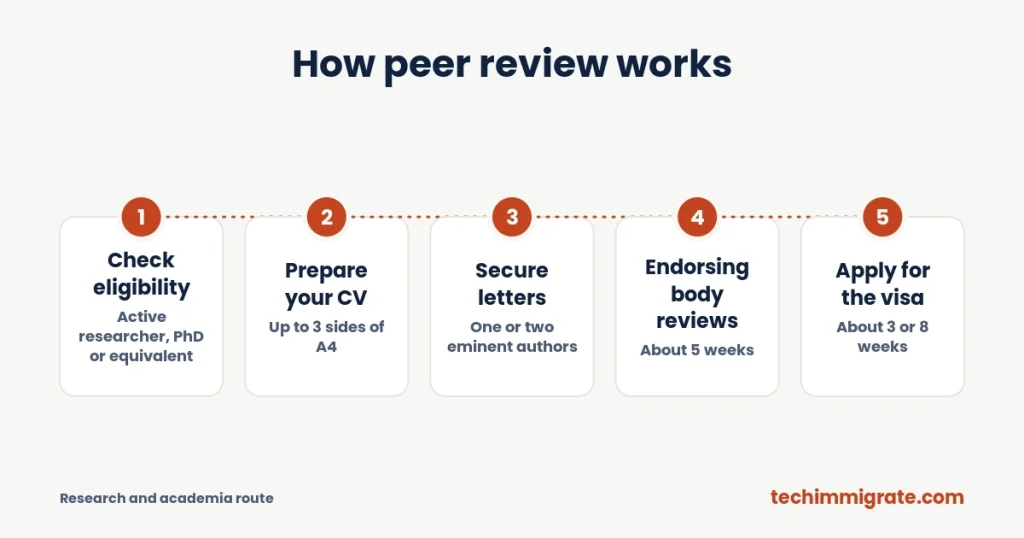
- Documents are fewer than on the Tech Nation route: a CV of up to 3 pages and one or two letters from eminent people, depending on your level.
- Endorsement decisions usually take about 5 weeks. The fees are the same as other Global Talent routes: £561 plus £205.
- Tech workers who are not active researchers usually belong on the Tech Nation route instead.
What "Peer Review" Means on the Global Talent Visa
Every Global Talent endorsement involves experts judging your work. But GOV.UK uses the phrase "peer review" for one specific path within the researcher and academic part of the visa.
Researchers and academics can be endorsed in several ways. If you have an eligible academic or research job, an individual fellowship, or a UKRI-approved research grant, you can use the fast-track routes, where decisions usually take about 2 weeks. If you have won an eligible prize, you can skip endorsement and apply for the visa directly. If none of these apply, you can still apply, but your application is peer reviewed by an endorsing body, and it takes longer.
So the peer review route is the standard, evidence-based path for researchers who do not have a ready-made qualifying role or award. It is the research equivalent of the Tech Nation assessment, but run by national academies rather than an industry body.
Who the Peer Review Route Suits
GOV.UK sets out the basic eligibility. You must:
- Work in an approved research discipline.
- Be an active researcher, for example in a university, research institute or business.
- Have a PhD or equivalent research experience, which can include industrial or clinical research.
- Show that you have exceptional talent or exceptional promise in your field.
You do not need a job offer. For Exceptional Promise, you must also be at an early stage of your career.
Tech professionals who often fit
- AI and machine learning researchers in universities, research labs or the research teams of tech companies.
- Computer scientists working on algorithms, systems, security or theory.
- Engineering researchers in robotics, semiconductors, communications, quantum or hardware.
- Industrial researchers with a PhD or equivalent experience who publish, patent or lead research projects in business.
Tech professionals who usually do not fit
- Software engineers, product managers or designers whose work is product development rather than research.
- People without a PhD or substantial equivalent research experience.
- People whose achievements are mainly commercial, such as revenue growth or product launches.
If you fall into the second group, the Tech Nation digital technology route is usually a better fit.
Which Endorsing Body Would Assess You?
The Home Office sends peer review applications to one of three endorsing bodies, depending on your field.
| Endorsing body | Fields |
|---|---|
| Royal Society | Science and medicine |
| British Academy | Humanities and social science |
| Royal Academy of Engineering | Engineering and technology |
For most tech researchers, the Royal Academy of Engineering or the Royal Society will be the relevant body. A machine learning researcher in a computer science department might go to either, depending on how the field is classified. The application form asks about your discipline, and the Home Office passes it to the appropriate body.
What You Need to Submit
One of the biggest differences from the Tech Nation route is the amount of material. The peer review route asks for a short, focused application.
Your CV
Your CV can be up to 3 single sides of A4, typed. It should outline your career and, where relevant, your publication history. For researchers, this means your key positions, publications, funding, prizes and other markers of standing in your field.
Letters of recommendation
This is where the route really differs.
- All applicants need one letter from an eminent person living in the UK who knows you and your work. The endorsing body must judge that they have internationally recognised expertise in your field. The letter must be written for this application and explain how they know you, why you show exceptional talent or promise, how you would benefit from being in the UK, how you would contribute, and your future plans.
- Exceptional Talent applicants also need a second letter from a different eminent person who is a senior member of a UK organisation. This person gives an objective assessment and does not need to know you personally. Their letter must explain how your work shows exceptional talent and how you would contribute to UK research and innovation, and must state that it is not influenced by personal knowledge of you.
Letters must be typed, dated and signed, be no more than 3 sides of A4 (excluding credentials and contact details), include the author's phone number and email, and come with the author's CV.
No other evidence at submission
GOV.UK says no other evidence is needed when you submit. That is a striking contrast with the Tech Nation route, where you choose up to 10 pieces of evidence. It means your CV and letters carry the whole case.
How Exceptional Talent and Exceptional Promise Are Judged
The endorsing body looks at different things depending on your level.
Exceptional Talent (a leader in your field)
- Whether you have won a prestigious prize or award.
- Whether you have secured significant funding for your work in the past 10 years.
- Whether you are regarded as a leader in your field.
Exceptional Promise (a potential future leader)
- Whether your application shows potential to become a future leader.
- How much extra funding you secured during or after a relevant fellowship.
- Whether you have won a relevant prize for early career researchers.
- How significant your contribution is, relative to your career stage.
The pattern is clear. Funding, prizes and standing in the research community are the main signals. This suits academics and research scientists far better than product-focused tech workers.
How Long the Peer Review Route Takes
GOV.UK says peer review endorsement decisions usually take about 5 weeks. That is longer than the fast-track routes (about 2 weeks) but generally in line with, or quicker than, many reports of the Tech Nation route.
After endorsement, the visa stage is the same as for every Global Talent applicant: usually about 3 weeks if you apply from outside the UK, and about 8 weeks from inside the UK. You may be able to pay for a faster visa decision.
A realistic total, from finishing your letters to holding the visa, is about 2 to 4 months. Securing the right letters can take longer than the assessment itself, so start early.
What It Costs
The fees are the same as for other Global Talent routes:
- Endorsement: £561.
- Visa: £205.
- Total for the main applicant: £766.
- Immigration Health Surcharge: usually £1,035 per year for an adult.
Each dependant pays £766 plus their own surcharge. If you are refused, you can request an endorsement review.
Peer Review vs the Tech Nation Route
Many tech professionals with research backgrounds could, in principle, apply through either the peer review route or the Tech Nation digital technology route. The two are quite different.
| Feature | Peer review (research) | Tech Nation (digital technology) |
|---|---|---|
| Who assesses | Royal Society, British Academy or Royal Academy of Engineering | Tech Nation |
| Core requirement | Active researcher with a PhD or equivalent | Leader or emerging leader in digital technology |
| Evidence | CV and one or two letters | Up to 10 pieces of evidence, three letters, statement and CV |
| Letters | From eminent people, one based in the UK | Three from established figures in digital technology |
| Main signals | Prizes, funding, standing in research | Innovation, impact, recognition beyond your employer |
| Typical decision time | About 5 weeks | Several weeks, often reported at 5 to 8 weeks |
| Fees | £561 + £205 | £561 + £205 |
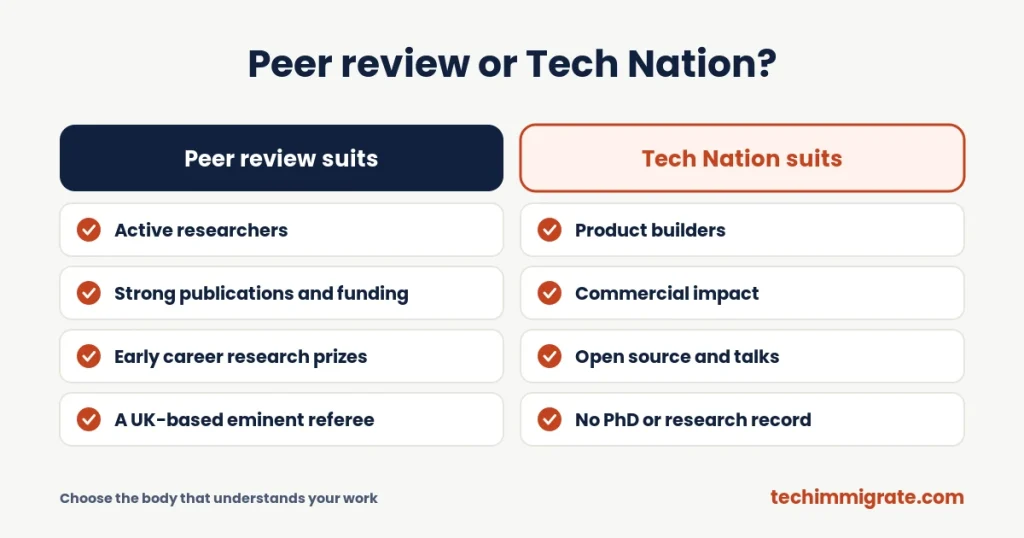
When peer review is likely to suit you better
- You are an active researcher with a strong publication and funding record.
- You know an eminent UK-based researcher who can write a detailed letter about your work.
- Your achievements are measured in academic terms rather than commercial ones.
When Tech Nation is likely to suit you better
- Your work is building products, not publishing research.
- Your achievements are commercial or technical, such as products shipped, users won or open source adoption.
- You do not have a PhD or equivalent research experience.
If you are in industrial research, such as an AI lab within a tech company, the choice can be genuinely close. Think about which body would understand your achievements best, and which set of evidence you can make strongest.
Getting the UK Letter Right
The letter from an eminent person living in the UK is the heart of a peer review application, and it is often the hardest part to secure.
Who counts as eminent
The endorsing body must judge that the author has internationally recognised expertise in your field. In practice, this usually means a senior academic, such as a professor or head of a research group, or a senior research leader in industry, with a strong record of their own. The author's CV, which you submit with the letter, is how the endorsing body checks this.
What a strong letter includes
- How the author knows you and your work, and for how long.
- Specific examples of your research and why it matters.
- A clear statement of why you show exceptional talent or promise, compared with others at your stage.
- How being in the UK would benefit your work, and how you would contribute to UK research.
- Your future plans, in enough detail to be credible.
Common problems with letters
- Generic praise without specific examples.
- Authors whose standing is not clear from their CV.
- Letters that are not tailored to this application.
- Missing contact details, signature or the author's CV.
- A second letter for Exceptional Talent that does not include the required statement about not being influenced by personal knowledge.
A Fictional Example: Dr Chen, a Machine Learning Researcher
Dr Chen has a PhD in computer science and 4 years of postdoctoral research experience at a university outside the UK. She has published at leading machine learning conferences, won an early career award from a respected society, and secured funding for a follow-on project after her fellowship. She does not yet have a UK job offer.
She applies under Exceptional Promise through the peer review route. Her CV summarises her positions, publications, funding and award on 3 pages. Her letter comes from a UK-based professor who co-authored one of her papers and has followed her work closely. The endorsing body judges the application against the Promise criteria, focusing on her funding, early career prize and the significance of her contribution for her career stage.
This example is fictional and simplified. Every application is assessed on its own merits.
Preparing a Peer Review Application Step by Step
Because the application is short, every part of it has to work hard. This order of work helps.
- Step 1: confirm the route. Check whether you have an eligible job, fellowship, UKRI-approved grant or prize. If you do, a faster route may be open to you. If not, peer review is the path.
- Step 2: choose your level. Look honestly at the Exceptional Talent and Exceptional Promise criteria. If you have significant funding over the last 10 years, a prestigious prize and clear standing as a leader, Talent may fit. If you are earlier in your career, Promise is usually right.
- Step 3: identify your letter writers. You need one eminent UK-based person who knows your work, and for Talent a second senior person at a UK organisation. Make a short list and approach them early.
- Step 4: brief your writers. Give each writer a summary of your key work, your funding and prizes, and your plans for the UK. Remind them of the content and format rules, including length, signature, contact details and their own CV.
- Step 5: write your CV. Use your 3 pages for the things the endorsing body looks for: funding, prizes, publications, research leadership and the significance of your contribution.
- Step 6: check everything against GOV.UK. Make sure every document meets the format rules before you submit, because a missing signature or CV can weaken an otherwise strong case.
Give yourself at least 6 to 8 weeks for this work. Senior academics are busy, and a rushed letter is rarely a strong one.
Industrial Researchers: Special Considerations
The peer review route is not only for university staff. GOV.UK says you can be an active researcher in a business, and that equivalent research experience can include industrial research. This matters for tech professionals working in corporate research labs, applied AI teams or deep tech start-ups.
If you are an industrial researcher, think carefully about how your record will read to an academy. Publications, patents, funded projects and recognition from the research community translate well. Commercial outcomes, such as revenue or product adoption, may be less familiar to the assessors, so explain their research significance rather than their business value.
Your UK letter writer also matters. A professor who has collaborated with your lab, or a senior industrial research leader with a strong public record, can speak to your work in terms the endorsing body understands. If your strongest achievements are commercial rather than scientific, compare this route carefully with the Tech Nation route before you decide.
Whichever route you choose, keep records of your research, funding and recognition as you go. They will help with any future extension or settlement application, and with a new endorsement if you later move between levels.
Common Mistakes on the Peer Review Route
- Applying through peer review without research credentials. If you are not an active researcher with a PhD or equivalent, you are unlikely to meet the basic eligibility.
- Treating the CV as a job history. It should highlight publications, funding, prizes and research leadership.
- Choosing a letter writer for their title alone. They must know your work and be able to speak to it in detail.
- Forgetting the second letter for Exceptional Talent. It must come from a different eminent person who is a senior member of a UK organisation.
- Overlooking faster routes. If you have an eligible job, fellowship or UKRI-approved grant, the fast-track route is quicker.
- Not considering the Tech Nation route. If your strongest achievements are commercial, that route may present them better.
After Endorsement: Living and Settling in the UK
Once endorsed, the visa itself is the same as every other Global Talent visa. You can work for any employer, change jobs freely, be self-employed, combine research with industry work and bring your family. You can be granted up to 5 years at a time and extend as often as you like.
Under the current rules, people endorsed by the Royal Society, the British Academy, the Royal Academy of Engineering or UKRI can generally apply to settle after 3 years, whether they were endorsed under Exceptional Talent or Exceptional Promise, if they meet the other settlement requirements. This is a real advantage over the Tech Nation route, where Exceptional Promise holders currently wait 5 years. The earned settlement reforms announced on 2 November 2026 will change settlement across most routes from 2027, although talent routes are expected to keep a short path. Check GOV.UK for the details before you plan around a specific date.
How to Decide Which Route to Use
If you are a tech professional with a research background, ask yourself these questions.
- Do I hold a PhD or have equivalent research experience?
- Am I currently an active researcher, in academia or business?
- Are my strongest achievements publications, funding and prizes?
- Do I know an eminent UK-based researcher who knows my work well?
- Do I have an eligible job, fellowship or grant that would allow a fast-track application?
If you answered yes to the first four, the peer review route is worth serious consideration. If you answered yes to the last, the fast-track route may be quicker still. If your answers were mostly no, the Tech Nation route is probably where you belong.
It is the path for researchers and academics who do not have a qualifying job, fellowship, grant or prize. Their application is reviewed by the Royal Society, British Academy or Royal Academy of Engineering.
Endorsement decisions usually take about 5 weeks, according to GOV.UK.
One letter from an eminent UK-based person for all applicants, plus a second letter from a senior member of a UK organisation for Exceptional Talent.
You need a PhD or equivalent research experience, which can include industrial or clinical research.
Usually not, unless they are active researchers with a PhD or equivalent experience. Most software engineers apply through Tech Nation.
No. The fees are £561 for endorsement and £205 for the visa, the same as other Global Talent routes.
Your Next Step
If you are a tech researcher, start by deciding which route presents your achievements best. Our Global Talent visa routes article compares every path, and our guide for PhD students and researchers goes deeper on research applicants. If the Tech Nation route fits you better, our role-specific Global Talent guides, including our guide for tech researchers, show what strong evidence looks like in practice.
How We Checked This Article
We checked the peer review route against GOV.UK's Global Talent researcher and academic pages and the peer review page, and the fees against GOV.UK's fee tables, in November 2026. Settlement reforms are from summaries of the earned settlement response of 2 November 2026.
Tech Immigrate is independent of the Home Office and the endorsing bodies. This article is general information, not legal advice. Check GOV.UK before you apply.
We write practical guides for tech professionals applying for the UK Global Talent visa. Tech Immigrate is independent of Tech Nation and the Home Office, and our articles are general information, not legal advice. Rules and fees change, so always check gov.uk before you apply.