
How to Extend Your Global Talent Visa (and When You Should Settle Instead)
How to extend a Global Talent visa: the earned money test, evidence that works, fees, timing, and when applying for ILR is the better option.


In this article
- Who Can Extend a Global Talent Visa?
- The Earned Money Requirement
- How to Extend: Step by Step
- What It Costs to Extend
- Choosing How Long to Extend For
- Founders and Freelancers: Make Earnings Easy to Read
- Changing Jobs, Gaps and Career Breaks
- Extend or Settle? How to Decide
- Extending for Exceptional Promise Holders
- Extending When Your Family Is on a Different Clock
- Your Settlement Clock Keeps Running
- When Extension Is Refused
- A Simple Extension Checklist
- Frequently Asked Questions
- Plan Your Route From the Start
- How We Checked This Article
Your Global Talent visa can last up to 5 years, and you can extend it as many times as you like while you still meet the requirements. But extending is not always the best move. If you are close to qualifying for indefinite leave to remain (ILR), settling may cost less over time and end your visa applications for good. If you are not yet eligible, or something has broken your continuous residence, an extension keeps you in the UK while you get there.
This guide explains how to extend a Global Talent visa, what the Home Office checks, the earnings evidence you need, what it costs, and how to decide between extending and settling. It also covers the situations where extension is the only option, such as Exceptional Promise holders before 5 years, people with too many absences, and families whose dependants are on a different settlement clock.
Key takeaways
- You can extend your Global Talent visa if your endorsement or prize has not been withdrawn. Each extension can be for 1 to 5 years, and there is no limit on the number of extensions.
- You must show you have earned money in your expert field while in the UK. The caseworker guidance sets no minimum amount and no fixed list of documents.
- The fee is £766 per person, plus the Immigration Health Surcharge of £1,035 for each year.
- Apply before your current visa expires. Decisions usually take about 8 weeks. Do not travel outside the UK, Ireland, the Channel Islands or the Isle of Man while you wait, or your application will be withdrawn.
- Partners and children apply separately, at the same time or before their own visas expire.
- If you already qualify for ILR, settling is usually better value than extending. Check your dates before you pay for an extension.
Who Can Extend a Global Talent Visa?
GOV.UK says you can usually extend if:
- you got your Global Talent visa through an endorsement that has not been withdrawn, or through an eligible prestigious prize that has not been withdrawn; and
- you apply before your current visa expires.
People who hold the older Tier 1 (Exceptional Talent) visa can also extend under Global Talent.
You do not need a new endorsement to extend. Tech Nation does not reassess your talent at extension. The Home Office checks that your endorsement still stands, that you have earned money in your field, and that you meet the general suitability rules.
The Earned Money Requirement
The central requirement for extension is that you have earned money in your expert field while in the UK.
The Home Office caseworker guidance (version 19.0, August 2026) gives three important points about this test:
- There is no minimum amount. You do not need to earn a set salary.
- There is no specified list of documents. GOV.UK gives payslips as an example, but other evidence can be used.
- The evidence must be independent and verifiable. A caseworker must be able to trust it and check it.
The guidance also allows caseworkers to give you a chance to fix weak evidence before refusing, but do not rely on that. Send clear evidence from the start.
What "in your expert field" means
You must have earned money from work in the field you were endorsed in. For Tech Nation holders, that means digital technology. If you were endorsed as a software engineer and moved into product management or engineering leadership, that is still digital technology. If you moved into an unrelated field, extension becomes harder, and you should explain the connection carefully or take advice.
Evidence applicants use
These examples come from the Tech Nation Visa Forum and our reading of the caseworker guidance. They are applicant-reported, not an official list.
| Your situation | Evidence applicants report using |
|---|---|
| Employed by a UK company | Payslips, P60s, an employer letter confirming your role and pay |
| Employed remotely by an overseas company while living in the UK | Contract, payslips, bank statements showing salary received, UK tax records |
| Freelance or contractor | Invoices, contracts, bank statements, SA302 tax calculations, tax year overviews |
| Running your own company | Company accounts, payroll records, dividend records, Companies House filings, an accountant's letter |
| Academic or research role in tech | Employment letter, payslips, grant letters |
The best evidence shows three things at once: that you were paid, that the work was in digital technology, and that it happened while you were in the UK.
How to Extend: Step by Step
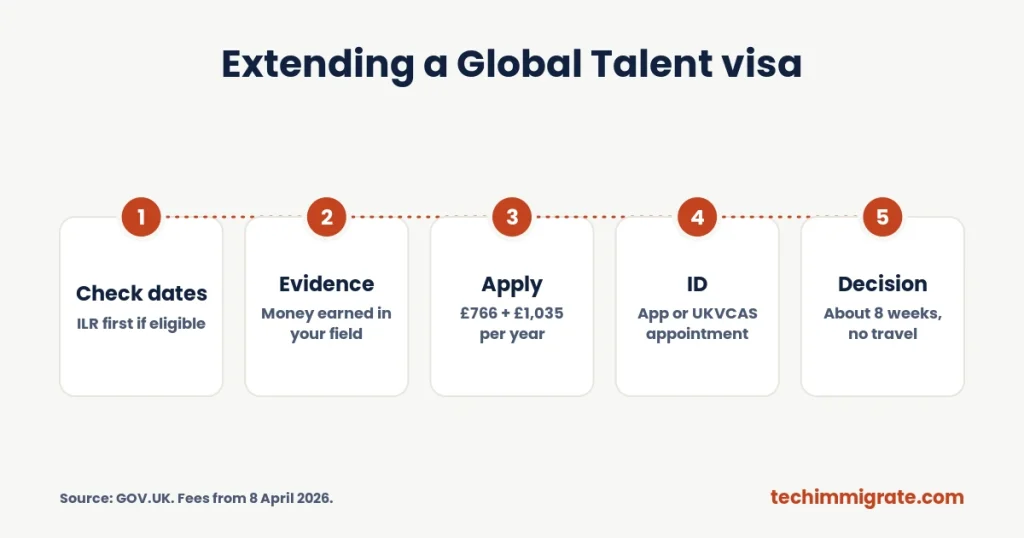
- Check your dates. Work out when your current visa expires and whether you already qualify for ILR. If you do, read the section on extending versus settling below before you start.
- Gather earnings evidence for your current period of permission.
- Decide how long to extend for. You can choose 1 to 5 years.
- Apply online on GOV.UK. You can save the form and finish it later.
- Pay £766 plus the health surcharge for each year of the new visa.
- Prove your identity, either through the UK Immigration: ID Check app or at a UK Visa and Citizenship Application Services appointment. The application tells you which.
- Upload or submit your documents as instructed.
- Wait for a decision. GOV.UK says this usually takes about 8 weeks from your application date. You may be able to pay for a faster decision; you will be told if this is available.
Do not travel while you wait
GOV.UK is clear: you must not travel outside the UK, Ireland, the Channel Islands or the Isle of Man until you get a decision, or your application will be withdrawn. Plan your extension around any trips abroad. If you need to travel urgently, take advice before you go.
Your rights while you wait
If you apply before your current visa expires, you can usually stay in the UK on the same conditions while your application is decided. Keep your application confirmation, because employers may need it to check your right to work.
Extending from outside the UK
GOV.UK says you can apply online from outside the UK if you have held a Global Talent visa in the last year. You can also apply at a visa application centre in a country where you have been allowed to live for at least 6 months. This is useful if your visa expires while you are abroad, but a gap outside the UK can affect continuous residence for settlement, so think about the timing.
What It Costs to Extend
| Cost | Main applicant | Each dependant |
|---|---|---|
| Extension fee | £766 | £766 |
| Immigration Health Surcharge | £1,035 per year | £1,035 per year |
| Identity appointment | Free | Free |
A 5-year extension for one person costs £766 + £5,175 = £5,941. A family of four extending for 2 years pays 4 × £766 + 4 × 2 × £1,035 = £11,344.
Compare that with indefinite leave to remain at £3,226 per person, with no health surcharge. That gap is why timing matters so much.
Choosing How Long to Extend For
Because you choose the length of each extension, it is worth thinking about the trade-off rather than picking 5 years by default.
A shorter extension costs less up front. If you are close to qualifying for ILR, for example an Exceptional Promise holder at 4 years, a 1 or 2-year extension may be all you need. The risk is that if your settlement application is delayed or refused, you may need yet another extension, with another fee.
A longer extension costs more in health surcharge up front but gives you a buffer. It suits people who are not sure when they will be able to settle: for example, because they expect to spend long periods abroad for work, are waiting to pass an English test, or are uncertain about the 2027 settlement changes.
A practical rule many applicants follow is to extend for at least the time needed to reach ILR, plus a margin of several months. Remember that the health surcharge for unused time may be partly refundable if you get ILR before your visa expires, but check the current rules rather than assuming a refund.
Also check your passport. Your visa will not be tied to your passport's expiry date in the same way as older physical visas, because your status is held as an eVisa, but you must keep your UKVI account updated with your current passport.
Founders and Freelancers: Make Earnings Easy to Read
Employees can usually show earnings with a few payslips and a P60. If you run your own company or work for yourself, the caseworker has to piece together your income from several documents. Make it easy.
- Write a short cover note listing each document and what it shows, in the order you submit them.
- Link the money to the work. Pair invoices or contracts that describe digital technology work with the bank statements showing payment.
- Use tax records. SA302 tax calculations and tax year overviews from HMRC are independent and verifiable, which is exactly what the guidance asks for.
- Get an accountant's letter confirming your income from the company and the nature of the business, if you pay yourself through dividends.
- Keep filings up to date. Late company accounts or tax returns make your evidence look weaker and can raise questions.
If your company has not paid you much because you have reinvested in growth, explain that and show what you did receive. The current rules set no minimum, but you still need to show you earned money in your field.
Changing Jobs, Gaps and Career Breaks
The Global Talent visa is not tied to an employer, so changing jobs during your permission is not a problem in itself. At extension, you show earnings in your field across your permission, which can include several employers, freelance work or a company of your own.
Gaps in work are also allowed. Parental leave, illness, caring responsibilities or a few months between roles do not, on their own, prevent extension. What matters is that you can show you have earned money in your field while in the UK. If there was a long gap, add a short explanation with supporting evidence.
If you have spent long periods abroad, extension may still be possible, but those absences can affect your future ILR application because of the 180-day rule. Keep a travel log throughout.
Extend or Settle? How to Decide
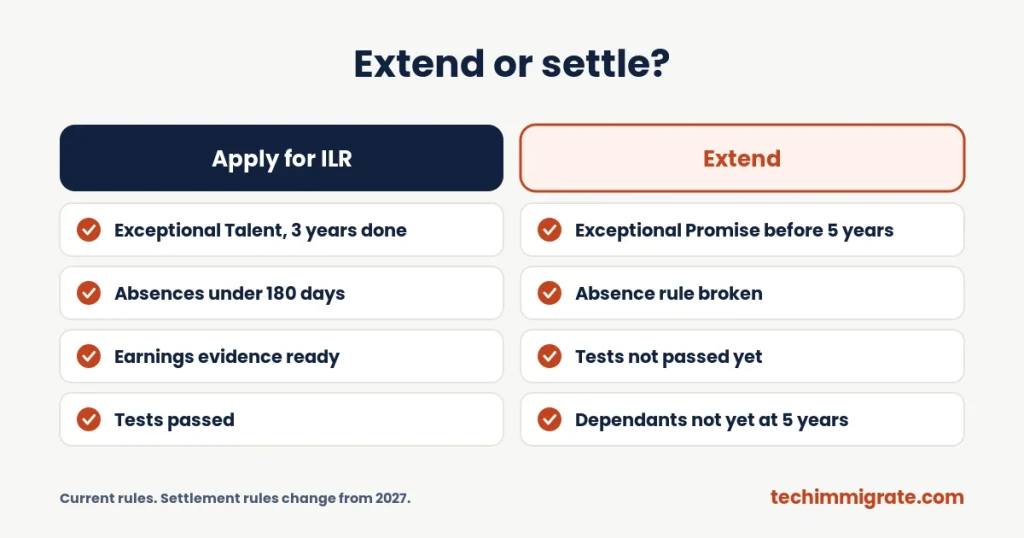
If you are already eligible for ILR, settling is usually the better choice:
- ILR costs less over time. One ILR fee replaces repeated extension fees and health surcharge payments.
- ILR is permanent. No more extension applications, earnings evidence or expiry dates.
- ILR leads to citizenship. Most people can apply to naturalise 12 months after ILR.
But there are situations where extending makes sense or is necessary:
| Situation | Usually best option |
|---|---|
| Exceptional Talent, 3 years done, absences fine, earnings evidence ready | Apply for ILR |
| Exceptional Promise, fewer than 5 years | Extend until 5 years |
| Too many absences in a 12-month window | Extend, then settle once you have a clean qualifying period |
| Not yet passed Life in the UK or English requirement | Extend if your visa is about to expire, then settle |
| Weak earnings evidence for the full period | Consider extending while you build clear evidence |
| Partner or children need 5 years but you can settle at 3 | You settle; your dependants extend |
Can you apply for ILR before your visa ends?
Yes. You do not need to wait until your visa expires. Many people on 5-year visas apply for ILR as soon as they reach 3 years. If you apply for ILR while your visa still has time left, you may be able to claim a partial refund of the health surcharge for the unused period once ILR is granted. Check the current refund rules on GOV.UK.
Settlement is changing
The government's response to the earned settlement consultation, published on 2 November 2026, keeps a 3-year path for a "Highest Talent Group" expected to include Global Talent, subject to Migration Advisory Committee advice. It also adds new mandatory requirements for everyone, such as English at B2, no debts to public bodies and a record of sustained earnings. Changes are due to be laid from the December immigration rules and implemented over 2027. If you are eligible for ILR under the current rules, applying sooner rather than later removes uncertainty. Our article on Global Talent ILR explains settlement in detail.
Extending for Exceptional Promise Holders
If you were endorsed as Exceptional Promise by Tech Nation, you need 5 years for ILR under the current rules. If you started on a 3-year visa, you will need to extend at least once.
Two strategies are common:
- Extend for 2 years to reach exactly 5 years, then apply for ILR. This keeps up-front costs lower.
- Extend for longer to give yourself a margin if something delays your settlement application, such as absences or a gap in earnings evidence. You pay more health surcharge up front but may be able to claim some back if you get ILR early.
Some Exceptional Promise holders who have grown into leaders apply for a new endorsement as Exceptional Talent. That is a new Stage 1 application with new evidence, not an extension. It can shorten the path to ILR, but it carries the usual endorsement risk.
Extending When Your Family Is on a Different Clock
Under the current rules, partners and children usually need 5 years to settle as dependants, even if the main applicant settles after 3. A family on the Tech Nation Visa Forum described settling the main applicant at 3 years and then extending the partner and children for the remaining period, with another round of health surcharge payments.
If your dependants still need time, they apply to extend separately, using your application details, before their current visas expire. Plan this alongside your own ILR application so nobody's permission lapses. Our article on Global Talent dependants explains the family rules.
Your Settlement Clock Keeps Running
A common worry is that extending resets the clock towards settlement. It does not. As long as each new grant of permission starts before the previous one ends, your continuous residence carries on. An Exceptional Talent holder who extends at 2 years, for example, can still apply for ILR at 3 years.
What does break continuous residence is a gap in your permission, or spending more than 180 days outside the UK in any 12-month period. That is why applying in time matters so much. If your visa expires before you apply, even by a day, the consequences for settlement can be serious, and you may need advice on whether the gap can be disregarded.
The same applies to your family. Each dependant's continuous residence depends on their own permission and absences, so their extensions must also be made in time.
When Extension Is Refused
Extension refusals are less common than endorsement refusals, but they happen. The main reasons applicants report:
- Weak or missing earnings evidence, especially for founders and freelancers.
- Work outside the endorsed field, with no explanation of the link.
- Applying after the visa expired. Late applications create serious problems.
- Endorsement withdrawn. Rare, but it blocks extension.
- Suitability issues, such as unpaid NHS debts or criminality.
- Travelling while the application was pending, which withdraws it.
If you are refused, the decision letter explains why and whether you can request an administrative review. Check the deadline and take advice quickly, especially if your permission is about to run out.
A Simple Extension Checklist
- Current visa expiry date checked, and application planned well before it.
- ILR eligibility checked first.
- Earnings evidence for your current permission: payslips, P60s, tax records or accounts.
- Evidence that the work was in digital technology.
- Passport valid for the period you want.
- Fee and health surcharge budget for you and your family.
- No travel planned during the 8-week decision period.
- Dependants' applications planned at the same time.
Frequently Asked Questions
Apply online on GOV.UK before your visa expires, pay £766 plus the health surcharge, prove your identity and send evidence that you have earned money in your expert field in the UK.
No. You need an endorsement that has not been withdrawn. Tech Nation does not reassess you at extension.
No. The caseworker guidance sets no minimum amount, but you must show you earned money in your field with independent, verifiable evidence.
Up to 5 years at a time, with no limit on the number of extensions.
Usually about 8 weeks from your application date. You may be able to pay for a faster decision.
No. If you travel outside the UK, Ireland, the Channel Islands or the Isle of Man before a decision, your application will be withdrawn.
If you already qualify for ILR, settling is usually better value and permanent. Extend if you do not yet qualify, for example as an Exceptional Promise holder before 5 years, or if your absences or evidence are not ready.
Yes. They apply separately, at the same time as you or before their own visas expire, and each pays £766 plus the health surcharge.
Plan Your Route From the Start
Every extension costs time and money, and every application carries some risk. Planning your settlement date from the day your first visa is granted, and keeping earnings and travel records as you go, makes each later step straightforward. The cheapest Global Talent journey is the one with the fewest extensions. That starts with the right endorsement: Exceptional Talent settles 2 years sooner than Exceptional Promise. Our role-specific Global Talent guides explain what Tech Nation looks for at each level, so you can aim for the endorsement your evidence supports.
How We Checked This Article
We checked the rules against GOV.UK's page on extending a Global Talent visa, Appendix Global Talent and the Home Office Global Talent caseworker guidance (version 19.0, 3 August 2026), in November 2026. Fees come from the Home Office fee schedule in force from 8 April 2026. The settlement reform section draws on the government's response to the earned settlement consultation (2 November 2026). Evidence examples and the family case come from Tech Nation Visa Forum threads, including extension earnings evidence and the 3-year dependant paradox. Forum material is applicant-reported, not official guidance.
Tech Immigrate is independent of Tech Nation and the Home Office. This article is general information, not legal advice. Check GOV.UK before you apply.
We write practical guides for tech professionals applying for the UK Global Talent visa. Tech Immigrate is independent of Tech Nation and the Home Office, and our articles are general information, not legal advice. Rules and fees change, so always check gov.uk before you apply.


