What Counts as Digital Technology for the Global Talent Visa?
What counts as digital technology for the Global Talent visa: technical vs business applicants, product-led companies, excluded roles and grey areas.


In this article
- Why the Definition Matters So Much
- Technical vs Business Applicants
- What "Product-Led" Means
- Roles Usually Not Considered Suitable
- Common Roles and How They Usually Fit
- The Grey Areas
- How to Frame Your Work So It Fits
- Fictional Examples
- Questions to Ask Yourself Before You Start
- If Your Work Does Not Fit Digital Technology
- What Tech Nation Looks for Once You Fit
- Industry by Industry: Where Tech Work Usually Fits
- Evidence That Shows You Are in the Sector
- Moving Into Product-Led Work to Become Eligible
- Common Mistakes
- Your Next Step
- How We Checked This Article
The Global Talent visa has a field called digital technology, and Tech Nation is the body that assesses it. That sounds simple until you try to work out whether your own job counts. Is a data engineer at a bank in digital technology? What about a product manager at an IT consultancy, a growth marketer at a fintech, a hardware engineer, or a solutions architect at a large software reseller? Many applications fail not because the applicant lacks talent, but because their work does not fit Tech Nation's idea of the digital technology sector, or because they present it in a way that makes it look like it does not.
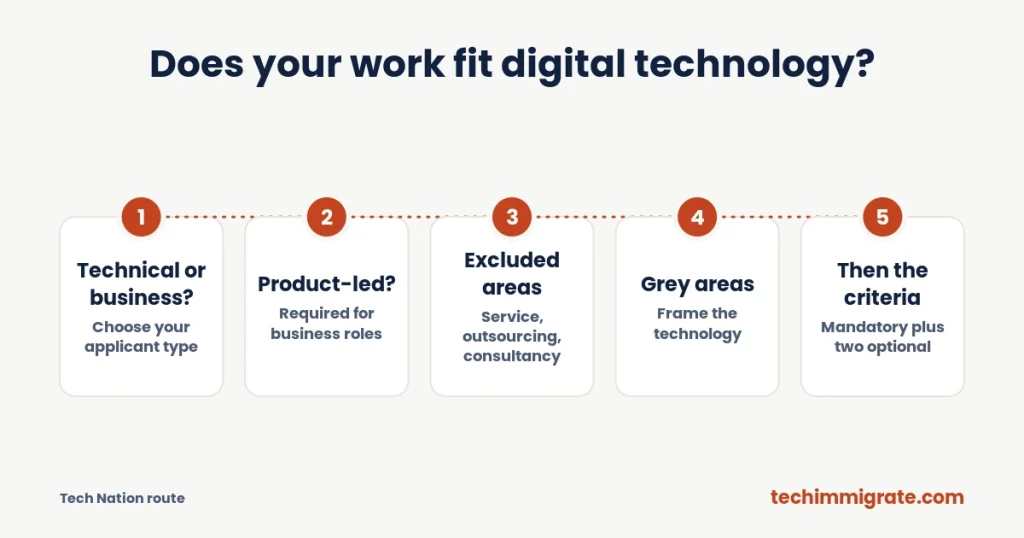
This guide explains what digital technology means for the Global Talent visa. It covers the difference between technical and business applicants, what "product-led" means, which kinds of companies and roles fit well, which are usually excluded, and how to handle the grey areas. It is the question to answer before you spend months building evidence.
Key takeaways
- The digital technology route is for people with technical or business skills in the digital technology sector, assessed by Tech Nation.
- Technical applicants, such as engineers and data scientists, can come from both tech and non-tech organisations.
- Business applicants, such as product managers, commercial leads and investors, must show their work is in product-led digital technology companies.
- Legal guidance summarising Tech Nation's criteria describes the sector as businesses whose main revenue comes from a proprietary digital product, platform, service or hardware.
- Service delivery, outsourcing, consultancy, ERP consultancy, systems administration and IT support are generally not considered suitable.
- If you sit in a grey area, the way you frame your role and evidence can decide whether it fits.
Why the Definition Matters So Much
Tech Nation's mandatory criterion asks you to show that you are recognised as a leading talent, or as having the potential to be one, in the digital technology sector. If your work is not in that sector, your evidence may not count, however impressive it is. A brilliant consultant or IT operations leader can be refused simply because the assessors do not see their work as digital technology in the sense the route intends.
The definition also shapes which evidence carries weight. For a technical applicant, adoption of a tool or library by other engineers might be strong evidence. For a business applicant, growing a product-led company's revenue might be. Knowing which type of applicant you are helps you choose evidence that speaks to the right criteria.
Technical vs Business Applicants
Tech Nation considers applicants with either technical or business skills. The two are assessed against the same criteria, but they are expected to show different kinds of achievement.
Technical applicants
Technical applicants work hands-on with technology. GOV.UK's published list of skills covered by Tech Nation includes, among others:
- Software engineers and developers, including principal and senior engineers.
- DevOps and SysOps engineers.
- Data scientists and data engineers.
- Artificial intelligence, natural language processing and machine learning experts.
- Cyber security experts.
- Hardware engineers.
- Front-end developers.
- Operating systems engineers.
- Video game developers.
- User experience and user interface designers.
- Mobile app developers.
- Back-end developers.
- Virtual and augmented reality developers.
- CTOs and VPs of engineering.
Importantly, technical applicants do not have to work at a tech company. A machine learning engineer at a bank or a retailer can apply, as long as their own work is in digital technology and they can show the required recognition and impact.
Business applicants
Business applicants bring tech products to market and grow tech companies. The published list includes experience such as:
- Commercial or business leadership (P&L, growth, sales and distribution strategy) in a digital business.
- Expanding or growing a significant product-led digital technology business.
- Sector-specific experience, such as payments or infrastructure.
- Leading substantial venture capital investment in digital technology.
- Experienced product management.
- Solution sales experience in a product-led digital technology company.
The key difference is that business skills only count when applied in-house at product-led digital technology companies. A product manager at a SaaS company fits. A business analyst at a consultancy that implements other companies' software usually does not.
What "Product-Led" Means
Product-led is the phrase that decides many applications. Legal guidance summarising Tech Nation's criteria describes the digital technology sector as businesses whose primary source of revenue is a proprietary digital product, service, platform or hardware.
In practice, that means the company builds and owns its technology and earns most of its money from it. Examples include:
- A SaaS company selling its own software.
- A fintech running its own payments platform.
- A marketplace or consumer app built on its own technology.
- A deep tech start-up developing its own AI models or hardware.
- A games studio building its own games.
Companies that are not usually seen as product-led include:
- IT outsourcing and managed service providers.
- Consultancies, including technology and management consultancies.
- Agencies that build software or run marketing for clients.
- Resellers and implementation partners for other companies' software.
- Non-tech companies whose core business is something else, such as retail, banking or manufacturing, for business applicants.
Roles Usually Not Considered Suitable
Published guidance and legal summaries of Tech Nation's criteria list several types of work that are generally not considered suitable for endorsement under digital technology.
- Service delivery and process delivery, where the focus is on running or delivering services rather than building products.
- Outsourcing, including roles at outsourcing providers.
- Consultancy, whether technical or management, including ERP consultancy.
- Systems administration and related fields.
- IT support and infrastructure management, which Tech Nation's own website describes as insufficient to show the required impact and recognition.
- Corporate roles managing large corporate teams, where the achievement is managerial scale rather than technology leadership.
- Junior investors and analysts, as opposed to people leading significant investments.
- Business roles at agencies, outsourcers or marketing firms, rather than at product-led tech companies.
This does not mean people in these roles can never be endorsed. Some build innovative products inside a services company, or move into product-led work, and can present that work as their core evidence. But if your main achievements are delivering projects for clients, the route is likely to be a difficult fit.
Common Roles and How They Usually Fit
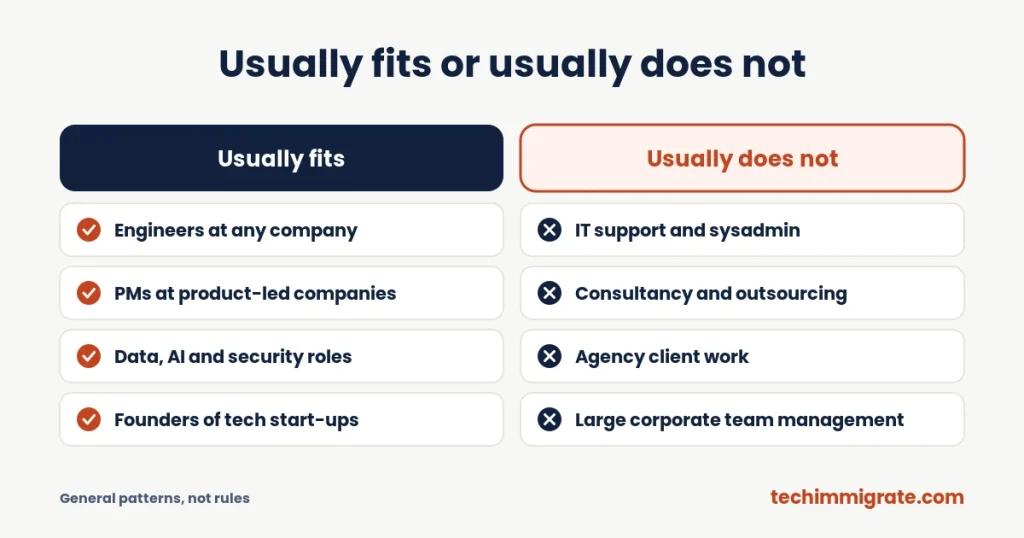
| Role | Usual fit | What decides it |
|---|---|---|
| Software engineer at a SaaS company | Strong | Recognition and impact |
| Machine learning engineer at a bank | Good (technical) | Own technical work, recognition beyond employer |
| Product manager at a product-led tech company | Good (business) | Products owned and their results |
| Product manager at an IT consultancy | Weak | Usually seen as service delivery |
| Growth marketer at a fintech | Possible (business) | Product-led company, personal impact on growth |
| Marketer at a marketing agency | Weak | Agency work for clients |
| Cyber security engineer | Good (technical) | Technical contribution and recognition |
| IT infrastructure manager at a retailer | Weak | Operations rather than product |
| ERP consultant | Weak | Listed as generally excluded |
| Investor leading major tech deals | Possible (business) | Scale and track record of investments |
| Founder of a tech start-up | Good | Innovation and traction |
These are general patterns, not rules. Every application is judged on its own evidence.
The Grey Areas
Many real careers do not fit neatly into one box. Here is how to think about the most common grey areas.
Technical roles in non-tech companies
If you are an engineer, data scientist or security specialist at a bank, insurer, retailer or manufacturer, you can still apply as a technical applicant. Focus your evidence on the technology you built, its impact and recognition from outside your employer. Avoid making your evidence about the company's core business.
Product work inside a services company
Some consultancies and agencies build their own products alongside client work. If you led the development of a proprietary product, that work can be your core evidence. Make the distinction clear: show that the product is owned by the company, is sold to customers as a product, and generates revenue in its own right.
Solutions architects and sales engineers
These roles can sit on either side. At a product-led company, a solutions architect who shapes the product and wins major customers can present a business or technical case. At a reseller or integrator, the same role may look like service delivery.
Data and analytics roles
Data engineers and data scientists usually fit as technical applicants. Analysts whose work is mainly reporting, without building technology or models, may find it harder. Emphasise any systems, models or tools you built.
Design roles
UX and UI designers are on the list of technical skills, so designers at tech companies can apply through Tech Nation. Since 1 July 2026, some designers can also use the design industry route through Arts Council England, assessed by the Design Business Association. Our article on Global Talent endorsing bodies explains the choice.
Hardware and deep tech
Hardware engineers are on the published list of technical skills. People working on chips, devices, robotics or other hardware with a strong digital element can fit, especially at product-led companies. Researchers in these fields may also consider the Royal Academy of Engineering.
How to Frame Your Work So It Fits
If your work is in digital technology but your job title or employer could confuse the assessor, framing matters.
- Lead with the technology. Describe what you built or the product you grew, not the client or business process.
- Name the product. Show that it is a proprietary product, platform or service, and how it makes money.
- Show your personal role. Separate your contribution from the team's or company's.
- Use the right vocabulary. Talk about products, users, adoption, architecture, growth and innovation, rather than delivery, implementation and support.
- Pick evidence that speaks to digital technology. Press coverage of the product, adoption by other companies, technical talks and open source work all help.
- Brief your referees. Ask them to describe your work in digital technology terms, with specific examples.
Framing does not mean exaggerating. Assessors may check your evidence and referees, and Tech Nation's guidance says false evidence can make you ineligible. But many strong candidates undersell themselves by describing their work in the language of their employer rather than the language of the sector.
Fictional Examples
Kofi: data scientist at a large bank
Kofi builds machine learning models for credit risk at a high-street bank. The bank is not a tech company, but Kofi is a technical applicant. His evidence focuses on a model he designed that is now used across the bank, a paper he presented at a well-known machine learning conference, and an open source tool he released. He frames his work as machine learning innovation, not banking.
Elena: product manager at an IT consultancy
Elena manages client projects at a consultancy. Her achievements are about delivering systems for clients on time and on budget. Her work is likely to be seen as service delivery. Unless she can point to a proprietary product she led, the Tech Nation route is a difficult fit, and she might consider other routes.
Jun: growth lead at a fintech start-up
Jun leads growth at a payments start-up with its own platform. He is a business applicant at a product-led company. His evidence focuses on the growth he drove, the markets he opened and recognition from the fintech community.
These examples are fictional and simplified.
Questions to Ask Yourself Before You Start
Before you invest months in an application, answer these questions honestly. They will tell you whether the digital technology route is a natural fit, a possible fit with careful framing, or a poor fit.
- Is my own work building, designing, securing or growing digital technology? If yes, you are likely in the sector, at least as a technical applicant.
- If I am a business applicant, does my company earn most of its money from its own digital product? If not, the business route is likely to be difficult.
- Is most of my work for clients, delivering or running systems they own? If yes, it may be seen as service delivery or consultancy.
- Can I point to a product, platform, tool or model and say: I built or grew this? That is the heart of a digital technology case.
- Would someone outside my company recognise my work as a contribution to the tech sector? Recognition beyond your employer is the mandatory criterion.
If the answers are mostly positive, move on to the criteria. If they are mixed, think about how to frame your strongest work, or whether to build more product-led evidence first. If they are mostly negative, look at the alternatives below before spending money on an application.
If Your Work Does Not Fit Digital Technology
If you conclude that your work does not fit, you have other options.
- Skilled Worker visa: if a UK employer will sponsor you. Many IT roles, including those that do not fit Global Talent, are eligible occupations. Our Global Talent vs Skilled Worker comparison explains the trade-offs.
- High Potential Individual visa: if you graduated from an eligible top university in the last 5 years.
- Research routes: if you are an active researcher with a PhD or equivalent.
- Changing your role: moving into product-led work for a year or two can make a future Global Talent application possible.
What Tech Nation Looks for Once You Fit
Fitting the sector is only the first step. You must then meet the mandatory criterion and two of the four optional criteria: innovation, recognition beyond your occupation, significant technical, commercial or entrepreneurial contributions, and academic contributions. Our article on Global Talent visa criteria explains each one, and our eligibility self-check helps you test your profile.
Industry by Industry: Where Tech Work Usually Fits
Digital technology cuts across many industries. Here is how the product-led test usually plays out in some of the most common ones.
- Fintech: payments, lending, banking and insurance platforms built on their own technology are classic product-led companies. Both technical and business applicants can fit well.
- Healthtech: companies building their own digital health products, such as diagnostic software or patient platforms, usually fit. Technical staff at hospitals or health providers can apply as technical applicants if their own work is in digital technology.
- E-commerce and marketplaces: companies that run their own platforms usually fit. Roles focused on merchandising or operations, rather than the technology, may not.
- Gaming: studios building their own games are product-led, and video game developers are on the published list of technical skills.
- Telecoms: engineers building new digital products or network technology can fit. Roles focused on running networks or service operations may look like infrastructure management.
- Govtech and public sector: technical staff building digital services can apply as technical applicants. Business applicants need to show work in product-led companies, which public bodies usually are not.
- Enterprise software: vendors selling their own software are product-led. Partners who implement it for clients are usually seen as services.
If your industry is not listed, ask the same two questions: does the company earn its money mainly from its own digital product, and is your own work about building or growing that product?
Evidence That Shows You Are in the Sector
Before your evidence can prove you are exceptional, it has to show that your work is in digital technology. Some kinds of evidence do this naturally.
- Product evidence: release notes, product pages, app store listings or technical documentation that name your product and your role.
- Company evidence: a short description of how your company makes money, showing that its revenue comes from its own technology.
- Technical evidence: code, architecture documents, patents or technical talks that show what you built.
- External recognition: press coverage, awards or industry reports about the product or technology you worked on.
Your CV and personal statement should make the link clear in plain language. One or two sentences explaining what your company does and what you built can save an assessor from guessing.
Moving Into Product-Led Work to Become Eligible
If your current role is in consultancy, outsourcing or IT operations, you may still be able to build a strong Global Talent case over time. Many people make the move by joining a product-led company, leading the development of a proprietary product inside their current employer, or building their own product or open source project on the side.
Give yourself enough time for the new work to produce results and recognition. Tech Nation looks mostly at evidence from the last 5 years, so a year or two of strong product-led work, backed by external recognition, can change the picture considerably.
Common Mistakes
- Assuming any IT job counts. IT support, systems administration and service delivery usually do not.
- Presenting client work as product work. Assessors look for proprietary products.
- Business applicants at non-product-led companies. Business skills count only in-house at product-led tech companies.
- Using your employer's language. Describe your work in digital technology terms.
- Ignoring the technical route. If you build technology at a non-tech company, you may still fit as a technical applicant.
- Ignoring alternatives. If you do not fit, another route may suit you better.
Technical or business work in the digital technology sector. Business work must be in-house at product-led digital technology companies.
Yes, as a technical applicant, if your own work is in digital technology and you meet the criteria.
Consultancy, including ERP consultancy, is generally not considered suitable, unless you can show product-led work as your core evidence.
Tech Nation's website describes IT support and infrastructure management as insufficient to show the required impact and recognition.
A company whose main revenue comes from its own proprietary digital product, platform, service or hardware.
UX and UI designers are on the list of technical skills. Some designers can also use the design industry route.
Your Next Step
Once you know you fit the digital technology route, the next step is building evidence that meets the criteria for your role. Our role-specific Global Talent guides explain how Tech Nation assesses software developers, data and AI specialists, product managers, designers, cyber security specialists, tech sales leaders, founders and investors, including how to present grey-area roles.
How We Checked This Article
We checked the digital technology route against GOV.UK's Global Talent digital technology pages and GOV.UK's published list of technical or business skills covered by Tech Nation, Tech Nation's website and law firm summaries of Tech Nation's criteria, in November 2026. Details of the design route come from law firm summaries published in 2026.
Tech Immigrate is independent of the Home Office and Tech Nation. This article is general information, not legal advice. Check GOV.UK before you apply.
We write practical guides for tech professionals applying for the UK Global Talent visa. Tech Immigrate is independent of Tech Nation and the Home Office, and our articles are general information, not legal advice. Rules and fees change, so always check gov.uk before you apply.