Global Talent Visa CV Requirements: 8 Rules for a CV Tech Nation Accepts
Global Talent Visa CV requirements explained: length, structure, what to cut and a before and after example. Check your CV against our rules today.

In this article
- What are the Global Talent Visa CV requirements?
- Why Tech Nation reads your CV differently from an employer
- Rule 1: Keep it to three sides, typed, and easy to scan
- Rule 2: Open with a profile that names your field and level
- Rule 3: List roles with dates, titles and the product
- Rule 4: Write impact, not duties
- Rule 5: Show recognition and publications with proof
- Rule 6: Make the CV match your evidence, letters and statement
- Rule 7: Cut what does not help your case
- Rule 8: Write it yourself and keep it honest
- Illustrative example (fictional): before and after
- How to build your CV in four steps
- Illustrative example (fictional): mapping a CV to criteria
- Global Talent Visa CV requirements checklist
- Common Global Talent Visa CV mistakes
- Do education and certifications belong in a Global Talent Visa CV?
- Does the CV change for Exceptional Talent and Exceptional Promise?
- Global Talent Visa CV requirements FAQ
- Your Next Step
- How We Checked This Article
The Global Talent Visa CV requirements are simple: a typed CV of up to 3 sides of A4 that sets out your career and any relevant publication history. Tech Nation then reads it as a map of your work. Each role, date and result should point to your evidence.
Most applicants know the page limit. Fewer know how the CV connects to the criteria, the letters and the personal statement. This guide gives you eight rules, a checklist and a fictional before and after example.
Key takeaways
- The official limit is a typed CV of up to 3 sides of A4, covering your career and any relevant publication history.
- Tech Nation reads the CV alongside your evidence, letters and personal statement, so dates, titles and claims must match everywhere.
- Impact beats duties: write what changed because of your work, with numbers and a source where you can.
- Cut anything that does not support a criterion, such as hobbies, old jobs and generic skills lists.
- Write the CV yourself. Tech Nation's guidance rules out AI-written and templated documents.
- A strong CV helps, but it is not enough alone. The panel decides on the whole application.
What are the Global Talent Visa CV requirements?
The official Global Talent Visa CV requirements say your CV must be typed, run to no more than 3 sides of A4, and include your career and any relevant publication history. That is the whole rule on gov.uk.
Everything else in this article is practice, not law. The guidance does not give you a template, a font or a section order. So you have room to design a CV that works for your case.
For context, the CV is one part of a bundle. The gov.uk document list also asks for three recommendation letters and up to 10 pieces of evidence. Each evidence document can run to 3 sides of A4.
The CV is the only document that covers your whole career in one place. That is why panels use it to check the rest.
Why Tech Nation reads your CV differently from an employer
Tech Nation reads your CV to test your story, while an employer reads it to fill a role. The panel is asking whether the facts in your evidence add up to a leader in digital technology.
Under the See the guides, you must show recognition as a leading or potential talent. You then need to meet two of the optional criteria. You can read the full breakdown in our Global Talent Visa criteria guide.
A CV that only lists jobs gives the panel nothing to work with. A CV that shows scope, results and outside recognition gives it a clear thread to follow.
In practice, applicants often write the CV last, in a rush. That is a mistake. Write it early, because it forces you to find the facts you need for every other document.
Rule 1: Keep it to three sides, typed, and easy to scan
Keep your CV to three typed sides of A4 at most, and aim for two and a half if that covers your career. A shorter CV with strong content beats a full one with filler.
Formatting rules that help a reader:
- Use one clean font at 10 to 11 points, with clear headings.
- Use a single column. Tables and graphics can break when a file is converted.
- Put dates in the same format on every line, such as "Mar 2022 to Present".
- Save as a PDF unless the portal asks for another format.
- Check the page count after you convert the file, not before.
Do not shrink the text to squeeze in more. Tech Nation's evidence rules ban shrunk or collage documents, and a tiny-font CV signals the same habit. If you cannot fit your career in three sides, you probably have too much old or low-value detail.
Rule 2: Open with a profile that names your field and level
Open with a three-line profile that names your field, your level and your strongest proof. The reader should know who you are before they reach your first job.
A good profile answers three questions. What do you do? At what scale? What proves it?
Here is a simple pattern:
Senior backend engineer with eight years in payments infrastructure. Led the platform that processes 40 million transactions a month. Maintains an open source library used by teams in 20 countries.
Notice what the profile avoids. It does not say "passionate", "dynamic" or "results-driven". Those words prove nothing, so cut them.
Keep every claim in the profile traceable. If you write "used by teams in 20 countries", your evidence folder should hold a document that shows it. Otherwise, remove the claim.
Rule 3: List roles with dates, titles and the product
List every role in reverse date order, with the exact title, company, dates and what the company makes. Panels check whether your company passes the product-led test, so name the product.
For each role, give the reader four things:
- Your title as it appears on your contract or payslip.
- Start and end dates in month and year.
- One line on the company and its product.
- Three to five bullets on what you did and what changed.
Dates matter more than most applicants think. Gaps, overlaps and mismatched titles raise questions. Likewise, if your CV says you left a company in June but your letter says you were there in September, the panel will notice.
Focus on the last five years. The criteria look for recognition in that window, so give those years the most space. Earlier roles can shrink to one line each.
Rule 4: Write impact, not duties
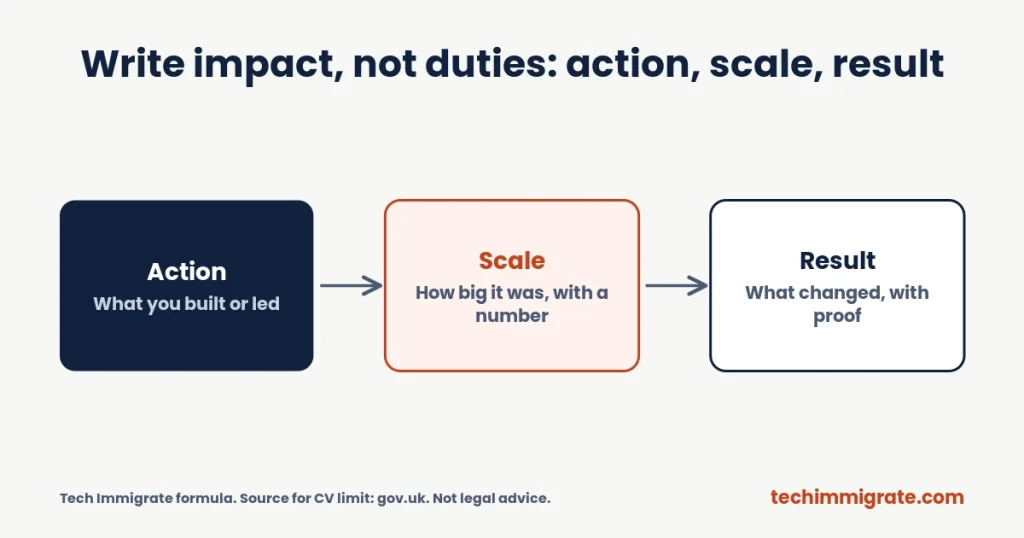
Write what changed because of your work, not what your job description said. A duty names a task. Impact names a result.
Use this formula for each bullet: action, scale, result. For example, "Rebuilt the checkout API for 2 million users, cutting failed payments by 18%." The reader sees what you did, how big it was and why it mattered.
Where do the numbers come from? Look at dashboards, release notes, press coverage, customer emails and performance reviews. If you cannot prove a number, soften it or leave it out. A claim you cannot support does more harm than a missing figure.
Tech Nation's own guidance warns that unsubstantiated claims weaken an application. Its applicant guidance lists vague details and unverifiable awards among the things that undermine supporting documents.
Match impact to a criterion
Each strong bullet should point to one of the criteria. Innovation bullets support the innovation criterion. Bullets about talks, mentoring or judging support recognition outside your day job. Research and peer review bullets support the academic criterion.
You do not need to label them. You only need to make sure that, for each criterion you plan to claim, your CV holds at least two or three bullets that back it up.
Rule 5: Show recognition and publications with proof
Give recognition its own section, and list each item with the date, the body that gave it and a link or reference. Recognition from outside your employer carries the most weight.
The gov.uk page asks for "any relevant publication history", so include papers, patents, talks, articles and open source work that fit your field. Use a short list rather than a long one.
For each item, give the reader enough detail to check it:
- Title and date.
- Where it appeared, such as the conference or journal.
- A link, if one exists.
- A number that shows reach, such as attendees, citations or downloads.
Applicants often pad this section with internal awards, LinkedIn posts and personal blog posts. Tech Nation's guidance says those do not count on their own for recognition. If an item came from your employer, say nothing or label it clearly as internal.
Keep proof public and easy to open. A reader who has to hunt for a link will often give up.
Rule 6: Make the CV match your evidence, letters and statement
Make every title, date and figure in your CV match your evidence, your three letters and your personal statement. The panel reads them together, so a mismatch reads like a warning.
Run this consistency check before you submit:
| Check | What to compare |
|---|---|
| Job titles | CV, letters, contracts, evidence documents |
| Dates | CV, letters, evidence timestamps |
| Numbers | CV bullets, evidence charts, letter claims |
| Names | Spelling of your name, employers and products |
| Story | Personal statement plans and CV direction |
The personal statement explains why you want to work in the UK and what you will do there. Your CV should show the track record that makes that plan believable. For example, if the statement says you will build AI tools for health, the CV should show related work.
The three referees need your CV too. Send it to them, so their letters repeat the same facts. Our guide to recommendation letters shows how letters and evidence support each other.
Rule 7: Cut what does not help your case
Cut anything that does not prove leadership or support a criterion. Space is tight, so every line should earn its place.
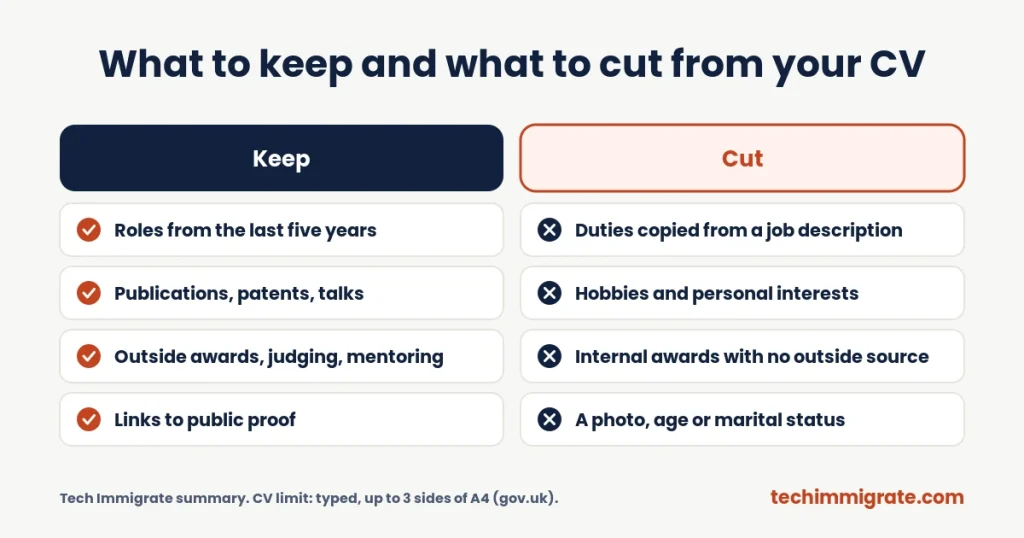
Here is a simple keep and cut guide:
| Keep | Cut |
|---|---|
| Roles from the last five years, with results | Duties copied from a job description |
| Publications, patents, talks and open source work | Hobbies and personal interests |
| Outside awards, judging and mentoring | Internal awards with no outside source |
| Degrees that relate to your field | School grades from long ago |
| Links to public proof | A photo, age or marital status |
| Tools that show specialist depth | A long list of every tool you have touched |
Language skills and hobbies rarely help a digital technology case. Cut them unless they connect to your work, such as a language that opened a market for your product.
If you are still over three sides, trim old roles first. Then merge small projects into one line. Finally, shorten bullets that repeat the same result.
Rule 8: Write it yourself and keep it honest
Write your CV yourself, in your own words, and never copy a template or use AI to draft it. Tech Nation's guidance rules out AI-written and templated documents.
You can still use tools to check spelling or format. The risk lies in generated content. Text that reads like every other application gives the panel no reason to trust it.
Honesty matters just as much. False information can make you ineligible and lead to a referral to the Home Office. Round numbers only when you can defend the rounding, and never claim a title you did not hold.
A good test: could you explain every line in an interview? If the answer is no, rewrite or remove it.
Illustrative example (fictional): before and after
Illustrative example (fictional): a data engineer called Sam rewrites one role to move from duties to impact. The facts are invented to show the method.
Before:
- Responsible for data pipelines at a fintech company.
- Worked with the analytics team on reporting.
- Helped with migration to the cloud.
After:
- Led a team of four that rebuilt the transaction data pipeline for a payments product with 1.5 million users, cutting report delay from 12 hours to 40 minutes.
- Designed the fraud-scoring feature set now used by risk analysts, which reduced manual reviews by 22%.
- Spoke at a regional data conference on streaming design (about 300 attendees, slides published).
The "before" version names tasks. The "after" version gives scale, results and a public item the panel can check. Each bullet also maps to a criterion: technical contribution, innovation and recognition outside the day job.
Sam would still need documents in the evidence folder to back up each claim. The CV points to proof. It does not replace it.
How to build your CV in four steps
Build your CV in four steps: gather facts, map them to criteria, draft in your own words, then test against your evidence. This order stops you writing claims you cannot prove.
- Gather facts. Collect contracts, payslips, reviews, release notes, talk programmes and press links from the last five years.
- Map to criteria. Pick the mandatory criterion and your two optional criteria. Note which facts support each one.
- Draft. Write the profile, then the roles, then recognition. Use action, scale and result for each bullet.
- Test. Compare every date and number with your evidence folder and ask each referee to read the CV.
Most applicants need a few evenings for step one alone. Start early, because chasing an old manager for a date can take weeks. Give yourself time for two full rewrites as well.
Illustrative example (fictional): mapping a CV to criteria
Illustrative example (fictional): Priya, a product-led SaaS engineer, maps her CV bullets to the criteria before she claims them. Her details are invented to show the method.
| CV bullet | Criterion it supports | Proof to keep in the evidence folder |
|---|---|---|
| Led the search rebuild for 800,000 monthly users | Contribution to a product-led business | Product analytics report, public release notes |
| Mentors at an external coding programme | Recognition outside the day job | Programme letter and public page |
| Judges at two national hackathons | Recognition outside the day job | Event pages and organiser emails |
| Co-authored a peer-reviewed paper | Academic contribution | Published paper with citation count |
Priya sees that two bullets support the same criterion, while no bullet backs a third one. So she drops the weak third criterion and spends her limited evidence slots on the two strong ones. Remember that one document cannot serve two criteria.
Global Talent Visa CV requirements checklist
Use this checklist as a final pass before you upload. It turns the Global Talent Visa CV requirements and the practice rules above into yes or no questions.
- Is the CV typed and no longer than 3 sides of A4?
- Does it cover your career and any relevant publication history?
- Does the profile name your field, level and best proof?
- Do your roles show title, company, product and exact dates?
- Can a reader see impact, with a number or a result, in each bullet?
- Have the last five years earned the most space?
- Does each criterion you claim have two or three CV bullets behind it?
- Do all titles, dates and figures match your letters and evidence?
- Did you write every line yourself, with no template or AI text?
- Could you defend each claim if the panel asked?
If you answer no to any item, fix it before you submit. A short fix now costs less than a refusal later.
Common Global Talent Visa CV mistakes
The most common mistakes are a job-description CV, mismatched dates and claims with no proof. Each one is easy to fix.
- Listing duties, not results. Fix it by adding a number or an outcome to every bullet.
- Using a generic template. Fix it by writing your own structure and wording.
- Overstating your role. Fix it by describing what you led, built or decided, and what you only supported.
- Hiding the last five years. Fix it by moving recent roles to the top and giving them space.
- Padding with internal praise. Fix it by moving outside recognition up and dropping the rest.
- Forgetting links. Fix it by adding public links to talks, papers and code.
For a wider view of what goes wrong, read our guide to Tech Nation endorsement mistakes. Applicants report that vague, unsupported claims are a common thread in refusals. That comes from applicant communities, not official guidance, so treat it as a pattern to avoid and not a rule.
Do education and certifications belong in a Global Talent Visa CV?
Include education only when it supports your field, and keep it to a few lines. The Global Talent Visa CV requirements do not ask for a full academic record.
A degree in computer science, data or a related field helps the reader place your background. A PhD matters more for the academic criterion, so list the thesis title and any papers. Cloud or security certifications can show depth, but one line each is enough.
Cut school results, short courses and unrelated degrees unless they explain a career change. If you moved from finance into machine learning, a single line on the conversion course can make the story clear.
Put education near the end. Your recent roles and recognition carry the case, so they should come first.
Does the CV change for Exceptional Talent and Exceptional Promise?
The CV rule is the same for both routes, but the emphasis differs. Exceptional Talent applicants show an established record of leadership, while Exceptional Promise applicants show fast growth and early signs of leadership.
An established leader often leads with scale: teams run, products shipped, years of recognition. An emerging leader leads with trajectory: quick promotions, early outside recognition and growing influence.
Both groups still need the same proof. Choose the route that fits your record, then shape the CV to match. Our comparison of Exceptional Talent and Exceptional Promise will help you see where your record sits.
Global Talent Visa CV requirements FAQ
Your CV can run to up to 3 sides of A4 and must be typed. That is the official limit on gov.uk. A tight two or three sides with strong results usually reads better than a full three sides with filler, so only use the space you can fill with proof.
Include your career history and any relevant publication history, as gov.uk requires. In practice, add exact roles and dates, impact with numbers, outside recognition, talks, patents, papers and links to public work. Focus most space on the last five years.
No, you should write it yourself. Tech Nation's guidance rules out AI-written and templated documents in applications. Tools that check spelling are different from tools that write your content. If in doubt, write the text in your own words and be ready to explain every line.
Usually not. Hobbies, age, marital status and photos rarely help a leadership case and use up limited space. Include a language or interest only when it connects to your work, such as a language that helped you launch a product in a new market.
Yes. Titles, dates and numbers should match across your CV, your three recommendation letters, your evidence and your personal statement. The panel reads them together, so a mismatch can raise doubt about your claims even when each document looks strong alone.
Your Next Step
A good CV is only one part of the application. The strongest applications pair it with a clear evidence plan, which is why we built role-specific endorsement guides with an evidence checklist and planner. Start at the guides hub to find yours.
If you work in engineering, see the software developers guide. Data and AI applicants can use the data and AI specialists guide. Product leaders have the product managers guide, and founders have the startup founders guide. Want the guide for your role? See the guides.
How We Checked This Article
We checked the CV, letter and evidence rules against the gov.uk page on documents you need to apply for endorsement. The criteria came from the gov.uk eligibility page. Tech Nation's own application guidance on supporting documents was the third source. Advice on structure and wording is our own practice-based view, and the example is fictional.
Tech Nation also says it cannot review your documents before you submit, so no outside source can confirm your CV in advance. Rules and fees change, so confirm them on gov.uk before you apply.
Tech Nation is a separate body, and Tech Immigrate is independent of Tech Nation and the Home Office. This article is general information, not legal advice, and nobody can guarantee an endorsement. Always confirm current rules on gov.uk before you apply.
We write practical guides for tech professionals applying for the UK Global Talent visa. Tech Immigrate is independent of Tech Nation and the Home Office, and our articles are general information, not legal advice. Rules and fees change, so always check gov.uk before you apply.