Academic Contribution Tech Nation Looks For: 5 Ways to Show It (Even Outside Academia)
Academic contribution Tech Nation explained: what counts, what does not, and 5 ways engineers and data people can show it. See if this criterion fits you.

In this article
- What Academic Contribution Tech Nation Means
- Where Academic Contribution Tech Nation Fits in the Application
- What Counts as Academic Contribution Tech Nation Accepts
- Do Patents, Peer Reviewing and Citations Count?
- What Does Not Count for Academic Contribution Tech Nation Checks
- Who Should Choose Academic Contribution Tech Nation Evidence?
- 5 Ways to Show Academic Contribution Tech Nation Wants (Even Outside Academia)
- Illustrative Example (Fictional): A Data Engineer's Evidence Plan
- How Engineers and Data People Can Use Academic Contribution Tech Nation Evidence
- Do You Need a PhD for Academic Contribution Tech Nation Evidence?
- Which Criterion Fits Your Evidence? A Quick Decision Table
- A Checklist for Your Academic Contribution Tech Nation Evidence
- Common Mistakes With Academic Contribution Tech Nation Evidence
- Exceptional Talent and Exceptional Promise: How the Bar Differs
- Academic Contribution Tech Nation FAQ
- Your Next Step
- How We Checked This Article
Academic contribution Tech Nation is the fourth optional criterion for the Global Talent Visa. It asks for research that is published or endorsed by an expert. Engineers and data people can meet it too, but only with real, checkable research evidence.
This guide is for applicants who have some research, a thesis, a paper or a conference talk. It also helps if you doubt that this criterion fits you at all.
Key takeaways
- Academic contribution is one of four optional criteria. You need two of the four, plus the mandatory criterion.
- The wording asks for research that is published or endorsed by an expert. Blogs and internal reports on their own do not qualify.
- Peer-reviewed papers, conference talks, competitive grants and doctoral work are the usual evidence types.
- Patents and peer reviewing are usually placed under other criteria. Check where your evidence fits best.
- Engineers can use this criterion, but only if the research is real, recent and independently verifiable.
- Code on GitHub rarely proves this criterion alone. Pair it with a paper or an expert letter.
What Academic Contribution Tech Nation Means
The criterion asks you to show exceptional ability in your field through research that others have published or endorsed. That is the plain meaning of the wording.
Law firms that quote Tech Nation's guidance give it as "exceptional ability in the field by academic contributions through research published or endorsed by an expert." The wording for the emerging-leader route is slightly different, so check it on the current guidance before you plan.
Here is where it sits. Tech Nation's panel looks for one mandatory criterion: recognition as a leading or emerging talent in digital technology. You then need two of four optional criteria. Academic contribution is the fourth. You can read the full list in our Global Talent Visa criteria guide.
Why most applicants skip it
Most tech workers pick another criterion. Their work is hands-on, so they have no papers to show.
That is fine. But if you did a master's or PhD, or you publish through your work, this criterion can be a strong pick. Know the rules first, and you save months.
Where Academic Contribution Tech Nation Fits in the Application
Academic contribution needs at least two evidence documents, and no document can be reused for another criterion. The Global Talent rules on gov.uk set the wider frame.
In practice, your evidence pack holds up to 10 documents, each up to 3 A4 sides. You need at least 2 documents per criterion. Evidence should come from the last 5 years.
Three recommendation letters support the evidence. They cannot replace it. Our guide to recommendation letters covers what each letter should say.
How the panel reads this criterion
Tech Nation's independent panel decides overall whether to endorse. Meeting a criterion is necessary, but it does not guarantee a result. So a weak academic file will not help just because it exists.
For this reason, quality beats volume. One strong, well-explained paper does more than five thin items.
What Counts as Academic Contribution Tech Nation Accepts
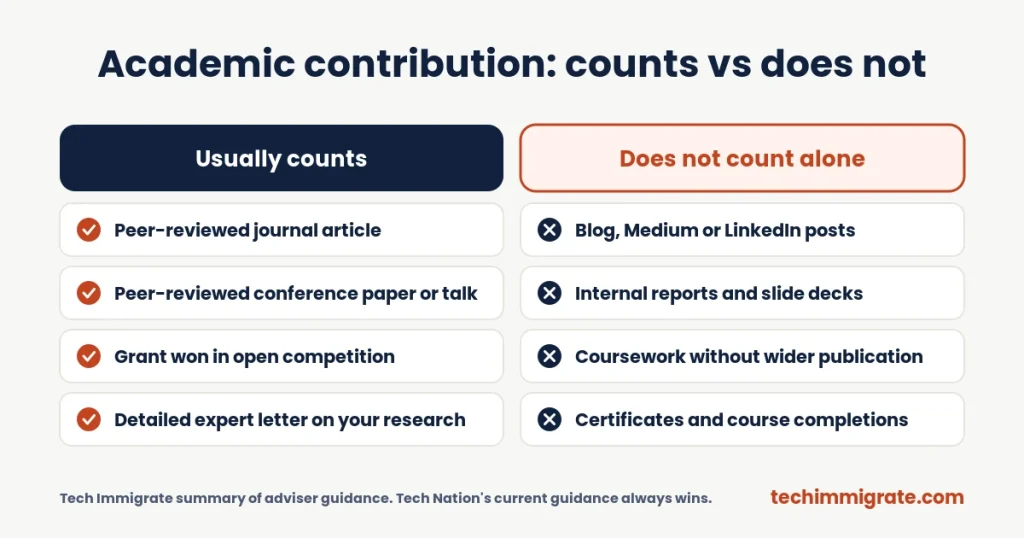
Research that has passed review or carries an expert's endorsement counts. The common examples come from published adviser summaries of Tech Nation's guidance, not from a single official list.
Applicants and advisers report that these evidence types work:
| Evidence type | Why it fits |
|---|---|
| Journal article, peer reviewed | Outside experts checked it |
| Conference paper or talk, peer reviewed | Reviewers chose it from many |
| Book or chapter from a known publisher | Editors checked the work |
| PhD thesis extract | PhD work counts, but degree coursework does not |
| Research grant won in open contest | Funders picked it on merit |
| Research backed by a government or NGO | An official body supports it |
| Expert letter on your research | A senior expert vouches for it |
Treat this table as a guide. Tech Nation's own current guidance always wins.
Published research
A paper in a respected journal is the cleanest proof. Advisers often mention journals indexed in Scopus or Web of Science as a quality sign.
Show the paper itself, not only a link. Add a short note on what your part was, and why the findings matter in digital technology.
Presentations and grants
A talk at a peer-reviewed conference counts more than a talk at an open meetup. The selection step is what proves the recognition.
The same goes for grants. A grant that you won in open competition shows that reviewers backed your work.
Expert endorsement
The wording says "published or endorsed." So an expert's formal view of your research can count even when the work is unpublished. Applicants report that this needs a letter from a senior researcher, kept separate from your three recommendation letters.
The letter should name the research, explain your role, and say why it is significant. Praise without detail adds little.
Do Patents, Peer Reviewing and Citations Count?
Patents, peer reviewing and citations sit in a grey area, because they are not named in the criterion wording that law firms quote. Treat each one with care.
Patents appear in adviser guidance under the innovation criterion, where they show new technology. They are not usually listed under academic contribution. If you hold a patent, ask first whether innovation is the better home for it.
Reviewing for journals and conferences is listed by some advisers under recognition for work outside your day job. That is a different criterion. Remember that one document cannot serve two criteria.
Citations can strengthen a paper you already submit. They are not evidence by themselves. A short note of citation counts, with a link, helps a reader see how far the paper has spread.
A simple rule of thumb
Ask what the evidence proves. Research quality fits academic contribution. Proof that you invented something fits innovation, and proof of standing among peers fits recognition.
What Does Not Count for Academic Contribution Tech Nation Checks
Material with no independent review or expert endorsement does not count. Tech Nation's guidance, as applicants describe it, rules out several common items.
- Blog posts and Medium or LinkedIn articles on their own.
- Internal company reports, white papers and slide decks.
- Undergraduate or master's coursework, without wider publication.
- Certificates and course completions, which show study rather than research.
- Letters of praise that name no research.
- Work from outside the last 5 years.
- Documents written by AI or built from a template.
Even so, some of these can still help elsewhere. For example, a popular open-source project may suit the innovation criterion. The section on engineers below shows how to use it well.
Who Should Choose Academic Contribution Tech Nation Evidence?
Choose this criterion when you already hold reviewed research, and you can explain its link to digital technology. Otherwise another criterion is usually easier.
Applicants in these situations often consider it:
- Data scientists and AI researchers with published papers.
- Engineers who finished a PhD or research master's in the last 5 years.
- Security researchers who present at peer-reviewed conferences.
- Founders with a technical paper behind their product.
When another criterion fits better
If your best work happened inside a company, the business contribution criterion may fit. If you speak, mentor or judge outside work, recognition may fit better. Our criteria guide compares all four.
Role-specific guides help here as well. The data and AI specialists guide shows which evidence suits that role, and the tech researchers guide does the same for research profiles.
5 Ways to Show Academic Contribution Tech Nation Wants (Even Outside Academia)
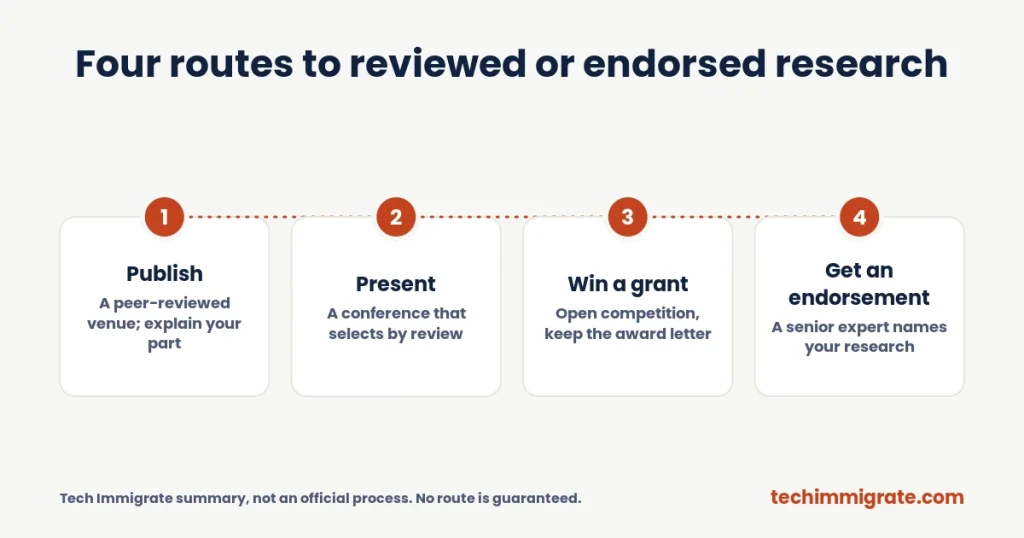
You can show academic contribution without a university job by building reviewed or endorsed research from the work you already do. These five routes appear most often in applicant stories.
Way 1: Publish in a peer-reviewed venue
First, turn a real project into a paper. Many engineering teams publish with a university partner. A co-authored paper counts, as long as you explain your part.
Next, pick a venue with a real review process. Then keep the acceptance email and the final paper.
Way 2: Present at a competitive conference
Submit a talk or paper to a conference that selects its programme by review. Then save the call for papers, the acceptance notice and the programme page.
Because selection is the proof, an invited keynote at an open event matters less. The review step is what you want to show.
Way 3: Use your doctoral or master's research
If you have a PhD, a thesis extract can serve as evidence. A thesis from the last 5 years sits best in the time window.
Master's work alone is usually described as weak evidence. However, a master's paper that later appeared in a journal is a different story.
Way 4: Win a competitive research grant
A grant won in open competition shows that independent reviewers backed your work. A grant can count when reviewers scored your plan.
Keep the award letter and the call document. Together they show that selection was competitive.
Way 5: Get an expert to endorse your research
If your research is unpublished, a senior researcher can endorse it in a detailed letter. First, choose someone who has seen your work for at least 12 months. Then ask them to name the research and describe its impact.
This route is the hardest to do well. So pair the letter with the work itself, such as a report, a dataset or a code release.
Illustrative Example (Fictional): A Data Engineer's Evidence Plan
Illustrative example (fictional): Priya is a data engineer in the fintech sector. She finished a research master's four years ago, and her thesis led to a conference paper.
Her optional criteria plan has three parts. She picks academic contribution and business contribution. She keeps her mandatory evidence separate.
Her academic contribution documents
Priya uses two documents. The first is her peer-reviewed conference paper, with the acceptance email on the same sides. The second is a one-page letter from her thesis supervisor.
This letter names the paper and says what Priya did. It also notes how fraud teams use the method, with a link to the source. Priya plans this early, so nothing is reused elsewhere.
What she does not use
Priya leaves out her company blog post and her internal white paper. Both are useful, but neither had independent review. She puts her product work under business contribution instead.
This is only a fictional case. It shows the thinking, not a promise of any result.
How Engineers and Data People Can Use Academic Contribution Tech Nation Evidence
Engineers and data people can use this criterion when their work has gone through review or expert endorsement. Day-to-day delivery alone does not do that.
First, think about where review already happens in your career. Many teams write papers with a university lab. Others present at industry research tracks that select talks by review. Each of these leaves a paper trail you can use.
Software engineers
A systems engineer might publish a paper on a database technique the team built. A machine learning engineer might co-author a benchmark study. In both cases, you need the accepted paper, the review proof and a clear line about your own part.
Open-source work is different. Code is strong proof of innovation or contribution, but it is not research until someone reviews it. Our GitHub evidence guide shows where code fits best.
Data and AI specialists
Data scientists often hold the best material. A thesis, a peer-reviewed paper or a competition paper at a reviewed workshop can all work. So can a dataset or model release that a supervisor endorses in writing.
Also keep the digital technology link clear. A paper that never mentions software, data or products leaves the panel guessing.
Security researchers and product people
Security researchers often present at reviewed conferences, so their talks sit well here. Product managers rarely have research evidence, so most choose business contribution instead. That is a sound choice, and it saves time.
Do You Need a PhD for Academic Contribution Tech Nation Evidence?
No, the wording does not name a degree. Still, a PhD makes this path much easier, and many advisers say so.
The reason is simple. A PhD gives you a thesis, a supervisor and often a paper or two. Each of these is a ready-made piece of proof. Without a PhD, you need to find that proof another way.
If you have no degree in research, do not give up on the idea. Look at your past work with fresh eyes. Perhaps a university partner once reviewed a project. Maybe you sent a paper to a workshop, or a lead scientist checked your method. If so, that is a clue. You can read more on the gov.uk digital technology page about who the route is for.
Which Criterion Fits Your Evidence? A Quick Decision Table
Match each piece of evidence to the criterion that it proves best, then spend your 10 documents wisely. This table is a general guide, not advice for your case.
| Your evidence | Usually fits best | Why |
|---|---|---|
| Paper, peer reviewed | Academic contribution | Outside review proves the research is sound |
| A patent you hold | Innovation | It shows something new |
| Talk at an open event | Work outside your job | It shows standing with peers |
| Paper at a reviewed conference | Academic contribution | Selection proves the quality |
| Product results at your firm | Business contribution | It shows real impact |
| Invites to review papers | Work outside your job | It shows expert standing |
Some pieces could fit two criteria. In that case, pick one, because one document cannot count twice. Think about which story you want the panel to read.
How long does it take to build this evidence?
Reviewed research takes time. A journal paper can take many months, and conference cycles follow fixed deadlines. So applicants who start late often switch to another criterion.
If you plan ahead, a competitive workshop paper or a grant is often quicker than a journal article. No route is guaranteed, so treat any timeline as a rough guess.
A Checklist for Your Academic Contribution Tech Nation Evidence
A short checklist keeps the file tidy and checkable. Work through it before you write your personal statement.
- Confirm the criterion wording on the current Tech Nation guidance.
- List every paper, talk, grant and thesis from the last 5 years.
- Mark which items were reviewed or endorsed by an expert.
- Choose the strongest 2 documents, each within 3 A4 sides.
- Check that no document is reused for another criterion.
- Add proof of selection: acceptance emails, programme pages or award letters.
- Ask a senior researcher for a separate, detailed endorsement letter, if you use one.
- Link the evidence to digital technology in your personal statement.
Your personal statement should then tie the pieces together.
Presenting the evidence
Keep it simple. A busy reader should see in ten seconds what the item is, when it happened and why it matters.
Do not shrink pages or build collages. Tech Nation's rules bar them, and they make the panel's job harder. Put the key facts on the first page, and use short captions to explain each item.
Common Mistakes With Academic Contribution Tech Nation Evidence
Most weak academic files fail because they confuse effort with proof. Applicants report the same problems again and again, although these reports are not official guidance.
- Counting a blog as research. A well-written post has no independent review.
- Using old work. Evidence should come from the last 5 years.
- Missing the link to tech. A paper in pure maths needs a clear digital technology angle.
- Relying on letters alone. Letters support evidence. They do not replace it.
- Reusing one paper twice. Each document can serve only one criterion.
- Overstating your role. Say plainly what you did on a co-authored paper.
Many of these overlap with errors in other criteria. Our list of Tech Nation endorsement mistakes covers more.
How to recover from a weak criterion
Try to spot trouble early. Ask a trusted peer to read your file cold, and ask what they think each document proves.
If you find a weak spot early, swap criteria. Many applicants drop academic contribution and use a stronger one. Doing that in the planning stage costs nothing.
Exceptional Talent and Exceptional Promise: How the Bar Differs
The route you pick changes how much evidence you need to show, because the panel looks for a leading talent or an emerging one. Both routes use the same criteria list, with slightly different wording.
Exceptional Talent suits established leaders. Settlement can come after 3 years. Exceptional Promise suits emerging leaders, and settlement can come after 5 years.
For early-career researchers, the promise route may feel closer. A single expert endorsement and a few papers can carry more weight there. Our comparison of Exceptional Talent vs Exceptional Promise goes deeper.
Unlike a points system, none of this adds up to a score. The panel judges the whole case. For the official route description, see the gov.uk Global Talent page.
Academic Contribution Tech Nation FAQ
Research that others have published or an expert has endorsed counts. Examples include peer-reviewed journal papers, peer-reviewed conference talks, books from known publishers, doctoral thesis extracts, competitive grants and a detailed expert letter. Blogs and internal reports usually do not count on their own.
The wording does not name a degree. However, advisers say a PhD makes the criterion easier to meet, because it gives you thesis work and supervisors who can endorse you. Without one, you need reviewed research or a strong expert endorsement.
Yes, if they have real research evidence. An engineer with a peer-reviewed paper or a conference talk can use it. Most engineers choose other criteria, because their work is practice-based and rarely published.
They are not named in the wording that law firms quote. Advisers usually place patents under innovation and reviewing under recognition outside your job. Decide which criterion your evidence proves best, and remember that one document cannot serve two criteria.
There is no official paper count in the wording we could verify. You need at least 2 evidence documents for the criterion. Some advisers suggest more, but that is adviser opinion, not Tech Nation guidance.
Your Next Step
First, run a quick self-check of your research evidence against the four criteria. Want the guide for your role? See the guides.
Then pick the guide that matches your role. Tech Immigrate's role-specific endorsement guides include an evidence checklist and planner. Start from the guides hub, or go straight to the software developers guide, the data and AI specialists guide or the tech researchers guide.
How We Checked This Article
We read the Global Talent pages on gov.uk, including the digital technology, eligibility and apply pages. We also read legal and adviser summaries of Tech Nation's guidance, such as Redfern Legal's note on this criterion.
Tech Nation's own site did not open for us. So the exact criterion wording comes from those quoted summaries. Applicant reports are labelled as reports, not official guidance.
Rules change over time. Tech Immigrate is independent of Tech Nation and the Home Office. This article is general information, not legal advice, and nobody can guarantee an endorsement. Always confirm current rules on gov.uk before you apply.
We write practical guides for tech professionals applying for the UK Global Talent visa. Tech Immigrate is independent of Tech Nation and the Home Office, and our articles are general information, not legal advice. Rules and fees change, so always check gov.uk before you apply.