Global Talent Visa for Tech Professionals: Benefits, Costs and Who Qualifies (7 Key Facts)
Global Talent Visa for tech professionals: see the benefits, the real costs and who qualifies, with worked examples. Check your fit before you pay any fee.

In this article
- What Is the Global Talent Visa for Tech Professionals?
- Benefits of the Global Talent Visa for Tech Professionals
- What Does the Global Talent Visa Cost?
- How Long Does the Global Talent Visa Take?
- Who Qualifies for the Global Talent Visa for Tech Professionals?
- The Product-Led Rule: Does Your Role Fit?
- How Hard Is It to Get? What Decides the Outcome
- Which Tech Roles Fit? A Quick Guide
- From Idea to Visa: The Stages in Order
- Are You Ready? A Self-Check Before You Pay
- Costs Beyond the Fees: What Else to Budget For
- Global Talent Visa vs Other UK Routes for Tech Workers
- Global Talent Visa for Tech Professionals FAQ
- Your Next Step
- How We Checked This Article
The Global Talent Visa for tech professionals lets leaders and emerging leaders in digital technology live and work in the UK without a job offer or a sponsor. You first need an endorsement from Tech Nation, then you apply to the Home Office.
At the time of writing, the application fees are GBP 766 for the main applicant, plus a yearly health surcharge. This guide is for engineers, product people, founders and other tech workers who want the benefits, the full budget and an honest view of who qualifies before they start.
Key takeaways
- The visa is not tied to an employer, so you can be employed, self-employed or run a company, and change jobs freely.
- There are two stages: a Tech Nation endorsement (GBP 561), then a Home Office visa application (GBP 205).
- The Immigration Health Surcharge, GBP 1,035 per adult per year, is usually the largest single cost.
- You need one mandatory criterion plus two of four optional criteria, backed by evidence from the last five years.
- Your role must fit Tech Nation's product-led focus, and meeting the criteria does not guarantee an endorsement.
- There is no points system, so you cannot add up points to see where you stand.
What Is the Global Talent Visa for Tech Professionals?
It is a UK visa for people who are leaders, or potential leaders, in digital technology, and Tech Nation is the body that endorses them. Other fields, such as research and the arts, have their own endorsing bodies.
The process has two stages. First, you apply to Tech Nation with a CV, a personal statement, three recommendation letters and up to 10 evidence documents. Then, if Tech Nation endorses you, you apply to the Home Office for the visa within three months.
Unlike a Skilled Worker visa, this route does not need a sponsoring employer. Your right to stay does not depend on keeping one job. The gov.uk page for digital technology sets out the official rules, and we check our numbers against it.
Two routes: Exceptional Talent and Exceptional Promise
Exceptional Talent is for established leaders, while Exceptional Promise is for emerging leaders. Tech Nation judges you against the route you choose, so the choice matters.
Applicants with more than five years in tech often look at Talent. Applicants with five years or less often look at Promise. Our guide to Exceptional Talent vs Exceptional Promise explains how to tell which one your evidence supports.
Benefits of the Global Talent Visa for Tech Professionals
The main benefit is freedom: you can work for yourself or for any employer without asking the Home Office. We cover each benefit in more detail on our benefits of the Global Talent Visa page. Here are the ones tech workers value most.
- No sponsor. You can be an employee, a freelancer or a company director. You can also change or stop your job without telling the Home Office, according to gov.uk.
- No job offer. Tech Nation endorses your track record, not a particular role.
- Flexible length. You choose how long your visa lasts, up to five years at a time, and you can extend it.
- Family can join. Partners and children can apply as dependants. The gov.uk page for partners and children says they can work and study, except that partners and children cannot work as a sportsperson or coach.
- A faster route to settlement. The general gov.uk Global Talent page says you may qualify for indefinite leave to remain after three years (leaders) or five years (potential leaders).
Settlement rules can change, so check gov.uk before you plan around a date. Also remember that a benefit only matters if you get through the first stage.
Illustrative example (fictional): the employee who wants options
Priya (fictional) is a backend engineer at a product-led SaaS company. Her employer cannot sponsor a Skilled Worker visa quickly, and she wants to keep the option of joining a startup later.
On this visa, a job change would not need a new sponsor. That flexibility is the reason many applicants in her position look at this route. However, she would still need independent recognition for her work, not just a good job title.
What Does the Global Talent Visa Cost?
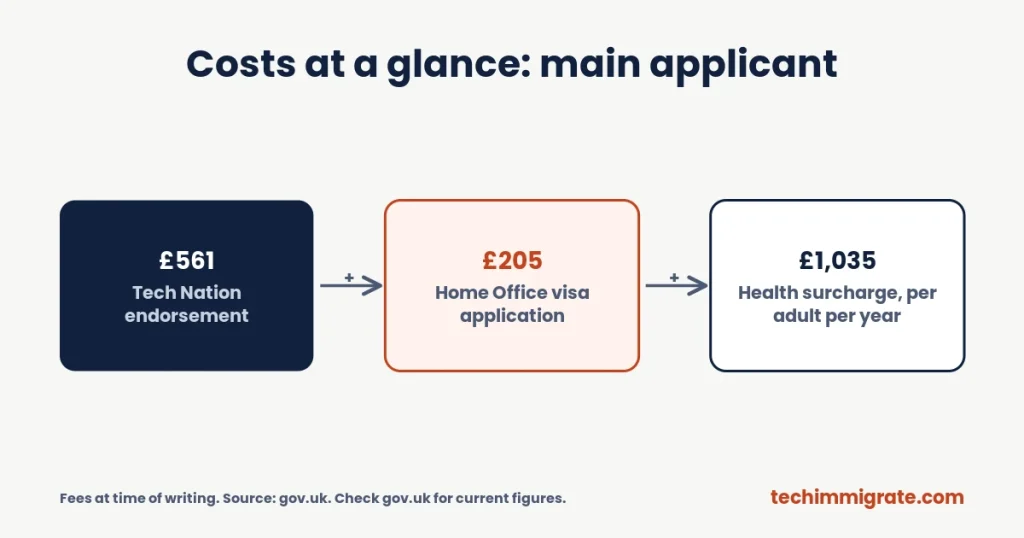
The two application fees total GBP 766 for the main applicant, and the health surcharge comes on top. At the time of writing, gov.uk lists GBP 561 for the endorsement and GBP 205 for the visa. Our full cost breakdown walks through every line.
Fees change from time to time, so check gov.uk on the day you pay. Write down the date you checked, because it helps if the numbers move before you apply.
The costs at a glance
| Cost | Who pays | Amount at the time of writing |
|---|---|---|
| Endorsement application (Tech Nation) | Main applicant | GBP 561 |
| Visa application (Home Office) | Main applicant | GBP 205 |
| Main applicant total before surcharge | Main applicant | GBP 766 |
| Visa application for each dependant | Each partner and child | GBP 766 (per gov.uk) |
| Immigration Health Surcharge | Each adult | GBP 1,035 per year |
| Immigration Health Surcharge | Each child under 18 | GBP 776 per year |
| Faster decision (optional) | Depends on choice | Extra fee, see gov.uk |
Dependants also pay their own surcharge. Because the surcharge is paid for the whole visa up front, a longer visa means a bigger bill at the start.
Illustrative example (fictional): a single applicant on a five-year visa
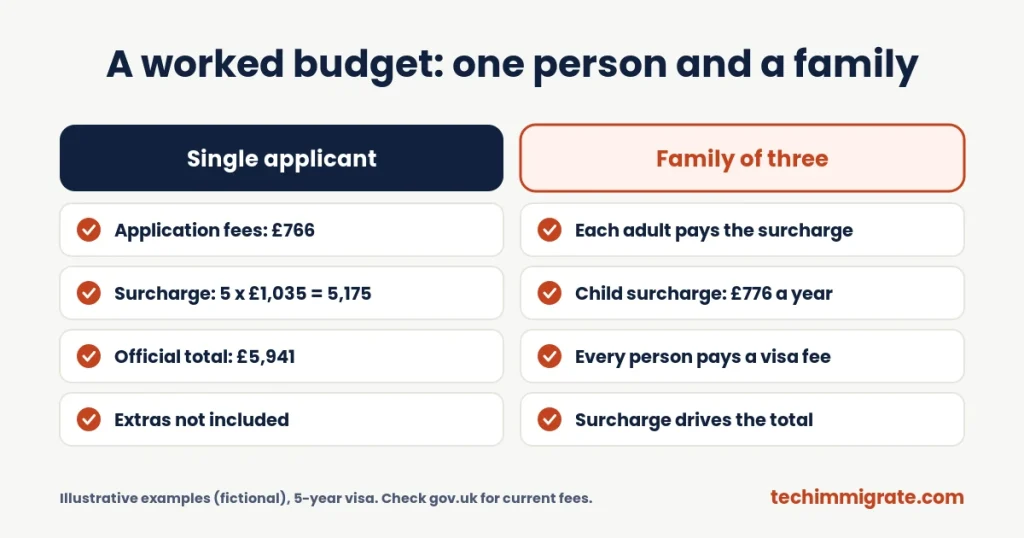
Omar (fictional) is single and chooses a five-year visa. He pays GBP 766 in application fees and five years of surcharge at GBP 1,035. That is GBP 5,175 for the surcharge.
His official total is GBP 5,941. It does not include optional faster decisions, translations or any adviser help. Omar should also set aside money for the time he spends preparing, because that cost is real even if no fee applies.
Illustrative example (fictional): a family of three
Ana (fictional) applies with a partner and one child under 18, again for five years. Ana pays GBP 766 plus five adult surcharges. Her partner pays the visa fee and the same adult surcharge. The child pays the visa fee and the lower child surcharge of GBP 776 per year.
The result is that the surcharge, not the visa fee, drives the total. Families should add every person's surcharge for every year before they choose a visa length. Check the gov.uk surcharge page for part-year rules, because a short visa may cost less than a full year.
How Long Does the Global Talent Visa Take?
Tech Nation usually decides on an endorsement in five to eight weeks, and the visa decision then takes about three weeks from outside the UK. From inside the UK, gov.uk says to expect about eight weeks. We explain the stages in our processing timeline guide.
Preparation is the part people underestimate. Gathering evidence, briefing referees and collecting signed letters often takes longer than the decision itself. Tech Nation's own guidance on what to consider suggests allowing plenty of preparation time, so start early.
Also note that you must apply for the visa within three months of your endorsement. Plan your documents for the visa stage before you submit the first one.
Who Qualifies for the Global Talent Visa for Tech Professionals?
You qualify if Tech Nation's panel decides you are a leading or emerging talent in digital technology, and you meet the criteria. Meeting the criteria is necessary, but the panel decides overall whether to endorse you.
You need the mandatory criterion plus two of four optional criteria. The mandatory criterion asks for recognition as a leading or emerging talent in digital technology, within the last five years. Our criteria guide goes through each one.
The four optional criteria in plain words
- OC1, innovation. You or your work brought something new to a product-led digital technology company or field.
- OC2, recognition outside your day job. You have contributed to the sector beyond your employer, for example through talks, mentoring or open source.
- OC3, significant contribution to a product-led business. You made a major technical, commercial or entrepreneurial contribution.
- OC4, academic contributions. You have research, peer review, publications or conference work.
Each criterion needs at least two evidence documents. A single document cannot be used for two criteria.
The evidence rules
You can submit up to 10 evidence documents, and each can run to three A4 sides. Evidence should come from the last five years. You also need three recommendation letters from established experts who have known your work for 12 months or more.
Letters alone are not enough, because they support your evidence. Tech Nation's guidance also says AI-written or templated documents are not acceptable.
The Product-Led Rule: Does Your Role Fit?
Tech Nation looks for people who work in or with product-led digital technology companies, so your role must fit. A product-led company earns its main revenue from its own digital product, platform, service or hardware.
Gov.uk and Tech Nation both describe two profiles. Technical applicants include developers, engineers and data scientists. Business applicants have commercial, product or investment expertise in building digital products.
Some roles are listed as unsuitable. These include consultancy and service delivery, IT support and infrastructure management, and business skills used in-house at agencies or outsourcers. Read the official list of skills covered by Tech Nation before you collect any evidence.
Illustrative example (fictional): same title, different outcome
Two growth marketers (fictional) both hold the title "Head of Growth". One works inside a product-led app company and owns its acquisition channels. The other works at an agency serving non-tech clients.
The first has a clear route to show contribution to a product-led business. By contrast, the second would face the in-house agency problem. In other words, the job title matters less than who your employer is and what you built.
How Hard Is It to Get? What Decides the Outcome
It is selective, because the panel looks at what your documents prove, not at your potential or your job title. Applicants who choose the right route and link each document to a criterion put themselves in the strongest position.
There is no points system for this visa. Some websites mention points, but there is no score to add up. Instead, the panel reads your evidence and decides overall.
Three things that often decide it
First, independent recognition. Awards, press coverage and invited talks come from people outside your employer, so they carry weight. Internal awards and your own posts, on their own, usually do not.
Second, clear links between claims and proof. Each document should say which criterion it supports and what it shows. Our guide to Tech Nation endorsement mistakes lists nine common problems.
Third, a personal statement that organises the case. It should point to your documents by number, not retell your CV. See our personal statement guide for how to structure it.
Which Tech Roles Fit? A Quick Guide
Many tech roles can fit, as long as the work sits in or with a product-led company. The table shows how applicants in common roles often think about their case, and it is not a ruling on any one person.
| Role | What often helps | What often hurts |
|---|---|---|
| Software developer | Open source others use, patents, technical talks | Only internal tickets and job descriptions |
| Data or AI specialist | Published models, papers, adopted tools | Dashboards nobody outside can verify |
| Product manager | Launches with named outside coverage or adoption | Team results with no personal share shown |
| Cybersecurity specialist | Credited vulnerability finds, conference talks | Confidential work with no outside proof |
| Founder | Independent press, traction you can verify | Company success with no personal role shown |
| Designer | Awards, published case studies, design systems others adopt | Portfolio pieces only you describe |
Each role has its own guide with a deeper checklist. You can browse them in our guides hub.
From Idea to Visa: The Stages in Order
The path has six stages, and skipping the early ones is the usual cause of delays. Here is the order most applicants follow.
- Check the role fit. Compare your last five years with the product-led rule.
- Pick your route. Choose Exceptional Talent or Exceptional Promise, based on the recognition you hold now.
- Map your evidence. Choose your two optional criteria and plan at least two documents for each.
- Brief your referees. Give them facts to confirm, then let them write in their own words.
- Apply to Tech Nation. Pay the endorsement fee and wait for the decision.
- Apply to the Home Office. Do this within three months of the endorsement.
Switching from inside the UK
Many people already live in the UK on another visa, and gov.uk says some can switch to this one. Whether you can depends on your current visa, so read the eligibility rules on gov.uk first.
If you apply from inside the UK, the visa decision usually takes about eight weeks. Applicants often plan their current visa expiry date around that wait.
Are You Ready? A Self-Check Before You Pay
Answer these questions honestly before you pay the endorsement fee, because the fee is not refundable. Applicants in this situation often find that a short audit saves a refused application.
- Do you work in or with a product-led digital technology company, or did you in the last five years?
- Has anyone outside your employer recognised your work, for example through press, awards or invited talks?
- Can you name three established experts who have known your work for at least 12 months?
- Can you pick two optional criteria and find two different strong documents for each?
- Do your titles, dates and figures match across your CV, LinkedIn and what your referees will say?
- Are all your evidence items from the last five years?
If you answer no to two or more, many applicants choose to build their evidence first. That can mean months of speaking, open source, mentoring or measurable product work. It is slower, but a refusal also costs a fee and time.
Illustrative example (fictional): the applicant who waited
Daniel (fictional) is a data engineer with strong internal reviews but no outside recognition. He answers no to questions two and three.
He spends a year contributing to an open source project, giving two talks at independent meetups and building relationships with senior people in his field. After that, he can answer yes to most questions. The wait gave him material that did not exist before.
Costs Beyond the Fees: What Else to Budget For
Official fees are only part of the picture, so plan for extras too. These vary by person and are not set by the Home Office.
- Optional faster decisions. Gov.uk lists priority options at the visa stage for an extra fee.
- Translations and certified copies. You need these if documents are not in English.
- Adviser or guide costs. Some applicants hire a lawyer, while others use a guide. Both are optional.
- Settlement later. Indefinite leave has its own fee, so budget for it when the time comes.
- Moving costs. Flights, housing deposits and your first months in the UK add up quickly.
Tech Nation cannot give immigration advice or pre-review applications, according to its own guidance. That is why some applicants choose to get a second opinion on their evidence.
A simple way to plan your budget
Split your budget into three buckets: fees you must pay, costs you choose, and costs that come later. The first bucket is fixed by gov.uk, so you can total it before you start. The second depends on how much help you want.
Many people forget the third bucket. Settlement fees, visa extensions and family travel all arrive after the first visa is granted. As a result, applicants who budget only for the application often feel squeezed in year three.
Global Talent Visa vs Other UK Routes for Tech Workers
This visa suits people who want flexibility and can show a strong track record, while other routes suit different situations. We do not tell you which to pick, but the differences are worth knowing.
| Feature | Global Talent | Skilled Worker |
|---|---|---|
| Needs an employer sponsor | No | Yes |
| Needs a job offer | No | Yes |
| Can change jobs freely | Yes | Usually needs a new sponsor |
| Needs a Tech Nation endorsement | Yes | No |
| Settlement | After 3 or 5 years | Usually longer |
Applicants who cannot yet show independent recognition sometimes choose a sponsored route first and apply later. Others may look at the Innovator Founder route if they are building a company. Check gov.uk for the current rules on each one.
Global Talent Visa for Tech Professionals FAQ
No. Tech Nation endorses your track record in digital technology, not a specific job. You can work as an employee, be self-employed or run a company, and you can change jobs without telling the Home Office.
At the time of writing, the main applicant pays GBP 561 for endorsement and GBP 205 for the visa, so GBP 766 before the health surcharge. The surcharge is GBP 1,035 per adult per year. Check gov.uk for current amounts.
Yes. Partners and children can apply as dependants. Gov.uk lists GBP 766 per dependant for the visa application, and each also pays the health surcharge. They can usually work and study, except as a sportsperson or coach.
Tech Nation usually decides on endorsement in five to eight weeks. The visa decision then takes about three weeks from outside the UK or eight weeks from inside. Preparing your evidence often takes longer than either decision.
It is selective. Tech Nation's panel decides overall, and meeting the criteria does not guarantee endorsement. Applicants who pick the right route, show independent recognition and link every document to a criterion give themselves the clearest case.
Your Next Step
Want the guide for your role? See the guides. Then read the role guide that matches your work.
Our guides hub lists role-specific endorsement guides with an evidence checklist and planner. Popular starting points include the software developers guide, the data and AI specialists guide, the product managers guide and the startup founders guide.
How We Checked This Article
We checked the fees, decision times, visa length, family rules and settlement timing against the gov.uk Global Talent digital technology page, the gov.uk partners and children page and the gov.uk health surcharge page. We checked the product-led rules and common refusal reasons against gov.uk's list of skills covered by Tech Nation and Tech Nation's own guidance on what to consider. The example people in this article are fictional.
Tech Immigrate is independent of Tech Nation and the Home Office. This article is general information, not legal advice, and nobody can guarantee an endorsement. Always confirm current rules on gov.uk before you apply.
We write practical guides for tech professionals applying for the UK Global Talent visa. Tech Immigrate is independent of Tech Nation and the Home Office, and our articles are general information, not legal advice. Rules and fees change, so always check gov.uk before you apply.