
When to Apply for the Graduate Visa: Finding Your Window
When to apply for the Graduate visa: after completion is reported and before your Student visa ends, plus the 31 December 2026 cut-off for 2 years.


In this article
- Your Application Window
- Step 1: Find Your Student Visa Expiry Date
- Step 2: Find Out When Completion Will Be Reported
- Step 3: Apply as Soon as You Can
- Travel and Timing
- Why Timing Trips People Up
- The Difference Between Course End Date and Completion Date
- How Universities Report Completion
- How Long the Window Usually Is
- The 31 December 2026 Cut-Off
- What to Do if Results Are Delayed
- Planning Around a Job Offer
- Planning Around Travel Home
- Planning Around Graduation Ceremonies
- Planning Around Moving Home
- Planning for Dependants
- What Happens if You Miss Your Window
- Applicant-Reported Experiences
- A Simple Timing Plan
- Our Summary
- A Fictional Example
- Questions to Ask Your University
- Undergraduate Timing
- Taught Master's Timing
- PhD Timing
- Professional Course Timing
- Timing When You Have a Sponsored Job Offer
- Timing and the Earned Settlement Changes
- How to Avoid Last-Minute Problems
- What to Prepare Before Your Window Opens
- Timing If Your Student Visa Is Being Curtailed
- Timing With a Scholarship
- Timing for Couples Who Both Studied
- Timing When You Plan to Start a Business
- Keeping Proof of When You Applied
- Your Next Step
- How We Checked This Article
Timing is the single most important part of a Graduate visa application. Apply too early and you will be refused because your university has not yet reported that you finished. Apply too late and you cannot apply at all, because your Student visa has expired. Between those two points is a window, and getting inside it is what makes the application work. In late 2026 there is a third date to think about too: applying on or before 31 December 2026 secures the two-year visa.
This guide explains when you can apply for a Graduate visa, how to find your window, how the January 2027 change affects your timing and how to plan around travel, jobs and family. For eligibility, see our guide to Graduate visa requirements.
Key takeaways
- You can apply once your university has told the Home Office you successfully completed your course.
- You must apply before your Student visa expires.
- You do not need to wait for your graduation ceremony or certificate.
- Apply on or before 31 December 2026 to get a 2-year visa. From 1 January 2027, most graduates get 18 months.
- You must be in the UK when you apply, and you should not travel abroad until you get a decision.
- The visa starts when it is approved, so applying early does not shorten it.
Your Application Window
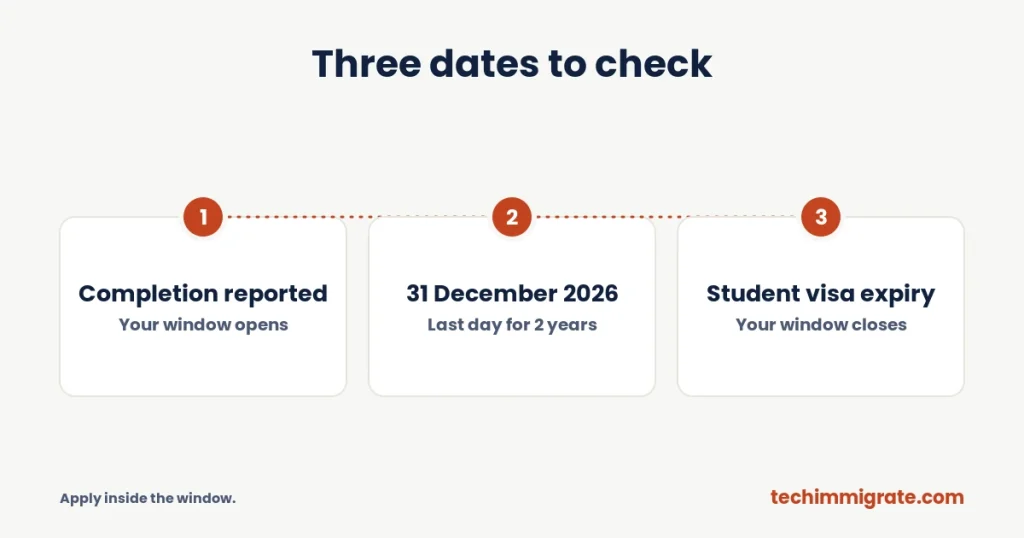
| Date | What it means |
|---|---|
| Course end date | Your studies finish, but you cannot apply yet |
| Completion reported | Your window opens |
| 31 December 2026 | Last day to apply for the 2-year version |
| Student visa expiry | Your window closes |
Step 1: Find Your Student Visa Expiry Date
Check your eVisa in your UKVI account. Student visas usually run for a few months after the official course end date.
Step 2: Find Out When Completion Will Be Reported
Ask your university's international student team when it will report your successful completion. Many send a confirmation email.
Step 3: Apply as Soon as You Can
Once completion is reported, applying promptly gives you the most margin. It also avoids peak periods and, in late 2026, helps you meet the 31 December cut-off.
Travel and Timing
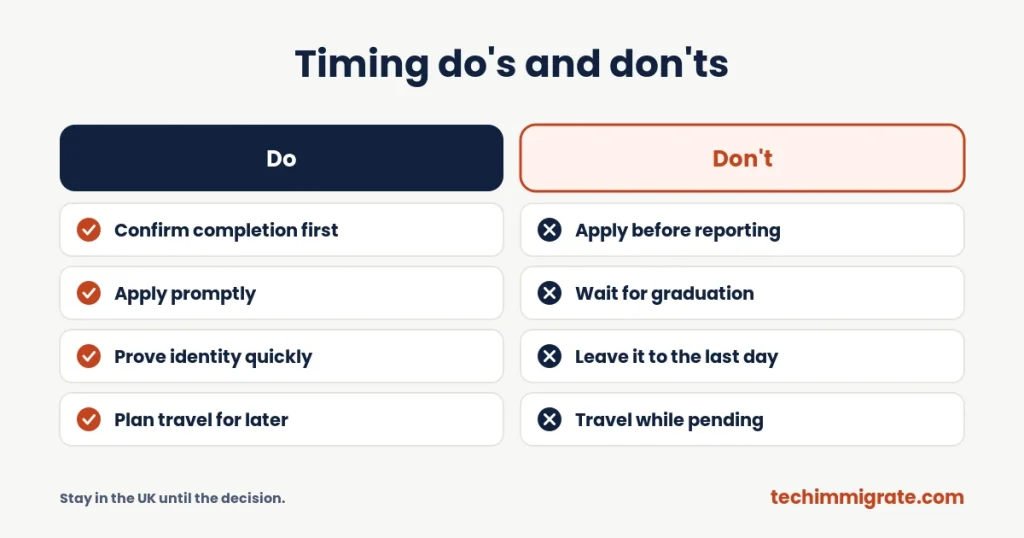
You must be in the UK to apply, and leaving the Common Travel Area before a decision usually withdraws your application. Plan trips home for after your decision.
After your university reports successful completion and before your Student visa expires.
No. You can apply once completion is reported.
Apply on or before 31 December 2026. From 1 January 2027, most graduates get 18 months.
No. You must be in the UK when you apply.
No. The visa starts on the day it is approved.
Why Timing Trips People Up
Most Graduate visa refusals are not about whether the graduate deserved the visa. They are about timing. The route has only a few requirements, and two of them depend on dates you do not fully control: when your university reports completion and when your Student visa expires. If you misunderstand either one, the application can fail even though you meet every other rule. Graduates also face competing pressures at the end of a course, such as moving home, starting a job or visiting family, which can push the application down the list. Understanding your window, and putting the application near the top of your priorities, avoids almost all timing problems.
The Difference Between Course End Date and Completion Date
Your course end date is the date your studies are scheduled to finish, often shown on your Confirmation of Acceptance for Studies. Your completion date, for Graduate visa purposes, is when your university confirms you have successfully passed the course. These are often different. For taught master's courses, the course end date may fall in September, but results may not be confirmed until November or December. For undergraduate courses, results are often confirmed soon after the end of the summer term. Only after completion is reported can you apply, so the completion date is the one that opens your window.
How Universities Report Completion
Universities report completion to the Home Office through the sponsor management system. Some do it automatically once exam boards have met. Others report on request or in scheduled batches. Many universities email students to confirm the report has been made, and some publish expected reporting dates for each course. If you are unsure, ask your international student team directly. They deal with this question every year and can usually give you a clear answer. Do not rely on your results being published in the student portal, because publication and reporting can happen on different days.
How Long the Window Usually Is
The length of your window depends on your course. Student visas usually include extra time after the course end date, often several months for courses of a year or longer and less for shorter courses. If your results are confirmed quickly, you may have a long window. If they are confirmed late, the window may be short. In rare cases, especially where results are delayed by resits or appeals, completion may not be reported before the Student visa expires, and you may not be able to use the Graduate route at all.
The 31 December 2026 Cut-Off
For graduates finishing in late 2026, a third date matters. Applications made on or before 31 December 2026 usually lead to a two-year visa, while those made from 1 January 2027 usually lead to eighteen months, unless you are a doctoral graduate. If your completion is reported in December, applying before the end of the month can give you an extra six months. If your completion will not be reported until January, you cannot apply in December, and you will receive the shorter visa. Ask your university whether reporting can happen before the holiday period if your results are already confirmed.
What to Do if Results Are Delayed
If your results are delayed, for example because of resits, extenuating circumstances or a delayed dissertation, completion cannot be reported until the final result is confirmed. If your Student visa will expire before then, talk to your university as soon as possible. In some cases, the university may be able to extend your Confirmation of Acceptance for Studies so you can apply to extend your Student visa, which in turn keeps the Graduate route open. This depends on your circumstances and your university's policy, so act early.
Planning Around a Job Offer
Many graduates receive job offers during their final term. If your job starts before your Graduate visa is granted, your Student visa conditions usually continue while a timely application is pending, which may allow you to work full time after your course has ended. Your employer may need to use the Employer Checking Service to confirm your right to work. Tell your employer your application timeline early so they can plan right to work checks and start dates.
Planning Around Travel Home
Many graduates want to go home after their course. Because you must be in the UK to apply and should not leave while the application is pending, travel needs careful planning. The safest approach is to wait for completion to be reported, apply, prove your identity and wait for the decision before travelling. If you travel before applying and your Student visa is still valid, you can usually return and apply, but you risk missing your window if anything goes wrong. Do not leave after applying, because that usually withdraws the application.
Planning Around Graduation Ceremonies
Graduation ceremonies often take place weeks or months after completion is reported. You do not need to wait for your ceremony to apply. In fact, waiting can push you close to your Student visa expiry date. If family members are coming to your ceremony, check that they have the right visas to visit, which is a separate process from your Graduate visa.
Planning Around Moving Home
If you are moving out of student accommodation at the end of your course, make sure you have a reliable address and email for the duration of your application. Landlords may ask about your immigration status during the application. They can use the Home Office Landlord Checking Service if your eVisa still shows your Student visa.
Planning for Dependants
If your partner or children are applying with you, they must also apply before their current permission expires. Their applications are linked to yours, so plan to apply together or close together. They must also stay in the UK while their applications are pending.
What Happens if You Miss Your Window
If your Student visa expires before you apply, you cannot apply for a Graduate visa. You would need to leave the UK or apply for another route that you qualify for. Some graduates in this situation apply for Skilled Worker if they have a sponsored offer, or return home and apply later from abroad for another route. Missing the window is one of the most frustrating ways to lose the Graduate route, because it is completely avoidable.
Applicant-Reported Experiences
On student forums, graduates often report that the most stressful part of the process was waiting for completion to be reported, rather than waiting for the decision itself. Some describe chasing their university for confirmation, especially at busy times. These are applicant-reported experiences, but they show why it is worth asking your university about reporting dates well in advance.
A Simple Timing Plan
A simple plan can help. In your final term, note your Student visa expiry date and ask your university when it expects to report completion. When results are published, ask for confirmation of reporting. As soon as you have that confirmation, apply and prove your identity. Then stay in the UK until you have a decision. If your course ends in late 2026, add the 31 December 2026 cut-off to your plan.
Our Summary
The right time to apply for a Graduate visa is as soon as your university has reported completion, and always before your Student visa expires. In late 2026, applying before the end of December can give you a longer visa. Stay in the UK until you have a decision, and plan travel and moves around it.
A Fictional Example
Consider a fictional master's graduate whose course officially ends on 30 September 2026 and whose Student visa runs until late January 2027. Their exam board meets in late November, and the university reports completion on 2 December. The graduate receives the confirmation email that afternoon, applies the next day and proves their identity with the app. Because they applied before 31 December 2026, they receive a two-year visa. Had they waited until after the holidays, they would still have been within their window, but they would have received only eighteen months. A single email to their university in October, asking about reporting dates, gave them the information they needed to plan.
Questions to Ask Your University
Before your course ends, ask your university a few simple questions. When will my completion be reported to the Home Office? Will I receive confirmation? What happens if my results are delayed? Can you help me check my application before I submit it? Most universities have clear answers and are glad to help. Asking early means you can plan your application, travel and job start with confidence.
Undergraduate Timing
For most undergraduate students, the course ends in early summer and results are confirmed by late June or July. Student visas for degree courses usually include around four months after the course end date. That typically gives undergraduates a comfortable window of several weeks or months to apply. Because summer is a busy period, applying as soon as completion is reported helps you avoid the peak and gives you more certainty before the autumn. If you plan to spend the summer at home, the safer approach is usually to apply and wait for the decision before you leave, rather than leaving first and returning to apply, because delays in travel or reporting could squeeze your window.
Taught Master's Timing
Taught master's courses often end in September, with dissertations submitted at the end of the summer. Results may not be ratified until November or December. Student visas for these courses often run until the following January or February. That leaves a window that can be several weeks long, but it opens late in the year. For courses ending in 2026, that timing sits right against the 31 December 2026 cut-off for the two-year visa. Master's students in this position should ask early when their exam board meets and when completion will be reported, and be ready to apply the same week.
PhD Timing
Doctoral timelines are less predictable. Completion usually depends on passing the viva and making any required corrections, followed by formal confirmation of the award. Some universities report completion once corrections are approved, others once the award is conferred. Because doctoral graduates get a three-year visa regardless of the 2027 change, the December cut-off does not affect them. But the Student visa expiry date still matters, so PhD students should track it carefully, especially if corrections take longer than expected. If you need more time, talk to your university about extending your Student visa before it runs out.
Professional Course Timing
Some professional courses, such as law conversion and practice courses, have their own assessment calendars. Results may be released at fixed points in the year. Check how your provider reports completion and how that fits with your Student visa expiry. If your course leads to a professional qualification that requires a period of supervised training, think about how the Graduate visa length fits with that training, because the visa cannot be extended.
Timing When You Have a Sponsored Job Offer
If you already have a sponsored job offer before your Student visa ends, you might be able to switch directly to Skilled Worker instead of applying for a Graduate visa. Students can usually switch once their course is complete, or after at least twenty-four months of a PhD. Switching directly saves the Graduate visa cost and starts your settlement clock sooner, but it ties you to a sponsor. Some graduates prefer to take the Graduate visa first for its freedom, then switch later. Both approaches are valid, but each has its own timing rules.
Timing and the Earned Settlement Changes
The government is introducing earned settlement, which will change how long people must wait before settling and what they must show. Time on the Graduate visa does not count towards settlement under these plans. If settlement is your long-term goal, the timing of your move from the Graduate visa to a qualifying route matters more than the timing of the Graduate application itself. Keep an eye on the changes as they are implemented through 2027.
How to Avoid Last-Minute Problems
Last-minute applications are risky for several reasons. Online systems can be slow or unavailable. Payment cards can be declined. Identity apps may not read your passport, forcing you to book an appointment. Emails from your university may arrive later than expected. Each of these is easy to fix with a few days to spare and stressful with a few hours. Aim to apply within a week of completion being reported, and never leave it to the final days of your Student visa.
What to Prepare Before Your Window Opens
You can prepare most of your application before completion is reported. Check that your passport is valid and readable by the ID Check app. Set up or update your UKVI account. Gather any scholarship consent letters you need. Decide whether dependants are applying with you and prepare their documents. Budget for the fee and health surcharge. When the completion email arrives, you can then apply the same day.
Timing If Your Student Visa Is Being Curtailed
If you stop studying early, withdraw from your course or are reported as no longer attending, your university may tell the Home Office, and your Student visa may be cut short. In that situation, you may not have completed your course, so the Graduate route is not available. If you finish your course but your university reports a change in your circumstances, such as finishing earlier than planned, your Student visa may be shortened to a new expiry date. Always check your eVisa for your current expiry date rather than relying on the date you remember from your original grant. If you receive any letter or email about curtailment, read it carefully and act quickly, because it can shrink your application window dramatically.
Timing With a Scholarship
If a government or international scholarship agency paid your fees and living costs in the last twelve months, you need their written consent before you apply. Request it early, because some agencies take weeks to respond. Without the consent letter, you cannot make a valid application, and waiting for it could push you towards the end of your window or past the 31 December 2026 cut-off. Ask your scholarship provider about their process during your final term so the letter is ready when completion is reported.
Timing for Couples Who Both Studied
If you and your partner both studied in the UK on Student visas, each of you may be eligible for your own Graduate visa. Your windows may differ, depending on your courses and visa dates. Some couples choose for one partner to apply as the main applicant and the other as a dependant, especially if one partner's course ends later. Others apply separately so each has their own permission. Think about which approach gives you both the most flexibility, and check each person's dates carefully.
Timing When You Plan to Start a Business
Graduates who want to start a business sometimes use the Graduate visa as a launch period. If that is your plan, applying early in your window gives you the most time to develop your idea, test the market and prepare for a longer-term route such as Innovator Founder or Global Talent. Because the Graduate visa cannot be extended, every month counts when building a business that you hope will support a future visa.
Keeping Proof of When You Applied
After you submit, save the confirmation email and the submission page showing the date and time of your application. If your Student visa expires while the application is pending, this proof shows that you applied in time and that your status continues. Employers, landlords and banks may ask for it. It is also useful if you later need to show the date you applied for the purposes of the 31 December 2026 cut-off.
Your Next Step
If you plan to build towards a route with no sponsor after your Graduate visa, look at Global Talent. Our role-specific Global Talent guides explain what Tech Nation looks for.
How We Checked This Article
We checked timing rules against GOV.UK's Graduate visa pages in November 2026.
Tech Immigrate is independent of the Home Office. This article is general information, not legal advice. Check GOV.UK before you apply.
We write practical guides for tech professionals applying for the UK Global Talent visa. Tech Immigrate is independent of Tech Nation and the Home Office, and our articles are general information, not legal advice. Rules and fees change, so always check gov.uk before you apply.


