
Graduate Visa Requirements: Every Rule Explained
Graduate visa requirements explained: being in the UK, your Student visa, eligible courses, completion reporting, study time and who cannot apply.


In this article
- The Core Requirements
- Eligible Courses
- Studying in the UK for Long Enough
- Scholarship Consent
- What You Do Not Need
- Why the Requirements Are Simple but Strict
- Being in the UK When You Apply
- Holding a Valid Student Visa
- What Counts as Successful Completion
- How Completion Reporting Works
- Bachelor's Degrees
- Postgraduate Degrees
- Professional and Other Courses
- Courses That Do Not Qualify
- Minimum Study Time in the UK
- Studying Abroad as Part of Your Course
- Scholarship Consent
- You Cannot Have Had a Graduate Visa Before
- No English Test
- No Maintenance Funds
- No Job Offer or Sponsor
- Restrictions Once You Have the Visa
- Dependants
- Timing Requirements
- Common Reasons for Refusal
- Checking Your Eligibility Before Applying
- Our Summary
- How the Requirements Compare With Skilled Worker
- How the Requirements Compare With Global Talent
- Requirements for Dependants
- Identity and Documents
- When Rules Change
- Getting Help
- A Fictional Example of Getting It Right
- A Fictional Example of Getting It Wrong
- The Role of Your University as Sponsor
- What Happens if Your Course Was Extended or Changed
- How Previous Immigration History Can Matter
- Planning Ahead From Your First Year
- Questions Graduates Often Ask
- Your Next Step
- How We Checked This Article
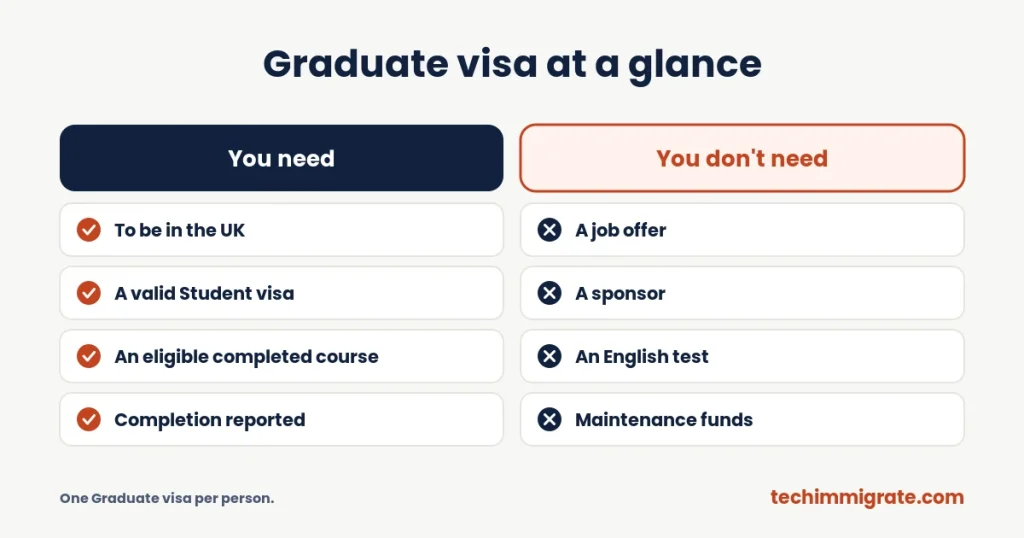
The Graduate visa has some of the simplest requirements of any UK work route. There is no job offer, no sponsor, no salary threshold, no English test and no maintenance funds to show. But the requirements it does have are strict, and missing one usually means refusal. The most common problems are timing: applying before your university has reported completion, or after your Student visa has already expired.
This guide explains every Graduate visa requirement in plain English: where you must be, which visa you must hold, which courses count, how long you must have studied in the UK, what your university must do, who cannot apply and what you do not need. For costs, see our guide to Graduate visa cost.
Key takeaways
- You must be in the UK when you apply.
- You must hold a Student visa, or the older Tier 4 (General) student visa, that is still valid.
- You must have successfully completed an eligible UK bachelor's degree, postgraduate degree or other eligible course.
- Your university must have told the Home Office that you completed your course.
- You usually must have studied in the UK for the whole course if it was 12 months or less, or for at least 12 months if it was longer.
- You cannot get a Graduate visa if you have had one before.
The Core Requirements
| Requirement | What it means |
|---|---|
| Location | You must be in the UK when you apply |
| Current visa | A valid Student or Tier 4 (General) visa |
| Course | An eligible UK bachelor's, postgraduate or other eligible course |
| Completion | Your provider has reported successful completion |
| Time in the UK | Minimum study time in the UK for your course |
| Previous Graduate visa | You must not have had one before |

Eligible Courses
Eligible courses usually include UK bachelor's degrees, postgraduate degrees such as master's and PhDs, and certain other courses such as a law conversion course, the Legal Practice Course, the Bar Practice Course and some professional qualifications. Your course must have been studied with a licensed student sponsor that has a track record of compliance.
Studying in the UK for Long Enough
If your course was 12 months or less, you usually must have studied in the UK for all of it. If it was longer than 12 months, you usually must have studied in the UK for at least 12 months.
Scholarship Consent
If a government or international scholarship agency paid your course fees and living costs in the last 12 months, you need their written consent to apply.
What You Do Not Need
- No job offer or sponsor.
- No salary threshold.
- No English test.
- No maintenance funds.
You must be in the UK on a Student visa, have completed an eligible course, and your university must have reported completion.
No. You can work, look for work or be self-employed.
No. English was assessed for your Student visa.
No. You can only get a Graduate visa once.
No. You can apply once your university has reported completion.
Why the Requirements Are Simple but Strict
The Graduate visa is designed as a reward for completing a UK degree. Because the Home Office already knows a great deal about you from your Student visa, it does not need to test your English, your finances or your job. Instead, it focuses on a few objective facts: where you are, what visa you hold, what you studied and whether you finished. Those facts are easy to check, which is why the route is relatively straightforward. But because they are objective, there is little room for discretion. If one requirement is not met, the caseworker usually has to refuse, even if everything else is perfect.
Being in the UK When You Apply
You must apply from inside the UK. If you leave after your course ends, even for a short holiday, and your Student visa is still valid, you can usually return and apply as long as the visa remains valid. But if you are outside the UK, you cannot apply. Many graduates plan a trip home after their course and then discover they cannot apply from there. If you want a Graduate visa, apply first, wait for the decision and then travel.
Holding a Valid Student Visa
Your current permission must be a Student visa or the older Tier 4 (General) student visa. It must still be valid on the day you apply. If it expires, even by one day, you cannot apply for the Graduate visa. People on other visas, such as dependant visas or visitor visas, cannot switch to the Graduate visa, even if they hold a UK degree. If you studied as a dependant of someone else, for example, you are not eligible.
What Counts as Successful Completion
Successful completion means you have passed the course you were sponsored to study, according to your university's rules. It does not mean you have attended graduation or received your certificate. If you were sponsored for a master's but left with a lower award, such as a postgraduate diploma, check with your university. In some cases, a lower award may not count as completing the course you were sponsored for.
How Completion Reporting Works
Your university is your sponsor on the Student route. When you complete your course, it must tell the Home Office through its sponsor management system. Until this happens, your Graduate visa application cannot be approved. Ask your university when it will report. Many send students an email confirming it has been done. Wait for that confirmation before you apply.
Bachelor's Degrees
A UK bachelor's degree completed with a licensed student sponsor usually qualifies. That includes standard three-year degrees, four-year degrees with a placement year and integrated master's degrees. Foundation degrees and some other undergraduate qualifications may not qualify. Check the eligibility rules if your award is unusual.
Postgraduate Degrees
Master's degrees, including taught and research master's, usually qualify. PhDs and other doctoral qualifications qualify and lead to a longer, three-year Graduate visa. Postgraduate certificates and diplomas may qualify in some cases. Check the rules for your specific award.
Professional and Other Courses
Some professional courses also qualify. These include certain law courses, such as the law conversion course, the Legal Practice Course and the Bar Practice Course, and some teaching qualifications. The list is set out in the Immigration Rules, so check it if you studied a professional course.
Courses That Do Not Qualify
Courses that are not degree-level, such as many short courses, English language courses and foundation programmes, do not usually qualify. Courses studied mainly outside the UK, such as distance learning programmes, do not usually qualify either. If you are unsure, ask your university's international student team.
Minimum Study Time in the UK
The rules require you to have studied in the UK for a minimum period. If your course lasted twelve months or less, you usually must have studied in the UK for the whole course. If it lasted longer, you usually must have studied in the UK for at least twelve months. During the pandemic, temporary concessions allowed some remote study to count, but those concessions have ended for new students.
Studying Abroad as Part of Your Course
Some courses include a period abroad, such as a study exchange or placement. Whether this affects your eligibility depends on how long you spent in the UK overall and whether the time abroad was a formal part of the course. Check with your university if your course included time outside the UK.
Scholarship Consent
If a government or international scholarship agency paid both your fees and your living costs in the twelve months before you apply, you need written consent from that agency. This rule exists because some scholarships require graduates to return home. Without consent, your application can be refused. Check your scholarship terms early.
You Cannot Have Had a Graduate Visa Before
You can only get a Graduate visa once. If you held one after a previous degree, you cannot get another, even after completing a new course. The same applies if you held permission under the older Doctorate Extension Scheme. If you are planning further study, think about how this affects your options.
No English Test
There is no English language requirement for the Graduate visa. Your English was assessed when you applied for your Student visa. You do not need a new test or certificate.
No Maintenance Funds
There is no requirement to show savings. That makes the Graduate visa easier than many routes, where you must show funds held for twenty-eight days. You still need to pay the fee and health surcharge, which is a significant cost.
No Job Offer or Sponsor
You do not need a job offer, a sponsor or any minimum salary. You can work in almost any job, at any skill level, be self-employed or look for work. This is the main attraction of the route.
Restrictions Once You Have the Visa
Once granted, you cannot claim most public funds, work as a professional sportsperson or sports coach, or study on a course that would be eligible for a Student visa. You can do some study, such as evening classes or short courses, as long as it is not a course that requires a Student visa.
Dependants
Partners and children can usually stay with you if they were already your dependants on your Student visa. Children born in the UK during your stay can also apply. New partners cannot usually join you on this route. Each dependant applies separately and pays their own fees.
Timing Requirements
The most important timing rule is that you apply after completion is reported and before your Student visa expires. The window between these dates varies. For some students it is several months. For others, especially on courses that end close to the visa expiry, it may be a few weeks. Check both dates early.
Common Reasons for Refusal
The most common reasons graduates report for refusal are applying before completion was reported, applying after the Student visa had expired, applying from outside the UK and having held a Graduate visa before. Missing scholarship consent is another. Each of these is avoidable with careful checks.
Checking Your Eligibility Before Applying
Before you apply, go through each requirement one by one. Confirm that you are in the UK, that your Student visa is valid, that your course qualifies, that completion has been reported, that you studied in the UK long enough, that you have never held a Graduate visa and that you have scholarship consent if needed. If all are met, you are ready to apply.
Our Summary
The Graduate visa has simple requirements, but they are strict. Focus on timing, location and your current visa. If those are right, most applications are straightforward.
How the Requirements Compare With Skilled Worker
It is worth comparing the Graduate visa with the Skilled Worker visa, because many graduates consider both. Skilled Worker requires a job offer from a licensed sponsor, an eligible occupation, a minimum salary and English at a set level. The Graduate visa requires none of these. But Skilled Worker counts towards settlement and can be extended, while the Graduate visa does neither. Graduates who already have a sponsored offer before their Student visa ends sometimes switch straight to Skilled Worker. Others use the Graduate visa first to explore the job market without pressure.
How the Requirements Compare With Global Talent
Global Talent has very different requirements. Instead of a degree and a Student visa, it looks at your record of achievement and potential in your field, assessed by an endorsing body. Few graduates meet the Global Talent criteria straight after their studies, but many build towards it during their Graduate visa. If that is your plan, start keeping records of your work, recognition and contributions from day one.
Requirements for Dependants
Dependants have their own requirements. A partner must have been your dependant on your Student visa and must show your relationship is genuine and ongoing. A child under eighteen must usually have been your dependant on your Student visa, unless born in the UK during your stay. A child over eighteen must already hold permission as your dependant. Children must live with you unless they are in full-time education elsewhere.
Identity and Documents
You will need a valid passport or other accepted identity document. Most applicants prove their identity with the UK Immigration: ID Check app. If the app does not work, you will need a service point appointment. You may also need your biometric residence permit if you still have one, although eVisas have largely replaced them.
When Rules Change
The Graduate visa rules have changed several times since the route opened, and further changes are planned, including the shorter eighteen-month length from January 2027. Always check GOV.UK and the Immigration Rules before applying, because requirements in force on the day you apply are the ones that count.
Getting Help
Your university's international student advisers are usually the best first source of help. They know your course, your completion date and your Student visa history. For complex situations, such as a previous refusal or a gap in your immigration history, consider a regulated immigration adviser.
A Fictional Example of Getting It Right
Consider a fictional software engineering master's student whose course runs for twelve months and whose Student visa ends four months after the course end date. During the year, they study entirely in the UK, apart from a two-week holiday during the winter break. After their final dissertation is marked, the university ratifies results and sends an email confirming it has reported successful completion to the Home Office. The student checks that their Student visa is still valid, confirms that they have never held a Graduate visa, and notes that their course was self-funded, so no scholarship consent is needed. They apply the following day from their flat in the UK, prove their identity with the app and continue job hunting. Every requirement is met on the day of application, which is exactly what the caseworker checks. The example is fictional, but it shows how simple the route is when the timing is right.
A Fictional Example of Getting It Wrong
Now consider a different fictional graduate. Their course ends in September, and they fly home in October to see family, planning to apply from there. When they try to apply, they discover that the Graduate visa can only be applied for from inside the UK. They return before their Student visa expires and apply, but they submit two days before their university reports completion. The application is refused because completion had not been reported when the caseworker checked, and by the time they realise, their Student visa has expired, so they cannot reapply. Each mistake on its own was avoidable. Together, they cost the graduate the route entirely. Careful attention to location and timing would have prevented both problems.
The Role of Your University as Sponsor
Until your Graduate visa is granted, your university remains your Student route sponsor. It holds information about your attendance, your course dates and your results, and it reports key events to the Home Office. That makes your university central to your Graduate visa application. Keep in touch with its international student team as your course ends, and make sure your contact details are up to date so you receive their emails about completion reporting. If you change your course, extend your studies or have a break in study, ask how that affects your eligibility and the timing of your application.
What Happens if Your Course Was Extended or Changed
Some students extend their studies, repeat a year or change course during their Student visa. If that happened to you, your eligibility depends on what you were ultimately sponsored for and whether you completed it. A change of course usually needs a new Confirmation of Acceptance for Studies and sometimes a new Student visa application. If your records are complicated, ask your university to confirm exactly what it will report and when, before you apply for the Graduate visa.
How Previous Immigration History Can Matter
The core Graduate visa requirements focus on your current Student visa and course, but the general grounds for refusal still apply. Serious criminal convictions, previous deception, unpaid NHS debts and some breaches of immigration conditions can all lead to refusal, regardless of whether the core requirements are met. If any of these apply to you, take advice before applying. Being honest in your application is essential, because deception can lead to long re-entry bans.
Planning Ahead From Your First Year
If you know from the start of your degree that you want to stay and work afterwards, plan ahead from your first year. Spend the required time studying in the UK, keep your Student visa valid, avoid long unauthorised absences and keep in touch with your university. Think about the work experience and achievements you can build during your studies, because they will help you find a job on the Graduate visa and, later, a longer-term visa. Graduates who plan early tend to make the most of the route.
Questions Graduates Often Ask
Graduates often ask whether a poor grade affects eligibility. It does not, as long as you passed the course you were sponsored to study. Others ask whether they can apply while waiting for a resit result. They cannot, because completion has not yet been reported. Some ask whether part-time study counts. The Student route is usually for full-time study, and the Graduate visa follows from that. Another frequent question is whether you can apply if your university's licence was suspended after you finished. In that situation, the rules can be more complex, so check GOV.UK and ask your university for guidance. If your question is not answered here, your university's international student advisers are usually the best people to ask first, because they can see your record and know how your course was reported.
Your Next Step
If you want a route with no sponsor after your Graduate visa, look at Global Talent. Our role-specific Global Talent guides explain what Tech Nation looks for.
How We Checked This Article
We checked eligibility rules against GOV.UK's Graduate visa eligibility page and the Immigration Rules Appendix Graduate in November 2026.
Tech Immigrate is independent of the Home Office. This article is general information, not legal advice. Check GOV.UK before you apply.
We write practical guides for tech professionals applying for the UK Global Talent visa. Tech Immigrate is independent of Tech Nation and the Home Office, and our articles are general information, not legal advice. Rules and fees change, so always check gov.uk before you apply.


