
Is the Skilled Worker Visa Temporary? How It Leads (or Doesn’t) to Settlement
Is the Skilled Worker visa temporary? How long each grant lasts, why there is no maximum stay, how it leads to ILR, and how the reforms change the path.


In this article
- What "Temporary" Means in UK Immigration
- How Long Each Skilled Worker Visa Lasts
- No Maximum Stay
- How the Skilled Worker Route Leads to Settlement
- Visas That Really Are Temporary
- What Makes Your Stay Depend on Your Sponsor
- What Can Stop You Settling
- The Earned Settlement Reforms
- How to Make the Skilled Worker Route Work Long Term
- What Temporary Status Means Day to Day
- Can You Buy a Home on a Skilled Worker Visa?
- What Happens at the End of Each Visa
- Your Family on a Temporary Visa
- Long-Term Planning on a Time-Limited Visa
- Why the Government Keeps the Route Open to Settlement
- Questions to Ask Yourself
- Temporary Status and Your Career
- Is Global Talent Less Temporary?
- A Worked Example: A Long-Term Plan
- A Worked Example: When the Route Feels Temporary
- Common Misunderstandings
- A Temporary Visa With a Permanent Destination
- How We Checked This Article
Is the Skilled Worker visa a temporary visa? It is a reasonable question, and the answer is both yes and no. Each grant of Skilled Worker permission is time-limited, ending on a fixed date. But unlike many UK visas, the Skilled Worker route can be extended without limit and can lead to permanent residence, known as indefinite leave to remain (ILR). It is a temporary visa on a permanent path, as long as you keep meeting the rules.
This guide explains what makes the Skilled Worker visa temporary, how it leads to settlement, how it compares with UK visas that really are temporary, what can stop you settling, and how the earned settlement reforms announced on 2 November 2026 could change the length of the path. It is written for tech workers deciding whether the Skilled Worker route can give them a long-term future in the UK.
Key takeaways
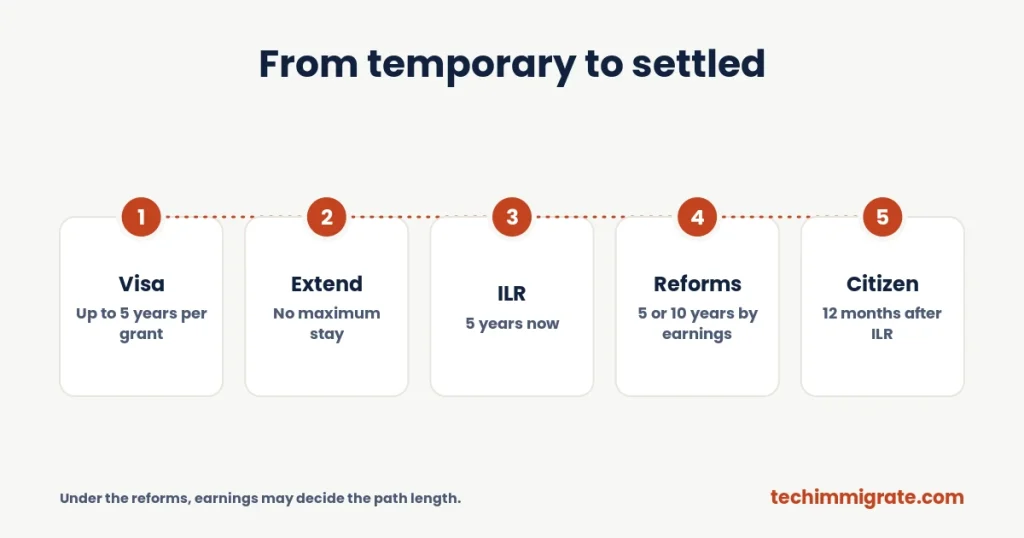
- Each Skilled Worker visa is granted for a fixed period, up to 5 years at a time, linked to your certificate of sponsorship.
- There is no overall limit on how long you can stay on the route. You can extend as many times as you need, as long as you meet the rules.
- Under the current rules, the Skilled Worker route leads to ILR after 5 years.
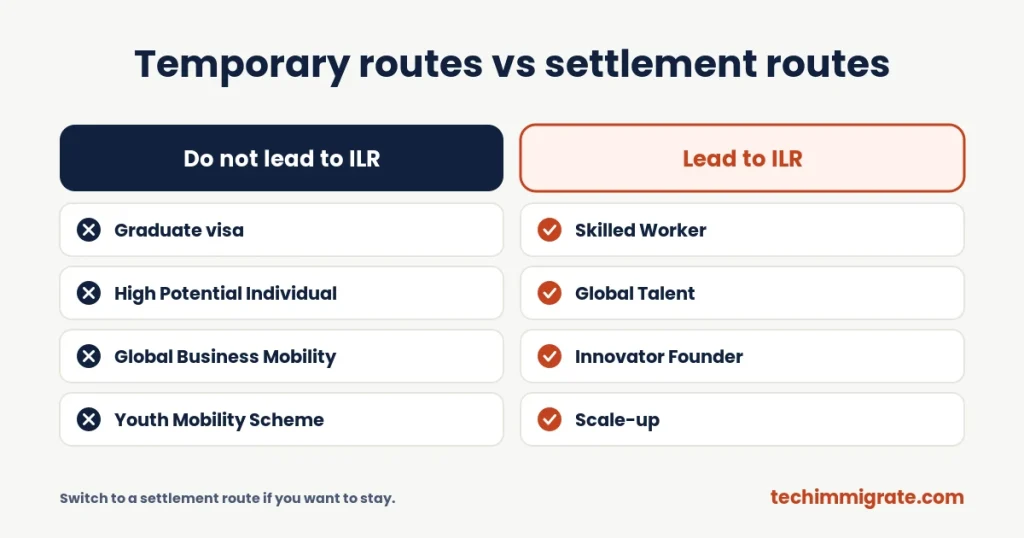
- Some UK visas really are temporary and do not lead to settlement, including the Graduate, High Potential Individual and Global Business Mobility routes.
- Your stay depends on your sponsor. If your job ends, your visa is usually shortened, often to 60 days.
- Under the earned settlement proposals, the default path to ILR becomes 10 years, with 5 years for people earning at least £50,271 and 3 years for the highest earners.
- For most tech professionals, the Skilled Worker route is a realistic path to permanent residence, but it depends on keeping a sponsor and meeting salary rules over time.
What "Temporary" Means in UK Immigration
In UK immigration law, most visas give "limited leave": permission to be in the UK for a set period, with conditions. The opposite is "indefinite leave": permission with no time limit.
In that sense, the Skilled Worker visa is temporary. It gives limited leave, with an end date and conditions, such as working only for your sponsor and not claiming most public funds. Your eVisa shows the end date, and employers and landlords will see it when they check your status.
But there is a second, more practical meaning. People often ask whether a visa is temporary because they want to know whether it can lead to staying permanently. On that question, the Skilled Worker route is not temporary in the way some other routes are. It is designed to be a route to settlement.
How Long Each Skilled Worker Visa Lasts
Each grant of Skilled Worker permission lasts as long as your certificate of sponsorship says, up to a maximum of 5 years per grant, plus a short additional period. Common patterns are:
- a 3-year visa followed by a 2-year extension, reaching 5 years;
- a single 5-year visa;
- several shorter visas, especially if you change employer.
When your visa nears its end, you can extend it with the same sponsor, move to a new sponsor, switch to another route, or, if you are eligible, apply for ILR.
No Maximum Stay
The old Tier 2 (General) visa had a maximum total stay of 6 years for people who did not qualify for settlement. That limit was removed when the Skilled Worker route replaced Tier 2 in December 2020. There is now no maximum stay on the route. You can extend as many times as you need, as long as you continue to meet the requirements.
This matters because it means a Skilled Worker who is not yet eligible for ILR, for example because they have not passed the Life in the UK test or because the rules change, can usually extend rather than having to leave. Our guide to Tier 2 vs Skilled Worker explains the differences.
How the Skilled Worker Route Leads to Settlement
Under the current rules, a Skilled Worker can apply for ILR after 5 years on the route, if they:
- are still sponsored, and their sponsor confirms they still need them;
- are paid at least the settlement salary requirement for their occupation;
- have lived in the UK continuously, with no more than 180 days outside the UK in any 12-month period;
- have passed the Life in the UK test and met the English requirement;
- meet the suitability rules.
Once you have ILR, your stay is no longer temporary. You can live, work and study in the UK without time limits, and usually apply for British citizenship 12 months later. Our ILR requirements checklist for Skilled Workers explains the details.
Visas That Really Are Temporary
Some UK visas give limited leave that cannot lead to settlement on its own. For tech professionals, the most common are:
| Visa | Typical length | Leads to settlement? |
|---|---|---|
| Graduate | 2 years (18 months for most from 1 January 2027), 3 years for PhD | No |
| High Potential Individual | 2 years, 3 for PhD | No |
| Global Business Mobility | Varies by category | No |
| Youth Mobility Scheme | Usually 2 or 3 years | No |
| Visitor | Usually up to 6 months | No |
| Skilled Worker | Up to 5 years per grant, extendable | Yes |
| Global Talent | Up to 5 years per grant, extendable | Yes |
People on truly temporary visas usually need to switch to a route like Skilled Worker or Global Talent if they want to stay long term.
What Makes Your Stay Depend on Your Sponsor
The Skilled Worker route can lead to settlement, but your path depends on your employer. If your sponsorship ends, for example through redundancy, resignation without a new sponsor, or your employer losing its licence, your visa will usually be shortened, often to 60 days. In that time, you need to find a new sponsor, switch to another route, or leave.
This dependence is the main sense in which the Skilled Worker visa feels temporary to many people. Even if the route leads to settlement, every step depends on keeping a sponsored job that meets the rules.
What Can Stop You Settling
Common reasons a Skilled Worker does not reach ILR on time include:
- Losing sponsorship and not finding a new sponsor within the 60-day window.
- Salary falling below the settlement threshold, for example after a pay cut or a move to a lower-paid role.
- Long absences that break continuous residence.
- Missing knowledge requirements, such as the Life in the UK test or English evidence.
- Immigration breaches, such as working for an employer other than your sponsor.
- Rule changes, which can change the length of the path or the requirements.
Most of these can be avoided with planning. The ones that are hardest to control are redundancy and rule changes. You can reduce the impact of redundancy by keeping your skills and network current and having savings to cover a job search. You can reduce the impact of rule changes by applying for ILR as soon as you are eligible rather than waiting for a convenient moment.
The Earned Settlement Reforms
The government's response to the earned settlement consultation, published on 2 November 2026, proposes a new framework for settlement:
- 10-year default for most migrants, with earnings of at least £12,571 in five of the last seven years;
- 5-year path for people earning at least £50,271 in three of the last five years;
- 3-year path for people earning at least £125,141 in three of the last four years, or in the highest talent group;
- 20-year path in some cases, such as after a qualifying breach or recent reliance on public funds.
New mandatory requirements would include English at B2, no debts to public bodies, and a sustained contribution requirement. The changes are expected to be implemented over 2027, with no general transitional protection for people already on the route.
For Skilled Workers, this means the route still leads to settlement, but for many people the path could be longer. Tech workers earning above £50,271 may keep a 5-year path. Those on lower salaries could face 10 years. Our guide to the new ILR rules for Skilled Worker visa holders explains the details.
How to Make the Skilled Worker Route Work Long Term
If you want the Skilled Worker route to lead to a permanent future, plan for it from the start:
- Choose sponsors carefully. A well-established sponsor with a good compliance record reduces the risk of losing sponsorship unexpectedly.
- Track your salary. Under the reforms, earnings may decide your path. Aim for salary growth, especially if you are on a new entrant rate.
- Keep your absences low. Log every trip abroad.
- Pass the Life in the UK test early, and get English evidence at B2.
- Apply for ILR as soon as you are eligible, rather than extending again.
- Keep your family's visas aligned, so everyone can settle together.
What Temporary Status Means Day to Day
Being on a time-limited visa affects everyday life in ways that people often only notice once they arrive:
- Right-to-work checks. Your employer must check your status before you start and again before your visa expires.
- Right-to-rent checks. In England, landlords must check your status, and may recheck before your visa ends.
- No recourse to public funds. You cannot claim most state benefits, even though you pay tax and National Insurance.
- Health surcharge. You pay the Immigration Health Surcharge for each year of your visa, rather than using the NHS on the same basis as settled residents.
- University fees. Children may be charged international fees rather than home fees, depending on their status and residence.
- Travel. You can travel freely, but you must keep your eVisa up to date and avoid long absences that could affect settlement.
These restrictions all fall away once you get ILR, which is why settlement makes such a difference in practice.
Can You Buy a Home on a Skilled Worker Visa?
Yes. There is no immigration rule stopping Skilled Workers from buying property in the UK. However, some mortgage lenders treat applicants on time-limited visas more cautiously. They may ask for a larger deposit, limit the mortgage term, or require a minimum amount of time left on your visa. Other lenders specialise in lending to visa holders. Shop around, and consider using a mortgage broker who works with people on work visas.
What Happens at the End of Each Visa
Every time your Skilled Worker visa approaches its end date, you have a decision to make:
- Extend with your current sponsor, if your job continues and you meet the rules.
- Change employer, with a new certificate from a new sponsor.
- Apply for ILR, if you have reached 5 years and meet the requirements.
- Switch to another route, such as Global Talent, if you qualify.
- Leave the UK, if none of the above is possible.
You must act before your current visa expires. If you apply in time, your existing permission continues while your application is decided. If you do not, you may become an overstayer, which can harm future applications and your path to settlement. Our guide to extending a Skilled Worker visa explains the process.
Your Family on a Temporary Visa
Your partner and children hold dependant visas linked to yours. Their visas are also time-limited and usually end on the same date as yours. Each needs to extend when you extend, and each can apply for ILR when they meet the requirements. Partners can usually work for almost any employer, which gives them more flexibility than the main applicant in some ways. Our guide to the Skilled Worker dependant visa explains the rules.
Long-Term Planning on a Time-Limited Visa
Many Skilled Workers find it hard to plan long term while their status depends on an end date. Practical steps that help:
- Pensions. Join your employer's pension scheme. Your contributions are yours whether you stay or leave, and many schemes can be transferred.
- Savings. Build an emergency fund that would cover living costs for at least 60 days, the usual period after losing sponsorship.
- Housing. Consider renting until you are close to settlement if mortgage terms are poor, or use a specialist lender.
- Career. Keep your skills and network strong, so that finding a new sponsor quickly is realistic if you need to.
- Records. Keep payslips, P60s and travel logs from day one, ready for settlement.
Why the Government Keeps the Route Open to Settlement
The Skilled Worker route is designed to help employers fill skilled roles, and many of those roles are long term. Allowing workers to settle helps employers keep experienced staff and helps workers build lives in the UK. Even under the earned settlement reforms, the government has kept a path to settlement for Skilled Workers. What has changed is the length of that path and the conditions attached to it, with earnings and contribution playing a much bigger role.
For tech workers, who are often well paid and in high-demand roles, this means the Skilled Worker route remains a credible way to build a permanent future in the UK, as long as they plan for the requirements.
Questions to Ask Yourself
If you are deciding whether the Skilled Worker route can give you the long-term future you want, ask:
- Is my employer likely to keep sponsoring me for 5 years or more?
- If not, how easy would it be to find another sponsor in my field and location?
- Is my salary likely to stay above £50,271, so I stay on a 5-year path under the reforms?
- Do I travel a lot, and can I keep my absences within the limits?
- Would I qualify for a less employer-dependent route, such as Global Talent?
The answers will tell you whether Skilled Worker is the right long-term route, or a stepping stone to something else.
Temporary Status and Your Career
For many tech professionals, the most noticeable effect of being on a temporary, sponsored visa is on their career choices. On Skilled Worker, you cannot easily:
- join an early-stage start-up that does not hold a sponsor licence;
- take a lower-paid role in an area you want to move into, if it falls below the threshold;
- go freelance or start your own company;
- take an extended career break.
These limits are temporary too. Once you get ILR, they disappear. Many people plan their career in two phases: building experience and salary with a sponsor until they settle, then taking bigger risks once they have permanent status. If you would rather not wait, Global Talent offers the freedom to make those choices earlier.
Is Global Talent Less Temporary?
Global Talent is also a time-limited visa that can lead to settlement, but it is not tied to a sponsor. You can change jobs, freelance or start a business without affecting your visa. People endorsed under exceptional talent can settle after 3 years under the current rules, and under the reforms, recognised talent is expected to keep a shorter path.
For tech professionals with a strong track record, this makes Global Talent feel much less temporary in practice. Losing a job does not shorten your visa. Time on Skilled Worker can usually be combined with Global Talent towards settlement, so switching does not mean starting again. Our comparison of Global Talent vs Skilled Worker explains the trade-offs.
A Worked Example: A Long-Term Plan
A software engineer arrives on a 3-year Skilled Worker visa in 2024 at £60,000.
- 2027: she extends for 2 years with a pay rise to £70,000.
- 2029: she reaches 5 years. Under the current rules, she would apply for ILR.
- Under the reforms: her earnings are above £50,271 in every year, so she would likely be on a 5-year path, and could still apply in 2029.
- 2030: she applies for British citizenship, 12 months after ILR.
For her, the Skilled Worker visa was temporary at each step, but the route led to permanent status.
A Worked Example: When the Route Feels Temporary
A junior developer joins on a new entrant salary of £36,000 in 2026. His employer runs into financial trouble in 2028 and he is made redundant.
- His visa is shortened to 60 days.
- He finds a new sponsor after 7 weeks and applies just in time.
- His salary is still below £50,271. Under the reforms, he could face a 10-year path unless his earnings rise.
For him, the route has felt temporary and uncertain. He focuses on building his skills and salary, and on building a public profile that could support a Global Talent application in the future.
Common Misunderstandings
- "The Skilled Worker visa is permanent." It is not. Each grant is time-limited, but the route can lead to ILR.
- "There is a 6-year limit." That applied to Tier 2. There is no maximum stay on Skilled Worker.
- "Time on a Graduate visa counts towards Skilled Worker settlement." It does not.
- "Losing my job means I have to leave immediately." Your visa is usually shortened to 60 days, giving you time to find a new sponsor or switch.
- "The reforms only apply to new applicants." The response says there is no general transitional protection.
Each grant is time-limited, but the route can be extended without limit and leads to settlement after 5 years under the current rules.
Up to 5 years per grant, and you can extend as many times as you need, as long as you meet the rules.
Yes. Under the current rules, after 5 years. Under the proposed reforms, the default becomes 10 years, with 5 years for people earning at least £50,271.
The Graduate, High Potential Individual, Global Business Mobility, Youth Mobility Scheme and visitor visas do not lead to settlement on their own.
Your visa will usually be shortened, often to 60 days, so you can find a new sponsor or switch route.
No. The 6-year maximum that applied to Tier 2 was removed.
A Temporary Visa With a Permanent Destination
The Skilled Worker visa is temporary in the legal sense, but for most tech professionals who keep a sponsor and meet the salary rules, it leads to permanent residence. Plan for settlement from day one, keep your salary and records in good shape, and apply for ILR as soon as you can. If you want a route that is less tied to your employer, our role-specific Global Talent guides explain what Tech Nation looks for.
How We Checked This Article
We checked the Skilled Worker route's length, extension and settlement rules against GOV.UK's Skilled Worker pages and settlement page in November 2026. Settlement reforms are from law firm summaries of the earned settlement response of 2 November 2026.
Tech Immigrate is independent of the Home Office. This article is general information, not legal advice. Check GOV.UK before you apply.
We write practical guides for tech professionals applying for the UK Global Talent visa. Tech Immigrate is independent of Tech Nation and the Home Office, and our articles are general information, not legal advice. Rules and fees change, so always check gov.uk before you apply.


