Documents Needed for Indefinite Leave to Remain: A Checklist by Route
Indefinite leave to remain documents: what every applicant needs, plus evidence for Skilled Worker, Global Talent, partner and long residence routes.


In this article
- Documents Every Applicant Needs
- Skilled Worker Applicants
- Global Talent Applicants
- Partner Route Applicants
- Long Residence Applicants
- Dependants
- Translations
- How to Organise Your Documents
- Writing a Clear Absence Record
- The Sponsor Letter in More Detail
- Earnings Evidence for Global Talent Holders
- English Evidence: What Counts
- Older and Missing Documents
- Documents for Suitability
- Evidence You May Need Under the New Rules
- Uploading Your Documents
- Common Document Mistakes
- The Bottom Line
- Getting Help
- A Simple Timeline for Gathering Documents
- Keep Copies for the Future
- Documents for Partners of Work Visa Holders
- Documents for Children
- What Happens if Documents Are Missing
- Identity Documents and Your eVisa
- Documents for Applicants Who Changed Routes
- Documents for Absences Over the Limit
- Checking Documents Against GOV.UK
- Proof You Applied in Time
- Documents for Self-Employed Applicants
- A Note on Format
- Why Getting It Right First Time Matters
- One Final Check
- Your Next Step
- How We Checked This Article
Most indefinite leave to remain applications that run into trouble do so because of documents: a missing sponsor letter, an English result that does not meet the requirement, an absence record that does not add up, or a translation that is not certified. The rules themselves may be clear, but proving that you meet them takes careful preparation.
This guide is a document checklist for ILR applications, organised by what every applicant needs and then by route. It covers Skilled Worker, Global Talent, partner, long residence and dependant applications, with notes on translations, older documents and how to organise everything before you apply. For a step-by-step guide to the form itself, see our article on how to apply for ILR.
Key takeaways
- Every applicant needs proof of identity, evidence of their immigration history, an absence record, Life in the UK evidence, English evidence or an exemption, and the fee.
- Each route adds its own documents, such as a sponsor letter for Skilled Workers or earnings evidence for Global Talent holders.
- Documents not in English or Welsh need certified translations.
- Most applications are made online, with documents uploaded through the ID Check app or at a service point.
- The ILR fee is £3,226 per person. Standard decisions usually take up to 6 months.
- Under the earned settlement reforms, extra evidence may be needed from 2027, for example on earnings and debts.
Documents Every Applicant Needs
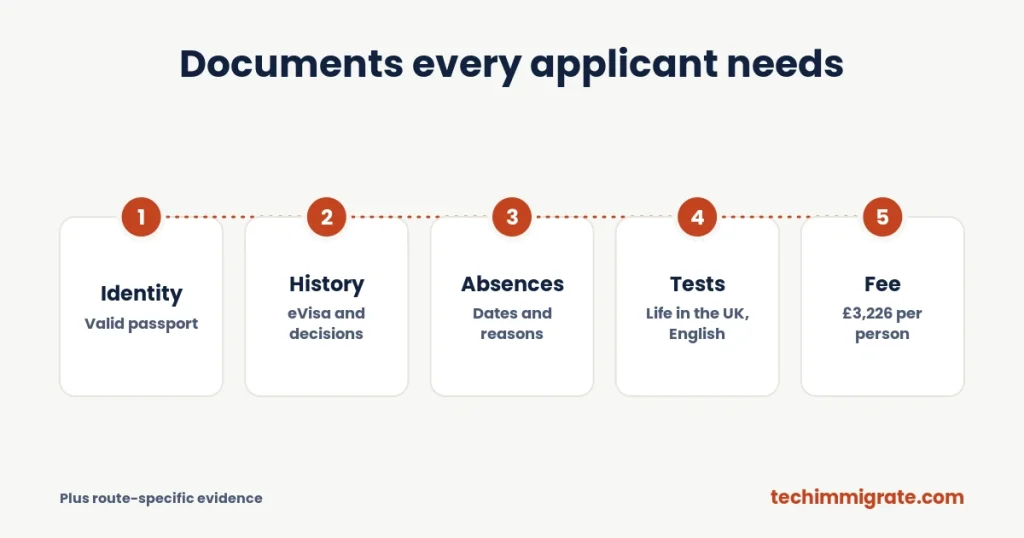
| Document | Why it is needed |
|---|---|
| Valid passport or travel document | To prove your identity and nationality |
| Access to your eVisa or previous visa documents | To confirm your immigration history |
| A list of absences from the UK | To show continuous residence |
| Life in the UK test reference | To show knowledge of life in the UK, unless exempt |
| English language evidence | To meet the English requirement, unless exempt |
| Payment of the fee | £3,226 per person |
Identity
You usually need a valid passport. If your passport has changed since your last visa, update your UKVI account so that your eVisa is linked to the new one.
Immigration history
The Home Office has its own records, but you should be ready to show your visa decision letters, especially if your history includes several routes.
Absences
List every trip outside the UK during your qualifying period, with dates and reasons. On most work routes, you must not have spent more than 180 days outside the UK in any 12-month period.
Life in the UK
The test costs £50, has 24 questions and must be booked at least 3 days ahead. Your pass is recorded electronically, and you provide your reference in the application.
English
You can usually show English with an approved test at the required level, a degree taught in English, or an exemption, for example as a national of a majority English-speaking country. The requirement is currently usually B1, and is planned to rise to B2 from 26 March 2027 under the earned settlement reforms.
Skilled Worker Applicants
In addition to the documents above:
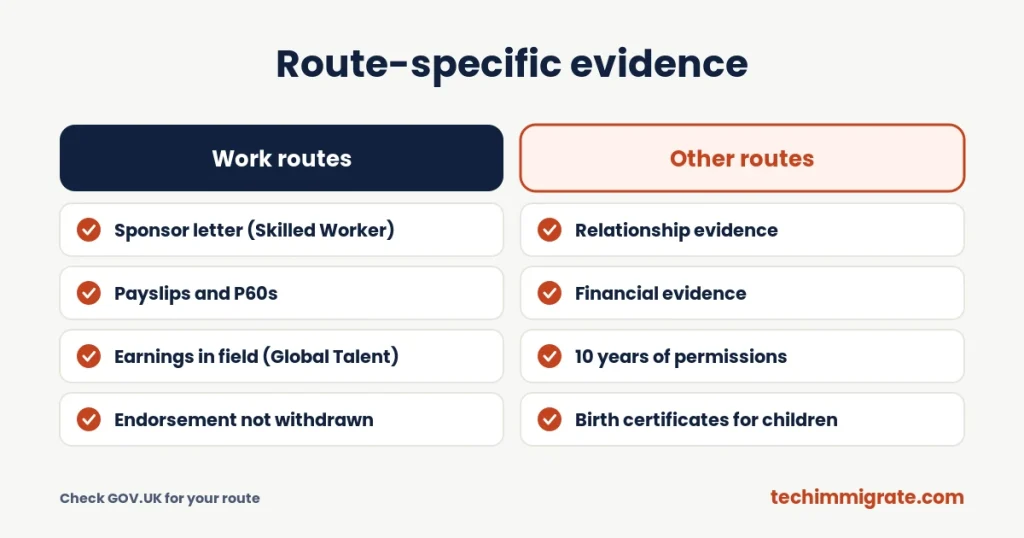
- A sponsor letter confirming that your employer still needs you in an eligible job and will continue to pay you at least the required salary.
- Recent payslips, showing your salary.
- Your P60s, useful supporting evidence of earnings.
Our article on ILR requirements for Skilled Workers explains what the sponsor letter should cover.
Global Talent Applicants
- Evidence that you earned money in your field during your time in the UK, for routes where this applies, such as digital technology. Useful documents include payslips, contracts, invoices, company accounts and tax returns.
- Confirmation of your endorsement, which must not have been withdrawn.
Our guide to Global Talent visa to ILR explains the requirements.
Partner Route Applicants
Partners of British citizens or settled people usually need:
- Evidence of the relationship, such as a marriage or civil partnership certificate.
- Evidence of living together, such as joint bills, tenancy agreements or bank statements at the same address, spread across the qualifying period.
- Financial evidence, showing that you meet the financial requirement.
- Accommodation evidence, showing adequate housing.
The family route has detailed evidence rules, so check GOV.UK carefully.
Long Residence Applicants
- Evidence of every period of permission over the 10 years, such as decision letters and passports.
- Evidence of applications made in time, where relevant.
- A detailed absence record for the whole 10 years.
- Supporting evidence of life in the UK, such as tax records and tenancy agreements, if needed.
Our guide to applying for ILR after 10 years covers long residence evidence in detail.
Dependants
Partners and children applying as dependants of a work visa holder usually need:
- Their own passports and immigration history.
- Evidence of the relationship, such as marriage or birth certificates.
- Evidence of living together, for partners.
- Their own Life in the UK and English evidence, for adults, unless exempt.
Children under 18 are usually exempt from the Life in the UK test and English requirement.
Translations
Any document not in English or Welsh needs a certified translation. The translation should include the translator's confirmation that it is accurate, the date, their full name and signature, and their contact details. Arrange translations early, because they can take time.
Proof of identity, your immigration history, an absence record, Life in the UK evidence, English evidence or an exemption, plus route-specific documents.
A sponsor letter confirming you are still needed and will be paid at least the required salary, plus recent payslips.
Evidence that you earned money in your field, where this applies, and an endorsement that has not been withdrawn.
Yes, any document not in English or Welsh needs a certified translation.
Children under 18 are usually exempt.
How to Organise Your Documents
A well-organised set of documents saves time and reduces the risk of mistakes. Create a folder for each category: identity, immigration history, absences, English, Life in the UK, route-specific evidence and family documents. Scan everything as clear PDFs and name each file so that its contents and date are obvious. When you complete the online form, keep your folders open alongside it, so that you can check every date and reference against the original document. If you are applying with family members, create a separate set of folders for each person.
Writing a Clear Absence Record
Your absence record is one of the most important documents in your application. List each trip with the date you left the UK, the date you returned, the number of days and the reason. Count the days carefully, usually excluding the day you left and the day you returned. Then check every rolling 12-month period to make sure none exceeds 180 days. If you travelled a lot for work, ask your employer for travel records to cross-check your dates. If you cannot find exact dates for an old trip, give your best estimate and explain how you reached it.
The Sponsor Letter in More Detail
For Skilled Workers, the sponsor letter is often the document most likely to cause delays. It should be on company letterhead, dated, signed by an authorised person, and confirm that your employer still requires you to work for it for the foreseeable future in an eligible job, and that it will continue to pay you at least the required salary. It helps if the letter also states your job title, occupation code, salary and start date with the company. Ask HR early, check the draft carefully, and make sure the details match your payslips.
Earnings Evidence for Global Talent Holders
Global Talent holders on the digital technology route need to show that they have earned money in their field. GOV.UK does not set a minimum amount or a fixed list of documents, so choose evidence that tells a clear story. Employees can use payslips, P60s and contracts. Freelancers and contractors can use invoices, bank statements and tax returns. Founders can use company accounts, payslips and dividend records. Include a short summary of your roles and how each relates to digital technology, so that the caseworker can see the link quickly.
English Evidence: What Counts
You can usually meet the English requirement in one of three ways. First, an approved Secure English Language Test at the required level from an approved provider. Second, a degree taught in English, with Ecctis confirmation if it is from outside the UK. Third, an exemption, such as being a national of a majority English-speaking country, being aged 65 or over, or having a long-term condition that prevents you meeting the requirement. Check that your evidence meets the level in force on the date you apply, especially if that is on or after 26 March 2027.
Older and Missing Documents
If you have been in the UK for many years, some documents may be lost or out of date. Old passports with visa vignettes, biometric residence permits and decision letters can all be important. If you cannot find them, you can request your immigration records from the Home Office through a subject access request, which is free but can take a month or more. Start early if you think you may need this.
Documents for Suitability
The application asks about criminal convictions, cautions and other matters that affect suitability. If you have any relevant history in the UK or abroad, gather documents such as court records or police certificates, and disclose them honestly. Failing to disclose information can lead to refusal for deception, which is more serious than the original issue. Under the earned settlement reforms, a UK criminal record and unpaid public debts are expected to become mandatory grounds for refusal.
Evidence You May Need Under the New Rules
The earned settlement framework planned from 2027 introduces new requirements, including a sustained contribution of at least £12,571 a year and no public debts. If you will apply under the new rules, you may need to show earnings over several years, and evidence that you have no outstanding NHS charges, tax debts or Home Office debts. Start keeping these records now: P60s, tax returns, payslips, and confirmations of any debts being paid. Our article on ILR new rules explains the planned requirements.
Uploading Your Documents
After you submit your online form and pay the fee, you prove your identity either with the UK Immigration: ID Check app or at a service point, and upload your supporting documents. Make sure each upload is clear, complete and readable. Upload documents in the categories requested, and avoid combining unrelated documents into one file. Poor-quality scans are a common cause of requests for more information.
Common Document Mistakes
- A sponsor letter that does not confirm you are still needed or does not mention salary.
- An absence record that does not match passport stamps or travel records.
- English evidence at the wrong level or from a non-approved provider.
- Uncertified translations.
- Missing relationship evidence for partners and dependants.
- Expired passports not linked to your UKVI account.
The Bottom Line
A successful ILR application is built on clear, complete documents. Start with the documents every applicant needs, add the evidence for your route, organise everything carefully and check it all against your online form before you submit. Starting a few months early gives you time to find missing documents and fix any problems.
Getting Help
If your history is complex, or you are unsure whether a document meets the requirements, check GOV.UK carefully or ask a regulated immigration adviser before you apply.
A Simple Timeline for Gathering Documents
- Six months before you apply: book the Life in the UK test and, if needed, an English test. Request any missing records from the Home Office.
- Four months before: start your absence record and gather your visa decision letters.
- Three months before: ask your employer for a sponsor letter, or gather earnings evidence if you are on Global Talent.
- Two months before: collect family documents and arrange translations.
- One month before: organise and scan everything, and check it against the online form.
Keep Copies for the Future
Once your application is decided, keep copies of everything you submitted. If you later apply for British citizenship, you will need to give details of your residence, absences and immigration history again. Having your ILR documents organised makes that application much easier.
Documents for Partners of Work Visa Holders
If your partner is applying for ILR as your dependant on the Skilled Worker or Global Talent route, they will usually need to show that your relationship is genuine and continuing, and that you have lived together throughout their qualifying period. Good evidence includes documents addressed to both of you at the same address, spread across the period, such as tenancy agreements, council tax bills, utility bills, bank statements and official letters. Aim for documents from different sources and different times, rather than many documents from one month. Your partner will also usually need their own Life in the UK pass and English evidence, unless exempt, and their own absence record, because the continuous residence rules apply to them too. Under the earned settlement reforms, partners who are with the main applicant are expected to settle at the same time, so preparing their documents alongside yours makes sense.
Documents for Children
Children applying for ILR as dependants usually need their passport, a full birth certificate showing both parents, and evidence that they live with you. If one parent is not applying, you may need to show that the applying parent has sole responsibility, or that both parents are settled or applying, or that the other parent consents. Children under 18 are usually exempt from the Life in the UK test and the English requirement. If a child has turned 18 since their last visa, check the rules for adult dependants, which may include showing that they are not leading an independent life.
What Happens if Documents Are Missing
If the Home Office finds that a document is missing or unclear, it may ask you for more information, usually by email, with a deadline to respond. This can delay your decision, even if you paid for a faster service, and the extra fee is usually not refunded. In some cases, missing evidence leads directly to refusal. The safest approach is to treat the checklist in this article as a starting point, check GOV.UK for your route, and submit everything you need the first time.
Identity Documents and Your eVisa
Your eVisa is linked to your passport. If you have renewed your passport since your last visa, update your UKVI account before you apply for ILR, so that the Home Office can match your identity to your immigration record. If you have changed your name, include evidence of the change, such as a marriage certificate or deed poll. Mismatches between your passport, your eVisa and your application form are a common source of delays.
Documents for Applicants Who Changed Routes
If you have held more than one visa during your qualifying period, for example Skilled Worker followed by Global Talent, include evidence for each period. Decision letters for each grant, along with documents showing you applied in time for each switch, help the caseworker see that your residence was continuous and lawful. Check the continuous residence guidance to confirm which routes can be combined for your settlement application.
Documents for Absences Over the Limit
If you exceeded the absence limit in any 12-month period, you will need strong evidence if you want the Home Office to consider whether the absence can be disregarded, for example because of serious illness, a natural disaster or another compelling reason. Medical letters, death certificates, evidence of travel restrictions or employer letters explaining unavoidable work requirements may help. There is no guarantee an absence will be disregarded, so consider getting advice before applying if this applies to you.
Checking Documents Against GOV.UK
The Home Office updates its guidance from time to time, and the documents needed can change, especially as the earned settlement reforms take effect. Before you apply, read the current GOV.UK guidance for your route and the settlement guidance for caseworkers. If anything in this checklist differs from GOV.UK, follow GOV.UK. Our article on ILR requirements explains each requirement behind these documents.
Proof You Applied in Time
Keep the confirmation email and receipt from every visa application you have made in the UK. These prove the date you applied, which shows that you applied before your previous permission expired. For long residence and work-route settlement alike, proof of in-time applications helps show that your residence was lawful throughout.
Documents for Self-Employed Applicants
If you have been self-employed or a company director during your qualifying period, for example on a Global Talent visa, your earnings evidence will look different from an employee's. Useful documents include your Self Assessment tax returns and HMRC tax calculations, company accounts filed with Companies House, invoices to clients, business bank statements, and records of salary and dividends paid to you. Make sure the documents show both the amount you earned and that the work was in your field.
A Note on Format
Upload documents as clear, complete scans or PDFs. Avoid photos taken at an angle, cropped pages or files that are hard to read.
Why Getting It Right First Time Matters
The ILR fee of £3,226 per person is usually not refunded if an application is refused. A refusal caused by a missing document means paying again, waiting again and, in some cases, dealing with gaps in your status. Under the planned earned settlement reforms, timing may also decide which rules apply to you. A complete set of documents is the best protection against all of these risks.
One Final Check
Before you submit, ask someone you trust to read through your form and documents with fresh eyes. A second reader often spots a wrong date, a missing page or an inconsistent name that you have stopped noticing.
Your Next Step
For tech professionals planning for settlement, the Global Talent visa offers one of the shortest paths. Our role-specific Global Talent guides explain what Tech Nation looks for.
How We Checked This Article
We checked the documents for each route against GOV.UK's guidance on indefinite leave to remain, the Skilled Worker and Global Talent pages, and GOV.UK's guidance on certified translations, in November 2026. Settlement reforms are from summaries of the earned settlement response of 2 November 2026.
Tech Immigrate is independent of the Home Office. This article is general information, not legal advice. Check GOV.UK before you apply.
We write practical guides for tech professionals applying for the UK Global Talent visa. Tech Immigrate is independent of Tech Nation and the Home Office, and our articles are general information, not legal advice. Rules and fees change, so always check gov.uk before you apply.