
How Long Is the Graduate Visa? 2 Years, 18 Months or 3 Years
How long is the Graduate visa? 2 years if you apply by 31 December 2026, 18 months from January 2027 and 3 years for PhDs. When it starts and ends.


In this article
- Graduate Visa Length at a Glance
- When the Visa Starts
- When It Ends
- No Extensions
- Settlement
- Why the Length Matters So Much
- The Change From January 2027
- Applying Before the Deadline
- How the Start Date Works
- How the End Date Works
- Dependants and the Visa Length
- PhD Graduates and the Three-Year Visa
- Why the Visa Cannot Be Extended
- Switching Before the End
- Timing a Skilled Worker Switch
- Building Towards Global Talent
- Settlement and the Graduate Visa
- Travel During Your Graduate Visa
- What Happens if You Leave Early
- Planning Your Time in Stages
- Our Summary
- Comparing Lengths With Other Routes
- What the Shorter Visa Means for Employers
- A Fictional Two-Year Plan
- A Fictional Eighteen-Month Plan
- How to Find Your Exact End Date
- What Happens if You Apply for Another Visa Late in Your Graduate Visa
- Career Breaks and Gaps
- Self-Employment and Freelancing
- Further Study During or After Your Graduate Visa
- How the Visa Length Interacts With New Entrant Rules
- Checking for Further Changes
- Using the First Months Well
- Using the Middle Period Well
- Using the Final Months Well
- A Checklist for Your Visa Timeline
- Talking to Your Family About the Timeline
- Your Next Step
- How We Checked This Article
How long you can stay on a Graduate visa depends on two things: the qualification you completed and the date you apply. For most graduates, the answer has been two years. But for applications made from 1 January 2027, the standard length falls to 18 months. PhD and other doctoral graduates keep three years. Because the visa cannot be extended, its length sets the time you have to find work, build experience and move onto your next visa.
This guide explains how long the Graduate visa lasts, when it starts and ends, how the 2027 change works, what happens when it runs out and how to make the most of the time. For eligibility, see our guide to Graduate visa requirements.
Key takeaways
- The Graduate visa lasts 2 years if you apply on or before 31 December 2026.
- From 1 January 2027, it lasts 18 months for bachelor's and master's graduates.
- PhD and other doctoral graduates get 3 years.
- The visa starts on the day your application is approved, not the day you apply.
- It cannot be extended. You must switch to another visa or leave before it ends.
- Time on the Graduate visa does not usually count towards settlement.
Graduate Visa Length at a Glance
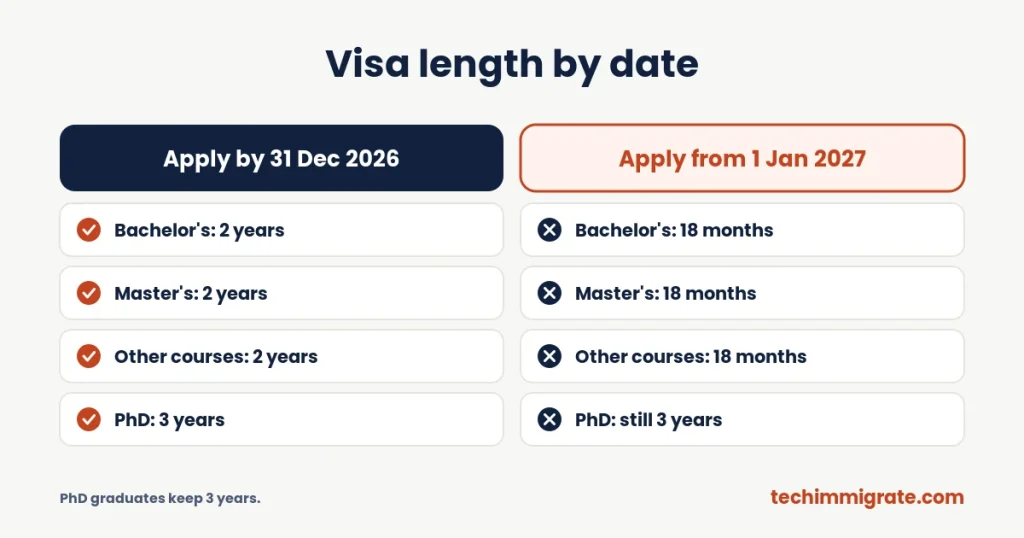
| Qualification | Apply on or before 31 Dec 2026 | Apply from 1 Jan 2027 |
|---|---|---|
| Bachelor's degree | 2 years | 18 months |
| Master's degree | 2 years | 18 months |
| Other eligible courses | 2 years | 18 months |
| PhD or other doctorate | 3 years | 3 years |
When the Visa Starts
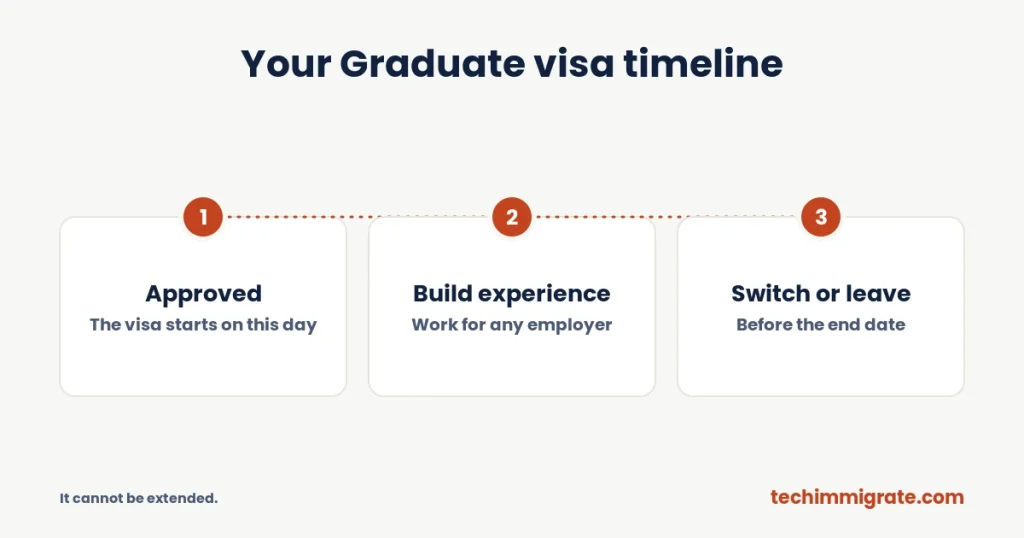
The Graduate visa starts on the day it is approved. If you apply in November and are approved in January, your visa runs from January.
When It Ends
Your eVisa shows the end date. Dependants' visas end on the same date as yours.
No Extensions
You cannot extend a Graduate visa. Before it ends, you need to switch to another route, such as Skilled Worker or Global Talent, or leave the UK.
Settlement
Time on the Graduate visa does not usually count towards settlement, so plan your next route early if you want to stay long term.
2 years if you apply by 31 December 2026, 18 months from 1 January 2027, or 3 years for PhD graduates.
On the day your application is approved.
No. You need to switch to another visa or leave.
Not usually. Time on it does not count towards settlement.
No. Doctoral graduates still get 3 years.
Why the Length Matters So Much
The length of your Graduate visa is the length of your runway. It is the time you have to find a job, prove yourself, build a professional network and secure a longer-term visa. Because the visa cannot be extended, there is no second chance once it ends. Graduates who treat the visa as a fixed window, with clear goals for each stage, tend to make better use of it than those who assume something will work out near the end. Knowing exactly how long you have, and when it ends, is the first step in planning that window well.
The Change From January 2027
The government announced that the Graduate visa would be shortened for most graduates. For applications made on or after 1 January 2027, bachelor's and master's graduates, and those on other eligible courses, will get eighteen months instead of two years. Doctoral graduates are not affected and will still get three years. The change was announced as part of wider reforms to legal migration. What matters is the date you apply, not the date your course ends or the date your visa is approved.
Applying Before the Deadline
If your course ends in late 2026, you may be able to secure the two-year version by applying on or before 31 December 2026. To do that, your university must have reported successful completion before you apply, and your Student visa must still be valid. Talk to your university early about when it will report completion. If results are delayed, the reporting date may fall after the deadline, in which case you would receive the shorter visa.
How the Start Date Works
The Graduate visa starts on the day your application is approved. That means time spent waiting for a decision does not eat into your visa. If you apply in late December and are approved in February, your visa runs from February. This is different from some routes where permission is calculated from a fixed date. It also means you cannot work out your exact end date until you receive your decision. Once approved, check your eVisa for the precise dates.
How the End Date Works
Your Graduate visa ends on the date shown on your eVisa. You must switch to another route or leave the UK before that date. If you apply for another visa from inside the UK before your Graduate visa ends, you are usually protected while that application is decided. If you miss the end date, you may become an overstayer, which can affect future applications. Set reminders well in advance.
Dependants and the Visa Length
If your partner or children are on your Graduate visa as dependants, their visas end on the same date as yours. They cannot stay longer on this route than you do. When you switch to another route, they will usually need to switch too, as your dependants on the new route, if eligible.
PhD Graduates and the Three-Year Visa
Doctoral graduates get a three-year Graduate visa, both before and after the 2027 change. That longer period reflects the time researchers often need to secure academic or industry roles. If you are completing a PhD, check that your qualification counts as a doctorate for this purpose. Most PhDs, DPhils and professional doctorates do, but check the rules if your award is unusual.
Why the Visa Cannot Be Extended
The Graduate visa is designed as a one-off period after study, not a long-term route. That is why it cannot be extended and why you can only hold it once. If you complete a second degree later, you cannot get a second Graduate visa. Plan with this in mind, especially if you are considering further study.
Switching Before the End
Most graduates who want to stay switch to another route before their Graduate visa ends. The most common is Skilled Worker, which needs a job offer from a licensed sponsor. Others include Global Talent, High Potential Individual for eligible universities, family visas and Innovator Founder for those starting businesses. Each route has its own requirements and costs, so start preparing well before your Graduate visa end date.
Timing a Skilled Worker Switch
If you plan to switch to Skilled Worker, you need a job offer and a certificate of sponsorship before you can apply. Employers may take weeks to issue a certificate. Start looking for sponsored roles early, ideally in the first half of your Graduate visa. Remember that new entrant salary rates are available for a limited period that includes your Graduate visa time.
Building Towards Global Talent
Global Talent does not need a sponsor, but it needs strong evidence of recognition in your field. The Graduate visa period is an ideal time to build that evidence. Work on high-impact projects, contribute to open source, speak at events, mentor others and gather recommendations from respected people. Start early, because strong evidence takes time.
Settlement and the Graduate Visa
Time on the Graduate visa does not usually count towards settlement. Under the earned settlement reforms, it is listed among routes that do not count. That means the shorter visa does not directly affect your settlement timeline, but it does reduce the time you have to move onto a route that counts. The sooner you switch, the sooner your settlement clock can start.
Travel During Your Graduate Visa
Once your Graduate visa is granted, you can travel in and out of the UK freely while it is valid. Long absences do not shorten the visa, but they reduce the time you have to build your career here. If you are planning extended travel, think about how it affects your plans for your next visa.
What Happens if You Leave Early
If you leave the UK permanently before your Graduate visa ends, you do not usually get a refund of the unused health surcharge. Your visa simply expires on its end date. If you later want to return, you would need a new visa, because the Graduate visa cannot be applied for from outside the UK.
Planning Your Time in Stages
Many graduates find it helpful to plan their visa in stages. In the first few months, focus on securing a role and settling in. In the middle period, focus on building experience, skills and evidence. In the final months, focus on your next visa application. With an eighteen-month visa, each stage is shorter, so planning matters even more.
Our Summary
The Graduate visa lasts two years if you apply by 31 December 2026, eighteen months from 1 January 2027, and three years for doctoral graduates. It starts on approval, cannot be extended and does not count towards settlement. Treat it as a fixed window and plan your next step from day one.
Comparing Lengths With Other Routes
It is useful to compare the Graduate visa length with other routes. The High Potential Individual visa lasts two years, or three for PhD holders, and also cannot be extended. Skilled Worker visas can be granted for up to five years at a time and extended. Global Talent visas can be granted for up to five years and extended without limit. If you need longer-term security, a route that can be extended and counts towards settlement is usually the better goal.
What the Shorter Visa Means for Employers
Employers hiring graduates on Graduate visas need to understand the length too. A shorter visa means less time before a graduate needs sponsorship or another route. Some employers may want to know your end date during recruitment. Being clear and prepared, including knowing whether you would need sponsorship later, helps employers make decisions with confidence.
A Fictional Two-Year Plan
Imagine a fictional data science master's graduate who applies in November 2026 and is approved in January 2027 with a two-year visa. In the first three months, they accept a junior analyst role at a mid-sized company that does not sponsor, chosen because it offers strong mentoring. Over the next year, they lead a forecasting project that saves the business money, publish two technical articles and speak at a local data meetup. By the eighteen-month mark, they have a job offer from a larger company that holds a sponsor licence, and they switch to Skilled Worker with several months to spare. Because they planned each stage, the end of their Graduate visa never became a crisis. The example is fictional, but it shows how a clear timeline turns the visa length into a manageable plan rather than a countdown.
A Fictional Eighteen-Month Plan
Now imagine a fictional software engineering graduate who applies in March 2027 and receives an eighteen-month visa. With less time, they compress each stage. They begin job hunting during their final term, so they can start work soon after approval. They target employers that already sponsor, so a switch to Skilled Worker is possible without changing jobs. Within the first year, they ask their employer about sponsorship and agree a timeline. They apply to switch with several months left on their Graduate visa, leaving room for any delays. The shorter visa did not stop them, but it rewarded early action. For many graduates on the eighteen-month version, the key lesson is to treat sponsorship conversations as a first-year task, not a final-months scramble.
How to Find Your Exact End Date
Your exact end date appears in your eVisa, which you can view in your UKVI account. Log in after your decision and note the date carefully. Add it to your calendar with reminders at six months, three months and one month before. Share it with anyone who needs it, such as your employer's HR team. If the date looks wrong, contact the Home Office straight away, because errors are easier to fix early. Do not rely on your own calculation from the approval date, because the official end date is what counts.
What Happens if You Apply for Another Visa Late in Your Graduate Visa
If you apply for another visa from inside the UK before your Graduate visa ends, you are usually allowed to stay while that application is decided, on the conditions of your Graduate visa. That protection lasts until a decision is made and through any administrative review. It is a valuable safety net, but it only works if you apply in time. Applying even one day late can leave you without lawful status, which can harm future applications and your ability to work, rent and travel. Build a margin into your plans so you are never applying in the final days.
Career Breaks and Gaps
Some graduates take time out during their Graduate visa, perhaps to travel, care for family or retrain. The visa allows this, because there is no requirement to be working throughout. But a long break reduces the time you have to build experience and secure your next visa. If you take a break, plan how you will use the remaining time. If you are building towards Global Talent, gaps in activity can weaken your story, so think about how to keep contributing to your field even during a break.
Self-Employment and Freelancing
The Graduate visa allows self-employment, which some graduates use to freelance, consult or start a business. If you go down this route, remember that the visa length still limits your time. Self-employment does not lead directly to Skilled Worker, because you cannot sponsor yourself in the usual way. If you want to stay long term as a founder, look at the Innovator Founder visa or Global Talent, and start preparing early.
Further Study During or After Your Graduate Visa
You cannot study a course that would require a Student visa while on a Graduate visa. If you decide to return to full-time study, you would usually need to apply for a new Student visa, which ends your Graduate visa permission. Remember that you can only hold a Graduate visa once, so a second degree will not give you another one. Weigh the value of further study against the time left on your Graduate visa before deciding.
How the Visa Length Interacts With New Entrant Rules
If you switch to Skilled Worker as a new entrant, you can be paid a lower salary for a limited period. That period is capped at four years in total, including time already spent on a Graduate visa. A three-year Graduate visa for a PhD graduate uses up much of that allowance, while an eighteen-month visa uses less. Check how much new entrant time you have left when you plan your switch, because it affects the salary your sponsor must pay.
Checking for Further Changes
The Graduate visa has been the subject of several policy reviews, and the move to eighteen months shows that the rules can change. Further changes may be announced. Check GOV.UK before applying and before making long-term plans, and treat any guide, including this one, as a starting point rather than the final word.
Using the First Months Well
The first few months of a Graduate visa often set the tone for the rest. Graduates who start work quickly gain experience, references and income that make the next steps easier. If you do not have a job lined up when your visa is approved, treat the search as a full-time project. Apply widely, but also target employers that sponsor, so a later switch is possible without changing jobs. Use your university's careers service, which often supports graduates for some time after they finish. Attend industry events and meetups, where many tech roles are filled through personal connections. Keep a simple log of applications, interviews and contacts, so you can see what is working and adjust quickly. Every month you save at the start is a month more for building the record that will support your next visa.
Using the Middle Period Well
The middle period of your Graduate visa is the best time to build evidence and relationships. If you are in a job, take on visible projects, ask for stretch assignments and document your impact. If you plan to apply for Global Talent, this is when you gather recommendation letters, public contributions and recognition. If you plan to switch to Skilled Worker, this is when you talk to your employer about sponsorship, check your occupation code and salary, and agree a timeline. Do not leave these conversations until the final months, because employers need time to prepare a certificate of sponsorship.
Using the Final Months Well
In the final months, your focus shifts to the next application. Gather documents, check requirements and submit with a comfortable margin before your end date. If something goes wrong, such as a refused application or a job offer falling through, you still have time to try another route. Graduates who reach their final month without a plan often face stressful decisions. Those who planned ahead usually have options.
A Checklist for Your Visa Timeline
A short checklist can keep you on track. Note your end date in several places. Set reminders for key points. Decide on your target next route. Identify what you need for it, such as a sponsor, endorsement or savings. Review your progress every few months. Adjust your plan if circumstances change. Simple habits like these make the visa length work for you rather than against you.
Talking to Your Family About the Timeline
If you have a partner or children with you, share the timeline with them early. Their visas end when yours does, so their plans for work, school and travel depend on your next step. A partner on a dependant visa may want to plan their own career around your end date, or even consider a visa in their own right. Children's school places may need to be confirmed for the following year. Talking openly about the timeline reduces stress for everyone and helps the whole family plan with confidence. If your next visa needs savings or a sponsor, involve your partner in planning how to meet those requirements, so there are no surprises in the final months.
Your Next Step
If you want to use your Graduate visa time to build towards a route with no sponsor, look at Global Talent. Our role-specific Global Talent guides explain what Tech Nation looks for.
How We Checked This Article
We checked visa length and rules against GOV.UK's Graduate visa pages in November 2026.
Tech Immigrate is independent of the Home Office. This article is general information, not legal advice. Check GOV.UK before you apply.
We write practical guides for tech professionals applying for the UK Global Talent visa. Tech Immigrate is independent of Tech Nation and the Home Office, and our articles are general information, not legal advice. Rules and fees change, so always check gov.uk before you apply.


