
Graduate Visa Cost: Fee, Health Surcharge and Family Totals
The full Graduate visa cost: the application fee, health surcharge, totals for 2-year, 18-month and PhD visas, what dependants pay and how to budget.


In this article
- The Two Main Costs
- Worked Totals
- What Dependants Pay
- Costs You May Not Expect
- Why the Graduate Visa Cost Catches People Out
- How the Health Surcharge Is Calculated
- The Shorter Visa From January 2027
- Planning Around Your Course Completion Date
- Paying the Fee and Surcharge
- Can Someone Else Pay?
- What Happens if Your Application Is Refused
- Health Surcharge Overlaps
- The Cost of Leaving Early
- Comparing With the Cost of Skilled Worker
- Comparing With Global Talent
- Family Budgeting
- Children Born in the UK
- Faster Decisions
- Identity Check Costs
- Planning Your Next Visa
- Settlement and the Graduate Visa
- Tax and Living Costs
- Our Summary
- Mistakes That Waste Money
- A Worked Example for a Single Graduate
- A Worked Example for a Family
- Comparing the Graduate Visa With Going Home and Returning
- What Your Money Buys
- Using Your Time Well
- Checking the Latest Fees Before You Apply
- Help From Your University
- Records to Keep
- Questions to Ask Before Paying
- Where the Money Goes
- Your Next Step
- How We Checked This Article
The Graduate visa lets international students stay in the UK to work or look for work after finishing an eligible degree. It is one of the most popular routes for new graduates in tech, because it needs no job offer, no sponsor and no salary threshold. But it is not cheap. Between the application fee and the Immigration Health Surcharge, the total can run to several thousand pounds, and families pay for each person.
This guide explains the full Graduate visa cost: the fee, the health surcharge, how the totals change with the length of the visa, what dependants pay, which costs you can avoid and how to plan your budget. For the route itself, see our guide to the Graduate visa.
Key takeaways
- The Graduate visa application fee is £937.
- The Immigration Health Surcharge is usually £1,035 for each year of the visa, paid up front.
- The visa lasts 2 years if you apply on or before 31 December 2026, and 18 months from 1 January 2027. PhD graduates get 3 years.
- Each partner or child applying as a dependant pays the same visa fee and their own health surcharge.
- You apply from inside the UK, so there is no travel cost, but optional faster decisions cost extra where available.
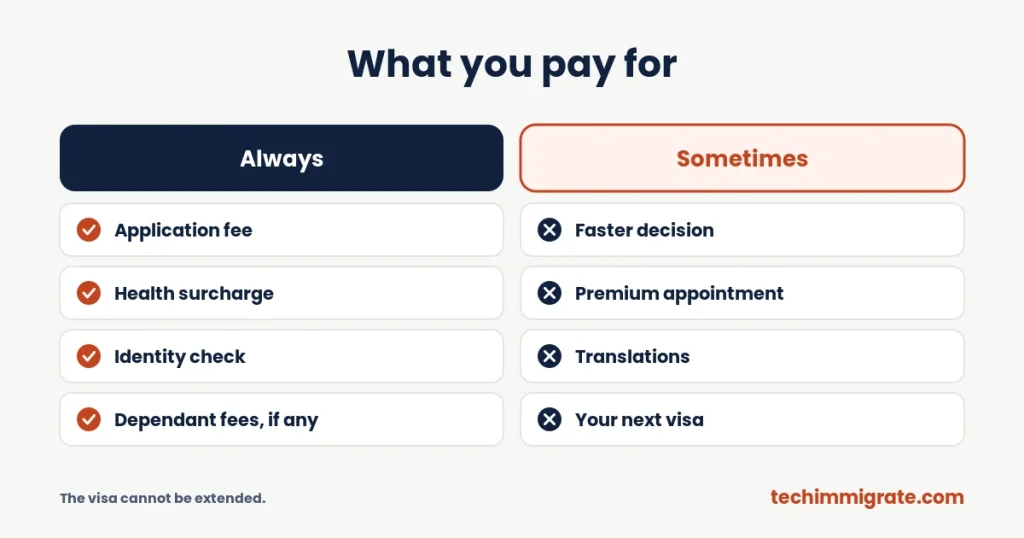
- The visa cannot be extended, so plan for the cost of your next visa too.
The Two Main Costs
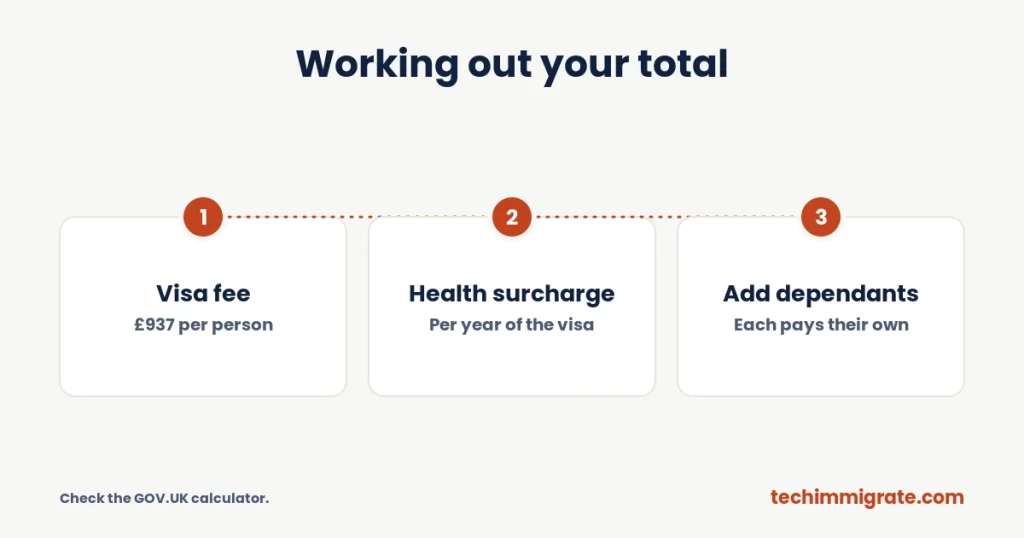
Every main applicant pays two things when applying:
- The application fee: £937.
- The Immigration Health Surcharge: usually £1,035 for each year of the visa. Where the visa includes part of a year of 6 months or less, you usually pay half the yearly amount for that part.
Worked Totals
| Visa length | Visa fee | Health surcharge | Total |
|---|---|---|---|
| 2 years (apply by 31 Dec 2026) | £937 | £2,070 | £3,007 |
| 18 months (apply from 1 Jan 2027) | £937 | £1,552.50 | £2,489.50 |
| 3 years (PhD) | £937 | £3,105 | £4,042 |
These totals are for one adult main applicant. Check the GOV.UK surcharge calculator for your exact figure.
What Dependants Pay
Partners and children who were already your dependants on your Student visa, and children born in the UK during your stay, can usually apply. Each pays the £937 fee and their own surcharge. The surcharge for children under 18 is usually £776 a year.
| Family member, 2-year visa | Visa fee | Health surcharge | Total |
|---|---|---|---|
| Partner | £937 | £2,070 | £3,007 |
| Child under 18 | £937 | £1,552 | £2,489 |
Costs You May Not Expect
- Faster decision services, where offered.
- Identity appointments at premium service points, if you cannot use the app.
- Your next visa, because the Graduate visa cannot be extended.
£937 plus the health surcharge, usually £1,035 a year. For a 2-year visa, the total is £3,007.
Usually £1,035 for each year, paid up front.
Yes, each dependant pays £937 plus their own surcharge.
The fee is the same, but the shorter 18-month length means a lower surcharge.
Only in limited cases, such as overlaps or refusals. Check GOV.UK.
Why the Graduate Visa Cost Catches People Out
Many students budget carefully for tuition and living costs but forget to plan for the Graduate visa. The application usually comes at the end of a course, when savings are often at their lowest and many graduates are between part-time work and a first full-time job. The health surcharge is the biggest single cost, and it must be paid in full when you apply, not in instalments. For a family, the combined bill can be larger than a term of tuition. Planning ahead by a few months makes a big difference. Some graduates set aside a small amount each month during their final year so the cost does not come as a shock. Others time their application so they have received a salary from a graduate role or internship first, while still applying before their Student visa expires.
How the Health Surcharge Is Calculated
The Immigration Health Surcharge gives you access to the National Health Service on broadly the same basis as a permanent resident. It is charged for each year of permission you are granted. When the visa includes part of a year, the rules depend on how long that part is and where you apply from. For in-country applications, a part year of six months or less is usually charged at half the yearly rate, and a part year of more than six months is charged as a full year. Because the Graduate visa is applied for from inside the UK, the eighteen-month version usually attracts one full year plus a half year. The GOV.UK calculator works this out for you, and it is worth using rather than relying on manual sums.
The Shorter Visa From January 2027
From 1 January 2027, the standard Graduate visa will last eighteen months instead of two years. PhD and other doctoral graduates will still get three years. The application fee stays the same, but because the visa is shorter, the health surcharge falls. That makes the total cheaper, but it also gives you less time to find a job, build experience and plan your next visa. If your course ends in late 2026, applying on or before 31 December 2026 secures the two-year version, provided your university has reported your completion in time. If your course ends later, you will be on the shorter version.
Planning Around Your Course Completion Date
You can only apply once your university has told the Home Office that you have successfully completed your course. You do not need to wait for your graduation ceremony or certificate. Because the reporting date controls when you can apply, it also affects whether you get the two-year or eighteen-month visa if your course ends close to the end of 2026. Ask your university's international student team when they expect to report completion. If the timing is tight, ask whether they can report promptly once your results are confirmed.
Paying the Fee and Surcharge
Both the application fee and the health surcharge are paid online when you submit the application. You usually pay by debit or credit card. Make sure your card has enough available balance or credit, as a declined payment can delay your application. Keep a copy of the payment confirmation and your reference numbers. If you are paying for dependants, each has their own application and payment, linked to yours.
Can Someone Else Pay?
There is no rule against a family member or employer paying your Graduate visa costs. Some employers who want to hire graduates offer to cover the fee or surcharge, although this is less common than for sponsored routes. Some universities offer hardship funds or loans that can help with visa costs in exceptional circumstances. Check with your student support team if paying in full would cause hardship.
What Happens if Your Application Is Refused
If your Graduate visa application is refused, the application fee is not usually refunded, because it pays for the decision. The health surcharge is usually refunded automatically if the application is refused, withdrawn or rejected as invalid. Check the current GOV.UK guidance for the exact rules. Refusals are relatively uncommon on this route when the basic requirements are met, but they do happen, often because the university had not reported completion or the applicant's Student visa had already expired.
Health Surcharge Overlaps
If you still have time left on your Student visa when you apply, the new surcharge may overlap with the period you already paid for. GOV.UK explains when overlap refunds apply. In general, overlaps of six months or more may be refunded, rounded down to the nearest six months. Shorter overlaps are not usually refunded. Because most graduates apply shortly before their Student visa ends, overlaps are often small.
The Cost of Leaving Early
If you leave the UK before your Graduate visa ends, for example because you take a job abroad, the health surcharge for the unused period is not usually refunded. That is worth bearing in mind if you are unsure whether you will stay for the full period. Some graduates still choose the visa as an option, knowing they may not use all of it.
Comparing With the Cost of Skilled Worker
Many graduates switch from the Graduate visa to a Skilled Worker visa once they find a sponsored job. A Skilled Worker application from inside the UK has its own fee and health surcharge, and the sponsor pays the Immigration Skills Charge. Some graduates skip the Graduate visa and go straight to Skilled Worker if they already have a sponsored offer before their Student visa ends. That can save the Graduate visa cost entirely, although it gives up the freedom to work for any employer.
Comparing With Global Talent
The Global Talent visa has a lower total fee for the main applicant than many routes, but it requires endorsement and a strong record. Few graduates qualify straight away. For those who build a strong record during their Graduate visa, Global Talent can be the next step, removing the need for a sponsor. Our guides explain the criteria in detail.
Family Budgeting
Families face the largest bills. A couple with one child on a two-year Graduate visa could pay well over eight thousand pounds in total. Plan early, and check whether each family member qualifies. Partners and children must usually have been your dependants on your Student visa, except children born in the UK during your stay.
Children Born in the UK
Children born in the UK to parents on a Student or Graduate visa do not automatically become British citizens. If you want them to stay and travel with you, you usually need to apply for dependant permission for them. They pay the visa fee and the child health surcharge, but they do not need to have been dependants on your Student visa.
Faster Decisions
Decisions for in-country Graduate applications usually take about eight weeks after you prove your identity. Faster decision services are not always available for every route. If speed matters, check GOV.UK when you apply to see what is offered and at what cost.
Identity Check Costs
Most applicants prove their identity using the UK Immigration: ID Check app, which is free. If you cannot use the app, you may need to attend a service point. Standard appointments may be free, while premium or flexible appointments can carry a charge.
Planning Your Next Visa
Because the Graduate visa cannot be extended, you need a plan for what comes next. That might be a Skilled Worker visa, Global Talent, a High Potential Individual visa, a family visa or leaving the UK. Each option has its own costs. Factor the next application into your budget from the start of your Graduate visa.
Settlement and the Graduate Visa
Time on the Graduate visa does not usually count towards settlement. Under the earned settlement plans, Graduate time is listed among routes that do not count. That makes the Graduate visa a stepping stone rather than part of a long-term settlement path. If settlement is your goal, aim to move onto a qualifying route as soon as you can.
Tax and Living Costs
On top of visa costs, remember living costs. Rent, transport, council tax and household bills can be high, especially in London. Graduates on the visa pay income tax and National Insurance like anyone else. Build a realistic budget for the whole visa period, not just the application.
Our Summary
The Graduate visa is a valuable route, but it carries a significant cost. Budget for the fee and surcharge, check the visa length you will get, plan for dependants and keep money aside for your next visa. With planning, the cost is manageable and the freedom it gives can be worth it.
Mistakes That Waste Money
The most expensive mistakes are applying too early, before the university has reported completion, and applying too late, after the Student visa has expired. Both usually lead to refusal and the loss of the application fee. Another costly mistake is travelling abroad while the application is pending, which usually withdraws the application. Read the rules carefully and plan your dates around the decision.
A Worked Example for a Single Graduate
Take a fictional computer science master's graduate whose university reports completion in early December 2026. Their Student visa runs until late January 2027. Because they apply before the end of December 2026, they are granted the two-year version. They pay the application fee and two years of health surcharge, a little over three thousand pounds in total, using savings from a part-time job and a small gift from family. They prove their identity with the app the same day and receive a decision in under eight weeks. During the following two years, they work at a startup, contribute to open-source projects and speak at meetups. Towards the end of the visa, they apply for Global Talent rather than relying on a sponsor. The example is fictional, but it shows how the cost fits into a wider plan rather than standing alone.
A Worked Example for a Family
Now consider a fictional PhD graduate with a partner and one child, all of whom were on the Student visa as a family. Because of the doctorate, the Graduate visa lasts three years. The main applicant pays the fee and three years of adult surcharge. The partner pays the same. The child pays the fee and three years of the lower child surcharge. Added together, the family's bill is well over eleven thousand pounds, all due when the applications are submitted. Planning for this months in advance, perhaps by saving part of a stipend or arranging help from family, is essential. Some families choose to apply for the main applicant first and the dependants shortly afterwards, but every application must still be made before the relevant permission expires.
Comparing the Graduate Visa With Going Home and Returning
Some graduates wonder whether it is cheaper to go home after their course and apply for a sponsored visa from abroad later. On paper, an out-of-country Skilled Worker application can be cheaper in fees than a Graduate visa followed by an in-country switch. But that comparison ignores the value of being in the UK while job hunting. Employers often prefer candidates who are already here and can start quickly. Networking, interviews and building local experience are also easier in person. For many graduates in tech, the freedom of the Graduate visa outweighs its cost, but it is worth weighing the options honestly against your circumstances.
What Your Money Buys
It helps to think about what the Graduate visa cost actually pays for. You gain the right to live in the UK and work for almost any employer, at any skill level and salary, without sponsorship. You can be self-employed, start a business, freelance or take short-term contracts. You gain access to the National Health Service. You can look for work without the pressure of a sponsor deadline. For many graduates, that freedom is exactly what they need to build a career foothold in a competitive market. Seen this way, the visa cost is an investment in time and options rather than a fee for a document.
Using Your Time Well
Because the visa is expensive and cannot be extended, it pays to use the time well. Many successful graduates set clear goals for each stage of their visa, such as securing a first role in the first few months, building a body of public work over the following year and preparing their next visa application well before the end. Keep records of achievements, recommendations and contributions as you go. If you plan to apply for Global Talent later, our guides explain the kinds of evidence that matter, and starting early makes the application far stronger.
Checking the Latest Fees Before You Apply
Visa fees and the health surcharge are reviewed regularly and can rise with little notice, usually announced in advance through a statement of changes or fees regulations. The figures in this article reflect GOV.UK at the time of checking. Before you apply, check the current fee on the Graduate visa page and run the health surcharge calculator with your exact dates. If a fee increase is announced, applying before the change date may save you money, provided you are already eligible.
Help From Your University
University international student teams handle Graduate visa questions every day. They can confirm when your completion will be reported, explain the application process and sometimes check your application before submission. Many also run information sessions near the end of each academic year. This support is usually free, so use it. They cannot give advice on every immigration route, but they are a reliable first port of call for the Graduate visa itself.
Records to Keep
Keep the confirmation emails, payment receipts and decision letter from your Graduate visa application in a safe place. You will need details of your immigration history when you apply for your next visa, and much later if you apply for settlement or citizenship. Keeping a simple folder, digital or paper, with every application, decision and receipt saves time and reduces the risk of mistakes. It also helps if you ever need to claim a health surcharge refund or show an employer what you paid.
Questions to Ask Before Paying
Before you pay, ask yourself a few simple questions. Has my university reported my completion? Is my Student visa still valid on the day I apply? Do I know which version of the visa I will get? Have I checked the latest fee and run the surcharge calculator? Are all my dependants eligible, and do I have their documents ready? If the answer to each is yes, you are ready to apply with confidence.
Where the Money Goes
The application fee covers the cost of processing and deciding your application. The health surcharge funds the National Health Service, which you can use in the same way as other residents once your visa is granted, although some services such as prescriptions, dental care and eye tests may still carry the standard charges that apply to everyone. Knowing this can make the cost feel less abstract. You are paying for a decision and for healthcare access for the full length of your stay, so it is worth registering with a local doctor as soon as you have an address and making sure you understand how the health service works in your area.
Your Next Step
If you are building a strong record in tech during your Graduate visa, the Global Talent visa could be your next step. Our role-specific Global Talent guides explain what Tech Nation looks for.
How We Checked This Article
We checked fees, surcharge and visa length against GOV.UK's Graduate visa pages and the Immigration Health Surcharge guidance in November 2026.
Tech Immigrate is independent of the Home Office. This article is general information, not legal advice. Check GOV.UK before you apply.
We write practical guides for tech professionals applying for the UK Global Talent visa. Tech Immigrate is independent of Tech Nation and the Home Office, and our articles are general information, not legal advice. Rules and fees change, so always check gov.uk before you apply.


