Global Talent Visa for Business Analysts: Can You Qualify, and How?
Can business analysts get the Global Talent visa? How Tech Nation sees analyst careers, which skills to position against, and what evidence counts.


In this article
- Can Business Analysts Get the Global Talent Visa?
- Why Is the Business Analyst Title a Problem?
- Which Recognised Skill Does Your Analyst Work Fit?
- Are Business Analysts Technical or Business Applicants?
- How Do the Criteria Apply to Analysis Work?
- How Do You Turn Analysis Into Evidence?
- What Does Recognition Look Like for an Analyst?
- Which Analyst Evidence Is Strong, and Which Is Weak?
- What Recent Analyst Applications Show
- Exceptional Talent or Exceptional Promise for Analysts?
- Who Should Write a Business Analyst's Letters?
- What Does the Visa Cost for a Business Analyst?
- Should an Analyst Request a Review or Reapply?
- What If the Global Talent Visa Does Not Fit Yet?
- How Should a Business Analyst Start?
- Get the Guide for Business Analysts
- Frequently Asked Questions
- How We Checked This Article
Business analysts can get the UK Global Talent visa, but "business analyst" is not one of the roles named on the government's list of skills covered by Tech Nation, updated on 1 July 2026. That means a business analyst has to show that their work fits a skill Tech Nation does recognise, such as product, data or commercial leadership in a digital business, and that it was done in-house at a product-led tech company rather than in consultancy, outsourcing or ERP work, which the list treats as unsuitable. You also need recognition outside your employer as a leader (Exceptional Talent) or emerging leader (Exceptional Promise).
This article is for business analysts, product analysts, systems and technical analysts, BI and data analysts, and analysts working in fintech and SaaS who are wondering whether the route can work for them. It explains how Tech Nation is likely to see an analyst's career, how to position your skills honestly, which criteria fit analysis work, what recognition means for analysts, and what recent applications on the Tech Nation Visa Forum show.
Key takeaways
- Business analysts are not named on the GOV.UK Tech Nation skills list, updated 1 July 2026. You need to show your work fits a recognised skill, such as product, data or commercial leadership in a digital business.
- Consultancy, ERP consultancy, outsourcing, process delivery and corporate roles are listed as unsuitable, and many analyst careers sit in them.
- A job title is treated as a job description, not as recognition. Refusal feedback in 2026 described strong letters as describing competent professional work.
- Analysis only counts when it led to a decision with a measurable outcome that someone else confirms.
- A November 2026 BI analyst refusal accepted a selective vendor community title as peer recognition but rejected paid press and self-authored impact evidence.
- Endorsement costs £561 and the visa £205, plus the £1,035 yearly health surcharge.
Can Business Analysts Get the Global Talent Visa?
Yes, but it is one of the harder profiles. The digital technology route is open to people with technical or business skills in the digital technology sector. The government publishes an indicative list of those skills, last updated on 1 July 2026. It names, among others, experienced product managers, experienced data scientists and data engineers, commercial leads who own growth or distribution, heads of operations at digital businesses, and sector-specific experts such as specialists in payments infrastructure in fintech.
Business analysts are not on that list by name. The list says it is not complete, so this does not rule analysts out. But it does mean you cannot rely on your title. You need to show that what you actually did fits the kind of skill Tech Nation recognises.
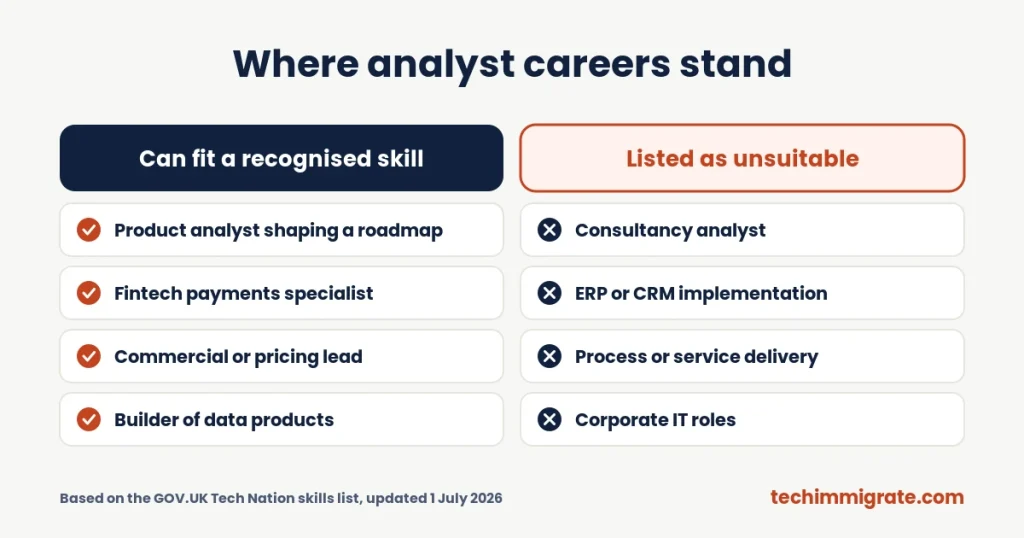
The list is also clear about what does not fit. In paraphrase, it describes as unsuitable: corporate roles, service delivery, process delivery, outsourcing, technical or management consultancy, ERP consultancy and systems administration. Business skills apply only to in-house work at product-led digital technology companies, not at agencies, outsourcers or service companies. Many business analyst careers are built in exactly those places: consultancies, systems integrators, ERP implementation partners and large corporate IT departments.
That is the honest starting point. If your analyst career has been in-house at product-led tech companies, and your analysis drove product or commercial decisions you can prove, you may have a case. If it has mostly been in consultancy or corporate IT, the route is much harder, and you may need to change where you work before you apply. Our article on why business analysts get refused covers the refusal patterns in detail.
Why Is the Business Analyst Title a Problem?
Tech Nation assesses what you did and what others recognised, not the name of your role. Titles that describe a function, like business analyst, systems analyst or product analyst, tell the assessor nothing about whether you are exceptional.
Refusal and review feedback shared on the forum in 2026 shows how this works in practice. In a review decision from February 2026 for a product designer, the panel said the applicant's recommendation letters described competent professional work rather than recognition as an emerging leader, and treated a founding job title as a job description, not an honour. The same reasoning applies to analysts. A letter saying you are an excellent business analyst, trusted by your managers, is evidence that you do your job well. The Mandatory Criterion asks for more than that.
The practical consequence is that a business analyst needs to describe their work in terms of its result. Not "gathered requirements and produced the specification for a new payments flow", but "identified that a third of failed payments came from one verification step, recommended removing it, and the redesigned flow lifted completed payments by a confirmed percentage".
Which Recognised Skill Does Your Analyst Work Fit?
The table below suggests how different analyst careers might be positioned against the skills on the GOV.UK list. It is a guide to honest positioning, not a way to relabel work you did not do.
| Analyst profile | Closest recognised skill | Typical fit |
|---|---|---|
| Product analyst at a SaaS or app company, shaping the roadmap | Experienced product manager | Good, if decisions and outcomes are yours |
| Data or BI analyst who built data products used across a tech company | Experienced data scientist or data engineer | Mixed; reporting alone is weak |
| Payments or lending analyst at a fintech whose platform is the business | Sector-specific expert (payments infrastructure) | Good, with product impact |
| Commercial or revenue analyst who owned pricing or growth decisions | Commercial or business lead | Good, if you owned the decision |
| Operations analyst who scaled a digital business's operations | Head of operations at a digital business | Mixed; needs seniority |
| Business analyst at a consultancy or systems integrator | None: consultancy is unsuitable | Weak |
| ERP, CRM or SAP business analyst | None: ERP consultancy is unsuitable | Weak |
| Business analyst in a bank or retailer's IT department | Corporate role | Weak to mixed |
Positioning is a matter of describing your work accurately, not changing your title. Assessors check your CV, your letters and your evidence together. A product analyst who presents as a product manager will be judged against product managers, and the evidence has to support that.
Are Business Analysts Technical or Business Applicants?
Tech Nation splits applicants into technical and business. Most business analysts will be business applicants, because their main contribution is to product, commercial or operational decisions rather than to building software.
This matters because, under the skills list, business skills only count for in-house work at product-led digital technology companies. A technical applicant can sometimes rely on work done at a non-tech company. A business applicant usually cannot. If you are a technical analyst who writes production code, builds data pipelines or designs systems, you may be assessed as a technical applicant, and the data or engineering articles on this site will be more relevant than this one.
Whichever you are, say it clearly in your personal statement and make your evidence consistent with it. Mixed signals, such as a CV that reads as a consultant and a statement that reads as a product leader, are a common source of refusals for analysts.
How Do the Criteria Apply to Analysis Work?
You need the Mandatory Criterion plus two of the four optional criteria.
| Criterion | What it asks | Analyst evidence that fits |
|---|---|---|
| Mandatory | Recognition as a leading talent or emerging leader in digital technology | Selective community titles, invited talks at tech events, expert roles, media that seeks your view |
| OC1: Innovation | A track record of innovation as a founder, senior executive or employee working on a new digital field or concept | A new analytical product, model or method that a digital product adopted |
| OC2: Beyond your job | Recognition for work outside your occupation that advances the field | Open tools or methods others use, structured voluntary mentoring with outcomes, selective writing |
| OC3: Significant contribution | Technical or commercial contribution as an employee of a product-led company | Analysis-led decisions that changed revenue, cost, conversion or risk, confirmed by the company |
| OC4: Academic | Research contributions | Rarely relevant unless you publish research |
OC3 is usually where an analyst's strongest evidence sits, because that is where the commercial result of your analysis can be shown. OC2 is possible for analysts who are active in their professional community, but the Mandatory Criterion and OC2 are both about recognition, and the same activity cannot carry both.
How Do You Turn Analysis Into Evidence?
The core problem for analysts is that analysis on its own is not an outcome. Requirements, process maps, dashboards and recommendations are deliverables. Tech Nation looks for what changed because of them.
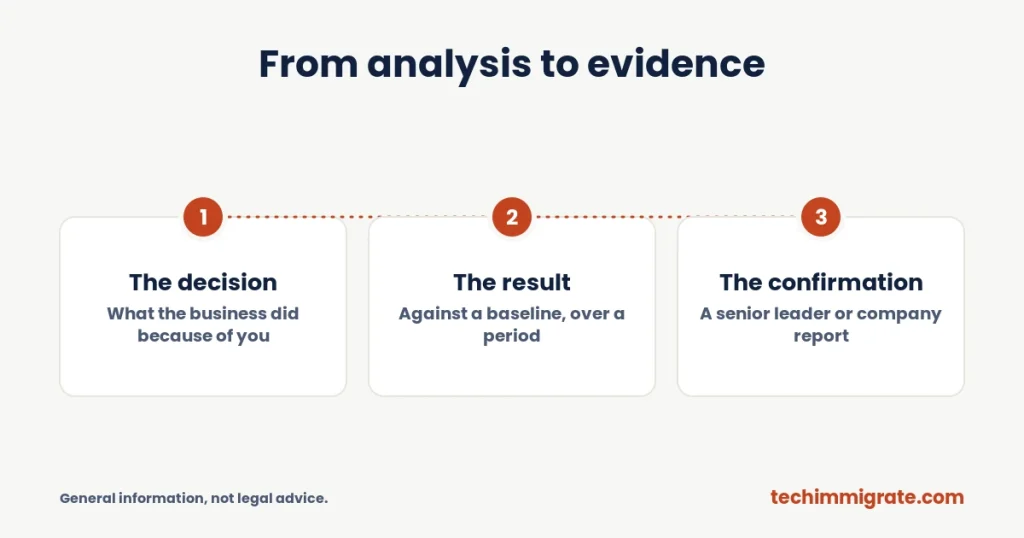
Three steps make an analyst's work into evidence:
- Show the decision. What did the business do because of your analysis? Launch, stop, change price, redesign a flow, enter a market, cut a cost?
- Show the result. What happened after the decision, against a baseline, over a stated period?
- Show who confirms it. A company-approved report, a letter from a senior leader who made or approved the decision, or public material that refers to the outcome.
If you cannot get past step one, because your analysis informed a decision someone else made with many other inputs, the evidence will be weak however good the analysis was. If you cannot get past step three, because the only proof is your own dashboard or document, it is likely to be treated as self-reported. In the November 2026 refusal described below, part of the applicant's impact evidence was described as largely self-authored.
What Does Recognition Look Like for an Analyst?
Recognition outside your employer is the hardest part for most analysts, because analysis is usually invisible outside the company. It is possible, though, and one recent case shows what can work.
In November 2026, a data visualisation and BI analyst shared a Promise refusal. Encouragingly, the panel accepted their selection as a community leader by a major analytics software vendor, in two consecutive years, as peer recognition. That is the kind of external, selective recognition the Mandatory Criterion looks for. What failed was the rest of the package: a press feature from an outlet the panel described as accepting payment for features, talks not seen as advancing the field, and impact evidence that was largely self-authored.
Recognition that tends to carry weight for analysts:
- Selective community titles awarded by respected technology vendors or professional communities, with published selection criteria and limited numbers.
- Invitations to speak at technology events about analytical work that changed a digital product.
- Expert roles, such as judging analytics competitions or advising start-ups through recognised programmes.
- Editorial media that seeks your expertise. Paid features and sponsored content are discounted.
What rarely carries it: certifications, internal awards, high salary, membership of professional bodies, and letters from managers saying you are excellent.
Which Analyst Evidence Is Strong, and Which Is Weak?
This is general guidance from the criteria and forum reports, not an official scoring system.
| Evidence | Usually strong when | Usually weak when |
|---|---|---|
| A decision your analysis drove | Senior leader confirms the decision and its result | You recommended it; others decided with other inputs |
| Revenue, cost or conversion change | Company-approved figures with a baseline | Your own dashboard or spreadsheet |
| A data product or tool you built | Used across the company or outside it | A report only you maintain |
| Community title or award | Selective, external, individually awarded | Certification or membership |
| Talk or article | Invited, tech audience, credible outlet | Internal or paid placement |
| Mentoring or community work | Structured, voluntary, with outcomes | Informal or within your job |
What Recent Analyst Applications Show
These cases come from the Tech Nation Visa Forum. They are applicant-reported, and replies are member opinion, not official guidance.
- 2022, business applicant refused. An applicant with just over two years in sales, business development and marketing at product-led companies applied under Promise with OC1 and OC3, and was refused on all criteria. Reviewers said the Mandatory Criterion evidence was not enough compared with similar profiles.
- August 2024, refused on evidence quality. A Promise applicant shared feedback that their documents were additional personal statements with embedded screenshots, and letters written for the application without evidence behind the claims. Only the Mandatory Criterion was met.
- January and February 2026, refused and review failed. A product designer's review decision described letters as covering competent professional work, a title as a job description, and solo work as the expected output of the role. The reasoning applies directly to analysts.
- November 2026, BI analyst refused. A data visualisation and BI analyst was refused on the Mandatory Criterion, OC2 and OC3, despite vendor recognition accepted as peer recognition. Impact evidence was described as self-authored, and one engagement was under a service agreement, which a reviewer warned may not meet OC3's employee or founder requirement.
The pattern across these cases: what analysts produce is easy to show, and what it achieved is hard to prove. The applications that came closest had external, selective recognition. Our article on the Global Talent visa success rate shows how much stricter Tech Nation has become.
Exceptional Talent or Exceptional Promise for Analysts?
| Exceptional Talent | Exceptional Promise | |
|---|---|---|
| Typical analyst | Senior analytics or product leader with tech-sector standing | Analyst with early, external recognition |
| Experience | Usually more than 5 years | 5 years or less in digital technology |
| Recognition | Recognised across the sector | Early signs of recognition |
| Settlement | After 3 years | After 5 years |
Refusal wording shared in 2022 and 2026 describes Promise as intended for people early in their careers, understood as five years or less in digital technology. Analysts who spent years in consultancy or corporate IT before moving to a product company should think carefully about how their tech experience will be counted. Our article on Exceptional Talent vs Exceptional Promise explains the choice.
Who Should Write a Business Analyst's Letters?
You need three letters from established leaders in digital technology. For analysts, strong writers usually include:
- A CPO, CTO, CFO or chief executive at a product-led company who made decisions based on your work and can describe the result.
- A senior person outside your employer who relied on your work, such as a partner or an investor.
- A recognised figure in your analytics or product community who knows your public work.
In the November 2026 refusal, the panel said the referees spoke kindly of the applicant but none evidenced individual recognition as a future leader. A forum reviewer added that referees should be able to judge the applicant's standing in the field, not just their performance. Letters must be signed documents; the Home Office does not accept web links. Our guide to recommendation letters covers who to ask.
What Does the Visa Cost for a Business Analyst?
Figures checked on GOV.UK in November 2026:
| Item | Cost or time |
|---|---|
| Endorsement (Stage 1) | £561 |
| Visa (Stage 2) | £205 |
| Immigration Health Surcharge | £1,035 per adult per year |
| Each partner or child | £766 each, plus their surcharge |
| Endorsement decision | Usually 5 to 8 weeks |
| Visa decision | About 3 weeks outside the UK, 8 weeks inside |
| Free endorsement review | Within 28 days of a refusal; no new evidence |
| Settlement | After 3 years (Talent) or 5 years (Promise) |
The government's earned settlement response of 2 November 2026 keeps 3 years for a highest talent group that includes Global Talent, while setting a 10-year baseline for most routes. New rules are expected from December 2026. Our cost breakdown has worked examples.
Should an Analyst Request a Review or Reapply?
If you are refused, you can ask for a free endorsement review within 28 days. You cannot add new evidence. Forum reviewers advising the BI analyst in November 2026 said a review is only worth it if your original documents clearly contradict the panel's findings, and that when several criteria fail, a review has to overturn more than one finding to succeed. Where the problem is the evidence itself, such as consultancy work, self-authored impact or paid press, a new application is usually the better path.
Each application is assessed independently, so a criterion met once can fail next time if it is presented differently. Keep what worked and rebuild what did not. Our article on how to challenge a Global Talent refusal explains every route.
What If the Global Talent Visa Does Not Fit Yet?
For many business analysts, the honest answer today is that the Global Talent visa is not the right route yet. That is not a judgement on your ability; it reflects where analysis work usually happens and how hard it is to make visible.
If you are in that position, the most useful moves are usually:
- Moving in-house to a product-led tech company, where your analysis can drive product decisions you can later prove.
- Owning outcomes, for example by taking on product, pricing or growth responsibilities rather than supporting them.
- Building external recognition through selective communities, invited talks and open tools, steadily rather than just before applying. Forum reviewers repeatedly warn that evidence created mainly for the application is weak.
In the meantime, a sponsored work visa can give you the time and the role to build this evidence. Many people endorsed for Global Talent first came to the UK on a Skilled Worker or Graduate visa.
How Should a Business Analyst Start?
Before paying £561:
- Map each role against the product-led test and the unsuitable list. Be honest about consultancy and corporate IT work.
- Choose your recognised skill and check your CV, letters and evidence all tell the same story.
- List decisions, not deliverables. For each, note the result, the baseline and who can confirm it.
- List external recognition only. Selective titles, invited talks, expert roles.
- Choose your level against the five-year line.
- Read the current Tech Nation guide and GOV.UK pages. Since August 2025 you apply on GOV.UK and email documents to the Home Office.
Our article on how much evidence is enough helps you judge whether you are ready.
Get the Guide for Business Analysts
The Global Talent Visa Endorsement Guide for Business Analysts is 124 pages, aligned with Tech Nation's applicant guide. It covers how to position analyst work against the skills Tech Nation recognises and turn it into evidence, with 23 evidence checklists, a 12-week planner, 30 refusal fixes and 4 applicant-reported refusal cases with the wording decoded.
I was refused the first time I applied for Global Talent, then reapplied and was endorsed. The guide is built on what changed between those two applications.
Frequently Asked Questions
Yes, but business analysts are not named on the GOV.UK Tech Nation skills list, updated 1 July 2026. You need to show your work fits a recognised skill, such as product, data or commercial leadership, at a product-led tech company.
They can apply, but technical and management consultancy, ERP consultancy and outsourcing are listed as unsuitable. Consultancy experience rarely carries an application on its own.
Most are business applicants, because their contribution is to product or commercial decisions. Business skills only count for in-house work at product-led digital technology companies.
Decisions your analysis drove, with a measurable result and a senior person or company report confirming it. Requirements documents and dashboards alone are deliverables, not outcomes.
It can. In a November 2026 refusal, the panel accepted a selective analytics vendor community title, held in consecutive years, as peer recognition. The application failed on other evidence.
Promise is intended for people with five years or less in digital technology, according to refusal wording shared on the forum. Longer careers may be assessed against the Talent standard.
GOV.UK says endorsement decisions usually take 5 to 8 weeks.
How We Checked This Article
We checked eligibility, fees, timings and settlement periods on the GOV.UK digital technology Global Talent pages and the list of technical and business skills covered by Tech Nation, updated 1 July 2026, in November 2026. Process details draw on the Home Office Global Talent caseworker guidance published 3 August 2026.
Applicant cases come from the Tech Nation Visa Forum: a November 2026 BI analyst refusal, a February 2026 failed review with detailed reasoning, an August 2024 refusal on evidence quality, a 2022 business applicant refusal, a 2022 refusal on the five-year line and a 2026 Promise refusal proforma. Forum material is applicant-reported or member opinion, not official guidance.
Tech Immigrate is independent of Tech Nation and the Home Office. This article is general information, not legal advice.
We write practical guides for tech professionals applying for the UK Global Talent visa. Tech Immigrate is independent of Tech Nation and the Home Office, and our articles are general information, not legal advice. Rules and fees change, so always check gov.uk before you apply.