
Skilled Worker Visa Processing Times
Skilled Worker visa processing times: 3 weeks from abroad, 8 weeks in the UK, when the clock starts, delays, faster decisions and a realistic start date.


In this article
- The Published Processing Times
- When the Clock Starts
- Faster Decisions
- What Happens Before the Clock Starts
- A Realistic Timeline From Abroad
- A Realistic Timeline From Inside the UK
- Why Applications Get Delayed
- Do Not Book Travel Too Early
- How to Speed Things Up
- Notice Periods and Start Dates
- Busy Times of Year
- If Your Decision Is Late
- Advice for Employers Hiring Internationally
- How It Compares With Global Talent
- Before You Travel: A Final Check
- Planning Extensions and Settlement
- Questions to Ask Your Employer About Timing
- Why Processing Times Vary Between People
- Processing Times for Family Members
- What Happens After the Decision
- A Worked Example: A Developer Applying From Abroad
- A Worked Example: A Change of Employer
- Common Mistakes
- Plan for the Whole Journey
- How We Checked This Article
When you accept a Skilled Worker job offer, the first question your new manager usually asks is: when can you start? The honest answer depends on how long the visa takes, and that depends on more than the Home Office's published processing time. Getting a certificate of sponsorship assigned, booking a tuberculosis test, sorting English evidence, finding a visa application centre appointment and waiting for the decision can all add weeks.
This guide explains Skilled Worker visa processing times: the published service standards for applications from outside and inside the UK, when the clock starts, faster decision options, what causes delays, and how to plan a realistic timeline from offer to first day. It is written for tech professionals and the employers hiring them.
Key takeaways
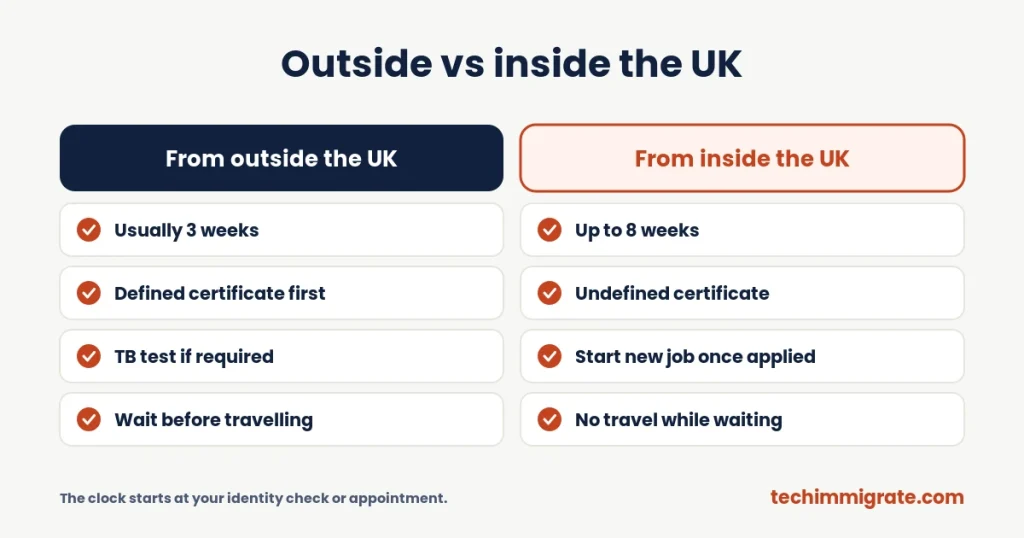
- GOV.UK says Skilled Worker applications from outside the UK usually take 3 weeks.
- Applications from inside the UK, such as extensions, changes of employer and switches, usually take up to 8 weeks.
- The clock starts when you verify your identity with the ID Check app or attend your visa application centre appointment, not when you submit the online form.
- Processing times count UK working days and include UK public holidays.
- Faster decisions may be available for a fee, depending on where you apply.
- Delays can happen if documents need checking, more evidence is needed, an interview is required, or demand is high.
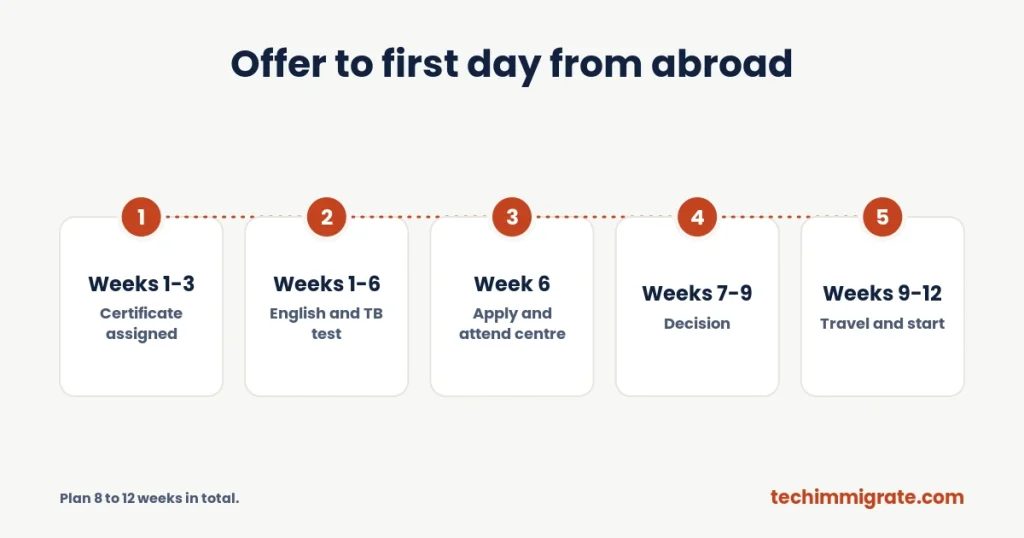
- From offer to start date, most international hires should plan for 8 to 12 weeks.
The Published Processing Times
| Type of application | Usual decision time |
|---|---|
| From outside the UK | 3 weeks |
| From inside the UK (extend, update or switch) | Up to 8 weeks |
These are the Home Office's service standards. Many applications are decided faster, especially straightforward ones. Some take longer. The standards are targets for the majority of applications, not a guarantee for each one, so build some slack into your plans rather than counting on the exact number of weeks.
When the Clock Starts
GOV.UK says processing starts once you either:
- verify your identity and submit your documents using the UK Immigration: ID Check app, if you are told you can use it; or
- attend your visa application centre appointment to give your fingerprints and photograph.
The date you fill in the online form and pay the fee does not start the clock. If your appointment is two weeks after you submit the form, add those two weeks to your planning.
GOV.UK also notes that processing times count UK working days, Monday to Friday, and include UK public holidays, but not public holidays in other countries.
Faster Decisions
Priority and super priority services may be available, at an extra cost, depending on the type of application and where you apply. For applications from inside the UK, these services are commonly offered for work visas. For applications from outside the UK, availability depends on the visa application centre in your country.
If you need a fast decision, check availability on GOV.UK and with the visa application centre before you apply. Ask your employer whether they will pay for it, because many sponsors cover the cost when a start date is tight. Faster services can sell out, and they do not guarantee a decision if your case needs further checks.
What Happens Before the Clock Starts
The Home Office's 3 or 8 weeks is only one part of the timeline. Before you can even apply, several things need to happen.
1. The certificate of sponsorship
Your employer must assign a certificate of sponsorship. If you are applying from abroad, they must first request a defined certificate from the Home Office, which is usually decided quickly but can take longer if the Home Office has questions. If you are applying from inside the UK, your employer can usually assign an undefined certificate from its allocation straight away. Our guide to the certificate of sponsorship explains the difference.
2. English evidence
If you are using a degree from outside the UK, you need an Ecctis assessment, which can take several weeks. If you need an English test, you may need to wait for a test date and then for results.
3. Tuberculosis test
If you have lived in a country on the Home Office's tuberculosis test list for 6 months or more, you need a certificate from an approved clinic. Appointments can take time to get, and you need the certificate before you apply.
4. Criminal record certificate
Some roles need a criminal record certificate. Most tech roles do not, but if yours does, allow time to get one from each country you have lived in.
5. Visa application centre appointment
In some countries, appointments are available within days. In others, especially at busy times, they can be weeks away. Premium appointments may be available for a fee, and some centres offer services such as document scanning or appointments outside normal hours.
A Realistic Timeline From Abroad
| Stage | Typical time |
|---|---|
| Offer accepted to defined certificate assigned | 1 to 3 weeks |
| English evidence and TB test (in parallel) | 2 to 6 weeks |
| Online application to appointment | Days to 2 weeks |
| Decision after appointment | Around 3 weeks |
| Travel and arrival | 1 to 2 weeks |
| Total | Around 8 to 12 weeks |
If you prepare English evidence and the TB test before you have an offer, you can shorten this considerably. Some candidates who prepare everything in advance go from offer to first day in around 6 weeks.
A Realistic Timeline From Inside the UK
| Stage | Typical time |
|---|---|
| Offer accepted to undefined certificate assigned | Days to 2 weeks |
| English evidence (if needed) | 0 to 4 weeks |
| Online application to identity check | Days to 2 weeks |
| Decision | Up to 8 weeks |
| Total | Around 6 to 12 weeks |
When you change employer, you can usually start the new job once you have applied, as long as the certificate has been assigned. When you switch from another route, check whether your current visa conditions allow you to start before the decision.
Why Applications Get Delayed
GOV.UK lists several reasons a decision may take longer:
- your information needs further review;
- you need to provide more evidence, such as proof of funds;
- documents need to be verified;
- an interview is required;
- further checks are needed, for example because of a criminal conviction;
- high demand for visas;
- unexpected technical problems.
In practice, tech applicants most often see delays because of:
- a mismatch between the certificate and the application, such as a different job title or salary;
- missing English evidence, or an Ecctis assessment that has not been issued;
- questions about whether the role is genuine, especially at smaller or newer sponsors;
- unclear bank statements, if maintenance has not been certified;
- identity issues, such as names spelled differently across documents.
GOV.UK says that if your application will take longer, you will be contacted within the current processing times. If it has overrun and you have not been contacted, you can contact UK Visas and Immigration.
Do Not Book Travel Too Early
GOV.UK advises that you should not book travel until you receive a decision, and that UK Visas and Immigration will not reimburse travel costs or other expenses if your application is refused or delayed. For tech hires, this means:
- agree a provisional start date with your employer, but keep it flexible;
- avoid non-refundable flights or accommodation until you have your decision;
- plan to give notice at your current job once you are confident of the timeline, not before.
How to Speed Things Up
- Prepare early. Get your Ecctis assessment or English test and your TB certificate done before you have an offer, if you are actively job hunting.
- Check every detail. Make sure the certificate matches your passport and your application exactly.
- Ask your employer to certify maintenance. This saves you from gathering bank statements and removes a common cause of delay.
- Book the earliest appointment. Consider a premium appointment if timing is critical.
- Consider a faster decision service, where available.
- Respond quickly. If the Home Office asks for more information, reply as soon as possible.
Notice Periods and Start Dates
For experienced tech professionals, the notice period at a current job is often the longest part of the timeline. Many senior roles have notice periods of one to three months. Working out how the visa process fits around your notice period avoids awkward conversations later:
- If your notice period is long, you may be able to complete the whole visa process during it. Wait for your visa decision before you resign if you can, or agree with your current employer that you can stay on if the visa is delayed.
- If your notice period is short, the visa process may take longer than your notice. Do not resign until you are confident of the timeline.
- If you are already in the UK changing employer, you can usually start the new job once you have applied, so the visa process rarely delays your start.
Tell your new employer your notice period at the offer stage, so they can plan the certificate of sponsorship and start date around it.
Busy Times of Year
Demand for UK visas is not even across the year. Summer is usually the busiest period, because of student applications and family travel. Visa application centres in some countries can have long waits for appointments in June to September. Around major rule changes, application numbers can also spike as people rush to apply before new rules take effect.
If your start date falls in a busy period, apply as early as you can within the rules. Remember that a certificate of sponsorship must be used within 3 months, and the job start date should normally be within 3 months of your application.
If Your Decision Is Late
GOV.UK says you will be contacted within the current processing times if your application will take longer. If your application has overrun and you have not heard anything:
- check your email, including spam folders, for messages from UK Visas and Immigration or the visa application centre;
- contact UK Visas and Immigration through the official contact routes on GOV.UK, with your application reference;
- tell your employer, so they can adjust your start date and, if needed, update the certificate;
- avoid making irreversible plans, such as giving up accommodation, until the decision arrives.
Advice for Employers Hiring Internationally
Employers can do a lot to keep the process on schedule:
- Request defined certificates promptly once an offer is accepted, with a precise job description.
- Tell candidates early what evidence they will need, including English evidence and any TB test.
- Certify maintenance where possible, to remove one source of delay.
- Build in a buffer between the expected decision date and the start date.
- Keep in touch with the candidate during the process, so problems are spotted early.
Small employers sponsoring for the first time often underestimate how long the process takes. Planning for 8 to 12 weeks from offer to start for international hires is a sensible default.
How It Compares With Global Talent
Global Talent applications have two stages: endorsement by Tech Nation, then the visa application. Endorsement decisions can take several weeks, and the visa stage then follows the usual Home Office processing times. Overall, Global Talent can take longer at the start than a straightforward Skilled Worker application. The advantage is that once you have it, there are no sponsor processes when you change jobs, so future moves are much faster.
Before You Travel: A Final Check
Once your decision arrives, a few final checks help avoid problems at the airport:
- Sign in to your UKVI account and check that your eVisa shows the right visa type, start date and conditions.
- Check that your eVisa is linked to the passport you will travel on. If you have a new passport, update your account before you fly.
- Check the date you can enter the UK. Your permission may start shortly before your job start date. You cannot usually enter before then.
- Carry your decision email and certificate details, in case a border officer asks about your job.
- Tell your employer your arrival date, so they can arrange your right-to-work check and onboarding.
If anything on your eVisa is wrong, report it through the eVisa service before you travel. Errors are much easier to fix before you are at the airport.
Planning Extensions and Settlement
Processing times matter later in your visa journey too. If you extend, apply well before your visa expires, because in-country applications can take up to 8 weeks. If you apply in time, your existing permission continues while you wait. When you reach the point of settlement, ILR decisions usually take up to 6 months, with faster services available. Our guides to extending a Skilled Worker visa and ILR processing times explain how to plan.
Questions to Ask Your Employer About Timing
When you accept an offer, ask your new employer:
- How quickly can you request or assign the certificate of sponsorship?
- Have you sponsored people from my country before, and how long did it take?
- Will you certify maintenance on the certificate?
- Do you use an immigration adviser or law firm, and who is my contact?
- Will you pay for a faster decision or a premium appointment if timing is tight?
- How flexible is the start date if the visa takes longer than expected?
Employers that sponsor regularly usually have clear answers and realistic timelines. Employers that sponsor rarely may need a little more guidance, and pointing them to the published processing times can help them plan.
Why Processing Times Vary Between People
Two people applying on the same day can get decisions weeks apart. The reasons are usually about the individual application rather than the system:
- Complete, consistent applications move faster, because the caseworker can decide without asking questions.
- Well-known sponsors with long compliance records may raise fewer questions than new or very small sponsors.
- Unusual job descriptions or roles that look different from the occupation code can prompt extra checks.
- Immigration history matters: previous refusals or breaches can lead to closer scrutiny.
- Identity checks can take longer if names differ across documents.
Most of these are within your control or your employer's. A clean, accurate application is the best way to get a fast decision.
Processing Times for Family Members
If your partner and children are applying with you, link their applications to yours. Each family member attends their own appointment or completes their own identity check, and each application is processed separately, though usually together. If you pay for a faster service, each person usually pays separately.
If your family plans to join you later, their applications will be processed on the same service standards when they apply.
What Happens After the Decision
If your application is approved:
- you receive a decision by email;
- you access your eVisa through your UKVI account;
- you can travel to the UK within the permitted dates;
- your employer will carry out a right-to-work check using a share code before you start.
If your application is refused, the decision letter explains why and whether you can ask for an administrative review. Your employer may be able to assign a new certificate if the issue can be fixed.
A Worked Example: A Developer Applying From Abroad
A mobile developer accepts an offer from a London start-up on 1 March.
- 1 to 10 March: the employer requests and receives a defined certificate.
- 1 to 20 March: in parallel, she gets her Ecctis assessment and her TB test certificate.
- 22 March: she submits her online application.
- 27 March: she attends her visa application centre appointment. The clock starts.
- 14 April: she receives her decision, under 3 weeks later.
- 28 April: she arrives in London and starts work on 1 May.
The whole process took 2 months from offer to start date.
A Worked Example: A Change of Employer
A data engineer already in the UK on Skilled Worker accepts a new role on 1 June.
- 5 June: the new employer assigns an undefined certificate.
- 8 June: he applies to update his visa and uses the ID Check app.
- 8 June onwards: he can start working for the new employer, because he has applied with a valid certificate.
- Late July: he receives his decision, within 8 weeks.
Because he could start work after applying, the processing time did not delay his start date.
Common Mistakes
- Assuming the clock starts at submission. It starts at your identity check or appointment.
- Booking travel before the decision. Costs are not reimbursed if there is a delay or refusal.
- Leaving English evidence until the last minute. Ecctis and tests take time.
- Forgetting the TB test. It must be done before you apply, if required.
- Errors in the certificate. Mismatches cause questions and delays.
- Not planning for dependants. Each family member needs their own appointment.
GOV.UK says usually 3 weeks after you verify your identity or attend your appointment.
Usually up to 8 weeks for extensions, updates and switches.
When you complete the ID Check app process or attend your visa application centre appointment.
Faster services may be available for a fee, depending on where you apply.
If you are changing employer from inside the UK, usually yes once you have applied with a valid certificate. If you are applying from abroad, you must wait for the decision.
GOV.UK advises not to book travel until you receive a decision.
For international hires, around 8 to 12 weeks is a realistic plan.
Plan for the Whole Journey
The Home Office's processing time is only one part of the timeline. Prepare English evidence and any TB test early, make sure your certificate is accurate, book your appointment promptly, and keep travel plans flexible until you have your decision. If you want to avoid sponsorship timelines altogether and you have a strong track record in tech, Global Talent may be worth considering. Our role-specific Global Talent guides explain what Tech Nation looks for.
How We Checked This Article
We checked processing times, when the clock starts and causes of delay against GOV.UK's visa processing times page and Skilled Worker extension page in November 2026. Typical timelines for certificates, English evidence and TB tests are indicative and vary by employer and country.
Tech Immigrate is independent of the Home Office. This article is general information, not legal advice. Check GOV.UK for the latest processing times before you apply.
We write practical guides for tech professionals applying for the UK Global Talent visa. Tech Immigrate is independent of Tech Nation and the Home Office, and our articles are general information, not legal advice. Rules and fees change, so always check gov.uk before you apply.


