
Skilled Worker Visa Cost for 2, 3 and 5 Years: Worked Examples
UK Skilled Worker visa fee for 3 years, with 2- and 5-year comparisons: visa fees, health surcharge, family totals and what employers pay.


In this article
- The Fees at a Glance
- Single Applicant From Outside the UK
- Single Applicant From Inside the UK
- A Couple From Outside the UK
- A Family of Four From Outside the UK
- What the Employer Pays
- Total Cost to Worker and Employer: An Example
- Is a Shorter Visa Cheaper Overall?
- Why the Visa Length Matters So Much
- Who Decides the Visa Length?
- How Part Years Affect the Surcharge
- Immigration Salary List Jobs
- Maintenance Funds
- Other Costs to Budget For
- Employer Relocation Support
- Worked Example: A Graduate Switching Inside the UK
- Worked Example: A Family Moving From Abroad
- Worked Example: Choosing 3 Years Then Extending
- What Changing Employer Costs
- How This Compares With Global Talent
- Fees Change Regularly
- Common Mistakes
- The Bottom Line
- Getting Help
- How Visa Length Interacts With Settlement
- Paying the Fees in Practice
- Thinking About the Total Cost of Moving
- Negotiating With Your Employer
- Checking the Numbers Before You Apply
- When a 2-Year Visa Makes Sense
- When a 5-Year Visa Makes Sense
- When a 3-Year Visa Makes Sense
- A Note on Tax
- Refunds if Things Go Wrong
- Your Next Step
- How We Checked This Article
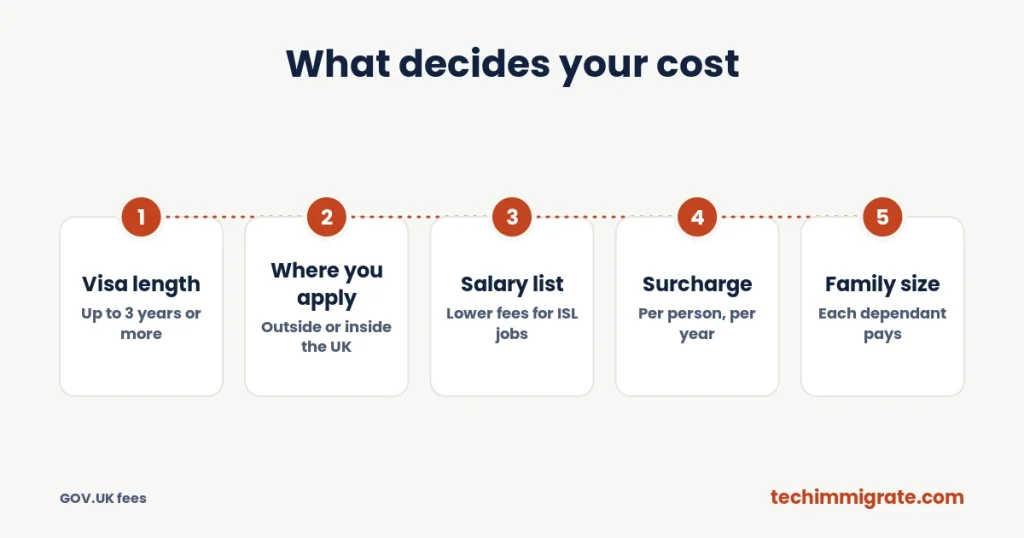
The cost of a Skilled Worker visa depends heavily on one decision that many people do not think about until they see the bill: how long the visa lasts. The visa fee jumps once the visa is longer than 3 years, and the Immigration Health Surcharge is charged for every year. Add family members, and the difference between a 2-year and a 5-year visa can run into tens of thousands of pounds.
This guide sets out what a Skilled Worker visa costs for 2, 3 and 5 years, with worked examples for single applicants and families, applying from outside and inside the UK. It also shows what the employer pays, so you can see the full picture. For a general breakdown of every fee, see our article on Skilled Worker visa fees.
Key takeaways
- The Skilled Worker visa fee is £819 for up to 3 years and £1,618 for more than 3 years, when applying from outside the UK.
- From inside the UK, the fee is £943 for up to 3 years and £1,865 for more than 3 years.
- Lower fees apply for jobs on the Immigration Salary List: £628 for up to 3 years and £1,235 for more than 3 years.
- The Immigration Health Surcharge is £1,035 per year for adults and £776 per year for children under 18.
- Employers pay the certificate of sponsorship (£525) and the Immigration Skills Charge (£1,320 per year for large sponsors, £480 for small), which they cannot pass on to you.
- For a single adult from outside the UK, a 5-year visa costs £6,793 in visa fee and surcharge; a 3-year visa costs £3,924.
The Fees at a Glance
| Fee | Up to 3 years | More than 3 years |
|---|---|---|
| Visa fee, outside the UK | £819 | £1,618 |
| Visa fee, inside the UK | £943 | £1,865 |
| Visa fee, Immigration Salary List jobs | £628 | £1,235 |
| Health surcharge, adult | £1,035 per year | £1,035 per year |
| Health surcharge, child under 18 | £776 per year | £776 per year |
Each dependant pays the same visa fee as the main applicant, plus their own surcharge.
Single Applicant From Outside the UK
| Visa length | Visa fee | Surcharge | Total |
|---|---|---|---|
| 2 years | £819 | £2,070 | £2,889 |
| 3 years | £819 | £3,105 | £3,924 |
| 5 years | £1,618 | £5,175 | £6,793 |
The jump between 3 and 5 years comes from both the higher visa fee and the two extra years of surcharge.
Single Applicant From Inside the UK
| Visa length | Visa fee | Surcharge | Total |
|---|---|---|---|
| 2 years | £943 | £2,070 | £3,013 |
| 3 years | £943 | £3,105 | £4,048 |
| 5 years | £1,865 | £5,175 | £7,040 |
Applying from inside the UK, for example when switching from a Graduate visa, costs more because the visa fees are higher.
A Couple From Outside the UK
| Visa length | Visa fees (2 people) | Surcharge (2 adults) | Total |
|---|---|---|---|
| 2 years | £1,638 | £4,140 | £5,778 |
| 3 years | £1,638 | £6,210 | £7,848 |
| 5 years | £3,236 | £10,350 | £13,586 |
A Family of Four From Outside the UK
Two adults and two children under 18:
| Visa length | Visa fees (4 people) | Surcharge | Total |
|---|---|---|---|
| 2 years | £3,276 | £7,244 | £10,520 |
| 3 years | £3,276 | £10,866 | £14,142 |
| 5 years | £6,472 | £18,110 | £24,582 |
The surcharge for the family on 2 years is two adults at £2,070 each plus two children at £1,552 each.
What the Employer Pays
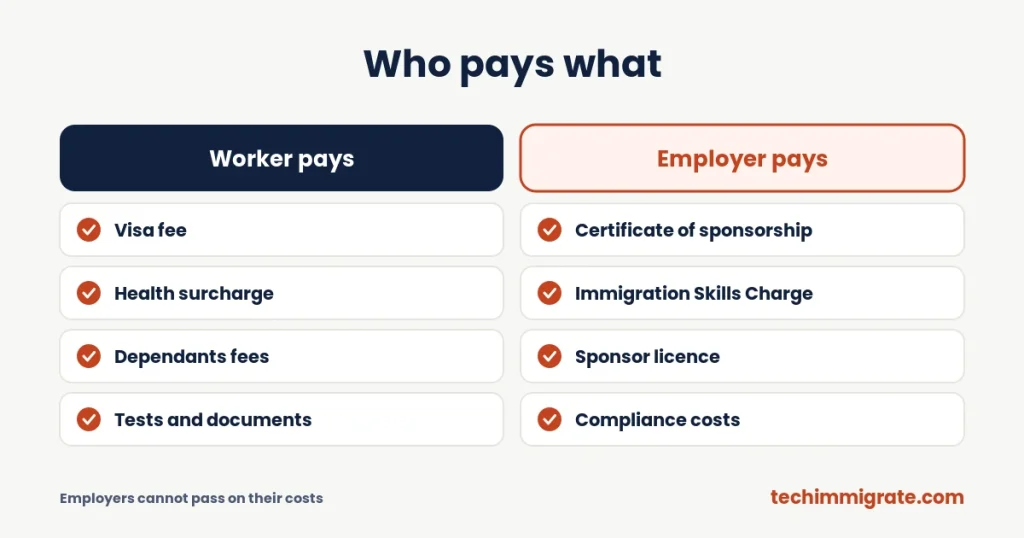
Your sponsor pays some costs that it cannot recover from you.
| Employer cost | Amount |
|---|---|
| Certificate of sponsorship | £525 per worker |
| Immigration Skills Charge, large sponsor | £1,320 for the first 12 months, then £660 per 6 months |
| Immigration Skills Charge, small or charitable sponsor | £480 for the first 12 months, then £240 per 6 months |
| Sponsor licence (one-off, per licence) | £1,682 large, £611 small |
For a large sponsor, the Immigration Skills Charge comes to £2,640 for 2 years, £3,960 for 3 years and £6,600 for 5 years. For a small sponsor, it is £960, £1,440 and £2,400. Some workers switching from a Student visa may be exempt from the charge in certain cases.
Total Cost to Worker and Employer: An Example
For a single software engineer applying from outside the UK for a 5-year visa with a large sponsor:
- Worker pays: £1,618 visa fee plus £5,175 surcharge = £6,793.
- Employer pays: £525 certificate plus £6,600 Immigration Skills Charge = £7,125.
- Combined: £13,918, before any legal or relocation costs.
Is a Shorter Visa Cheaper Overall?
Not necessarily. A 2- or 3-year visa costs less up front, but if you plan to stay, you will need to extend. Each extension means a new visa fee and a new surcharge payment for the extra time. For example, a 3-year visa from outside the UK (£3,924) followed by a 2-year extension from inside the UK (£943 plus £2,070 = £3,013) comes to £6,937 for 5 years, slightly more than a single 5-year visa at £6,793, and with an extra application.
On the other hand, the surcharge is not refunded if you settle early or leave early, so a visa that runs well beyond your plans can waste money.
From outside the UK, £819 visa fee plus £3,105 surcharge, £3,924 for one adult.
From outside the UK, £1,618 visa fee plus £5,175 surcharge, £6,793 for one adult.
Yes. Visa fees are lower from outside the UK.
Each dependant pays the same visa fee as the main applicant, plus their own surcharge.
No. Sponsors cannot recover the certificate of sponsorship fee or the Immigration Skills Charge from workers.
Why the Visa Length Matters So Much
Two things change with the length of a Skilled Worker visa. First, the visa fee: it roughly doubles once the visa is longer than 3 years. Second, the health surcharge: it is charged for every year, for every person. For a single person, the difference between a 3-year and a 5-year visa from outside the UK is nearly £2,900. For a family of four, it is over £10,000. That is why it pays to think carefully about visa length, rather than simply accepting whatever dates appear on your certificate of sponsorship.
Who Decides the Visa Length?
The length of your visa is usually based on the dates on your certificate of sponsorship, which your employer assigns. The visa is normally granted for the period of employment on the certificate plus some extra time either side, up to the maximum allowed. If you want a particular length, talk to your employer before the certificate is assigned. Some employers default to the maximum, others to a shorter period. Your employer's choice also affects its own costs, because the Immigration Skills Charge is paid for the full period on the certificate.
How Part Years Affect the Surcharge
Because visas are usually granted with a little extra time on top of the certificate dates, the surcharge calculation may include a part year. GOV.UK says that from outside the UK, a part year of 6 months or less carries no surcharge, while from inside the UK it carries half the yearly rate. A part year of more than 6 months is charged as a full year wherever you apply. The online application calculates the exact figure, but expect it to be close to the whole-year figures in the tables above.
Immigration Salary List Jobs
If your job is on the Immigration Salary List, the visa fee is lower: £628 for up to 3 years and £1,235 for more than 3 years. Few tech roles are on the list, and some roles have been affected by the temporary shortage list rules, which end on 31 December 2026. Your employer can confirm whether your occupation code is on the list. Our article on Skilled Worker occupation codes for tech roles explains the codes.
Maintenance Funds
If you apply from outside the UK, or have been in the UK for less than 12 months, you usually need to show that you have at least £1,270 available, held for 28 days, unless your employer certifies maintenance on your certificate of sponsorship. Dependants need extra funds: £285 for a partner, £315 for the first child and £200 for each additional child. These are not fees, but you need the money in your account, so include them in your planning.
Other Costs to Budget For
On top of the visa fee and surcharge, budget for:
- An English test, if you need one. New main applicants have needed B2 since 8 January 2026.
- A tuberculosis test, if you have lived in a listed country.
- Certified translations of documents not in English or Welsh.
- Optional faster decisions: £500 for priority or £1,000 for super priority, per person, where available.
- Travel and relocation, including flights, temporary housing and a deposit.
These can add several hundred to several thousand pounds, depending on your situation.
Employer Relocation Support
Many tech employers that sponsor overseas workers help with some of these costs. Packages vary. Some pay the visa fee and surcharge for the whole family. Some pay only for the main applicant. Some lend the money and recover it from salary, and some offer no help beyond their legal obligations. If your employer offers support, ask whether you would need to repay it if you leave within a certain period, and get the terms in writing.
Worked Example: A Graduate Switching Inside the UK
Aisha has just finished her master's and is on a Graduate visa. A UK tech company offers her a role as a new entrant. She applies to switch inside the UK for a 3-year visa. She pays £943 visa fee plus £3,105 surcharge, £4,048 in total. If she had chosen a 5-year visa, she would have paid £1,865 plus £5,175, £7,040. Because new entrant rates are time-limited, she and her employer choose 3 years, planning to extend later at the full going rate. This example is fictional and simplified.
Worked Example: A Family Moving From Abroad
Tom, a senior engineer, is moving to the UK with his partner and two children. His employer offers a 5-year certificate of sponsorship. The family pays £6,472 in visa fees and £18,110 in surcharge, £24,582 in total. His employer pays £525 for the certificate and £6,600 in Immigration Skills Charge as a large sponsor. Tom negotiates a relocation package that covers the surcharge for his children. This example is fictional and simplified.
Worked Example: Choosing 3 Years Then Extending
Priya takes a 3-year visa from outside the UK, paying £3,924. After 3 years, she extends for 2 years from inside the UK, paying £943 plus £2,070, £3,013. Her total over 5 years is £6,937, slightly more than a single 5-year visa, but she spread the cost and kept flexibility to change employer or route. This example is fictional and simplified.
What Changing Employer Costs
If you change employer on a Skilled Worker visa, you usually need a new visa application, with a new visa fee and surcharge for the new period. If the new visa overlaps with time you already paid surcharge for, you may get a partial refund for overlaps of 6 months or more. Your new employer pays a new certificate of sponsorship fee and Immigration Skills Charge. Our article on changing employer on a Skilled Worker visa explains the full cost.
How This Compares With Global Talent
The Global Talent visa costs £766 in fees (£561 endorsement plus £205 visa), whatever the length, plus the same surcharge of £1,035 per year for adults. There are no employer costs, no salary threshold and no sponsor. For a 5-year visa, a single applicant pays £5,941, compared with £6,793 for a Skilled Worker visa from outside the UK. The catch is that you need to be endorsed. Our comparison of Global Talent and Skilled Worker explains the trade-offs.
Fees Change Regularly
Home Office fees usually change each April, and the surcharge and Immigration Skills Charge have both risen in recent years. The figures in this article are those in force in November 2026. Check GOV.UK's fee tables before you apply, and build in a margin in case fees rise before your application date.
Common Mistakes
- Forgetting the surcharge. It is usually larger than the visa fee.
- Not checking the visa length on the certificate. It decides both the fee band and the surcharge.
- Forgetting dependants. Each pays the visa fee and surcharge.
- Assuming the employer pays everything. Employers only have to pay their own costs.
- Ignoring maintenance funds. You may need to show money in your account.
- Budgeting with old fees. Check GOV.UK before you apply.
The Bottom Line
For a single adult applying from outside the UK, a Skilled Worker visa costs about £2,889 for 2 years, £3,924 for 3 years and £6,793 for 5 years in visa fee and surcharge. For families, the totals multiply. Think about visa length with your employer, include every family member, budget for extras and check GOV.UK for the latest fees.
Getting Help
If you are unsure which fee band applies to you, whether your role is on the Immigration Salary List or how part years affect your surcharge, ask your employer's sponsor management team or check GOV.UK's fee tables. For complex family situations, a regulated immigration adviser can help.
How Visa Length Interacts With Settlement
Under the current rules, Skilled Workers can usually apply for indefinite leave to remain after 5 years. If you are planning to settle, it makes sense to choose a visa length, or a combination of a first visa and an extension, that takes you to your settlement date without paying for much extra time. The surcharge is not refunded when you settle, so a visa that runs a year or two past your settlement date wastes money. Under the earned settlement reforms announced on 2 November 2026, the qualifying period may change: Skilled Workers earning at least the higher income threshold are expected to keep a 5-year path, while others may face a longer default. If you are unsure how long you will need, a shorter first visa followed by an extension can give you flexibility, at the cost of an extra application. Our article on new ILR rules for Skilled Worker visa holders explains the reforms.
Paying the Fees in Practice
You pay the visa fee and the surcharge online when you submit your application, usually by debit or credit card. You cannot pay in instalments through the Home Office. If your employer is covering some of the costs, agree in advance whether it will pay directly, reimburse you, or advance the money as a loan. Keep receipts for everything, because you may need them for reimbursement, for tax purposes, or to claim a partial surcharge refund later if you switch to another visa with overlapping dates.
Thinking About the Total Cost of Moving
Visa costs are only part of the cost of moving to the UK. Rent in tech hubs such as London, Manchester, Cambridge and Edinburgh can be high, and landlords usually ask for a deposit and the first month's rent up front. You may need temporary accommodation while you search for a home, furniture, a phone contract and transport costs. Families also need to think about school uniforms and childcare. Because you cannot claim most public funds on a Skilled Worker visa, it is wise to arrive with enough savings to cover at least a couple of months of living costs, even if your employer certifies maintenance.
Negotiating With Your Employer
Visa costs are a legitimate part of salary negotiations. If you are moving with a family, the surcharge alone can equal several months of salary for some roles. It is reasonable to ask whether your employer will contribute to visa costs, especially for senior roles or where the employer is keen to fill a hard-to-recruit position. Some employers prefer to offer a one-off relocation payment that you can use flexibly. Others are happy to pay fees directly. Make sure any agreement, including clawback terms if you leave early, is written into your offer letter.
Checking the Numbers Before You Apply
Before you submit your application, add up every cost for every family member, using the current fee tables on GOV.UK and the visa dates you expect. Compare the total with your available funds, and leave a margin for anything unexpected, such as a translation you had forgotten or a faster decision you decide to buy at the last minute. Having the full amount ready in your account avoids delays, because your application will not move forward until the visa fee and surcharge are paid.
When a 2-Year Visa Makes Sense
A 2-year visa is the cheapest option up front, and it can make sense in a few situations. If your contract is fixed-term, if you are not sure you want to stay in the UK long-term, or if you are a new entrant whose salary will rise significantly once the new entrant period ends, a shorter visa avoids paying for time you may not use. It also gives you a natural point to reconsider your route, for example switching to the Global Talent visa if your profile has grown. The downside is that you will face another application, another fee and another surcharge payment sooner, and you will need your employer's cooperation again for the extension.
When a 5-Year Visa Makes Sense
A 5-year visa costs the most up front but brings the most stability. If you are confident you will stay with your employer, want to reach settlement without extensions and can afford the cost, a single 5-year visa removes the stress and admin of extending. It also protects you from fee rises during that period, because you have already paid. For families with school-age children, the stability of a long visa can be worth a great deal. Just remember that the surcharge is not refunded if you settle, leave or switch to an exempt route early.
When a 3-Year Visa Makes Sense
A 3-year visa is often a sensible middle ground. It stays in the lower fee band, keeps the up-front surcharge manageable, and gives you time to see how life in the UK suits you before committing further. Many people extend for a further 2 years to reach the 5-year settlement point. For a single person applying from outside the UK, the 3-year route plus a 2-year extension inside the UK costs only slightly more in total than a single 5-year visa, while spreading the payments.
A Note on Tax
If your employer pays your visa costs, there may be tax implications, depending on how the payment is structured and whether relocation tax reliefs apply. Ask your employer's payroll team or an accountant how any support will be treated, so that there are no surprises in your payslip.
Refunds if Things Go Wrong
If your Skilled Worker application is refused, you usually get a full refund of the surcharge, but the visa fee is usually not refunded. If you are granted less time than you paid surcharge for, you may get a partial refund. If you withdraw your application before a decision, the rules on refunds depend on how far the application has progressed. Keep all payment confirmations, so that you can follow up if a refund is due.
Your Next Step
If you are a tech professional comparing routes, the Global Talent visa costs £766 in total fees, plus the same surcharge, with no employer costs. Our role-specific Global Talent guides explain what Tech Nation looks for.
How We Checked This Article
We checked visa fees against GOV.UK's Skilled Worker visa pages and fee tables, the surcharge against GOV.UK's Immigration Health Surcharge pages, and employer costs against GOV.UK's sponsor guidance, in November 2026.
Tech Immigrate is independent of the Home Office. This article is general information, not legal or financial advice. Check GOV.UK before you apply.
We write practical guides for tech professionals applying for the UK Global Talent visa. Tech Immigrate is independent of Tech Nation and the Home Office, and our articles are general information, not legal advice. Rules and fees change, so always check gov.uk before you apply.


